

Paolo Veronese, Rebecca at the Well, 1580 to 1585. CC0.
Genesis 24:10 · Place · Featured Study
Mesopotamia
The land Abraham left sent Israel a bride for Isaac, a prophet hired to curse it, and the first oppressor of the judges.
Abraham would not let his son marry a Canaanite, so he sent back to the country he had left.
and Isaac was forty years old when he married Rebekah, the daughter of Bethuel the Aramean from Paddan-aram and the sister of Laban the Aramean.
- Region
- Between the Euphrates and the Tigris
- First named
- Genesis 24:10 “Then the servant took ten of his master’s…”
- Last named
- Acts 7:2 “…while he was still in Mesopotamia, before he…”
Abraham would not let his son marry a Canaanite, so he sent back to the country he had left.
Summary
Mesopotamia is the Greek name for the land between the Euphrates and the Tigris, which the Hebrew of Genesis calls Aram-naharaim and Paddan-aram.
- Abraham's servant found Rebekah at Nahor's town, and Jacob later served her brother Laban in Paddan-aram.
- Balaam came from Pethor by the Euphrates, and Cushan-rishathaim ruled Israel from the same country for eight years.
- Luke names the land twice in Acts, once among the crowd at Pentecost and once in Stephen's speech.
Aram of the Two Rivers
Genesis 24 and 25 name the country two ways in two chapters.
and Isaac was forty years old when he married Rebekah, the daughter of Bethuel the Aramean from Paddan-aram and the sister of Laban the Aramean.Genesis calls Rebekah's father and brother Arameans, after the land they lived in.
The Hebrew dictionary of James Strong's concordance of 1890 glosses Paddan-aram as a region of Syria. Albert Barnes, on Genesis 25:19, gives Paddan the sense of a ploughed field. Adam Clarke, on Judges 3:8, records that the Septuagint and the Vulgate translated Aram-naharaim as Mesopotamia.
The Hebrew dictionary of James Strong's concordance of 1890 glosses Paddan-aram as a region of Syria. Albert Barnes, on Genesis 25:19, gives Paddan the sense of a ploughed field. Adam Clarke, on Judges 3:8, records that the Septuagint and the Vulgate translated Aram-naharaim as Mesopotamia.
Mesopotamia on Hurlbut's Plate
Jesse Lyman Hurlbut's plate draws the Old Testament world from Egypt to the Persian Gulf.
Hurlbut set the three names of the family's country in the north, between the bend of the Euphrates and the Tigris.
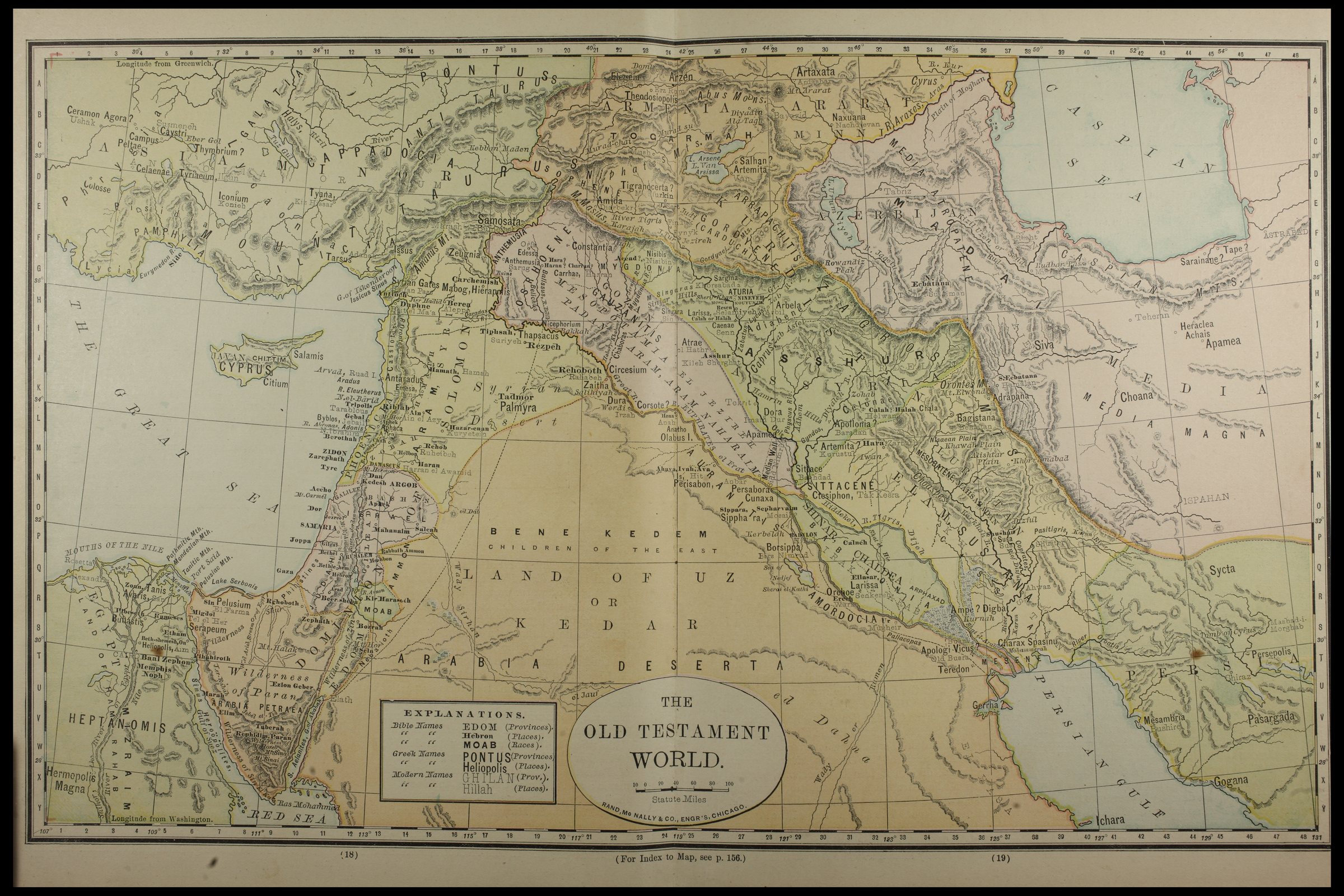
- MesopotamiaThe Greek name runs across the land between the rivers.Acts 7:2
- Padan AramHurlbut prints the name between the Belik and the Khabour.Genesis 28:2
- Aram NaharaimThe Hebrew name runs south-east along the Euphrates.Judges 3:8
- HaranHurlbut prints Laban's home under its later name Carrhae.
- The EuphratesHurlbut calls it the Great River, which Jacob crossed on his way home.Genesis 31:21
- The TigrisThe plate's River Tigris is the Hiddekel of Genesis 2:14.Genesis 2:14
- NinevehGenesis 10:11 records the building of Nineveh in Assyria, on the Tigris.
- BabylonAt Babel the LORD confused the language of the whole world.
- UrTerah's household set out from Ur of the Chaldeans.
Jesse Lyman Hurlbut, The Old Testament World, engraved by Rand McNally, National Library of Israel. Public domain; Wikimedia Commons, File:Jesse_Lyman_Hurlbut,_The_Old_Testament_World_(FL46962224_3908830).jpg.
Nine places are numbered where the plate prints them, from Haran in the north to Ur in the south.
The Land in Scripture's Record
Scripture follows the family's country from Terah's departure from Ur to Stephen's speech.
The family's country sent brides to the patriarchs and enemies to their children, and in Acts it hears the gospel.
- Terah's journeyThe household leaves Ur of the ChaldeansGenesis 11:31
- Isaac's marriageIsaac is forty when he marries the sister of LabanGenesis 25:20
- Jacob's flightIsaac sends Jacob to his mother's brotherGenesis 28:5
- Jacob's returnJacob drives home the livestock he acquired thereGenesis 31:18
- At Bethel againGod appears to Jacob after his returnGenesis 35:9
- Jacob's memoryRachel died on the road back, some distance from EphrathGenesis 48:7
- Balak's messengersMoab sends for Balaam son of Beor at PethorNumbers 22:5
- The first oppressionIsrael serves the king of Aram-naharaim for eight yearsJudges 3:8
- Othniel's victoryThe land has rest for forty yearsJudges 3:11
- Hanun's warAmmon pays a thousand talents of silver for chariots and horsemen1 Chronicles 19:6
- PentecostResidents of Mesopotamia are in the crowdActs 2:9
- Stephen's speechStephen recalls Abraham's first call before the councilActs 7:2
Each row gives the event and the verse that tells it.
Balak's messengers, The first oppression, Othniel's victory, Hanun's war, Pentecost, Stephen's speech
Aram-naharaim Against Israel
A prophet, a king and a hired chariot force came from Aram-naharaim to curse Israel or to fight it.
For they did not meet you with food and water on your way out of Egypt, and they hired Balaam son of Beor from Pethor in Aram-naharaim to curse you.Moses gives Balaam's hiring as one reason the Ammonite and the Moabite were barred from the assembly.
Jamieson, Fausset and Brown, on Numbers 22:5, call Pethor a city of Mesopotamia on the Euphrates.
Then the anger of the LORD burned against Israel, and He sold them into the hand of Cushan-rishathaim king of Aram-naharaim, and the Israelites served him eight years.Othniel, son of Caleb's younger brother Kenaz, ended this rule in Judges 3:9 to 10.
When the Ammonites realized that they had become a stench to David, Hanun and the Ammonites sent a thousand talents of silver to hire for themselves chariots and horsemen from Aram-naharaim, Aram-maacah, and Zobah.Ammon's war with David drew in allies from as far as the Euphrates.
Adam Clarke, on 1 Chronicles 19:6, notes that Second Samuel does not mention these chariots and horsemen from Mesopotamia, and suggests that they arrived only after the first battle was lost.
Mesopotamia in Stephen's Speech
Stephen opens his defence before the council with Abraham's homeland.
And Stephen declared: “Brothers and fathers, listen to me! The God of glory appeared to our father Abraham while he was still in Mesopotamia, before he lived in Haran,Stephen places this first appearing before Haran, in the land of the Chaldeans of Acts 7:4.
And Terah took his son Abram, his grandson Lot son of Haran, and his daughter-in-law Sarai the wife of Abram, and they set out from Ur of the Chaldeans for the land of Canaan. But when they arrived in Haran, they settled there.Genesis names the city the household left as Ur of the Chaldeans.
Jamieson, Fausset and Brown, on Acts 7:2, note that Genesis does not record this first call in Ur. They find it implied in Genesis 15:7 and Nehemiah 9:7, where the LORD brought Abram out of Ur of the Chaldeans.
What Scripture Leaves Unsaid
Scripture leaves three things about the land untold.
Genesis 24:10 calls the servant's goal Nahor's hometown and gives the town no name, and Numbers 22:5 says only that Pethor was by the Euphrates.
Scripture does not say how far Paddan-aram reached, or whether it covers the same ground as Aram-naharaim.
The Gospel Reaches Mesopotamia
Pilgrims who lived in the country Abraham left were in Jerusalem at Pentecost.
Parthians, Medes, and Elamites; residents of Mesopotamia, Judea and Cappadocia, Pontus and Asia,Luke's list runs from the east, and Mesopotamia stands near its head.
both Jews and converts to Judaism; Cretans and Arabs—we hear them declaring the wonders of God in our own tongues!”The languages had been divided at Babel in the same land, and here each pilgrim hears in his own tongue.
Galatians 3:8 says the Scripture foretold the gospel to Abraham in the promise that all nations would be blessed through him.
The Voices on Mesopotamia
Origen, Cyril of Alexandria, Matthew Henry and John Wesley wrote on the people of this country and the marriage made there.
died 253 · Origen of Alexandria
Origen reads the name of the king of Aram-naharaim as a sign of what Israel's pride had earned.
“Now Chusarsaton's name is translated as ‘humiliation.’ They were delivered, then, to the hands of one who would humiliate them. And it was because they acted wickedly on the heights of the mountains against the Most High that he sent them to their humiliation. But I don't want you to think that it is only in relation to the ancients that divine providence delivers those who were exalted in wickedness for the purpose of humiliating them and that they may be healed by such a wholesome remedy.”
Origen of Alexandria · Homilies on Judges 3.1 · on Judges 3:8Patristic
died 444 · Cyril of Alexandria
Cyril of Alexandria reads Laban's pursuit of Jacob as a figure of the world's anger at Christ.
“The fact that the world should have been offended because of Christ, after the increase in the flocks of believers, and that it, excited by its anger, would have reacted, does not need to be confirmed with a long speech. Just see how Laban, together with his sons, pursued Jacob, who was running away, and recalled him. Christ himself, in a sense, departed from the world with his brides, that is, the churches, and moved out with the entire household by spiritually addressing his companions with these words: ‘Arise, let us go from here.’”
Cyril of Alexandria · GLAPHYRA ON Genesis, 5.5 · on Genesis 31:21Patristic
1662 to 1714 · Matthew Henry
Matthew Henry explains why Rebekah was ready to leave her father's house at once.
“We may hope that the notice she had taken of the servant's piety and devotion gave her such an idea of the prevalence of religion and godliness in the family she was to go to made her desirous to hasten thither, and willing to forget her own people and her father's house, where religion had not so much the ascendant.”
Matthew Henry · Commentary on the Whole Bible · on Genesis 24:58Puritan
1703 to 1791 · John Wesley
John Wesley sees in the answer to the servant's prayer God's care in small things.
“God, in his providence, doth sometimes wonderfully own the prayer of faith, and gratify the innocent desires of his praying people even in little things, that he may shew the extent of his care, and may encourage them at all times, to seek him, and trust in him; yet we must take heed of being over bold in prescribing to God, lest the event should weaken our faith rather than strengthen it.”
John Wesley · Explanatory Notes upon the Old Testament · on Genesis 24:15Evangelical
Matthew Henry, John Wesley
How Far Does Aram-naharaim Reach?
The Hebrew name and the Greek name may cover the same ground or only part of it.
he sent messengers to Balaam son of Beor at Pethor, which is by the Euphrates in the land of his people. “Behold, a people has come out of Egypt,” said Balak. “They cover the face of the land and have settled next to me.Pethor is the one town of Aram-naharaim whose river Scripture names.
The whole land between the riversAdam Clarke; John Gill
Adam Clarke, on Judges 3:8, takes Aram-naharaim, Syria of the two rivers, as the district between the Tigris and the Euphrates. John Gill, on the same verse, says the Greek name Mesopotamia comes from it.
The objection: Pethor stood by the Euphrates, Laban of Nahor's family lived at Haran (Genesis 27:43), and Genesis never calls Ur Aram-naharaim.
The northern country of the EuphratesAlbert Barnes
Albert Barnes, on Habakkuk 3:7, records the remark that the king of Aram-naharaim was king of north Mesopotamia, and probably ruled the Aram from which Balak sent for Balaam.
The objection: Stephen calls the land of Ur Mesopotamia in Acts 7:2, so the Greek name in the New Testament reaches the south.
The Country Abraham Left
Mesopotamia is the country Abraham left at God's call, and his family kept going back to it for wives. The promise he carried out of it was fulfilled in Christ. The text asks the reader to leave what God calls him from and to look for the city Abraham looked for.
For he was looking forward to the city with foundations, whose architect and builder is God.Abraham's hope reached past every country on earth to a city God would build.
Sources
Scripture is the Berean Standard Bible.
- James Strong, Exhaustive Concordance of the Bible (1890), Hebrew dictionary, entries 763 and 6307.
- Adam Clarke, Commentary on the Bible (1832), on Judges 3:8.
- Adam Clarke, Commentary on the Bible (1832), on 1 Chronicles 19:6.
- John Gill, Exposition of the Old Testament, on Judges 3:8.
- Albert Barnes, Notes, Explanatory and Practical, on the Old and New Testaments, on Genesis 25:19.
- Albert Barnes, Notes, Explanatory and Practical, on the Old and New Testaments, on Habakkuk 3:7.
- Jamieson, Fausset and Brown, Commentary Critical and Explanatory on the Whole Bible (1871), on Numbers 22:5.
- Jamieson, Fausset and Brown, Commentary Critical and Explanatory on the Whole Bible (1871), on Acts 7:2.
- Jamieson, Fausset and Brown, Commentary Critical and Explanatory on the Whole Bible (1871), on Acts 2:9.
- Matthew Henry, Commentary on the Whole Bible (1710), on Genesis 24:58.
- Origen, Homilies on Judges 3.1, on Judges 3:8.
- Cyril of Alexandria, Glaphyra on Genesis 5.5, on Genesis 31:21.
- John Wesley, Explanatory Notes upon the Old Testament (1765), on Genesis 24:15.
Keep Studying
Read it4
People and groups10
Places9
Doctrines1