

1 Enoch 6 · Featured Study · A Labeled Study Resource, Not Canon
Mount Hermon: the Oath
The Bible’s land has one mountain that dwarfs all the others: 9,200 feet of snow-capped massif standing over the whole north, so commanding that three nations kept three names for it. Scripture makes it the conquest’s border, a Baal shrine’s address, and the very picture of blessing flowing down. And the oldest Jewish book outside the Bible adds a darker memory: two hundred rebel Watchers, an oath sworn together, a descent onto this summit, and a mountain named forever for the curse they bound themselves under. Centuries later, Jesus of Nazareth walked to the pagan grotto at that mountain’s foot, asked His disciples who the Son of Man is, and announced a church the gates of Hades would not stop. This page walks the whole mountain: the texts, the names, the geography, and the reversal.
Unknown engraver, Picturesque Palestine, Mount Hermon from Rasheiya, 1881. Public domain.
Summary
Mount Hermon is the Levant's tallest peak, named in 1 Enoch for the oath two hundred Watchers swore on its summit, and the mountain's own biblical story runs from the conquest's northern border to the foot where Jesus asked who the Son of Man is. The page lays out the geography, the wordplays, and the two positions on which mountain saw the Transfiguration.
- At 2,814 metres, Hermon towers over Jerusalem, Tabor, and the Sea of Galilee, and three ancient nations each had their own name for it.
- 1 Enoch 6:6 says the mountain was named Hermon because the Watchers swore and bound themselves there, a wordplay on the Hebrew root for a ban or curse.
- Scripture traces the mountain's own story from Joshua's conquest border and a Baal shrine at its foot to Psalm 133's picture of blessing and Jesus's question at Caesarea Philippi.
- Whether Hermon or Mount Tabor was the site of the Transfiguration is presented as an open question, with both positions and their holders named.
- 1 Enoch is a labeled study resource, not Scripture, and its account never overrides the sixty-six-book canon.
The Oath on the Summit
1 Enoch 6: two hundred Watchers, one pact, and a mountain named for it
Genesis 6 gives the event in four spare verses: “the sons of God saw that the daughters of men were beautiful, and they took as wives whomever they chose” (Gen 6:2, BSB). 1 Enoch 6, the earliest surviving Jewish retelling of that text, slows the scene down and gives it an address. The angels do not simply fall; they conspire. Their leader Semjâzâ fears to act alone, “I alone shall have to pay the penalty of a great sin” (6:3), so all two hundred bind themselves together first:
“And they were in all two hundred; who descended in the days of Jared on the summit of Mount Hermon, and they called it Mount Hermon, because they had sworn and bound themselves by mutual imprecations upon it.”1 Enoch 6:6 (Charles, 1917) — a labeled study resource, not canon
A shared oath means shared guilt: no one can later claim he was misled. The book’s point is that the corruption of the earth was not an impulse but a covenant, a deliberate counter-pact sworn on a summit, and the mountain has carried the name of that curse ever since. Whether a reader takes the scene as history or as ancient Jewish interpretation of Genesis 6, the geography is not decoration: the book knows this exact corner of the land, down to the springs at the mountain’s foot (“the waters of Dan… to the south of the west of Hermon,” 1 En 13:7) where Enoch hears the Watchers’ sentence.
- 200Watchers in the pact
- 2,814 mthe summit of the Levant
- 3 namesHermon · Sirion · Senir
- 1 En 6:6the mountain named for the oath
- Matt 16:13Jesus at its foot
The Name Is the Story
two wordplays sitting inside one verse: open the words themselves
1 Enoch 6:6 is built on two Hebrew puns, and both survive translation once you see them. Hermon shares its root with cherem, the ban, the curse, the thing devoted to destruction, so “they called it Mount Hermon, because they had sworn” reads, in Hebrew ears, as Curse Mountain, named for the cursing. And the descent happens “in the days of Jared”, the patriarch of Genesis 5:18 whose name is the verb yarad, “to go down.” The men of that generation carried a name that remembered a descent (both wordplays are marked in R. H. Charles’s own notes and in the standard commentary, Nickelsburg’s 1 Enoch 1, at 6:6).
Scripture itself remembers the mountain’s many names, and its compromised history. Moses records the mountain “which the Sidonians call Sirion but the Amorites call Senir” (Deut 3:9, BSB); Joshua’s conquest halts at “Baal-gad… under mount Hermon” (Josh 11:17); and in the judges’ era it is bluntly “mount Baal-hermon” (Judg 3:3): the high place wore a pagan lord’s name inside Israel’s own borders for centuries.
One Mountain, One Story
every biblical beat on the massif, in order, each a live door
1 · 1 Enoch 6:1–6 · study resource
The oath on the summit
Two hundred Watchers, in the days of Jared, swear together and descend, and the book says the mountain was NAMED for that oath.
2 · Deuteronomy 3:8–9
Three nations, three names
“Which Hermon the Sidonians call Sirion, and the Amorites call it Senir.” A peak so commanding that every neighboring people had its own name for it.
3 · Joshua 11:17
The conquest stops beneath it
Joshua's northern limit is “Baal-gad in the valley of Lebanon under mount Hermon.” Already a Baal shrine when Israel arrived.
4 · Judges 3:3
A pagan name sticks
The Hivites dwell “in mount Lebanon, from mount Baal-hermon.” Through the judges' era the mountain wears a cult title.
5 · Psalm 133:3
The dew of Hermon
Its snowmelt abundance becomes Scripture's picture of blessing flowing down, “for there the LORD has bestowed the blessing of life forevermore.”
6 · Matthew 16:13–18
Jesus at its foot
At Caesarea Philippi, beside the pagan grotto under Hermon, Jesus asks who the Son of Man is, and announces His church against the gates of Hades.
7 · Matthew 17:1–2
A high mountain apart
Six days later He is transfigured. Which mountain? The positions are laid out below, honestly, with their holders.
And one beat of pure grace: “It is like the dew of Hermon falling on the mountains of Zion. For there the LORD has bestowed the blessing of life forevermore” (Ps 133:3, BSB), the same summit’s snowmelt, turned into Scripture’s picture of brothers dwelling in unity.
The Grotto at Its Foot
Caesarea Philippi: where Jesus chose to ask the question
At Hermon’s southwest base, a great spring pours from a cliff riddled with cult niches, the grotto of Pan that gave the place its Greek name, Paneas. Herod the Great built a temple to Augustus against that cliff, and his son Philip rebuilt the town as Caesarea Philippi (Josephus, Antiquities15.363–364; 18.28). It was the most openly pagan ground in the whole region: a shrine-face of rock, dedicated to a goat-god, at the foot of the mountain of the oath. That is the backdrop Matthew names before the most important question in the Gospels:
“When Jesus came to the region of Caesarea Philippi, He questioned His disciples: Who do people say the Son of Man is?… Simon Peter answered, You are the Christ, the Son of the living God.” Matthew 16:13, 16 (BSB)
And then, standing before a rock-face shrine soaked in centuries of idolatry: “on this rock I will build My church, and the gates of Hades will not prevail against it” (Matt 16:18). Readers across the centuries have felt the force of the setting: death’s doors defied on death’s own doorstep. Michael Heiser’s Reversing Hermon(Defender, 2017) presses the point furthest on this site’s roster: the ground of the rebellion is precisely where Jesus announces the assault that will not fail.
A High Mountain Apart
six days after Caesarea Philippi: which mountain saw the Transfiguration?
- Mount Hermon2,814 m
- Jerusalem / Zion754 m
- Mount Tabor588 m
- Sea of Galilee-212 m
“After six days Jesus took with Him Peter, James, and John the brother of James, and led them up a high mountain by themselves. There He was transfigured before them. His face shone like the sun, and His clothes became as white as the light.” (Matt 17:1–2, BSB). Peter never names the mountain, only that it was “the holy mount” where he heard the voice (2 Pet 1:18). The Gospels leave a six-day gap and a geography question.
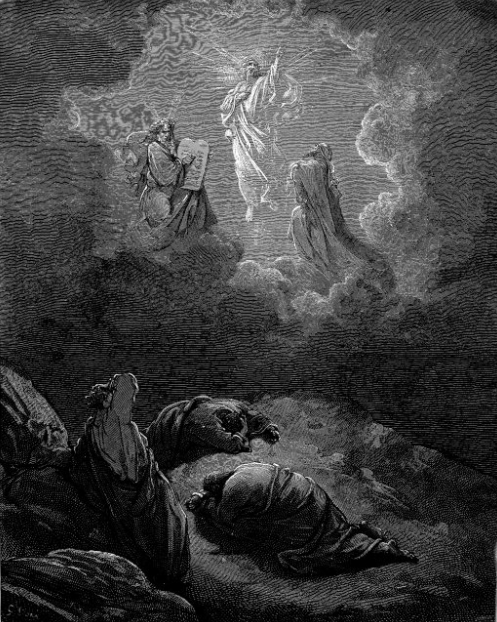
◈Which mountain: the positions, and who holds themcontested
Mount Tabor: the traditional site
Attested in the church from the early centuries (Origen’s era onward; Cyril of Jerusalem names Tabor outright), with the Basilica of the Transfiguration standing on the summit today. Its holders own the difficulties honestly: Tabor stands far south of Caesarea Philippi, rises only 588 metres, and carried a settlement on top in Jesus’s day.
Mount Hermon: the proximity reading
The previous scene sits at Hermon’s foot; six days later they climb “a high mountain apart”, and Hermon is THE high mountain of the region, genuinely apart. Widely held among modern commentators; Heiser (Reversing Hermon) argues the choice of ground is the message itself: the glory of the Son declared on the rebellion’s own summit.
What the text settles, and what it doesn’t
Scripture does not name the mountain, so neither does this site. Both readings are held by people who love the text; the traditional site keeps its honored place, and the proximity case is laid out with its evidence. What no reading changes: the Father’s own voice, “This is my beloved Son”, over the region where, in the oldest Jewish telling, heaven’s rebels once swore their oath.
The Mountain, Reversed
Read the whole arc once, end to end. A summit where, in the oldest Jewish telling of Genesis 6, two hundred rebels swore a mutual curse and came down. A border the conquest could not cross, a high place wearing Baal’s name for centuries. Then a Galilean rabbi walks His disciples to the most pagan rock-face in the land, at that same mountain’s foot, and asks who the Son of Man is, and on Peter’s confession announces a church that the gates of Hades will not withstand. Six days later, on a high mountain apart, His face shines like the sun and the Father speaks over Him.
The old book called it the mountain of the oath: a pact of corruption, sworn downward. The Gospels answer with a better word on better ground: where sin abounded, grace did much more abound. Nothing here treats 1 Enoch as Scripture: it is a labeled study resource, and the Bible remains the sixty-six books. But as the ancient witness to why this one mountain carried a shadow, it explains something the map alone never could: why the Son of Man went there to ask His question.
The Voices on This Mountain
with the work named
Reversing Hermon: Enoch, the Watchers, and the Forgotten Mission of Jesus Christ (Defender, 2017)
Cite-only, ≤50 words, per the modern-voice rule. The book whose title is this page's thesis: the Watcher rebellion at Hermon as background the New Testament writers knew, and Jesus's northern ministry, Caesarea Philippi, the gates of Hades, the Transfiguration question, as its deliberate reversal.
Learn the Bible in 24 Hours (Thomas Nelson) — the Genesis 6 session
Marcus Brown's formative teacher. Reads the sons of God of Genesis 6:1–4 as fallen angels, the Watchers of 1 Enoch, and the Nephilim as their offspring, the reading this site itself holds; the doctrine's full treatment lives on the Watchers page.
Birthright (2020)
Cite-only. A topical treatment of the Watcher rebellion and its aftermath, not a commentary, arguing the assault at Hermon was aimed at the seed-promise line of Genesis 3:15.
The Book of Enoch (2nd ed., 1912; translation reprinted 1917)
The public-domain translation this site hosts: his notes at 1 Enoch 6:6 mark both wordplays: Hermon from the oath-root, and the descent “in the days of Jared.”
1 Enoch 1 (Hermeneia; Fortress Press, 2001)
The standard critical commentary on the Book of the Watchers, the scholarly anchor for chapter 6's oath scene, its geography, and its wordplays.
Marcus Brown's own commentary leads above all; within a tier, all voices are equal.
Read the Great Books
the works this study is built on
1 Enoch: the Book of the Watchers (chs 1–36)
c. 3rd century BC or earlier, a labeled study resource, not canon
The oath, the descent, the giants, the sentence: MannaFest’s own reader carries the full Charles text with chapter-by-chapter study commentary.
READ IT →The Book of Enoch
R. H. Charles · 2nd ed. 1912, translation reprinted 1917
The translation this site hosts, with Charles’s notes, including his marks on the Hermon and Jared wordplays at 6:6.
READ IT FREE →Antiquities of the Jews, Books 15 & 18
Flavius Josephus, c. AD 94 · Whiston translation
The ancient historian on Paneas: Herod’s temple to Augustus at the grotto, and Philip’s rebuilding of it as Caesarea Philippi.
READ IT FREE →Keep studying
Read it4
On this page
Studies4
Symbols1