
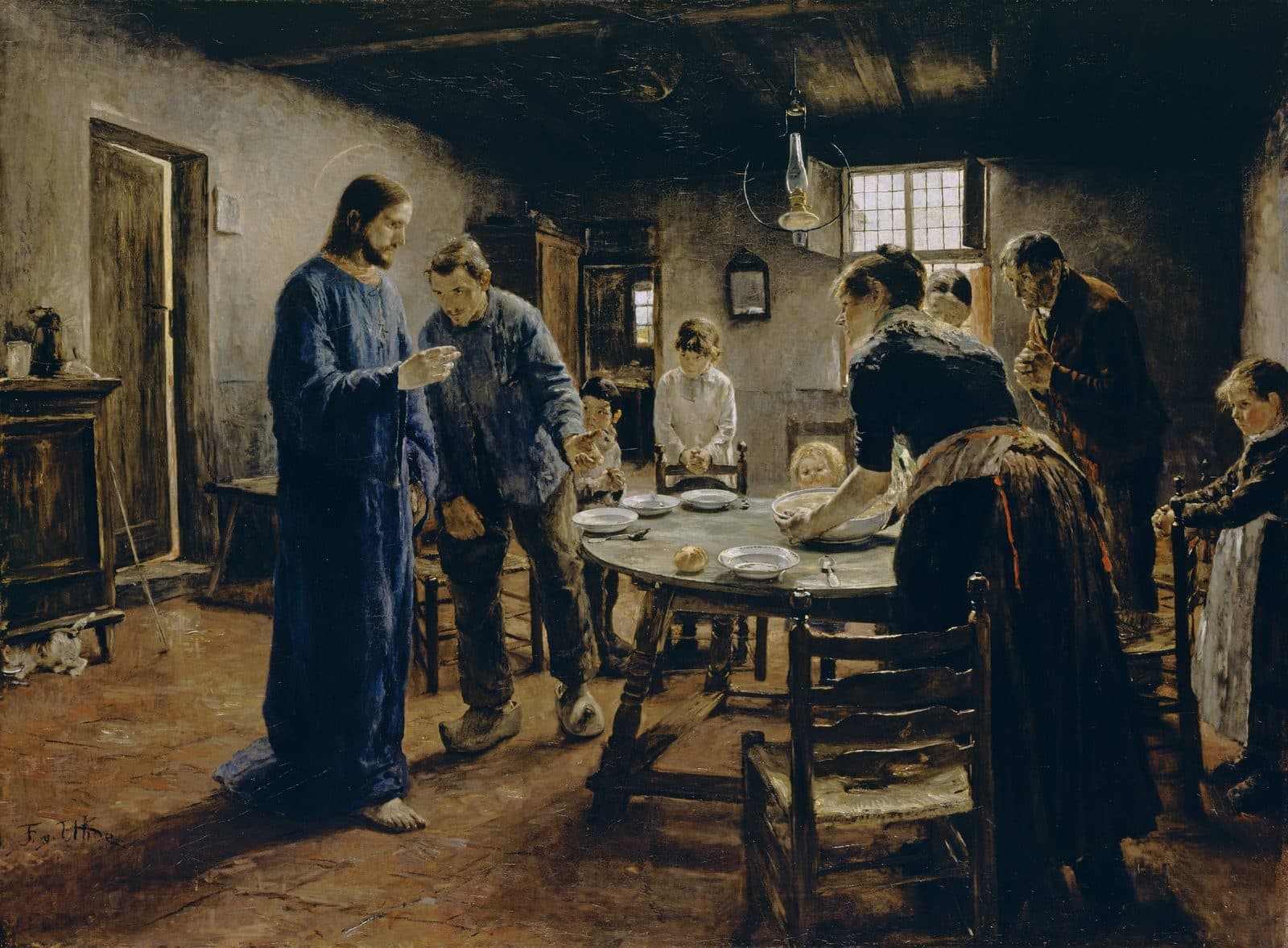
Deuteronomy 8:10 and 1 Timothy 4:4 to 5 · Subject · Gratitude
Grace Before Meals
Scripture joins thanks to food from the law of Moses to the letters of Paul, and Jesus gave thanks over bread at His meals.
After fourteen days of storm at sea, "Paul took bread and gave thanks to God in front of them all."
When you eat and are satisfied, you are to bless the LORD your God for the good land that He has given you.
- Books
- Deuteronomy, 1 Timothy
- Hold in memory
- 1 Timothy 4:4 to 5
Summary
Grace is the short prayer of thanks to God said at a meal. Scripture grounds it in the goodness of what God has made and in the duty of a creature to name the Giver. It shows thanks spoken at the tables of Israel, of Jesus and of the apostles, and the Mishnah, the code of Jewish law compiled in about AD 190 to 230, sets a blessing over bread.
- Deuteronomy 8:10 tells Israel to bless the LORD after eating and being satisfied, and verses 11 to 14 warn that plenty can make the heart forget Him.
- Jesus gave thanks or spoke a blessing over bread at the feeding of the five thousand, at the Last Supper and at Emmaus (John 6:11, Matthew 26:26 and Luke 24:30).
- Paul teaches that every creation of God is good and that food received with thanksgiving is sanctified by the word of God and prayer (1 Timothy 4:4 to 5).
Thanks at the Table
The law's command to bless the LORD for food stands in Deuteronomy 8:10.
The practice of thanks at the table matters to every reader who eats each day, because the table is where a person most often receives from God without a word.
The question at the centre of the study is why Scripture joins thanks to eating. Moses, the Gospel writers and Paul each give a part of that answer, and it reaches every meal of an ordinary day. Saying grace belongs to gratitude, the thanks owed to God for who He is and for what He has done.
Four Meals and Their Verbs
The Gospels and Acts describe Jesus and Paul at table with the same few verbs.
At each of the four meals the thanks or blessing comes before the bread is shared.
| Meal | Took | Gave thanks or blessed | Broke | Gave |
|---|---|---|---|---|
| The feeding of the five thousand | took the loaves and the fish | gave thanks | not recorded in John | distributed to those who were seated |
| The Last Supper | took bread | spoke a blessing | broke it | gave it to the disciples |
| The meal at Emmaus | took bread | spoke a blessing | broke it | gave it to them |
| Paul on the ship | took bread | gave thanks to God in front of them all | broke it | not recorded in Acts |
Grace from the Law to the Letters
The Gospels and Acts record thanks or a blessing at four meals.
The 4 texts in canon order.
Each station opens its verse page.
Otherwise, when you eat and are satisfied, when you build fine houses in which to dwell, and when your herds and flocks grow large and your silver and gold increase and all that you have is multiplied, then your heart will become proud, and you will forget the LORD your God who brought you out of the land of Egypt, out of the house of slavery.The warning shows why the command of 8:10 is needed, for plenty is the very condition in which Israel would forget.
While He was reclining at the table with them, He took bread, spoke a blessing and broke it, and gave it to them. Then their eyes were opened and they recognized Jesus—and He disappeared from their sight.At Emmaus the two disciples recognized Jesus straight after He had blessed and broken the bread.
He who observes a special day does so to the Lord; he who eats does so to the Lord, for he gives thanks to God; and he who abstains does so to the Lord and gives thanks to God.In a church divided over food and holy days, Paul counts both the one who eats and the one who abstains as giving thanks to God.
For every creation of God is good, and nothing that is received with thanksgiving should be rejected, because it is sanctified by the word of God and prayer.Against teachers who forbade certain foods, Paul grounds the goodness of food in creation and its right use in thanksgiving and prayer.
Romans 14:6, 1 Timothy 4:4 to 5
The Blessing over Bread and Rinkart's Table Grace
Jewish law and Lutheran hymnody each set a blessing at the table outside Scripture.
Mishnah Berakhot 6:1, in the William Davidson edition on Sefaria, prescribes a blessing over bread that praises God for bringing bread from the earth.
Martin Rinkart's hymn "Nun danket alle Gott", sung in English as "Now thank we all our God", stands in his Jesu Hertz-Büchlein of 1663 under the title Tisch-Gebetlein, a short prayer at table. John Julian records the title in his Dictionary of Hymnology.
The Words for Grace
The New Testament uses two Greek verbs for what Jesus and Paul said over bread.
John 6:11 and Acts 27:35 use eucharisteō, to give thanks, and Strong's lexicon adds that it is used specially of saying grace at a meal. Matthew 26:26 and Luke 24:30 use eulogeō, to speak well of, which used of God means to bless or to thank. In Deuteronomy 8:10 the Hebrew verb is barak, to bless.
The two Greek verbs stand side by side in the accounts of the feeding of the crowds. Matthew 14:19 says Jesus spoke a blessing over the five loaves, and Mark 8:6 says He gave thanks over the seven.
Luther and Brother Lawrence
Two later Christian voices speak of thanks for God's gifts and of turning to God at the table.
1483 to 1546 · Martin Luther
Martin Luther's Table Talk was recorded by guests at his table and translated by Henry Bell. In it Luther says that God asks of the people He feeds "only that we do acknowledge him for our God, and thank him for his gifts". In the same collection he says, "I give more thanks to our Lord God for one tree or bush than all rich farmers and husbandmen do for their large and fruitful grounds".
1614 to 1691 · Brother Lawrence
Brother Lawrence wrote to a friend in trouble in the seventh letter of The Practice of the Presence of God (Revell translation, 1895). He wrote, "Lift up your heart to Him, sometimes even at your meals, and when you are in company".
Every Meal a Gift
Grace at the table names the Giver at the moment His gift is used.
If I partake in the meal with thankfulness, why am I denounced because of that for which I give thanks? So whether you eat or drink or whatever you do, do it all to the glory of God.Paul joins thankful eating to the rule that whatever a believer does is done to the glory of God.
Sources
Scripture is the Berean Standard Bible.
- STEP Bible TBESH and TBESG, Tyndale House, CC BY 4.0, with Strong's definitions.
- Mishnah Berakhot 6:1, The William Davidson Talmud edition, Sefaria (CC BY-NC), cited and not reproduced.
- John Julian, A Dictionary of Hymnology (London: John Murray, 1892; revised 1907), article Rinkart, Martin, pp. 962 to 963.
- Martin Luther, Table Talk, translated by Henry Bell (1652), Cassell's National Library edition with an introduction by Henry Morley (London: Cassell, 1886)
- Brother Lawrence (Nicholas Herman of Lorraine), The Practice of the Presence of God (New York: Fleming H. Revell, 1895 translation)
Keep Studying
In this value7