
Numbers 33 · Place · Featured Study
The Wilderness Itinerary
Israel camped forty-one times between Rameses in Egypt and the Jordan across from Jericho.
The LORD chose every place His people camped for forty years, and Moses wrote each one down.
- Region
- From the eastern Nile Delta through the Sinai peninsula and the Negev to the plains of Moab (Numbers 33:3 to 48)
- First named
- Numbers 33:1
- Last named
- Numbers 33:49
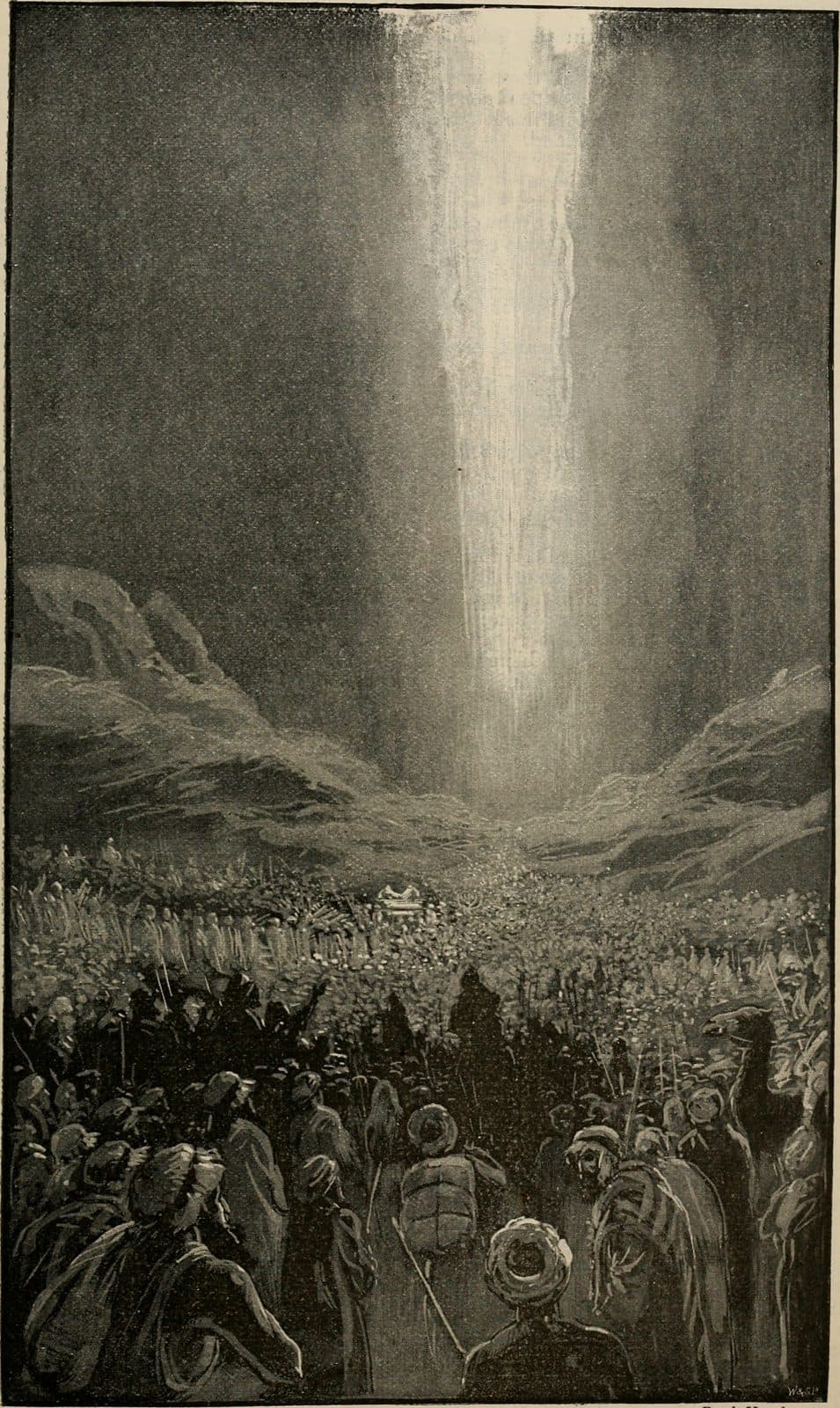
Paul Hardy, The Pillar of Fire, from The Art Bible, London, George Newnes, 1896. Public domain by date (published before 1930), via Wikimedia Commons.
THE ARTWORKPaul Hardy drew the camp on the move at night, led by the pillar of fire between the hills. In Numbers 9:17 the Israelites set out whenever the cloud lifted from above the tent.
Summary
The wilderness itinerary is the list of stations in Numbers 33, each named by the place Israel set out from and the place it camped.
- Aaron died on Mount Hor in the fortieth year, at the age of 123.
- Deuteronomy 10:6 to 7 gives four of the camps in another order, and commentators explain the difference three ways.
- Origen read the camps as stages of the soul's progress toward God.
The Record Moses Kept
Numbers 33 opens with its author, its authority and the date the march began.
These are the journeys of the Israelites when they came out of the land of Egypt by their divisions under the leadership of Moses and Aaron. At the LORD’s command, Moses recorded the stages of their journey. These are the stages listed by their starting points: On the fifteenth day of the first month, on the day after the Passover, the Israelites set out from Rameses. They marched out defiantly in full view of all the Egyptians, who were burying all their firstborn, whom the LORD had struck down among them; for the LORD had executed judgment against their gods.The first camp of the list follows in verse 5.
Whenever the cloud was lifted from above the Tent, the Israelites would set out, and wherever the cloud settled, there the Israelites would camp. At the LORD’s command the Israelites set out, and at the LORD’s command they camped. As long as the cloud remained over the tabernacle, they remained encamped.This is the rule behind every line of the list.
The Route on Clare's Plate
The route turns at Mount Sinai, at Kadesh-barnea and at Mount Hor.
Kadesh-barnea stands at the turn of the march, between Mount Sinai and Mount Hor.
- Located: the site is known
- Identified: the point stands for an area, or is rounded
- Proposed: one candidate among several
- The route, in the order the text gives
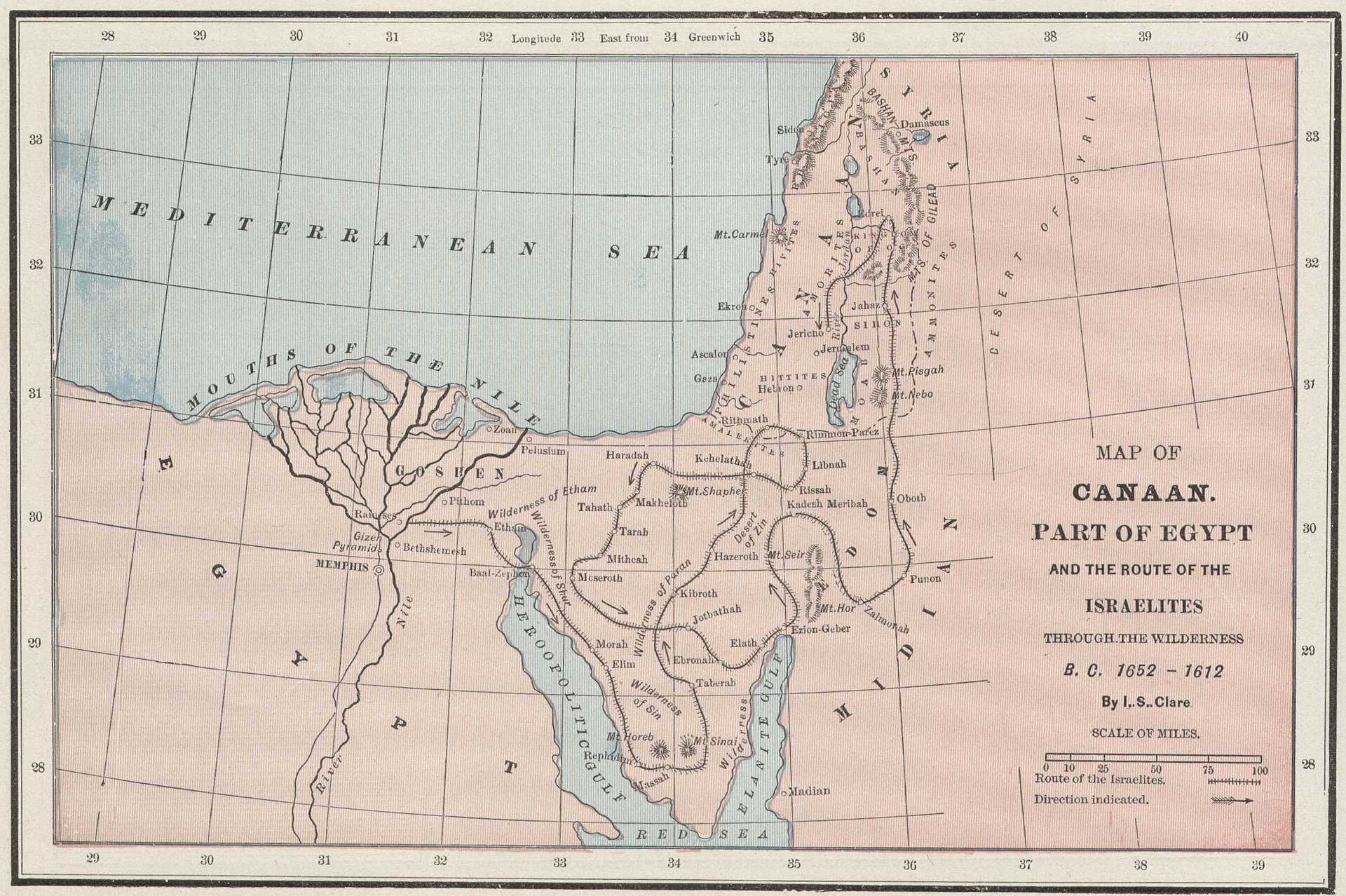
- 1Goshen, The district of Rameses, where the march began, Numbers 33:3
- 2Mount Sinai, Israel camped in the Wilderness of Sinai, Numbers 33:15
- 3Kadesh-barnea, Kadesh in the Wilderness of Zin, Numbers 33:36
- 4Mount Hor, Aaron died there in the fortieth year, Numbers 33:38
- 5Mount Nebo, The mountains of Abarim facing Nebo, Numbers 33:47
- 6Jericho, The plains of Moab by the Jordan across from Jericho, Numbers 33:48
Base map: The route of the Israelites through the wilderness, George F. Cram atlas plate, public domain. Each place stands at its place page's coordinates, set on the plate by Jerusalem and Mount Sinai, as the plate prints them.
Six places of the march in the order of Numbers 33, drawn over I. S. Clare's plate.
The Camps in Their Order
Rashi set the stages in three periods and found the fewest in the longest.
The first year and the last together hold more stages than the thirty-eight years between them.
The 3 stages as a table
| Period | Stages | Where it begins and ends | Verse |
|---|---|---|---|
| Before the spies | 14 | From Rameses until Rithmah, in the first year | Numbers 33:3 to 18 |
| The wandering | 20 | From Rithmah to Mount Hor, over thirty-eight years | Numbers 33:19 to 37 |
| After Aaron's death | 8 | From Mount Hor to the plains of Moab, in the fortieth year | Numbers 33:41 to 48 |
Rashi's count of the forty-two stages of Numbers 33, by the period in which each falls.
In his commentary on Numbers 33:1, Rashi drew a lesson of mercy from the count. The decree of Numbers 14 sent Israel back into the wilderness, and yet the people moved only twenty times in all the years of the decree.
Your children will be shepherds in the wilderness for forty years, and they will suffer for your unfaithfulness until the last of your bodies lies in the wilderness. In keeping with the forty days you spied out the land, you shall bear your guilt forty years—a year for each day—and you will experience My alienation.This is the decree whose years the middle bar counts.
All forty-one camps, with their versesNumbers 33:5 to 48
| No. | Camp | What the verse adds | Verse |
|---|---|---|---|
| 1 | Succoth | The first camp after Rameses | Numbers 33:5 |
| 2 | Etham | On the edge of the wilderness | Numbers 33:6 |
| 3 | Pi-hahiroth | Opposite Baal-zephon, near Migdol | Numbers 33:7 |
| 4 | Marah | Three days into the Wilderness of Etham after the sea | Numbers 33:8 |
| 5 | Elim | Twelve springs and seventy palm trees | Numbers 33:9 |
| 6 | The Red Sea | Numbers 33:10 | |
| 7 | The Desert of Sin | Numbers 33:11 | |
| 8 | Dophkah | Numbers 33:12 | |
| 9 | Alush | Numbers 33:13 | |
| 10 | Rephidim | There was no water for the people to drink | Numbers 33:14 |
| 11 | The Wilderness of Sinai | Numbers 33:15 | |
| 12 | Kibroth-hattaavah | Numbers 33:16 | |
| 13 | Hazeroth | Numbers 33:17 | |
| 14 | Rithmah | Numbers 33:18 | |
| 15 | Rimmon-perez | Numbers 33:19 | |
| 16 | Libnah | Numbers 33:20 | |
| 17 | Rissah | Numbers 33:21 | |
| 18 | Kehelathah | Numbers 33:22 | |
| 19 | Mount Shepher | Numbers 33:23 | |
| 20 | Haradah | Numbers 33:24 | |
| 21 | Makheloth | Numbers 33:25 | |
| 22 | Tahath | Numbers 33:26 | |
| 23 | Terah | Numbers 33:27 | |
| 24 | Mithkah | Numbers 33:28 | |
| 25 | Hashmonah | Numbers 33:29 | |
| 26 | Moseroth | Numbers 33:30 | |
| 27 | Bene-jaakan | Numbers 33:31 | |
| 28 | Hor-haggidgad | Numbers 33:32 | |
| 29 | Jotbathah | Numbers 33:33 | |
| 30 | Abronah | Numbers 33:34 | |
| 31 | Ezion-geber | Numbers 33:35 | |
| 32 | Kadesh | In the Wilderness of Zin | Numbers 33:36 |
| 33 | Mount Hor | On the outskirts of the land of Edom; Aaron died there | Numbers 33:37 to 38 |
| 34 | Zalmonah | Numbers 33:41 | |
| 35 | Punon | Numbers 33:42 | |
| 36 | Oboth | Numbers 33:43 | |
| 37 | Iye-abarim | On the border of Moab | Numbers 33:44 |
| 38 | Dibon-gad | Verse 45 calls the camp before it Iyim | Numbers 33:45 |
| 39 | Almon-diblathaim | Numbers 33:46 | |
| 40 | The mountains of Abarim | Facing Nebo | Numbers 33:47 |
| 41 | The plains of Moab | By the Jordan across from Jericho | Numbers 33:48 |
Two Questions About the March
Two questions readers ask of the forty years are answered here from their verses.
WAS ISRAEL ON THE MOVE FOR FORTY YEARS WITHOUT REST?
The cloud sometimes stayed over the tabernacle for a month or longer, and the people stayed in camp as long as it remained.
DOES THE LIST REPEAT THE MARCH AS EXODUS TELLS IT?
Numbers 33 names camps Exodus never mentions, among them the camp by the Red Sea after Elim and the two camps between the Desert of Sin and Rephidim.
The Hebrew of the Camps
Four Hebrew words carry the list, each taken from the life of a people living in tents.
The verb of every line, nasa, means to pull up the tent pins and start out. Its noun, massa, is a departure, and by extension the station a march sets out from.
The second verb, chanah, means to pitch a tent and encamp.
Verse 2 calls the list Israel's motsa'im, their goings out, which the Berean text renders as the stages listed by their starting points.
So they called that place Kibroth-hattaavah, because there they buried the people who had craved other food.Some camps took their names from what happened there, as this one did.
It is an eleven-day journey from Horeb to Kadesh-barnea by way of Mount Seir.This short road is the measure of the delay that followed.
The List in the Record
Adam Clarke and John Gill wrote on the list in the eighteenth and nineteenth centuries.
Adam Clarke on the first book of travelsCommentary on the Bible (1832), on Numbers 33:2
“And Moses wrote their goings out according to their journeys - We may consider the whole book of Numbers as a diary, and indeed the first book of travels ever published. Dr. Shaw, Dr. Pococke, and several others, have endeavored to mark out the route of the Israelites, through this great, dreary, and trackless desert, and have ascertained many of the stages here described. Indeed there are sufficient evidences of this important journey still remaining, for the descriptions of many are so particular that the places are readily ascertained by them; but this is not the case with all.”
Adam Clarke · Commentary on the Bible · on Numbers 33:2Evangelical
Aaron's age at his deathJohn Gill, Exposition of the Old Testament, on Numbers 33:39
At the LORD’s command, Aaron the priest climbed Mount Hor and died there on the first day of the fifth month, in the fortieth year after the Israelites had come out of the land of Egypt. Aaron was 123 years old when he died on Mount Hor.Gill works out the age from Exodus 7:7.
“And Aaron was one hundred and twenty three years old when he died in Mount Hor. He was eighty three when he stood before Pharaoh, Exo 7:7, and forty years he had been with Israel since, which make this number; he was three years older than Moses.”
John Gill · Exposition of the Old Testament (1748-1763) · on Numbers 33:39Reformed
What the List Leaves Unsaid
The list keeps to names, order and two dates.
A reader who wants the distance between two camps or the length of a stay must look outside Numbers 33.
From Rimmon-perez to Ezion-geber the list is names alone, seventeen in a row.
He Led You All the Way
Moses read the forty years as the LORD's leading and testing, and Jesus answered the tempter from the same chapter.
Remember that these forty years the LORD your God led you all the way in the wilderness, so that He might humble you and test you in order to know what was in your heart, whether or not you would keep His commandments. He humbled you, and in your hunger He gave you manna to eat, which neither you nor your fathers had known, so that you might understand that man does not live on bread alone, but on every word that comes from the mouth of the LORD.Moses names two purposes of the march, to humble Israel and to teach it to live by the LORD's word.
But Jesus answered, “It is written: ‘Man shall not live on bread alone, but on every word that comes from the mouth of God.’”After forty days in the wilderness Jesus kept the word Israel had broken in forty years.
And with whom was God angry for forty years? Was it not with those who sinned, whose bodies fell in the wilderness? And to whom did He swear that they would never enter His rest? Was it not to those who disobeyed? So we see that it was because of their unbelief that they were unable to enter.The letter to the Hebrews names unbelief as the reason the generation of the list died on the way.
In his comment on Numbers 33:1 Rashi also gave Tanchuma's parable of a king who took his sick son to a distant place to be healed. On the way home the father named each stage: here we slept, here we caught cold, here your head ached.
Voices on the Stages
Origen read the camps as stages of the soul, and John Wesley read the forty years as a test of the heart.
Origen on the Tombs of LustHomilies on Numbers 27.12
“From there they come to the Tombs of Lust [Kibroth-hattavah]. What are the Tombs of Lust? Doubtless it is where lusts are buried and covered over, where all desire is quenched and the flesh no longer lusts against the spirit, since it has been put to death by the death of Christ.”
Origen of Alexandria · Homilies on Numbers 27:12 · on Numbers 33:16Patristic
Origen on Abarim facing NeboHomilies on Numbers 27.12
“There follows next the stage at Abarim opposite Nabau [Nebo], which is ‘passage.’ But Nabau means ‘separation.’ For when the soul has made its journey through all these virtues and has climbed to the height of perfection, it then ‘passes’ from the world and ‘separates’ from it, as it is written of Enoch, ‘And he was not found, because God had taken him across.’”
Origen of Alexandria · Homilies on Numbers 27:12 · on Numbers 33:47Patristic
John Wesley on what the wilderness showedExplanatory Notes upon the Old Testament (1765), on Deuteronomy 8:2
“To know - That thou mightest discover to thyself and others that infidelity, inconstancy, hypocrisy, and perverseness, which lay hid in thy heart; the discovery whereof was of singular use both to them, and to the church of God in all succeeding ages.”
John Wesley · Explanatory Notes upon the Old Testament · on Deuteronomy 8:2Evangelical
Moserah and the Two Orders
Deuteronomy 10:6 to 7 gives four camps in another order than Numbers 33, and commentators read the difference three ways.
They set out from Hashmonah and camped at Moseroth. They set out from Moseroth and camped at Bene-jaakan. They set out from Bene-jaakan and camped at Hor-haggidgad. They set out from Hor-haggidgad and camped at Jotbathah.This is the order Numbers gives.
The Israelites traveled from Beeroth Bene-jaakan to Moserah, where Aaron died and was buried, and Eleazar his son succeeded him as priest. From there they traveled to Gudgodah, and from Gudgodah to Jotbathah, a land with streams of water.This is the order Deuteronomy gives, with Aaron's death at Moserah.
| Reading | What it holds | Held by | The strongest objection |
|---|---|---|---|
| Receive the notice as it stands | The notice is in the oldest Hebrew manuscripts and was given by inspiration, though its place in Deuteronomy cannot be explained | Jamieson, Fausset and Brown, Commentary (1871), on Deuteronomy 10:6 | It leaves the difference in order without an account |
| Moserah lies at Mount Hor | Mosera, Moseroth and Hor are names of one place, or Moseroth was a town near the mountain where Aaron died | Adam Clarke, Commentary on the Bible (1832), on Numbers 33:30 | Numbers 33 sets Moseroth seven camps before Mount Hor |
| Israel went back and forth | Israel went from Hashmonah to Moseroth, then to Bene-jaakan, and back again, as Rashi held | John Gill, Exposition of the Old Testament (1748 to 1763), on Numbers 33:30 | Numbers 33 records no return to any camp |
Gill reports that Rashi took Gudgodah to be Hor-haggidgad, while Ibn Ezra took it as a name for the region of Zalmonah, Punon and Oboth.
The LORD Your God Has Been With You
Indeed, the LORD your God has blessed you in all the work of your hands. He has watched over your journey through this vast wilderness. The LORD your God has been with you these forty years, and you have lacked nothing.Moses sums up the forty years in one sentence of provision.
At the end of the forty years Moses could say that Israel had lacked nothing on the way.
The reader who follows Christ is asked to trust the same LORD at every stage of the way, in the camps where nothing is written as in those where much is.
Keep studying
Studies5
Places10