

Genesis, Exodus & Deuteronomy · Featured Study · Comparative Honesty
The Bible and the Ancient Near East
Genesis was not written into an empty room. A thousand years before Moses, Mesopotamian scribes were already writing creation accounts, flood accounts, and law codes, and when you set them beside Scripture, some of the resemblances are close enough to be uncomfortable and some of the differences are wide enough to be decisive. This page puts the strongest parallels on the table at full strength, states the differences at full strength, and keeps one question in front of both: what does a parallel actually prove?
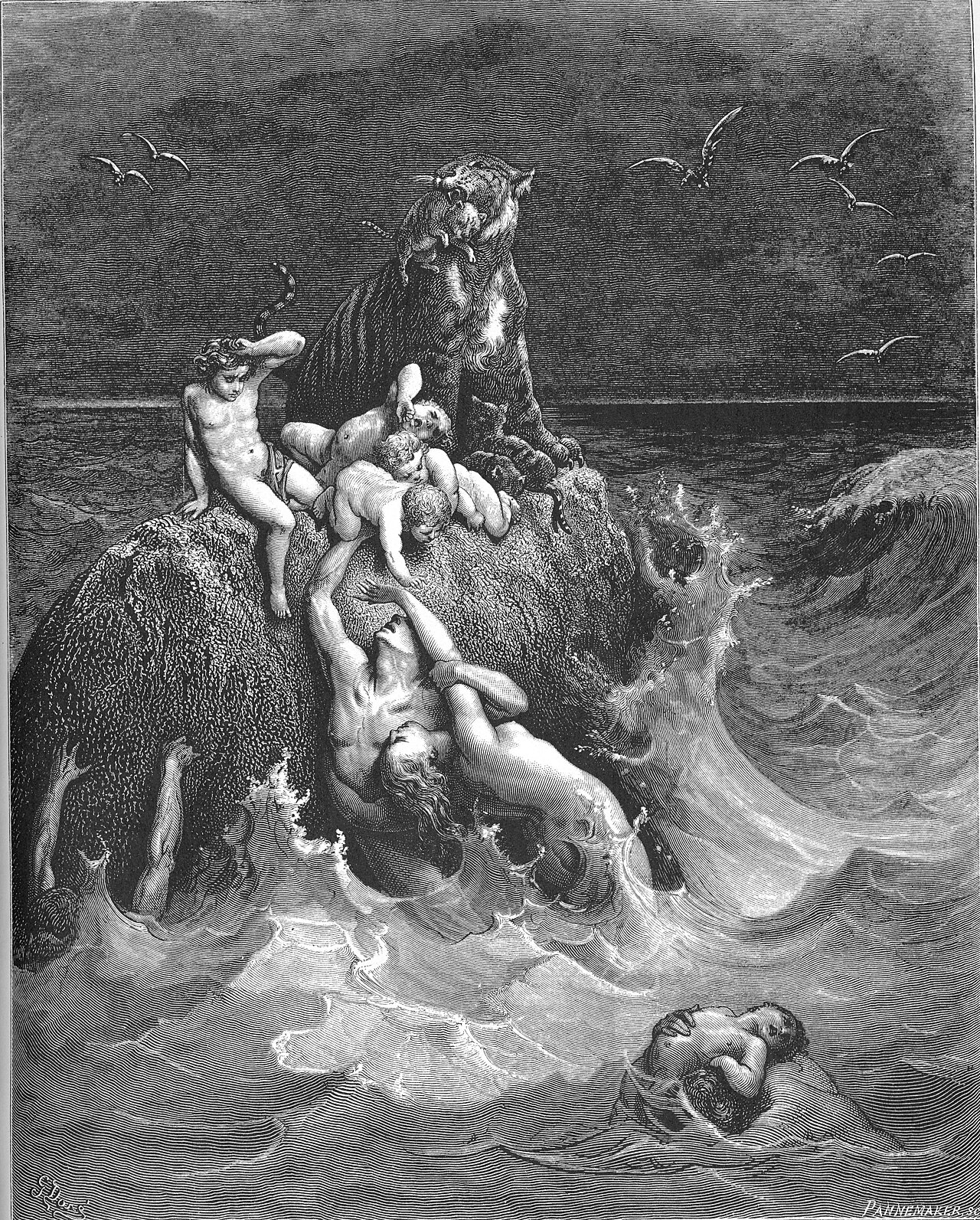
Gustave Dore, The Holy Bible, 1866. Public domain.
Summary
This page sets four ancient Near Eastern texts beside Scripture (Enuma Elish, the flood epics, Hammurabi's code, and the Hittite treaty form) and asks one question of each: what does a parallel actually prove?
- Three readings of any parallel are laid out at full strength: dependence, a shared regional world, or deliberate polemic against the source material.
- The closest parallel in the whole comparison is the flood account: even conservative scholarship grants how close Gilgamesh XI runs to Genesis.
- In three of the four exhibits, the sharpest resemblance sits directly on top of the widest theological gulf, gods who are hungry and irritable against a God who binds Himself in covenant.
- A comparison can show a text belongs to a real place and time; it cannot settle direction of borrowing or authority, which is why this page states parallels and differences both at full strength.
The Question Under Every Parallel
stated first, because it governs everything below it
Almost every argument in this field goes wrong in the same place. Someone establishes a resemblance and then treats the resemblance as if it had already answered a question it has not even asked. A parallel is a fact about two texts. It is not, by itself, a fact about which one came first, or whether either read the other, or what either of them means. Those are three separate questions, and a resemblance can be entirely real while leaving all three open.
So before a single tablet is set beside a single chapter, here are the three readings a real parallel can bear. All three are held by serious people. Each is stated below in the strongest form its own advocates would recognise, and none of them is settled by the comparison itself, which is the point of putting them at the top rather than the bottom.
Dependence
The biblical writer knew the Mesopotamian text (or a text very like it), and used it.This is not a fringe position and it is not motivated only by hostility to Scripture. Where the resemblance descends to specific narrative detail rather than general theme, coincidence gets expensive fast: the sequence of birds released from a vessel to test for dry land, or a goring-ox statute that runs through the same sub-cases in the same order. Israel was a small, late-arriving culture inside a literary world that had been writing for a thousand years before Moses; the burden of proof does not obviously sit on the person who says the smaller culture read the larger one. In its strongest current form the argument is made for law, not myth: David P. Wright argues that the Covenant Code shows direct literary use of the Hammurabi stele rather than diffuse cultural inheritance.
Strongest where: The tightest verbal and sequential parallels, the bird release (Gen 8:6–12), the goring ox (Exod 21:28–32).
Friedrich Delitzsch, the Babel und Bibel lectures (1902); David P. Wright, Inventing God's Law (2009)
A shared world
Both texts draw on a common regional inheritance; neither copied the other.Casuistic law, the "if a man does X, then Y shall follow" form: is the ordinary legal grammar of the whole ancient Near East, the way common-law case reporting is the ordinary grammar of the English-speaking legal world. Two jurisdictions that both treat the goring ox in the same style are not thereby shown to have read one another; they are shown to have inherited the same casebook problems and the same way of writing them down. The same argument runs on the flood: cultures across the region and far beyond it preserved deluge traditions, and a common inheritance explains the family resemblance without requiring anyone to have held anyone else's tablet. This is the reading most conservative Assyriology has defended, and it is also the reading that fits a shared memory of a real event.
Strongest where: Legal form and vocabulary; the broad shape of the flood tradition; the distribution of deluge stories well outside Mesopotamia.
Alexander Heidel's 1946 study of the Gilgamesh epic and its Old Testament parallels; Kenneth Kitchen, On the Reliability of the Old Testament (Eerdmans, 2003)
Polemic
The biblical writer knew the material and deliberately wrote against it.A counter-story has to resemble what it answers, or it answers nothing. On this reading the resemblances are not embarrassments to be minimized but the mechanism itself: Genesis picks up the furniture of the Babylonian imagination (the primeval waters, the divided heavens, the man made of clay, the flood, the sacrifice at the end of it), and puts it under a different management, so that a reader who knows the other story cannot miss what has been changed. It explains the pattern that pure dependence does not: the sharpest resemblances sit precisely where the theology is most completely inverted. The gods swarm over Utnapishtim's offering because they have not eaten since the flood began; the LORD smells Noah's and speaks a covenant. Same motif. Opposite universe.
Strongest where: The post-flood sacrifice (Gen 8:21); the creation of man (Gen 2:7); the sun, moon and stars demoted to lamps rather than deities (Gen 1:14–18).
John Walton's 2006 survey of ancient Near Eastern thought and the Old Testament; Gordon Wenham's 1987 Genesis commentary
The first failure mode: parallelomania
Samuel Sandmel gave this error its name in a 1962 Journal of Biblical Literature essay of that title. Two texts share a motif; the motif is described in language that maximises the overlap; the overlap is then treated as a demonstrated line of descent. The tell is that the argument never states what a non-parallel would look like. If every resemblance counts as evidence and no difference counts against it, no evidence is being weighed at all.
The second failure mode, the apologetic shrug
The mirror error, and the one a confessional site is far likelier to commit: minimising the parallels until they sound trivial. They are not trivial. The bird release and the post-flood sacrifice are close, the goring-ox statutes are closer, and a reader who first meets them from a hostile source after being told here that there was nothing to see has been badly served. MannaFest states the parallels at their real strength or it has no business stating the differences.
Exhibit One: Enuma Elish and Genesis 1
the Babylonian creation epic beside the opening chapter of Scripture
Enuma Elish (“When on high”), is the Babylonian creation epic, seven tablets recovered from Nineveh and first published in a full English edition by L. W. King in 1902. It is the text most often produced to argue that Genesis 1 is a tidied-up Babylonian myth, and it is also the comparison where careless handling in both directions is most common. The ledger looks like this.
Primeval waters
What is genuinely shared
Both open before any ordered world exists, with undifferentiated water as the starting condition rather than empty space.
What genuinely differs
In Enuma Elish the water is a person: Tiamat, a goddess who must be defeated. In Genesis 1:2 it is scenery: “the earth was waste and void; and darkness was upon the face of the deep.” Nothing has to be killed.
The waters divided
What is genuinely shared
Both accounts produce the visible world by splitting a body of water into an upper and a lower portion.
What genuinely differs
Marduk splits Tiamat's corpse to make sky and sea; the division is the trophy of a battle. Genesis 1:6 divides by speech alone (“Let there be a firmament in the midst of the waters”), and there is no combatant, no corpse, and no war.
Humanity from clay
What is genuinely shared
In both, man is formed from earthy material combined with something belonging to the divine side.
What genuinely differs
Babylonian man is made from clay and the blood of a slain god so that the gods can stop doing manual labour; he exists to feed them. Genesis 2:7 forms man of dust and the breath of God, and Genesis 1:26 gives him dominion and the divine image. Servitude versus sonship, the motif is shared and the purpose is inverted.
Rest at the end
What is genuinely shared
Both narratives close with the deity at rest and a sanctuary in view.
What genuinely differs
Marduk's rest follows the building of Babylon and its temple, and the ordered cosmos exists to house and supply the gods. Genesis closes with a blessed and hallowed day given to man, not a shrine built to relieve the gods of hunger.
▸ ▾ The tehom / Tiamat claim, and why it is the wrong argument
The most repeated version of this comparison is linguistic: that tehom, “the deep” of Genesis 1:2, is the demythologised corpse of Tiamat, the Babylonian chaos-goddess. It is a striking claim and it circulates on both sides: used by critics as proof of borrowing, and conceded by apologists who then argue that Genesis has domesticated the myth.
The correction cuts against both of them. Tehom is the ordinary Semitic word for a deep body of water, cognate with the Akkadian term rather than borrowed from the name Tiamat, a loan from the proper noun would not produce the form Hebrew actually has. And Genesis 1 contains no combat myth at all: nothing resists, nothing is defeated, and the deep is never personified even once. David Tsumura's Creation and Destruction (2005) is the standard statement of this case.
This is the sort of correction worth keeping, because it embarrasses the careless version of both positions. The parallel that everyone argues about turns out to be the weakest one on the table, while the parallels that are real (the divided waters, the man of clay), are ones neither camp usually leads with.
What the comparison settles
That Genesis 1 was written by someone who knew what a Mesopotamian creation account looked like, and that its shape is recognisable within that world rather than alien to it.
What it does not settle
That Genesis is derived from Enuma Elish. The tehom argument, which is the only properly linguistic one on offer, does not hold; and the deepest resemblances (the divided waters, the clay-formed man), sit exactly where the theology is most completely reversed, which is as consistent with deliberate counter-writing as with borrowing.
Exhibit Two: Gilgamesh XI and the Flood
the closest parallel in the whole comparison, reported without discount
There are three principal cuneiform flood witnesses, not one: the Sumerian Flood Story (its hero Ziusudra), the Akkadian Atra-Hasis epic (Atrahasis), and Tablet XI of the Epic of Gilgamesh (Utnapishtim). W. G. Lambert and A. R. Millard's Atra-Hasis: The Babylonian Story of the Flood, with the Sumerian Flood Story (Oxford, 1969) remains the critical edition. Old Babylonian Atra-Hasis material from the seventeenth century BC pushes the tradition back at least a millennium before the Gilgamesh XI version most readers meet.
Conservative scholarship grants the closeness outright. The Assyriologist Alan Millard, writing from within a conservative commitment: put it as plainly as anyone has: “No Babylonian text provides so close a parallel to Genesis as does the Flood story of Gilgamesh XI” (“A New Babylonian ‘Genesis’ Story,” reprinted in I Studied Inscriptions from before the Flood, 1994, p. 123).
The warning and the vessel
What is genuinely shared
A single man is told by deity that a flood is coming and instructed to build a great vessel; he takes family and animals aboard; all other life perishes.
What genuinely differs
Utnapishtim is warned by Ea behind the other gods' backs, the salvation is a leak in a divine conspiracy. Noah is warned by the God who is sending the flood, in the open, as an act of the same justice that sends it.
The reason for the flood
What is genuinely shared
Both floods are sent by divine decision, not by accident or blind nature.
What genuinely differs
Atrahasis gives the clearest Babylonian motive: mankind has become too numerous and too noisy, and the gods cannot sleep. Genesis 6:5 gives a moral one: “the LORD saw that the wickedness of man was great upon the earth.” Irritation versus judgment. This is the widest gap in the whole comparison.
The birds
What is genuinely shared
The hero releases birds from the vessel to test whether the waters have gone down. This is the closest narrative parallel in the two accounts, and it is not a vague one.
What genuinely differs
Utnapishtim sends a dove, then a swallow, then a raven; Noah sends a raven, then a dove three times (Gen 8:6–12), “Then Noah sent out a dove to see if the waters had receded from the surface of the ground.” The species overlap, the order differs, and the difference is not theologically loaded.
The sacrifice after
What is genuinely shared
The survivor offers sacrifice on leaving the vessel, and the deity responds to its smell.
What genuinely differs
In Gilgamesh XI the gods, who have gone without offerings for the length of the flood, gather over the sacrifice like flies. In Genesis 8:21 “the LORD smelled the pleasing aroma” and the response is a covenant promise never to do this again. The identical motif is the point: one text has hungry gods, the other has a God who binds himself.
After the waters
What is genuinely shared
The survivor is blessed and the human race resumes from him.
What genuinely differs
Utnapishtim is granted personal immortality and removed from human society to live at the ends of the earth. Noah is sent back into it: “Be fruitful, and multiply, and replenish the earth” (Gen 9:1). One ending withdraws the hero from history; the other returns him to it.
▸ ▾ The Ark Tablet, the parallel that arrived in 2008
In 2008 a member of the public brought the British Museum a Babylonian cuneiform tablet dating to around 1850 BC, now known as the Ark Tablet. It carries detailed boat-building instructions for a flood-survival vessel, including its shape (a large circular coracle), and an animal-boarding instruction in pairs that sits strikingly close to Genesis 6:19–20. Irving Finkel, the British Museum's Assistant Keeper of Ancient Mesopotamian script, published and documented it.
It belongs on this page because it is the strongest recent addition to the parallel side of the ledger, and because a page that only reported findings favourable to its own conclusions would not be worth reading. Note precisely what it adds and what it does not: the “two by two” motif is now attested in the Mesopotamian tradition at a very early date, and the vessel's shape is not the ark's. A round coracle and a three-decked rectangular box are different objects that solve the same problem.
▸ ▾ The conservative reading of the flood traditions
On the four exhibits of this page, three are left where the evidence leaves them. On the flood, the historic conservative reading holds that the flood traditions across Mesopotamia and far beyond it are the residue of one real event, preserved with least corruption in the inspired Genesis account, with the Babylonian versions showing later polytheistic drift: gods who flood the world because they cannot sleep, then swarm over the sacrifice like flies because they are hungry.
That is a confessional judgment rather than a finding of comparative literature. The critical alternative, Genesis as a late composition dependent on Babylonian sources, stands as one of the three options at the top of this page.
What the comparison settles
That the flood tradition is genuinely shared, that the Mesopotamian written witnesses are older than any plausible date for the writing of Genesis, and that at least one narrative detail (the birds), is close enough that coincidence is a strained explanation.
What it does not settle
The direction of the relationship. The old pan-Babylonian thesis, that Genesis simply borrowed, has been abandoned even in critical scholarship; the live options are a common inheritance and a deliberate counter-story, and the moral gulf between an irritated pantheon and a God who judges is the reason the second option stays live.
Exhibit Three: Hammurabi and the Covenant Code
the parallel where the strongest case for direct dependence is made
The stele of Hammurabi, king of Babylon in the eighteenth century BC, carries roughly three hundred laws beneath a relief of the king receiving his commission from the sun-god. L. W. King's 1915 translation is public domain and is the text used here. Set beside the Covenant Code of Exodus 21–23, the resemblance is not thematic but procedural: the same case-law form, the same stock problems, sometimes in the same order. This is where the argument for literary dependence is at its most serious, and where the differences are also sharpest.
The case-law form
What is genuinely shared
Both codes are overwhelmingly casuistic (“if a man does X, then Y”), and both work through the same stock problems in a recognisable order.
What genuinely differs
The Covenant Code interleaves this shared form with apodictic command, the flat “thou shalt not” that has no conditional at all, and no real counterpart in Hammurabi. A Babylonian code tells a judge what to do. The Torah also tells a covenant people who they are.
Talion: eye for eye
What is genuinely shared
Hammurabi §196 provides that if a man destroys the eye of another man, they shall destroy his eye. Exodus 21:24 reads “eye for eye, tooth for tooth, hand for hand, foot for foot.” The principle and the phrasing are both shared.
What genuinely differs
Hammurabi's penalties are stratified by class: what a man suffers for injuring a noble, a commoner, or a slave differs, and the compensation scale tracks the victim's rank. The Torah's talion is not class-stratified. Same principle, different anthropology.
The goring ox
What is genuinely shared
Hammurabi §§250–252 and Exodus 21:28–32 treat the same problem with the same sub-cases: the ox that has not gored before, the ox known to be dangerous, the negligent owner. This is one of the most specific parallels in all of biblical law.
What genuinely differs
Exodus 21:28 stones the ox and forbids eating its flesh, a treatment of animal bloodguilt that the Babylonian statute, which handles the case purely as a matter of compensation, does not contemplate. Where Hammurabi assesses damages, Exodus also registers that a life was taken.
Deposit and theft
What is genuinely shared
Exodus 22:7–13 and Hammurabi §9 and §120 following run the same property-law casuistry on goods left in another man's keeping.
What genuinely differs
Exodus resolves the unprovable case by oath before God rather than by documentary proof before a court. The procedural difference is theological: the unwitnessed case is referred upward rather than dismissed.
▸ ▾ The counter: Hammurabi was not simply harsher
It would be easy, and false, to run this comparison as a demonstration that Israel's law was uniformly the more humane. The Code of Hammurabi §117 already caps debt-servitude at three years' service, with release in the fourth, a shorter term than Exodus 21:2's six. A term limit on debt-slavery is a shared feature of the legal world Israel lived in, not an Israelite invention, and any “uniquely humane” framing of the six-year release overclaims. MannaFest will not.
What does stand out is a different pair. Making man-stealing itself a capital crime, “And he that stealeth a man, and selleth him, or if he be found in his hand, he shall surely be put to death” (Exod 21:16): strikes at the supply side of slavery rather than regulating its terms. And Deuteronomy 23:15–16 forbids returning an escaped slave outright: “Thou shalt not deliver unto his master a servant that is escaped from his master unto thee… thou shalt not oppress him.” Surrounding codes, Hammurabi §§15–20 among them, treat harbouring a fugitive as a serious crime and require his return. That is a genuine reversal, and it is the pair worth pointing at.
The same comparison, at greater length and with the objection presented at full strength, is the spine of MannaFest’s treatment of the Bible and slavery.
▸ ▾ The dependence argument at full strength, and the answer
The claim. David P. Wright's Inventing God’s Law (2009) argues that the Covenant Code is not merely written in a shared legal idiom but shows direct literary use of the Hammurabi stele, that the sequence and grouping of topics track the Babylonian arrangement too closely for independent composition, and that the Covenant Code should therefore be read as a deliberate reworking of a specific known document.
The answer. The parallels reflect a common casuistic legal culture rather than copying: the goring ox is a stock problem attested across the region, and shared stock problems produce shared arrangements without anyone reading anyone. And the theological framing has no Babylonian counterpart at all: covenant rather than royal decree, apodictic command interleaved with the case law, and the absence of class stratification in the talion. Kenneth Kitchen's On the Reliability of the Old Testament (Eerdmans, 2003) is the standard statement of this position; Bruce Wells has pressed the methodological objection to Wright's sequencing argument in review.
Both are cited here, not quoted. This is a live scholarly dispute between people who have read the cuneiform, and that it is not going to be settled by a reader (or by this page), deciding which conclusion is more congenial.
What the comparison settles
That the Covenant Code is written in the legal language of its world, in a form a Babylonian judge would have recognised, and that this is not an embarrassment, a law given to a people in the fifteenth or thirteenth century BC that used none of that world's legal grammar would be the stranger thing.
What it does not settle
Whether the resemblance runs through a specific document or through a shared regional tradition. What the comparison does show, on any reading of that question, is that the two codes are doing different jobs: one adjudicates a stratified society, the other constitutes a covenant people.
Exhibit Four, The Hittite Treaty Form and Deuteronomy
the parallel that runs the other way: where the shared form is the argument for the text
The other three exhibits are usually produced against Scripture. This one is usually produced for it, which makes it the exhibit most in need of the same discipline. In 1931 the jurist Viktor Korošec isolated the recurring parts of a Hittite suzerain-vassal treaty. In 1954 George Mendenhall brought that form-analysis into biblical studies in Biblical Archaeologist 17.3, arguing that the Sinai covenant is structured as a suzerainty treaty; in 1963 Meredith Kline's Treaty of the Great King read the whole book of Deuteronomy as a single treaty document. The sequence maps like this.
| Treaty part | In a Hittite treaty | In Deuteronomy |
|---|---|---|
| 1 · Preamble | Names the great king and his titles, who is speaking. | Deuteronomy 1:1–5: “These are the words which Moses spake unto all Israel.” |
| 2 · Historical prologue | Recites the suzerain's past benefactions to the vassal, so that obligation rests on gratitude rather than on raw power. | Deuteronomy 1:6–4:49, the whole wilderness history retold before a single stipulation is given. |
| 3 · Stipulations | The terms the vassal is bound to keep. | Deuteronomy 5–26, the Ten Words first, then the detailed law. |
| 4 · Deposit and public reading | The tablet is stored in the sanctuary and read aloud at fixed intervals so neither party can plead ignorance. | Deuteronomy 31:26: “Take this Book of the Law and place it beside the ark of the covenant of the LORD your God”; the septennial public reading, 31:9–13. |
| 5 · Witnesses | A list of gods (the vassal's and the suzerain's), invoked to observe the oath. | Deuteronomy 30:19: “I call heaven and earth to witness against you this day.” The slot is filled and the gods are gone; creation itself is subpoenaed in their place. |
| 6 · Blessings and curses | Sanctions for fidelity and for breach. | Deuteronomy 27–28, the Ebal and Gerizim ceremony, and the long curse list. |
The substitution at part five is the one worth stopping on. Every Hittite treaty needs witnesses, and every Hittite treaty finds them among the gods. Deuteronomy keeps the slot and empties it of deities: “I call heaven and earth to witness against you this day, that I have set before thee life and death, the blessing and the curse: therefore choose life” (Deut 30:19). The form is borrowed whole and the pantheon is simply not there, which is the same move Genesis 1 makes when the sun and moon are named as lamps rather than as gods.
▸ ▾ What the treaty form does and does not prove about the date
The claim. Kenneth Kitchen presses a diachronic argument: the full six-part form, and specifically the historical prologue, is characteristic of second-millennium Hittite treaties, whereas first-millennium Neo-Assyrian treaties (the Vassal Treaties of Esarhaddon are the standard example), drop the prologue and lead with curses. If Deuteronomy runs the second-millennium sequence, the argument goes, its form fits a late-second-millennium composition, which is to say a Mosaic-era one.
The critique. Moshe Weinfeld's Deuteronomy and the Deuteronomic School (1972) and others argue that the closest parallels are in fact the first-millennium Assyrian material, particularly in the curse sections, which would support a seventh-century setting instead. Dennis McCarthy's Treaty and Covenant (Pontifical Biblical Institute, 1963; revised 1978) catalogues both bodies of material and is the standard place to see how much weight the formal comparison will bear.
The split: that Deuteronomy is treaty-shaped is broadly agreed across the confessional and critical divide. The dating inference drawn from that shape is contested, and it is contested largely along the same confessional lines that were already in place before anyone counted the parts. A parallel that establishes a form does not thereby establish a date, which is the same discipline this page applied to Gilgamesh, running in the direction less comfortable for the site.
What the comparison settles
That Deuteronomy is not a loose anthology of laws but a document in a known ancient genre, and that the genre is the key to reading it, a covenant grounded in recited benefaction rather than a legal code grounded in royal authority.
What it does not settle
When it was written. The form is a real datum and the dating argument built on it is an inference, held on both sides by scholars whose prior commitments were settled before the comparison began.
Where This Lands
what a reader should carry away from four exhibits
Four comparisons, and not one of them resolves into a clean verdict, which is itself the finding. The resemblances are real and the differences are real, and in three of the four exhibits the sharpest resemblance sits directly on top of the widest theological gulf. That pattern is the most interesting thing on this page. Pure borrowing would not produce it; a borrower has no reason to keep the furniture and invert the meaning of every room.
What comparison establishes, and establishes securely, is that Scripture is a set of documents written in a real place at a real time, in genres its first readers already knew. That is a gain, not a concession. A creation account that shared nothing with any creation account, a law code in no known legal form, a covenant in no recognisable treaty shape, that would be a text with no address, and a text with no address cannot be examined at all. The comparative material is what makes Genesis, Exodus and Deuteronomy historically checkable in the first place.
What comparison cannot establish is direction, and it cannot establish authority. Whether a resemblance is descent, inheritance, or answer is a judgment made on other grounds, and honest readers with the same tablets in front of them reach different ones. So the ledger is what this page puts in the reader's hands: the parallels at full strength, the differences at full strength, the three readings each stated as its own advocates would state it, and the single place where the founder plants a flag clearly marked as his.
Keep studying
On this page
Studies4
Doctrines1
Go further1