
Numbers 11 · Psalm 78 · Psalm 106 · Subject · Featured Study
The Quail at Kibroth-hattaavah
Numbers 11 read beside Exodus 16, the Psalms and 1 Corinthians 10, with the readings of Jewish and Christian commentators.
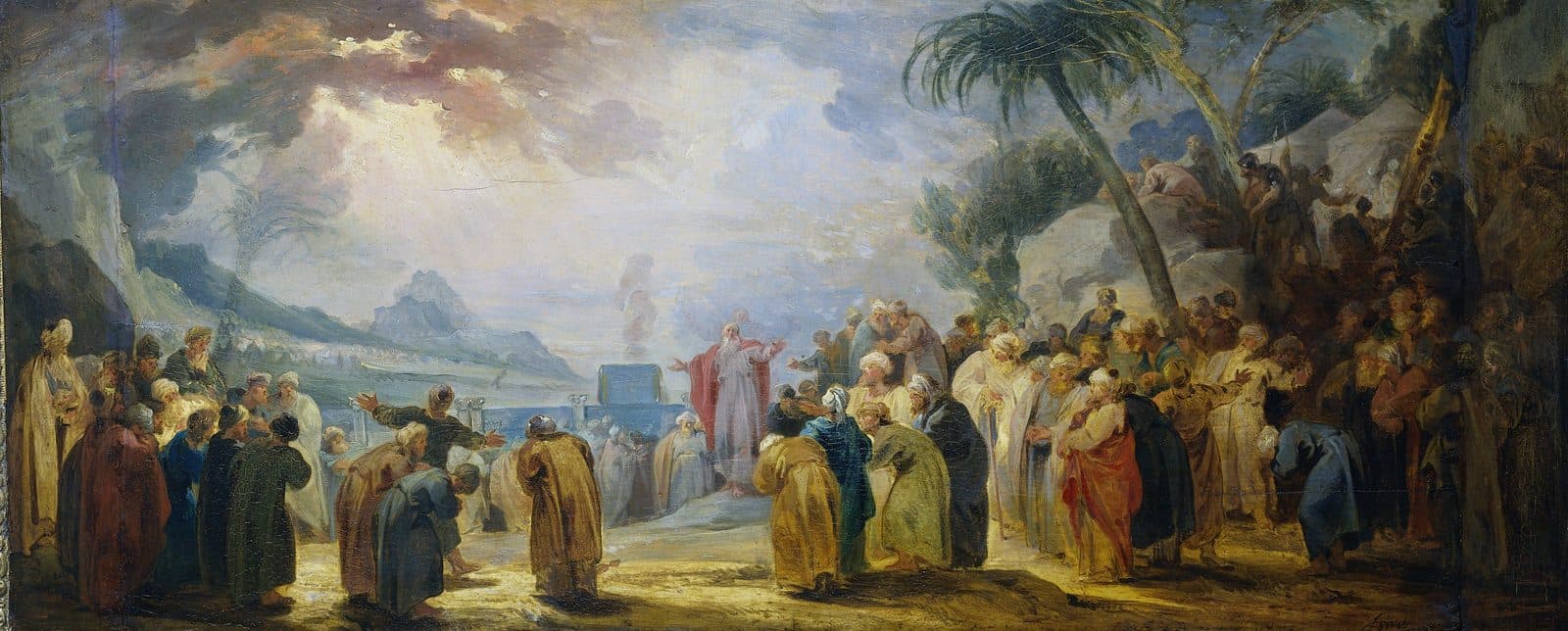
Jacob de Wit, Moses Chooses the Seventy Elders, oil on panel, 1736 to 1737, Rijksmuseum, Amsterdam. Public domain by date (the painter died in 1754), via Wikimedia Commons.
THE ARTWORKDe Wit painted Moses with his arms spread among the people in the wilderness camp, the scene of Numbers 11:24 when he gathered seventy of the elders around the tent. It was his small model for the large canvas in the council chamber of the Amsterdam town hall.
Israel wept for meat in the wilderness, and the place took its name from the graves of those who had craved it.
Summary
Kibroth-hattaavah was the first camp after Sinai, where a plague struck the people while they were still eating the birds the LORD had sent.
- The rabble among the people began the craving, and the Israelites then wept for the fish and vegetables of Egypt.
- Seventy elders received the Spirit that was on Moses, and two of them, Eldad and Medad, prophesied in the camp.
- Moses later names Kibroth-hattaavah with Taberah and Massah as places where Israel provoked the LORD.
- The Psalms and 1 Corinthians 10 read the event as a warning against craving.
The Quail in Exodus and Numbers
The first quail before Sinai, then the craving and the promise kept after it
Scripture tells of quail sent to Israel twice, once on the way to Sinai and once on the way from it.
That evening quail came and covered the camp, and in the morning there was a layer of dew around the camp.The first quail came on the evening the LORD had promised, in the Desert of Sin.
Meanwhile, the rabble among them had a strong craving for other food, and again the Israelites wept and said, “Who will feed us meat? We remember the fish we ate freely in Egypt, along with the cucumbers, melons, leeks, onions, and garlic. But now our appetite is gone; there is nothing to see but this manna!”The people's complaint here is against the manna itself, which they say has taken away their appetite.
And say to the people: Consecrate yourselves for tomorrow, and you will eat meat, because you have cried out in the hearing of the LORD, saying: ‘Who will feed us meat? For we were better off in Egypt!’ Therefore the LORD will give you meat, and you will eat. You will eat it not for one or two days, nor for five or ten or twenty days, but for a whole month—until it comes out of your nostrils and makes you nauseous—because you have rejected the LORD, who is among you, and have cried out before Him, saying, ‘Why did we ever leave Egypt?’”The LORD promises meat until it makes them sick, and He names their rejecting of Him as the reason.
Now a wind sent by the LORD came up, drove in quail from the sea, and brought them near the camp, about two cubits above the surface of the ground, for a day’s journey in every direction around the camp. All that day and night, and all the next day, the people stayed up gathering the quail. No one gathered less than ten homers, and they spread them out all around the camp.These two verses show the promise of Numbers 11:20 kept.
The Two Accounts of the Quail
Exodus 16 and Numbers 11 set side by side
| What the text gives | Exodus 16 | Numbers 11 |
|---|---|---|
| The place | The Desert of Sin, between Elim and Sinai | Kibroth-hattaavah, the first camp after the Wilderness of Sinai |
| The date | The fifteenth day of the second month after leaving Egypt | After the cloud lifted on the twentieth day of the second month of the second year |
| The complaint | That the people would starve in the desert | That there was nothing to see but the manna |
| How the quail came | In the evening, covering the camp | On a wind from the sea, for a day's journey around the camp |
| How long | One evening is named | A whole month |
| What followed | No punishment is named | A severe plague and the burial of those who craved |
- What the text gives
- The place
- Exodus 16
- The Desert of Sin, between Elim and Sinai
- Numbers 11
- Kibroth-hattaavah, the first camp after the Wilderness of Sinai
- What the text gives
- The date
- Exodus 16
- The fifteenth day of the second month after leaving Egypt
- Numbers 11
- After the cloud lifted on the twentieth day of the second month of the second year
- What the text gives
- The complaint
- Exodus 16
- That the people would starve in the desert
- Numbers 11
- That there was nothing to see but the manna
- What the text gives
- How the quail came
- Exodus 16
- In the evening, covering the camp
- Numbers 11
- On a wind from the sea, for a day's journey around the camp
- What the text gives
- How long
- Exodus 16
- One evening is named
- Numbers 11
- A whole month
- What the text gives
- What followed
- Exodus 16
- No punishment is named
- Numbers 11
- A severe plague and the burial of those who craved
From the Craving to the Graves
Numbers 11 in six scenes, from the fire at Taberah to the march to Hazeroth
The chapter moves between the complaint of the people and the complaint of Moses, and the LORD answers both.
The fire at TaberahNumbers 11:1 to 3
Soon the people began to complain about their hardship in the hearing of the LORD, and when He heard them, His anger was kindled, and fire from the LORD blazed among them and consumed the outskirts of the camp. And the people cried out to Moses, and he prayed to the LORD, and the fire died down. So that place was called Taberah, because the fire of the LORD had burned among them.This first judgment on the march from Sinai came before the craving, at the edge of the camp.
The rabble and the mannaNumbers 11:7 to 9
Now the manna resembled coriander seed, and its appearance was like that of gum resin. The people walked around and gathered it, ground it on a handmill or crushed it in a mortar, then boiled it in a cooking pot or shaped it into cakes. It tasted like pastry baked with fine oil. When the dew fell on the camp at night, the manna would fall with it.The narrator describes the manna the people despised, so the reader can weigh their complaint against it.
Rashi, the eleventh-century Jewish commentator, reads the fish eaten freely in Egypt as food eaten free of the commandments, since the Egyptians gave Israel no straw for nothing. He cites Sifrei Bamidbar for the reading.
The complaint of MosesNumbers 11:10 to 15
I cannot carry all these people by myself; it is too burdensome for me. If this is how You are going to treat me, please kill me right now—if I have found favor in Your eyes—and let me not see my own wretchedness.”Moses asks to die rather than carry the people alone, and the LORD answers this request before He answers the craving.
Henry sets this prayer beside the humility that Numbers 12:3 credits to Moses.
“Is this the meekest of all the men on the earth? The best have their infirmities, and fail sometimes in the exercise of that grace for which they are most eminent.”
Matthew Henry · Commentary on the Whole Bible · on Numbers 11:15Puritan
The seventy eldersNumbers 11:16 to 17 and 24 to 30
Then the LORD came down in the cloud and spoke to him, and He took some of the Spirit that was on Moses and placed that Spirit on the seventy elders. As the Spirit rested on them, they prophesied—but they never did so again.The LORD answers the complaint of Numbers 11:14 by sharing the burden with seventy men.
But Moses replied, “Are you jealous on my account? I wish that all the LORD’s people were prophets and that the LORD would place His Spirit on them!”Joel 2:28 later makes this wish a promise, and Peter quotes Joel at Pentecost in Acts 2:16 to 17.
Cyril of Jerusalem, in his Catechetical Lectures, explains how the Spirit was shared among the elders.
“This Spirit descended upon the seventy elders in Moses' day. My object is to prove that he knew all things and worked according to his will. The seventy elders were chosen: ‘The Lord then came down in the cloud, and taking some of the spirit that was on Moses, he bestowed it on the seventy elders.’ It was not that the Spirit was divided, but his gifts were distributed according to the vessels and the capacity of the recipients. Now there were sixty-eight present, and they prophesied. Eldad and Medad were not present.”
Cyril of Jerusalem · Catechetical Lecture 16.25 · on Numbers 11:25Patristic
The promise Moses doubtedNumbers 11:21 to 23 and 32
But Moses replied, “Here I am among 600,000 men on foot, yet You say, ‘I will give them meat, and they will eat for a month.’ If all our flocks and herds were slaughtered for them, would they have enough? Or if all the fish in the sea were caught for them, would they have enough?” The LORD answered Moses, “Is the LORD’s arm too short? Now you will see whether or not My word will come to pass.”Moses counts the flocks and the fish, and the LORD answers with a question about the reach of His arm.
Wesley explains how each gatherer came to hold ten homers.
“So the meaning is not, that every Israelite had so much for his share, but that every collector gathered so much for the family, or others by whom he was intrusted. That the people did not gather for their present use only, but for a good while to come, and being greedy and distrustful of God's goodness, it is not strange if they gathered much more than they needed.”
John Wesley · Explanatory Notes upon the Old Testament · on Numbers 11:32Evangelical
The plague and the nameNumbers 11:33 to 35
Wesley takes the name to mean the graves of the men who lusted, so that the plague struck those who were inordinate in desire and use, and not everyone who ate.
From Kibroth-hattaavah the people moved on to Hazeroth, where they remained for some time.The march to Hazeroth closes the account and leaves the graves behind in the wilderness.
What the Text Says of the Quail
Three things often said of the quail and the camp, each tested by a verse
THE QUAIL WERE LOCUSTS
Henry reports that Bishop Patrick took the creatures for locusts, and the psalm calls them winged birds.
THE MEAT ITSELF CAUSED THE PLAGUE
The text gives the anger of the LORD as the cause, and Keil and Delitzsch read the plague as an extraordinary judgment of God.
TABERAH WAS ANOTHER CAMP
Keil and Delitzsch take Taberah as the name of the edge of the camp where the fire burned, which is why the list of camps in Numbers 33 names no Taberah.
The Camp and the Birds
Where Kibroth-hattaavah stands in the march from Sinai, and the birds the wind brought
Kibroth-hattaavah lay at the end of a three-day journey from the mountain of the LORD.
You continued to provoke the LORD at Taberah, at Massah, and at Kibroth-hattaavah.This verse shows the name of the camp still stood as a warning when Moses spoke in Deuteronomy.
Keil and Delitzsch write that quail fly north in great numbers in the spring from the interior of Africa, and Barnes that the bird is nowhere more common than near the Red Sea. Keil and Delitzsch give the homer as the largest Hebrew measure of capacity, holding ten ephahs.
He stirred the east wind from the heavens and drove the south wind by His might.The psalm gives the direction of the wind that Numbers 11 calls a wind sent by the LORD.
What the Text Leaves Unsaid
Three questions Numbers 11 leaves open
Numbers calls the plague severe and does not say how many died. Clarke adds that the writer says nothing of what kind of judgment it was.
But while the meat was still between their teeth, before it was chewed, the anger of the LORD burned against the people, and the LORD struck them with a severe plague. So they called that place Kibroth-hattaavah, because there they buried the people who had craved other food.These two verses are the whole account of the judgment and the burials.
The text gives no landmark by which the camp can be found, and Keil and Delitzsch call the site of Kibroth-hattaavah and of Hazeroth altogether unknown.
They set out from the Wilderness of Sinai and camped at Kibroth-hattaavah. They set out from Kibroth-hattaavah and camped at Hazeroth.The record of the journey places the camp only by the stops before and after it.
Numbers 11 does not compare the two events or say why the second ended in graves when the first did not.
“I have heard the grumbling of the Israelites. Tell them, ‘At twilight you will eat meat, and in the morning you will be filled with bread. Then you will know that I am the LORD your God.’”The purpose given for the first quail is knowledge of the LORD, and the verse names no judgment.
He Gave Them What They Craved
How the Psalms and Paul read the quail
Both psalms say that God gave the people what they asked for and that judgment came with the gift.
So they ate and were well filled, for He gave them what they craved. Yet before they had filled their desire, with the food still in their mouths, God’s anger flared against them, and He put to death their strongest and subdued the young men of Israel.Psalm 78 places the judgment inside the meal itself.
They craved intensely in the wilderness and tested God in the desert. So He granted their request, but sent a wasting disease upon them.This psalm sets the quail among the sins Israel committed after the crossing of the sea.
Henry, on Psalm 78:28, draws two lessons from the gift of the meat.
“We have the account Num. xi. See how good God is even to the evil and unthankful, and wonder that his goodness does not overcome their badness. See what little reason we have to judge of God's love by such gifts of his bounty as these; dainty bits are no tokens of his peculiar favour.”
Matthew Henry · Commentary on the Whole Bible · on Psalm 78:28Puritan
Paul names craving first among the wilderness sins in 1 Corinthians 10.
These things took place as examples to keep us from craving evil things as they did.Paul applies the craving of the wilderness to the believers at Corinth.
Two Teachers on the Craving
Matthew Henry and Jerome
Henry gives a test for any desire a believer holds.
“We should not indulge ourselves in any desire which we cannot in faith turn into prayer, as we cannot when we ask meat for our lust, Ps. lxxviii. For this sin the anger of the Lord was kindled greatly against them, which is written for our admonition, that we should not lust after evil things as they lusted, 1 Cor. x.”
Matthew Henry · Commentary on the Whole Bible · on Numbers 11:4Puritan
Jerome, in his treatise Against Jovinian, uses the graves in the wilderness to argue against greed for food.
“How is it that the graves of lust where the people fell in their devotion to flesh remain even to this day in the wilderness? Do we not read that the stupid people gorged themselves with quails until the wrath of God came upon them?”
Jerome · Against Jovinian 2.17 · on Numbers 11:34Patristic
The Height or the Depth of the Two Cubits
Two readings of Numbers 11:31 and the objection to each
The birds flew at the height of a man's breastRashi on Numbers 11:31, after Sifrei Bamidbar 97
Rashi reads the two cubits as the height of the flight, about breast high, so that no one had to stretch up or bend down to gather the birds. Keil and Delitzsch report the same reading in the Latin Vulgate and many rabbis, Clarke holds it in his commentary, and the Berean text renders the verse as a height above the ground.
The objection: Keil and Delitzsch read the Hebrew verb as throwing the birds down upon the camp.
He felled them in the midst of their camp, all around their dwellings.The objection rests on this verse, since it places the fallen birds inside the camp and among the dwellings.
The birds lay deep on the ground in placesKeil and Delitzsch, The Pentateuch, volume 3, 1871
Keil and Delitzsch read the verse as the wind throwing the birds down a day's journey on either side of the camp, so that they lay in places as much as two cubits deep. They argue that only such a mass explains two days and a night of gathering and ten homers for the one who gathered least.
The objection: Jamieson, Fausset and Brown answer that birds lying so deep would be useless as food, since Israel could not eat an animal that died of itself.
You are not to eat any carcass; you may give it to the foreigner residing within your gates, and he may eat it, or you may sell it to a foreigner. For you are a holy people belonging to the LORD your God. You must not cook a young goat in its mother’s milk.This verse is the law Jamieson, Fausset and Brown appeal to.
Books on the Quail
Two works to read whole
Rashi on Numbers
Rashi, in the English of M. Rosenbaum and A. M. Silbermann · 1929 to 1934
Rashi explains words and phrases of Numbers 11 and names the midrash he draws each reading from.
Read Rashi on Numbers 11 at SefariaBiblical Commentary on the Old Testament: The Pentateuch, volume 3
C. F. Keil and F. Delitzsch, translated by James Martin · 1871
The commentary explains the Hebrew of Numbers 11 and answers earlier scholars on the quail and the plague.
Read volume 3 at the Internet ArchiveThe Bread of Life
Israel craved the food of Egypt while the manna still fell on the camp. In John 6 a crowd recalls the manna and asks Jesus for a sign. The text asks the reader to bring every desire to Jesus and to take Him as the bread God gives.
Jesus answered, “I am the bread of life. Whoever comes to Me will never hunger, and whoever believes in Me will never thirst.Jesus answers the crowd by naming Himself the bread of life.
Keep studying
Studies5