
Numbers 25 and Numbers 31:8 and 16 · An Iconic Story
Baal of Peor
Numbers 25 with Numbers 31:8 and 16, and five texts that remember the day, from Deuteronomy 4 to Revelation 2.
Israel came through Balaam's curses unharmed and then fell at a feast in its own camp at Shittim.
- Where
- Shittim, Peor, Jericho
- Who
- Phinehas, Zimri, Cozbi, Balaam son of Beor, Moses
- When
- the fortieth year after the exodus, on the plains of Moab (probable)
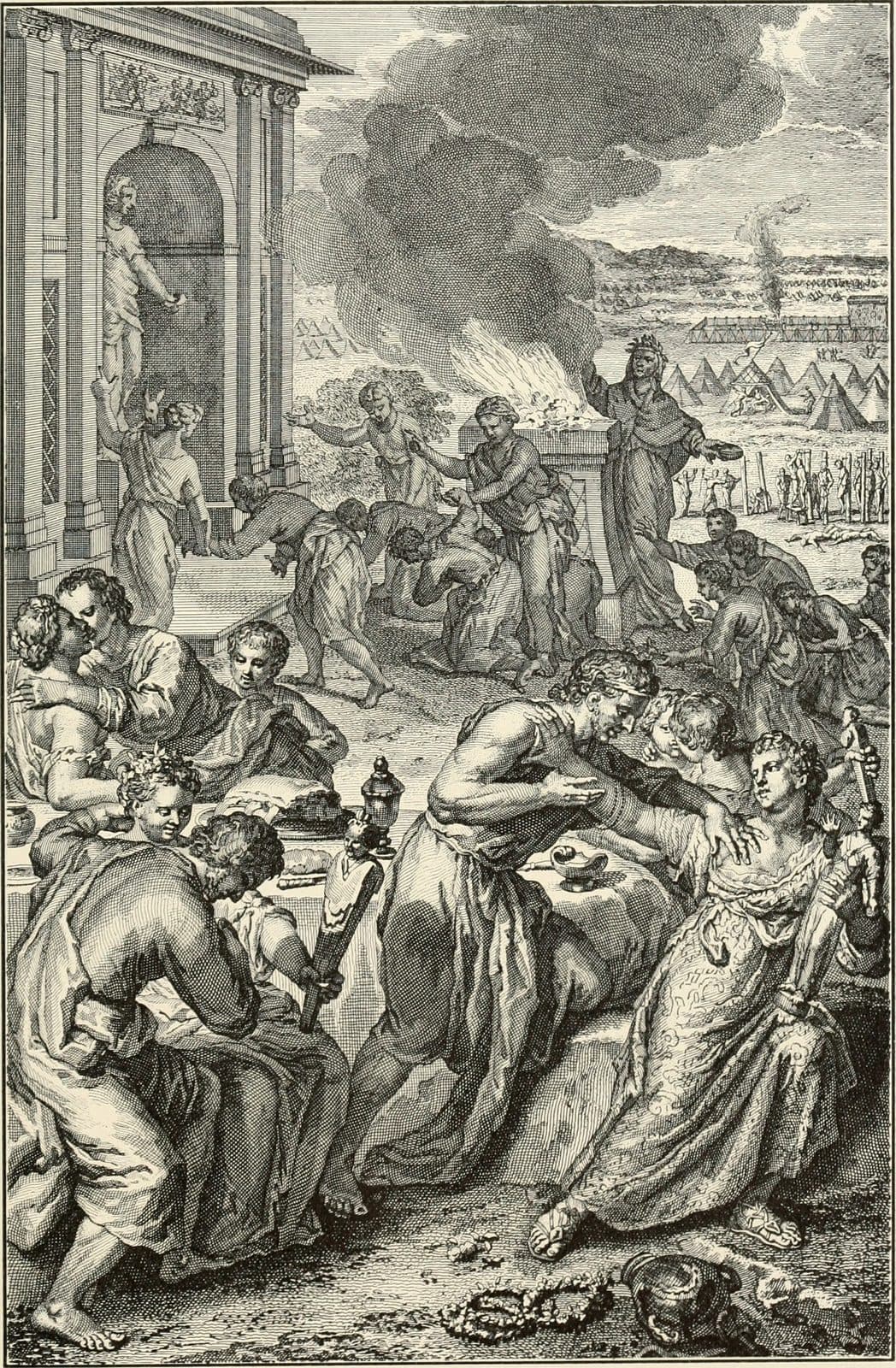
Gerard Hoet, Moab Leads Israel into Sin, engraving, reproduced in The Bible and Its Story, New York, 1908. Public domain by date (published before 1930), via Wikimedia Commons.
THE ARTWORKGerard Hoet set the feast of Numbers 25:2 in the foreground and the bowing to the idol behind it. In the distance he drew the punishment of the leaders that Numbers 25:4 orders.
Summary
At Shittim, Israel's last camp before the Jordan, the men joined the sacrifices of Moab's gods, and a plague from the LORD killed 24,000.
- Phinehas son of Eleazar stopped the plague, and the LORD gave him a covenant of peace and of permanent priesthood (Numbers 25:11 to 13).
- The two he killed were Zimri, a Simeonite leader, and Cozbi, the daughter of the Midianite chief Zur (Numbers 25:14 to 15).
- Balaam died with the five kings of Midian in the war that followed (Numbers 31:8).
- Simeon, Zimri's tribe, counted 59,300 men at Sinai and 22,200 at the census taken after the plague (Numbers 1:23; 26:14).
- Paul gives a second count of the dead, 23,000 (1 Corinthians 10:8).
The Days at Shittim
The verses of Numbers 25 tell the sin, the sentence and the spear, and then name the two who died.
Balak, the king of Moab, had hired Balaam to curse Israel, and Balaam blessed the people three times and went home (Numbers 24:10 and 25).
While Israel was staying in Shittim, the men began to indulge in sexual immorality with the daughters of Moab, who also invited them to the sacrifices for their gods. And the people ate and bowed down to these gods. So Israel joined in worshiping Baal of Peor, and the anger of the LORD burned against them.The chapter opens on the camp's sin in the verse after Balaam goes home.
Then the LORD said to Moses, “Take all the leaders of the people and execute them in broad daylight before the LORD, so that His fierce anger may turn away from Israel.” So Moses told the judges of Israel, “Each of you must kill all of his men who have joined in worshiping Baal of Peor.”The LORD's sentence falls on the leaders first, and Moses passes it to the judges for their own men.
Just then an Israelite man brought to his family a Midianite woman in the sight of Moses and the whole congregation of Israel while they were weeping at the entrance to the Tent of Meeting.The sin is done in public, before Moses and the weeping congregation.
On seeing this, Phinehas son of Eleazar, the son of Aaron the priest, got up from the assembly, took a spear in his hand, followed the Israelite into his tent, and drove the spear through both of them—through the Israelite and on through the belly of the woman. So the plague against the Israelites was halted,The plague is halted in the same verse that tells the spear, so the text ties the two together.
Numbers counts the dead and names the two who died at the tent only after the plague has stopped.
The name of the Israelite who was slain with the Midianite woman was Zimri son of Salu, the leader of a Simeonite family. And the name of the slain Midianite woman was Cozbi, the daughter of Zur, a tribal chief of a Midianite family.Both are named with their fathers and their rank, so the reader learns that a leader of Israel and a daughter of Midian's chiefs died together.
From the Feasts to the War on Midian
The war on Midian in Numbers 31 carries out the order the LORD gave in Numbers 25:17.
- The men join the sacrifices of Moab's godsShittimNumbers 25:1 to 2
- Israel joins in worshiping Baal of Peorthe LORD's anger burnsNumbers 25:3
- The leaders are sentenced and the judges told to actin broad daylightNumbers 25:4 to 5
- Zimri brings Cozbi to his familybefore the Tent of MeetingNumbers 25:6
- Phinehas drives the spear through bothin the tentNumbers 25:7 to 8
- The plague is haltedthe day Cozbi diedNumbers 25:8
- The dead are counted24,000Numbers 25:9
- Phinehas receives the covenant of peacethe LORD's word to MosesNumbers 25:10 to 13
- The second census is takenafter the plague, on the plains of MoabNumbers 26:1 to 4
- Israel strikes Midian, and Balaam falls with five kings, Zur among themthe land of MidianNumbers 31:7 to 8
- Moses rebukes the officers for sparing the womenoutside the camp, after the warNumbers 31:13 to 16
A timeline of eleven steps in the order Numbers gives them, from Numbers 25:1 to 31:16; the text gives them no day or month, so the steps stand in order and not to scale.
Simeon, Zimri's tribe, fell by more men between the two censuses than the plague's whole count of dead.
The 4 counts as a table
| Who was counted | Counts | Where | Verse |
|---|---|---|---|
| Simeon at the first census | 59,300 | the Wilderness of Sinai | Numbers 1:23 |
| Simeon at the second census | 22,200 | the plains of Moab | Numbers 26:14 |
| Simeon's loss | 37,100 | Numbers 1:23 and 26:14 | Numbers 26:14 |
| The dead of the plague | 24,000 | Shittim | Numbers 25:9 |
Four bars from zero: Simeon's counts in Numbers 1:23 and 26:14, the difference between them, and the plague's dead in Numbers 25:9.
What the Text Says and What Is Often Said
Three things often said of Peor differ from what Numbers and the later texts say.
“BALAAM HAD NO PART IN PEOR”
Numbers 25 tells the sin without naming Balaam. Moses names his counsel as its cause in Numbers 31:16, and Revelation 2:14 says Balaam taught Balak to place a stumbling block before the Israelites.
“ONLY THE WOMEN OF MOAB WERE INVOLVED”
The chapter opens with the daughters of Moab, and the woman Phinehas killed was Cozbi, a Midianite. The LORD's order of Numbers 25:17 is against Midian.
“PHINEHAS ACTED ON HIS OWN ZEAL ALONE”
The LORD Himself says that Phinehas turned His wrath away and acted for His sake.
Who was Baal of Peor?Numbers 23:28 and 25:3
Baal means lord, and Peor names a height in Moab. Jamieson, Fausset & Brown, in their Commentary of 1871, took the god to be Chemosh, the god of Moab. Albert Barnes, in his Notes on Numbers 25:3, reads the name as the Baal worshipped at Peor and says the link with Chemosh had been given up.
And Balak took Balaam to the top of Peor, which overlooks the wasteland.Balak's last attempt at a curse was made from this height, two chapters before its god is named.
The psalm and the prophet on PeorPsalm 106:28 and Hosea 9:10
They yoked themselves to Baal of Peor and ate sacrifices offered to lifeless gods.The psalm adds a judgment Numbers leaves unstated, that the gods of those feasts were lifeless.
I found Israel like grapes in the wilderness. I saw your fathers as the firstfruits of the fig tree in its first season. But they went to Baal-peor, and consecrated themselves to Shame; so they became as detestable as the thing they loved.Hosea sets Peor at the point where the fathers God delighted in became detestable.
The Plains of Moab
Numbers 33:49 gives the camp's length from Beth-jeshimoth to Abel-shittim.
The plains of Moab were Israel's camp at the end of the forty years in the wilderness (Numbers 22:1 and 33:48 to 49, with Deuteronomy 1:3), and Numbers 25:1 calls the place Shittim.
Moses reminds Israel that they stayed in the valley opposite Beth-peor (Deuteronomy 3:29).
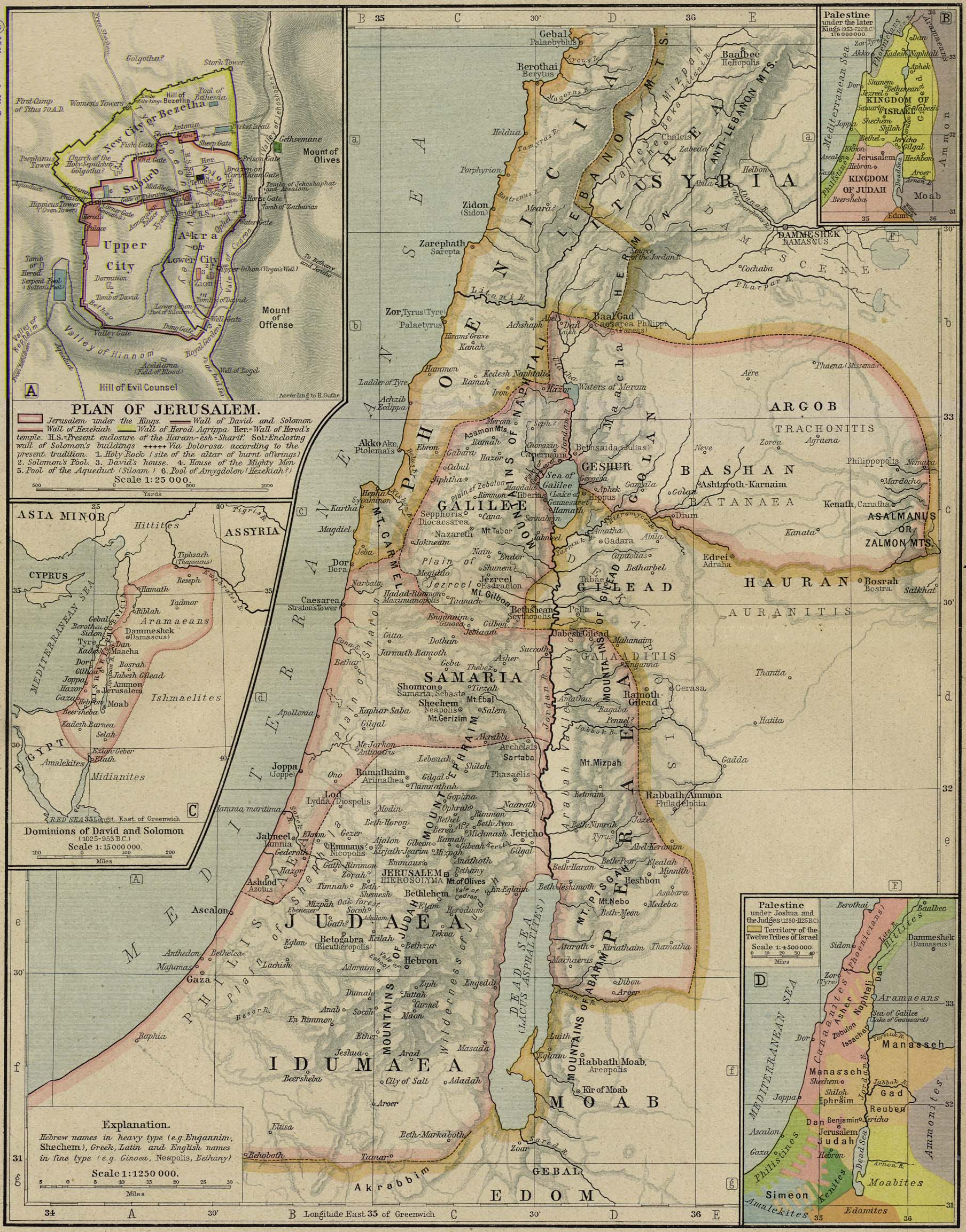
Jericho stood west of the Jordan and Mount Nebo east of it, with the plains of Moab between.
- Located: the site is known
- Identified: the point stands for an area, or is rounded
- 1Jericho, Joshua sent two spies from Shittim to inspect it. Joshua 2:1
- 2The Jordan River, Israel crossed it from Shittim. Joshua 3:1
- 3Mount Nebo, Moses went up from the plains of Moab to its top. Deuteronomy 34:1
- 4Shittim (Abel-shittim), Israel was staying there when the men sinned. Numbers 25:1
- 5Peor, Balak took Balaam to its top. Numbers 23:28
- 6Beth-peor, Moses' grave lies opposite it, its place unknown. Deuteronomy 34:6
Not placed: Shittim (Abel-shittim) (4), Peor (5), Beth-peor (6).
Base map: Reference map of ancient Palestine, Rand McNally reference map (1926), public domain. Each place stands at its place page's coordinates, set on the plate by Jerusalem and Damascus, as the plate prints them.
The map marks Jericho, the Jordan and Mount Nebo on an old atlas plate, and Israel's camp lay between them on the plains of Moab (Numbers 33:49). Its key names Shittim, Peor and Beth-peor, which it does not place.
The elders who hired BalaamNumbers 22:4 to 7
So the Moabites said to the elders of Midian, “This horde will devour everything around us, as an ox licks up the grass of the field.” Since Balak son of Zippor was king of Moab at that time,Moab brings the elders of Midian into its fear of Israel, so the two peoples stand together from the start.
The elders of Moab and Midian departed with the fees for divination in hand. They came to Balaam and relayed to him the words of Balak.Both peoples paid for the curse Balaam was hired to speak.
What the Text Leaves Unsaid
Numbers tells the sin, the plague and the count in plain words, and it leaves three questions open.
What were the rites of Peor?Numbers 25:2 to 3
Numbers says the people ate and bowed down to the gods of Moab, and neither Numbers nor Psalm 106 describes the rite. Rashi, the Jewish commentator of eleventh-century France, passes on an account from the Talmud (Sanhedrin 60b) in his commentary on Numbers 25:3.
When did Balaam meet Balak again?Numbers 24:25 and 31:16
Numbers 24:25 has Balaam go home after his blessings, and Numbers 31:8 has him killed among the Midianites. Between those two verses Scripture gives no time or place for a second meeting with Balak. Rashi, on Numbers 25:1, reads the whole chapter as Balaam's advice and cites the Talmud, Sanhedrin 106a.
How long did the plague run?Numbers 25:8 to 9 and 25:18
Numbers gives the number of the dead and calls the day of Cozbi's death the day the plague came because of Peor (Numbers 25:18), and it gives no length in days.
The Covenant of Peace
The LORD rewarded Phinehas with a covenant of peace, and Paul and the risen Christ return to Peor in the New Testament.
“Phinehas son of Eleazar, the son of Aaron the priest, has turned My wrath away from the Israelites; for he was zealous for My sake among them, so that I did not consume the Israelites in My zeal. Declare, therefore, that I am granting him My covenant of peace. It will be a covenant of permanent priesthood for him and his descendants, because he was zealous for his God and made atonement for the Israelites.”This is the LORD's own verdict on the act, given to Moses after the plague.
Psalm 106 tells the day again and says the act was credited to Phinehas as righteousness for endless generations (Psalm 106:30 to 31).
Paul's warning, in the verses1 Corinthians 10:11 to 13
Now these things happened to them as examples and were written down as warnings for us, on whom the fulfillment of the ages has come.Paul applies Peor and the other falls to the church of his own day.
So the one who thinks he is standing firm should be careful not to fall. No temptation has seized you except what is common to man. And God is faithful; He will not let you be tempted beyond what you can bear. But when you are tempted, He will also provide an escape, so that you can stand up under it.The warning ends in a promise, since God provides an escape from every temptation.
Balaam's teaching, in the versesRevelation 2:14 and 2 Peter 2:15
But I have a few things against you, because some of you hold to the teaching of Balaam, who taught Balak to place a stumbling block before the Israelites so they would eat food sacrificed to idols and commit sexual immorality.The risen Christ finds the teaching of Peor still at work in a church of His own day.
They have left the straight way and wandered off to follow the way of Balaam son of Beor, who loved the wages of wickedness.Peter names the motive behind the way of Balaam, the love of the wages of wickedness.
Henry on the covenant of peaceNumbers 25:12 to 13
“By the covenant of peace given him, some understand in general a promise of long life and prosperity, and all good; it seems rather to be meant particularly of the covenant of priesthood, for that is called the covenant of life and peace ( Mal. ii. 5 ), and was made for the preservation of peace between God and his people.”
Matthew Henry · Commentary on the Whole Bible · on Numbers 25:12 to 13Puritan
Barnes and Clarke on the spear as an exceptionNumbers 25:8 and 25:11
Albert Barnes, in his Notes on Numbers 25:11, says the act of Phinehas must be regarded as exceptional. Adam Clarke, in his Commentary on Numbers 25:8, says it can never be a precedent on any common occasion.
How the Teachers Read Peor
Teachers from the third century to the nineteenth wrote on the feasts, the plague and the spear.
Barnes on the people of the plainOn Numbers 25:1
“The records of the neighboring cities of the plain, and the circumstances of the origin of Moab (Gen 19:30 ff) suggest that the people among whom Israel was now thrown were more than ordinarily licentious.”
Albert Barnes · Notes, Explanatory and Practical, on the Old and New Testaments (1832-1869) · on Numbers 25:1Evangelical
Origen on bowing downOn Numbers 25:2
“I might say that those who deny Christianity on oath at the tribunals or before they have been put on trial do not worship but only bow down to idols when they take ‘God’ from the name of the Lord God and apply it to vain and lifeless wood. Thus the people who were defiled with the daughters of Moab bowed down to idols but did not worship them.”
Origen of Alexandria · Exhortation to Martyrdom 6 · on Numbers 25:2Patristic
Henry on the sacrifices of the deadOn Psalm 106:28
“Those that did often partake of the altar of the living God now ate the sacrifices of the dead, of the idols of Moab (that were dead images, or dead men canonized or deified), or sacrifices to the infernal deities on the behalf of their dead friends.”
Matthew Henry · Commentary on the Whole Bible · on Psalm 106:28Puritan
Origen on the zeal of PhinehasOn Numbers 25:7
“And lest we appear to you to bring these things forth from our own understanding rather than from the authority of the divine Scriptures, go back to the book of Numbers and recall what Phinehas the priest did when he saw a harlot of the Midianite people with an Israelite man clinging in impure embraces in the eyes of all. Filled with the wrath of divine jealousy, he drove a sword, which he had seized, through the breast of both.”
Origen of Alexandria · Homilies on Genesis 1:17 · on Numbers 25:7Patristic
Gregory of Nyssa on the spear and baptismOn Numbers 25:8
“But when we are aware of his attacks, we ought to repeat to ourselves the apostolic words, ‘As many of us as were baptized into Christ were baptized into His death.’ Now if we have been conformed to His death, sin henceforth in us is surely a corpse, pierced through by the javelin of Baptism, as that fornicator was thrust through by the zealous Phinehas. Flee therefore from us, ill-omened one! for it is a corpse thou seekest to despoil, one long ago joined to thee, one who long since lost his senses for pleasures.”
Gregory of Nyssa · On the Baptism of Christ · on Numbers 25:8Patristic
Tertullian on judgment for fornicationOn Numbers 25:9
“As far as that goes, we too have examples from this same past in favor of our own way of thinking, examples of a judgment on fornication which was not only not remiss but rather immediately executed. It is quite enough, I should think, that so great a number of the chosen people, twenty-four thousand, perished at one stroke after they had fornicated with the daughters of Midian. I prefer, however, for the glory of Christ, to derive ecclesiastical discipline from Christ.”
Tertullian · On Purity 6.6.12-14 · on Numbers 25:9Patristic
Henry on the generation that followedOn Numbers 26:64
“The goodness of God to this people, notwithstanding their provocations. Though that murmuring race was cut off, yet God raised up another generation, which was as numerous as they, that, though they perished, yet the name of Israel might not be cut off, lest the inheritance of the promise should be lost for want of heirs.”
Matthew Henry · Commentary on the Whole Bible · on Numbers 26:64 to 65Puritan
Henry on the falls as typesOn 1 Corinthians 10:11
“Not only the laws and ordinances of the Jews, but the providences of God towards them, were typical. Their sins against God, and backslidings from him, were typical of the infidelity of many under the gospel. God's judgments on them were types of spiritual judgments now.”
Matthew Henry · Commentary on the Whole Bible · on 1 Corinthians 10:11Puritan
Where the Readers Divide
Readers divide on three questions: how Numbers 25:9 and 1 Corinthians 10:8 agree, why the LORD sent Israel against Midian and spared Moab, and what Zimri did with Cozbi.
Twenty-four thousand and twenty-three thousandNumbers 25:9 and 1 Corinthians 10:8
but those who died in the plague numbered 24,000.Moses' count of the dead stands at 24,000 in this verse.
We should not commit sexual immorality, as some of them did, and in one day twenty-three thousand of them died.Paul's count stands at 23,000, and he limits it to one day.
John Gill, in his Exposition on Numbers 25:9, counts those hanged at the order of Numbers 25:4 apart from those who fell in the plague, and he supposes they were a thousand. Adam Clarke, in his Commentary on 1 Corinthians 10:8, joins the two numbers the same way. Albert Barnes, in his Notes on Numbers 25:9, has Paul follow a Jewish tradition that took away a thousand slain by their own brothers.
Why Midian was struck and Moab sparedNumbers 25:17 to 18 and 31:2
For they assailed you deceitfully when they seduced you in the matter of Peor and their sister Cozbi, the daughter of the Midianite leader, the woman who was killed on the day the plague came because of Peor.”The LORD grounds the order against Midian in Midian's deceit at Peor and names Cozbi in it.
John Wesley, in his Explanatory Notes on Numbers 25:17, holds that the Midianites were most guilty, since they joined in sending for Balaam, received him after Balak dismissed him and helped him plan the plot. Rashi, on Numbers 31:2, says Moab entered the matter out of fear, and on Numbers 25:18 he says Moab was spared because Ruth would come from Moab, citing the Talmud, Bava Kamma 38b.
What Zimri did with CozbiNumbers 25:6 to 8 and 25:14 to 15
Adam Clarke, in his Commentary on Numbers 25:6, takes the rank of the two, a prince of Simeon and a princess of Midian, as proof of a marriage alliance. Matthew Henry, in his Commentary on Numbers 25:8, reads the tent as a booth fitted up for vice and says Zimri declared his sin as Sodom did.
Rashi, on Numbers 25:15, reads Cozbi's rank as a sign of Midian's hatred, since its chiefs gave up even a princess to lead Israel into sin. On Numbers 25:14 he cites Midrash Tanchuma: where Scripture gives a good man's descent to praise him, it gives the descent of the bad man in the same story to shame him.
The Great Books on This Story
Commentary on the Whole Bible
Matthew Henry · 1710
Henry comments on Numbers 25, Psalm 106 and 1 Corinthians 10 alike, so a reader can follow Peor through all three in one work.
Read it free at CCELCommentary on the Bible
Adam Clarke · 1832
Clarke covers both Testaments, and on 1 Corinthians 10:8 he reports that no Hebrew manuscript varies at Numbers 25:9.
Read it free at CCELNotes on the Old and New Testaments
Albert Barnes · 1832 to 1869
Barnes reads the act of Phinehas as an atonement God accepted, a covering in the sense of Numbers 25:13.
Read it free at CCELPentateuch with Rashi's Commentary
M. Rosenbaum and A. M. Silbermann, translators · 1929 to 1934
The edition sets Rashi's notes verse by verse through the Pentateuch in English and names the Talmud or Midrash passage behind each one.
Read it free at SefariaThe Priest Who Lives Forever
Your eyes have seen what the LORD did at Baal-peor, for the LORD your God destroyed from among you all who followed Baal of Peor. But you who held fast to the LORD your God are alive to this day, every one of you.Moses draws a warning against idols from Peor, which his hearers had seen with their own eyes.
Now there have been many other priests, since death prevented them from continuing in office. But because Jesus lives forever, He has a permanent priesthood. Therefore He is able to save completely those who draw near to God through Him, since He always lives to intercede for them.Hebrews sets one priest who lives forever beside the many priests whom death removed.
Phinehas made atonement for one plague, and his priesthood passed from father to son.
The text asks the reader to hold fast to the LORD, to take the warning of those who fell, and to come to God through Christ, whose intercession never ends.
Keep studying
Studies6
Doctrines7
Peoples and groups1