
Genesis 10 · Group · Featured Study
The Table of Nations
Genesis 10 traces the peoples of the world after the flood to Japheth, Ham and Shem, and gives each line its lands.
Genesis 10 reads like a list of names, and it does the work of an atlas.
- Began
- After the flood, from Noah's sons Shem, Ham and Japheth (Genesis 10:1)
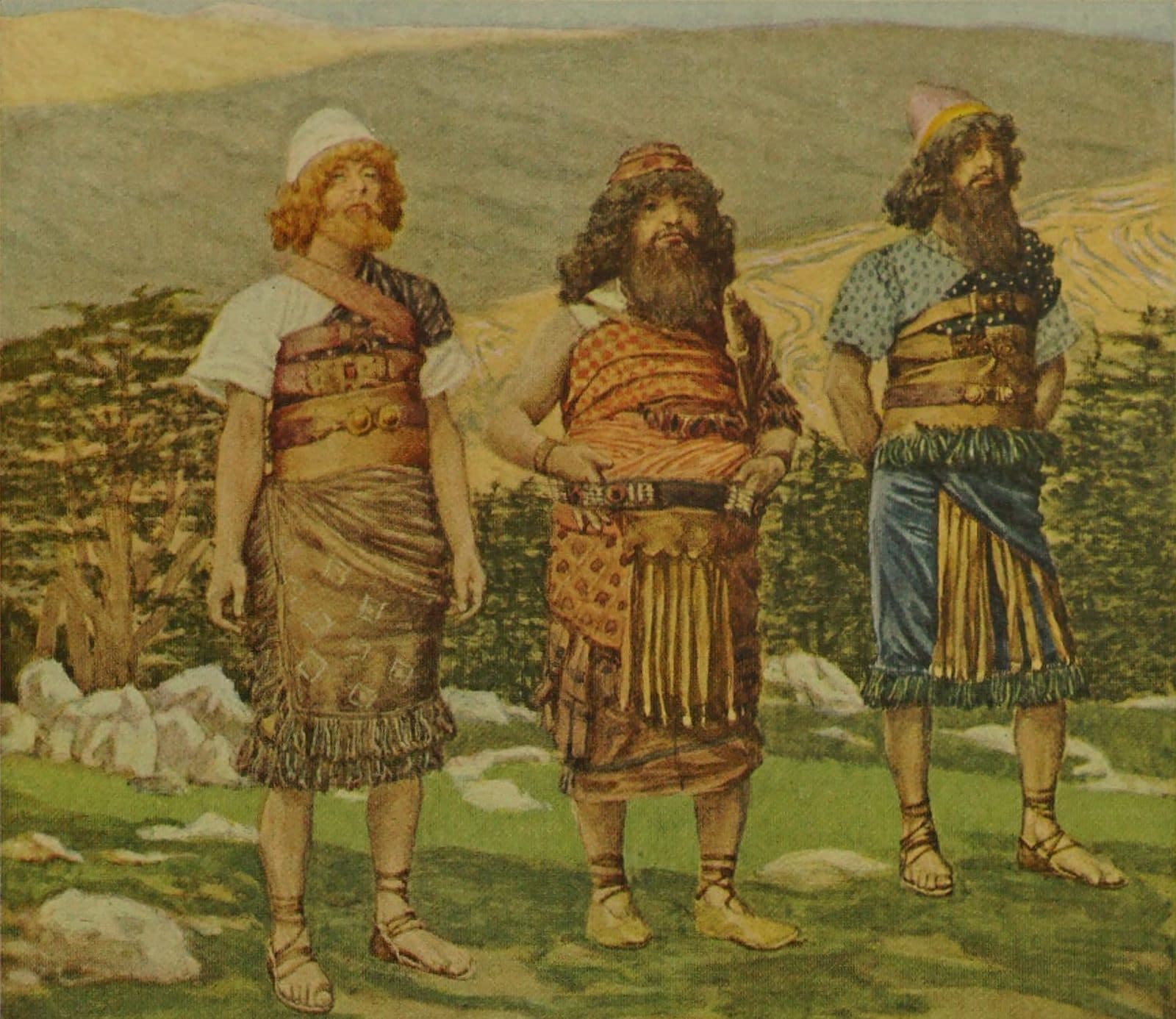
James Tissot, Shem, Ham and Japheth, 1896 to 1902. Public domain.
Summary
Seventy nations descend from the three sons of Noah, and Genesis 10 lists them by their clans, languages, lands and nations.
- Genesis 10 sets out the peoples of the known world as the families of one man.
- Josephus, the Assyrian annals and Phoenician inscriptions identify many of its names with peoples known in history.
- From seventy nations the story narrows to one man, Abraham.
- The nations return at Pentecost in Acts 2 and before the throne in Revelation 7:9.
A Genealogy That Is Really a Geography
Genesis 10 names the sons of Noah and the peoples descended from them, and it places each people in its land.
From these, the maritime peoples separated into their territories, according to their languages, by clans within their nations.The same four marks of land, language, clan and nation close the list of Ham in verse 20 and the list of Shem in verse 31.
The names are of more than one kind. Some are persons, such as Nimrod, who began to be a mighty one on the earth (Genesis 10:8). Some are peoples, marked by the Hebrew plural ending im or by the ending ite, such as the Ludites, the Kittites, the Jebusites and the Amorites. Some are cities and regions, such as Sidon, Tarshish and the four cities of Nimrod's kingdom.
All these are the clans of Noah’s sons, according to their generations and nations. From these the nations of the earth spread out after the flood.The last verse of the chapter gathers all seventy names under Noah's sons and gives the spreading of the nations as its subject.
The words goyim and toledotGenesis 10:1, 10:5 and 10:32
The recurring word is goyim, nations, which stands in Genesis 10:5 and in Genesis 10:32. The heading's Hebrew word is toledot, generations, which stands in Genesis 10:1 and again in Genesis 10:32. The list stands under its own heading, the account of Noah's sons (Genesis 10:1), the heading Genesis also gives to the line of Shem (Genesis 11:10) and to the line of Terah (Genesis 11:27). Genesis presents it as a historical record of the world after the flood, which fills in as Genesis follows the family it starts from. Everything after Genesis 11 happens on the ground this list lays out.
The same list in 1 Chronicles 11 Chronicles 1:4 to 27
The sons of Noah: Shem, Ham, and Japheth. The sons of Japheth: Gomer, Magog, Madai, Javan, Tubal, Meshech, and Tiras.The Chronicler's genealogy, which begins with Adam in verse 1, gives the list of Genesis 10 in short from the sons of Noah onward.
Adam Clarke calls the Chronicler's verse on Nimrod a copy of the text in Genesis. Albert Barnes notes that the Chronicler holds Shem back until after Japheth and Ham, because the genealogy continues through him.
So from Shem came Arphaxad, Shelah, Eber, Peleg, Reu, Serug, Nahor, Terah, and Abram (that is, Abraham).The Chronicler runs the line of Shem to Abram in ten names, the line that Genesis 11:10 to 26 gives with each father's age.
One Family, Scattered into a World
After the flood, three sons of Noah repopulate the earth, and Genesis 10 gives each line its region.
The table sets out the three lines of Genesis 10 and their total in four rows: the number of names in each line, where each settled, and seven of its names.
| Line | Names | Where they settled | Among them |
|---|---|---|---|
| Japheth | 14 | North and west: Anatolia, the islands and the coastlands | Gomer, Magog, Madai, Javan, Tubal, Meshech, Tiras |
| Ham | 30 | South: Egypt, Cush, Canaan, and Nimrod's Mesopotamia | Cush, Mizraim, Put, Canaan, Sidon, the Hittites, Nimrod |
| Shem | 26 | The center: Elam, Asshur, Aram, and the line to Abram | Elam, Asshur, Arphaxad, Lud, Aram, Eber, Peleg |
| All three lines | 70 | The whole earth after the flood | All the clans of Noah's sons |
Deuteronomy 32:8 and the number seventyGenesis 46:27 and Deuteronomy 32:8
Seventy, the total of the table, is also the number of Jacob's family who went down to Egypt (Genesis 46:27).
When the Most High gave the nations their inheritance, when He divided the sons of man, He set the boundaries of the peoples according to the number of the sons of God.The Berean text reads the sons of God, and the Masoretic text, which the King James Version follows, reads the children of Israel; with that reading the verse sets the nations beside Israel's number.
Jamieson, Fausset and Brown tie the naming of Peleg to this verse, and they read the division of the earth in his days as made by divine instruction, perhaps given through Eber.
The seventy names of Genesis 1015 rows
The table lists the seventy names by line and branch in the order of Genesis 10, with the count of each branch.
| Line | Branch | Names | Count |
|---|---|---|---|
| Japheth | Sons of Japheth | Gomer, Magog, Madai, Javan, Tubal, Meshech, Tiras | 7 |
| Japheth | Sons of Gomer | Ashkenaz, Riphath, Togarmah | 3 |
| Japheth | Sons of Javan | Elishah, Tarshish, the Kittites, the Rodanites | 4 |
| Ham | Sons of Ham | Cush, Mizraim, Put, Canaan | 4 |
| Ham | Sons of Cush | Seba, Havilah, Sabtah, Raamah, Sabteca | 5 |
| Ham | Sons of Raamah | Sheba, Dedan | 2 |
| Ham | Son of Cush | Nimrod | 1 |
| Ham | Peoples of Mizraim | The Ludites, the Anamites, the Lehabites, the Naphtuhites, the Pathrusites, the Casluhites, the Caphtorites | 7 |
| Ham | Peoples of Canaan | Sidon, the Hittites, the Jebusites, the Amorites, the Girgashites, the Hivites, the Arkites, the Sinites, the Arvadites, the Zemarites, the Hamathites | 11 |
| Shem | Sons of Shem | Elam, Asshur, Arphaxad, Lud, Aram | 5 |
| Shem | Sons of Aram | Uz, Hul, Gether, Mash | 4 |
| Shem | Son and grandson of Arphaxad | Shelah, Eber | 2 |
| Shem | Sons of Eber | Peleg, Joktan | 2 |
| Shem | Sons of Joktan | Almodad, Sheleph, Hazarmaveth, Jerah, Hadoram, Uzal, Diklah, Obal, Abimael, Sheba, Ophir, Havilah, Jobab | 13 |
| All three lines | The Philistines of Genesis 10:14 are not counted | Seventy names | 70 |
Ham, Ham, Ham, Shem, Shem, Shem, Shem, Shem and 1 more
John Gill notes that some reckon Ham's descendants at thirty and others at thirty-one, if the Philistines are taken in.
Seventy-two names in Augustine's countAugustine, Adam Clarke and Luke
The Masoretic text gives seventy names. Augustine, in The City of God, book 16, chapter 3, counts seventy-three in the text he read and corrects the count to seventy-two. The Greek text adds a Cainan between Arphaxad and Shelah, as Adam Clarke notes on Genesis 10:24, and Luke 3:36 names that Cainan in the line of Jesus.
After this, the Lord appointed seventy-two others and sent them two by two ahead of Him to every town and place He was about to visit.The Berean text sends out seventy-two, where the King James Version reads seventy, the same two numbers the counts of the nations give.
From Seventy Nations to One Man
Genesis 10:21 to 11:26 follows one line out of the seventy, the line of Shem.
And sons were also born to Shem, the older brother of Japheth; Shem was the forefather of all the sons of Eber.Shem is named as the forefather of all the sons of Eber before his own sons are listed, which marks the line the story will follow.
The line of Shem runs to Arphaxad, to Shelah, to Eber, whose name the Hebrews carry, and to Peleg.
Two sons were born to Eber: One was named Peleg, because in his days the earth was divided, and his brother was named Joktan.Peleg's name means division, and Genesis ties it to the dividing of the earth in his days.
Ten generations from Shem to AbramGenesis 11:10 to 26
The table follows the line of Genesis 11:10 to 26 through ten generations, with each father's age when the named son was born and the years he lived after.
7, 8, 9, 10
Matthew Henry, citing Bishop Patrick, reads this line as the bearer of the promise of the Messiah.
“The great promise of the Messiah (says bishop Patrick) was translated from Adam to Seth, from him to Shem, from him to Eber, and so to the Hebrew nation, who were entrusted, above all nations, with that sacred treasure, till the promise was performed and the Messiah had come, and then that nation was made not a people.”
Matthew Henry · Commentary on the Whole Bible · on 1 Chronicles 1:17 to 23Puritan
Noah's Word over His Sons
Genesis 9:18 to 27 introduces the three brothers and records Noah's curse on Canaan and his blessing on Shem and Japheth.
The sons of Noah who came out of the ark were Shem, Ham, and Japheth. And Ham was the father of Canaan. These three were the sons of Noah, and from them the whole earth was populated.These verses name the three brothers from whom the whole earth was populated, the claim Genesis 10 sets out name by name.
he said, “Cursed be Canaan! A servant of servants shall he be to his brothers.”The curse falls on Canaan, one of Ham's four sons, and on none of the other three.
He also declared: “Blessed be the LORD, the God of Shem! May Canaan be the servant of Shem. May God expand the territory of Japheth; may he dwell in the tents of Shem, and may Canaan be his servant.”Shem's blessing is tied to the LORD's name, and Japheth is promised room to expand and a place in Shem's tents.
Justin Martyr on the curse of CanaanGenesis 9:22 to 25
The curse is often called the curse of Ham, but the text names Canaan. Justin Martyr gives a reason why the curse began with the son.
“For another mystery was accomplished and predicted in the days of Noah, of which you are not aware. It is this: in the blessings wherewith Noah blessed his two sons, and in the curse pronounced on his son's son. For the Spirit of prophecy would not curse the son that had been by God blessed along with [his brothers]. But since the punishment of the sin would cleave to the whole descent of the son that mocked at his father's nakedness, he made the curse originate with his son.”
Justin Martyr · Dialogue with Trypho, Chapter CXXXIX · on Genesis 9:22 to 25Patristic
Names the Ground Remembers
Ancient writers and inscriptions identify many names of Genesis 10.
Much of the Table of Nations can be checked. The earliest surviving list of identifications is Josephus's, in Antiquities of the Jews 1.6.1, finished about AD 93. Beside the eight names in the table, Josephus derives the Thracians from Tiras.
The brick and tar Genesis gives the builders in Shinar (Genesis 11:3) fit the land. Adam Clarke notes that the district had an utter scarcity of stone, so the builders used brick for stone and bitumen for mortar.
Eight names and their identifications8 rows
The table gives eight names of Genesis 10, the people or place each is identified with, and the source of the identification.
| Name in Genesis 10 | The people or place | Source |
|---|---|---|
| Javan | The Ionians and the Greeks | Josephus, Antiquities 1.6.1 |
| Madai | The Medes, east of Assyria | Josephus, Antiquities 1.6.1; Assyrian records, after Driver |
| Mizraim | Egypt, by its Hebrew name | The Old Testament throughout, after Driver |
| Cush | The land south of Egypt, Ethiopia in the English versions | Driver, from Egyptian records of Kash; Josephus 1.6.2 |
| Tubal and Meshech | The Tabali and the Mushku of Anatolia | Assyrian annals, after Driver |
| Kittim | Kition, a city of Cyprus | Josephus 1.6.1; the Phoenician name Kiti, after Driver |
| Asshur | Assyria | Josephus, Antiquities 1.6.4 |
| Nimrod's cities | Erech is Uruk, Calah is Nimrud, Nineveh is Kouyunjik; the site of Accad is uncertain | Excavated mounds, after Driver |
Asshur, Nimrod's cities
John Wesley on NimrodGenesis 10:8
John Wesley reads Nimrod's tyranny as the spirit of the giants before the flood revived in one man.
“The same spirit that the giants before the flood were acted by, chap. vi, 4, now revived in him; so soon was that tremendous judgment, which the pride and tyranny of those mighty men brought upon the world, forgotten.”
John Wesley · Explanatory Notes upon the Old Testament · on Genesis 10:8Evangelical
Whether that spirit traces to the sons of God of Genesis 6 is a contested question of its own, taught on the page on the Watchers and the Nephilim. Nimrod's rise, his cities and his kingdom are taught on the page Nimrod and the First Kingdoms.
Where the Map Goes Quiet
Genesis 10 leaves three matters unsettled, some addresses, Nimrod's identity and the order of Noah's sons.
Some names have no settled address. Josephus places Magog among the Scythians, and S. R. Driver notes that the origin of the name is not apparent. S. R. Driver reads Put as probably Libya, and he places Havilah both on the African coast and in north-east Arabia. Jerome places the sons of Joktan, Ophir and Havilah among them, in India.
The Berean text of Genesis 10:21 calls Shem the older brother of Japheth. John Wesley reads the verse the other way and makes Japheth the elder.
Proposals for Nimrod's identityS. R. Driver, The Book of Genesis (1904)
Genesis records Nimrod's deeds and leaves his throne name unsaid. S. R. Driver records two proposals, the Kassite king Nazi-murudash and Gilgamesh, the champion of Erech, and he calls the second an attractive conjecture. Neither is proven.
From Babel to Pentecost
Acts and Revelation show the nations of Genesis 10 gathered again.
At Babel one language became many and the nations scattered. In Acts 2 the nations gather again, and each hears in his own tongue.
Parthians, Medes, and Elamites; residents of Mesopotamia, Judea and Cappadocia, Pontus and Asia, Phrygia and Pamphylia, Egypt and the parts of Libya near Cyrene; visitors from Rome,Luke's list names the Medes and the Elamites, peoples Genesis 10 traces to Madai and to Elam.
From one man He made every nation of men, that they should inhabit the whole earth; and He determined their appointed times and the boundaries of their lands.Paul grounds his preaching at Athens in the claim Genesis 10 makes, that every nation comes from one man.
After this I looked and saw a multitude too large to count, from every nation and tribe and people and tongue, standing before the throne and before the Lamb. They were wearing white robes and holding palm branches in their hands.John sees the peoples and tongues that Babel divided standing together before the Lamb.
Jerome sees mercy in the scattering itself.
“Just as when holy men live together, it is a great grace and blessing; so, likewise, that congregation is the worst kind when sinners dwell together. The more sinners there are at one time, the worse they are. Indeed, when the tower was being built up against God, those who were building it were disbanded for their own welfare. The conspiracy was evil. The dispersion was of true benefit even to those who were dispersed.”
Jerome · HOMILIES 21 · on Genesis 11:9Patristic
Revelation 7:9, Jerome
Three Voices on the Nations
Josephus, John Wesley and Matthew Henry
died 100 · Josephus
Josephus places the five sons of Shem between the Euphrates and the Indian Ocean.
“Shem, the third son of Noah, had five sons, who inhabited the land that began at Euphrates, and reached to the Indian Ocean. For Elam left behind him the Elamites, the ancestors of the Persians.”
Josephus · Antiquities of the Jews - Book I, Chapter 6, Sections 4 · on Genesis 10:21 to 31Jewish
1662 to 1714 · Matthew Henry
Matthew Henry holds that Noah's language, likely Adam's, came through the flood.
“If there were any different languages before the flood, yet Noah's only, which it is likely was the same with Adam's, was preserved through the flood, and continued after it.”
Matthew Henry · Commentary on the Whole Bible · on Genesis 11:1Puritan
1703 to 1791 · John Wesley
John Wesley explains why the sons of Canaan are listed in more detail than any other line.
“The account of the posterity of Canaan, and the land they possessed is more particular than of any other in this chapter, because these were the nations that were to be subdued before Israel, and their land was to become Immanuel's land.”
John Wesley · Explanatory Notes upon the Old Testament · on Genesis 10:15Evangelical
How Readers Divide over the Table
Readers divide over Peleg's division, over who the names are, and over the order of Genesis 10 and 11.
The peoples were divided at BabelJosephus, Jerome and S. R. Driver
On this reading the division of Genesis 10:25 is the scattering of the peoples and their languages told in Genesis 11:9. Josephus says Peleg was born at the dispersion of the nations, and Jerome says the languages were divided in Babylon in his days. S. R. Driver reads the earth here as the population of the earth, as in Genesis 11:1, and he records A. H. Sayce's reading of the word as the cutting of canals in Babylonia. The Hebrew verb is niphlegah, was divided, and the verses around it speak of nations.
The objection: S. R. Driver notes that the word for divided can be read in more than one way, so the verse alone does not settle whether the peoples or the land are meant.
Continents and islands were partedAdam Clarke
On this reading the earth of Genesis 10:25 is the land, and the division is the parting of continents and islands from one great mainland. Adam Clarke, in his Commentary on the Bible, calls this opinion the most likely.
The objection: the chapter's subject is nations and languages (Genesis 10:5 and 10:32), and Genesis 11:1 uses the earth for the people who live on it.
The names are ancestors whose names passed to nationsJosephus, Antiquities 1.6
On this reading the names are men of Noah's family, and each people took the name of the man who first settled its land. Josephus writes so of the grandchildren of Noah in Antiquities 1.6.1.
The objection: many names are peoples or places in form, with plural endings or city names, as S. R. Driver notes of the Ludim and Sidon.
The names stand for peoplesS. R. Driver, The Book of Genesis (1904)
On this reading each name stands for a people, and the family tree pictures how the nations were thought to be related. S. R. Driver, in The Book of Genesis, takes none of the names as a real individual.
The objection: Genesis gives Nimrod a kingdom and a proverb, and it gives Eber and Peleg sons and ages (Genesis 10:8 to 10; 11:14 to 19).
Genesis 10 records the result of Babel before its causeAdam Clarke; Josephus; Jerome
On this reading the chapter gives the outcome of the scattering, out of the order of time, and Genesis 11 tells the single event behind it. Adam Clarke reads Genesis 10:5 as spoken by way of anticipation, and Josephus and Jerome date Peleg's naming to the dispersion at Babel.
The objection: S. R. Driver finds two sources joined in the chapter, so its order is the compiler's and the two accounts need no single storyline.
Genesis 10 joins two sourcesS. R. Driver, The Book of Genesis (1904)
On this reading the chapter joins two lists with separate accounts of national origin. S. R. Driver assigns Genesis 10:1 to 7, 20, 22 to 23 and 31 to 32 to the Priestly source and most of the rest of the chapter to the source called J.
The objection: Peleg's name in Genesis 10:25 already points to the division of Genesis 11, and Josephus and Jerome read the two chapters as one account.
Books to Read Next
Three works on the Table of Nations, each free to read
Antiquities of the Jews, Book 1
Flavius Josephus, translated by William Whiston · about AD 93; translated 1737
Josephus gives the oldest surviving list of the peoples of his day descended from the names of Genesis 10.
Read it free at Project GutenbergThe City of God, Volume II
Augustine of Hippo, translated by Marcus Dods · 1871 translation
Augustine traces the city of God from Noah's family to the kings of Israel.
Read it free at Project GutenbergThe Book of Genesis
S. R. Driver · 1904
Driver identifies each name of Genesis 10 from the inscriptions known in his day.
Read it free at the Internet ArchiveThe Nations and the Promise
Genesis 10 asks the reader to see every people on earth as one family under one Creator. Paul told the Athenians that God set the times and lands of the nations so that they would seek Him (Acts 17:26 to 27).
The line the Table narrows to runs from Shem to Abram and on to Christ. Paul writes that the Scripture foretold the gospel to Abraham in the promise that all nations will be blessed through him (Galatians 3:8).
Sources
Scripture is the Berean Standard Bible.
- The King James Version.
- Miqra according to the Masorah, the Hebrew text of the Bible, via Sefaria.
- Flavius Josephus, Antiquities of the Jews, translated by William Whiston (1737), public domain.
- Augustine of Hippo, The City of God, translated by Marcus Dods (1871), public domain.
- S. R. Driver, The Book of Genesis, with Introduction and Notes (Westminster Commentaries, 1904), public domain.
- Adam Clarke, Commentary on the Bible.
- John Gill, Exposition of the Old Testament.
- Albert Barnes, Notes, Explanatory and Practical, on the Old Testament.
- John Wesley, Explanatory Notes upon the Old Testament.
- Jamieson, Fausset and Brown, Commentary Critical and Explanatory on the Whole Bible.
- Jerome, Hebrew Questions on Genesis, and his Homilies.
- Matthew Henry, Commentary on the Whole Bible.
- Justin Martyr, Dialogue with Trypho.
Keep Studying
Read it6
Studies1
People and groups6
Places10
Show the next 4 titles
Symbols1
Doctrines5
Subjects1