
%20John%20Martin%20-%20NGA%202004.64.1.jpg?width=1600)
Warrior
Joshua
Conqueror of Canaan · Conquest · c. 1500-1390 BC
Joshua Commanding the Sun to Stand Still upon Gibeon, John Martin
Summary
Joshua was Moses' servant and successor, who led Israel into the promised land. His name means "the LORD saves", the same name Jesus bears in Greek.
- Joshua was born in Egypt under slavery and served Moses for about forty years before he led anything of his own.
- Moses changed his name from Hoshea to Joshua, which means the LORD saves, and the Greek form of that name is Jesus.
- He and Caleb were the only two of their generation who said the land could be taken, and the only two who lived to walk in it.
- He crossed the Jordan at about eighty, ran a campaign of roughly seven years, and died at a hundred and ten.
- The story he is known for opens with a man holding a drawn sword who told Joshua He was on neither side.
On this page
Start here
Have I not commanded you to be strong and courageous? Do not be afraid; do not be discouraged, for the LORD your God is with you wherever you go.”
Joshua 1:9→- 6 key events in order
- 209 verses name Joshua, across 15 books
In Scripture
- Verses
- 209
- Books
- 15
Joshua
- Role
- Conqueror of Canaan
- Era
- Conquest
- Dates
- c. 1500-1390 BC
- Tribe
- Ephraim
- Father
- Nun
- Mother
- Unknown
- Spouse
- Unknown
The life in order
in the order the canon tells it
- His first battle, and Moses hands him the armyExodus 17:13So Joshua overwhelmed Amalek and his army with the sword.
- He stays in the tent after Moses leaves itExodus 33:11Thus the LORD would speak to Moses face to face, as a man speaks to his friend. Then Moses would return to the camp, but his young assistant Joshua son of Nun would not leave the tent.
- He asks Moses to stop the prophesying, and Moses refusesNumbers 11:28Joshua son of Nun, the attendant to Moses since youth, spoke up and said, “Moses, my lord, stop them!”
- Moses gives Hoshea the name JoshuaNumbers 13:16These were the names of the men Moses sent to spy out the land; and Moses gave to Hoshea son of Nun the name Joshua.
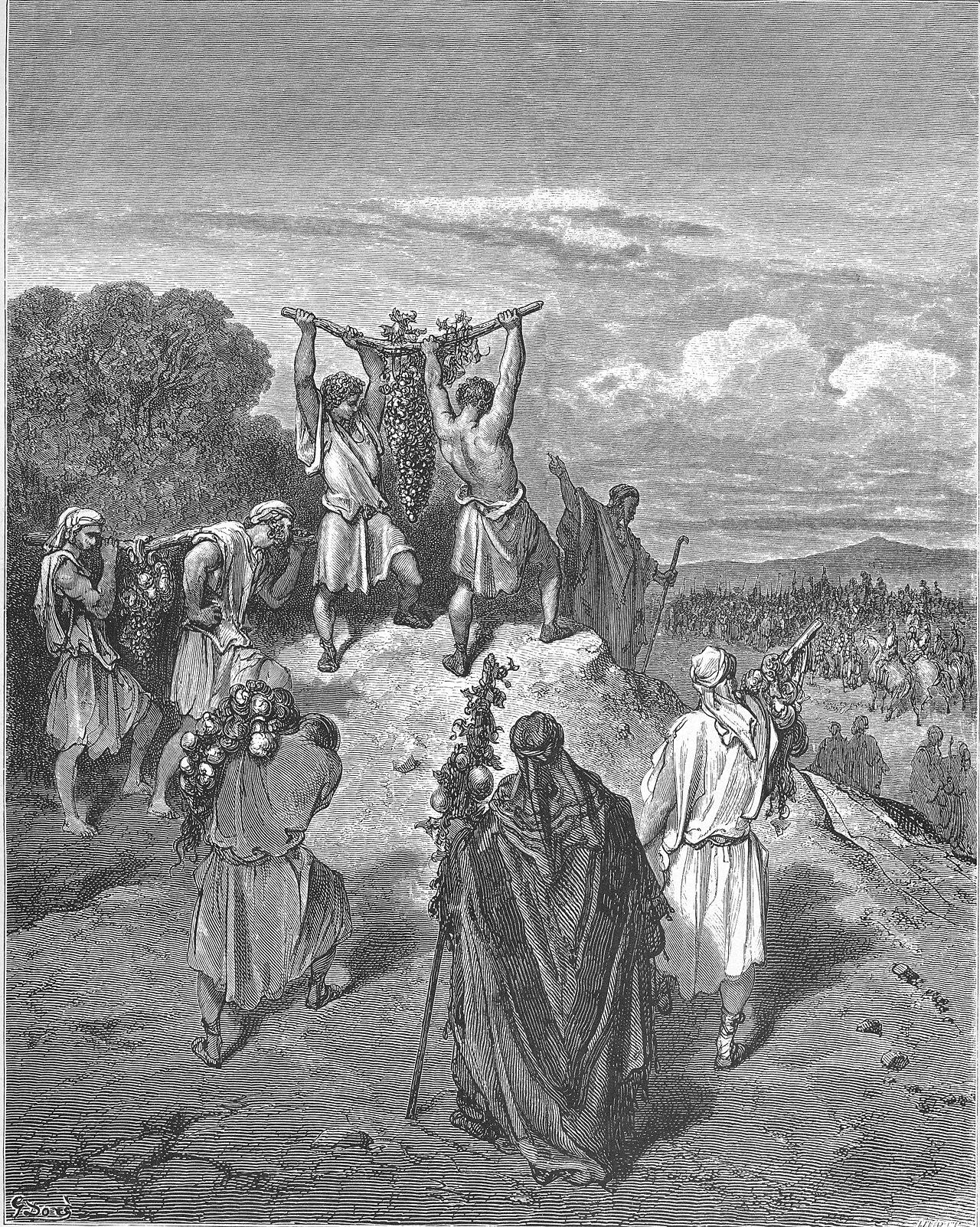
- He and Caleb tell the congregation the land can be takenNumbers 14:9Only do not rebel against the LORD, and do not be afraid of the people of the land, for they will be like bread for us. Their protection has been removed, and the LORD is with us. Do not be afraid of them!”
- A man with the Spirit in him, chosen to succeed MosesNumbers 27:18And the LORD replied to Moses, “Take Joshua son of Nun, a man with the Spirit in him, and lay your hands on him.
- The LORD commissions him and promises to be with himDeuteronomy 31:23Then the LORD commissioned Joshua son of Nun and said, “Be strong and courageous, for you will bring the Israelites into the land that I swore to give them, and I will be with you.”
- His orders are attached to a book rather than to a battle planJoshua 1:8This Book of the Law must not depart from your mouth; meditate on it day and night, so that you may be careful to do everything written in it. For then you will prosper and succeed in all you do.
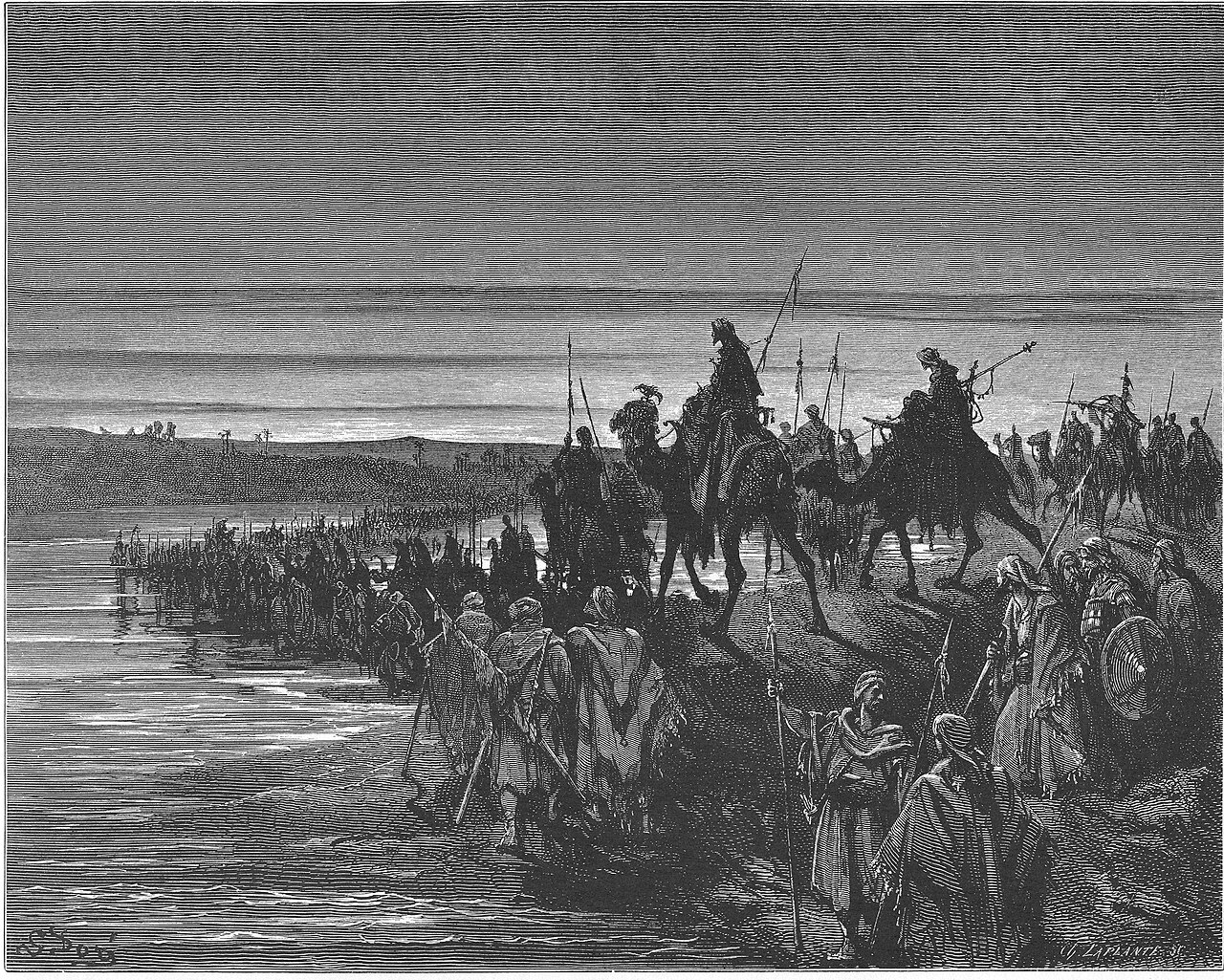
- The nation crosses the flooded Jordan on dry groundJoshua 3:17The priests carrying the ark of the covenant of the LORD stood firm on dry ground in the middle of the Jordan, while all Israel crossed over the dry ground, until the entire nation had crossed the Jordan.
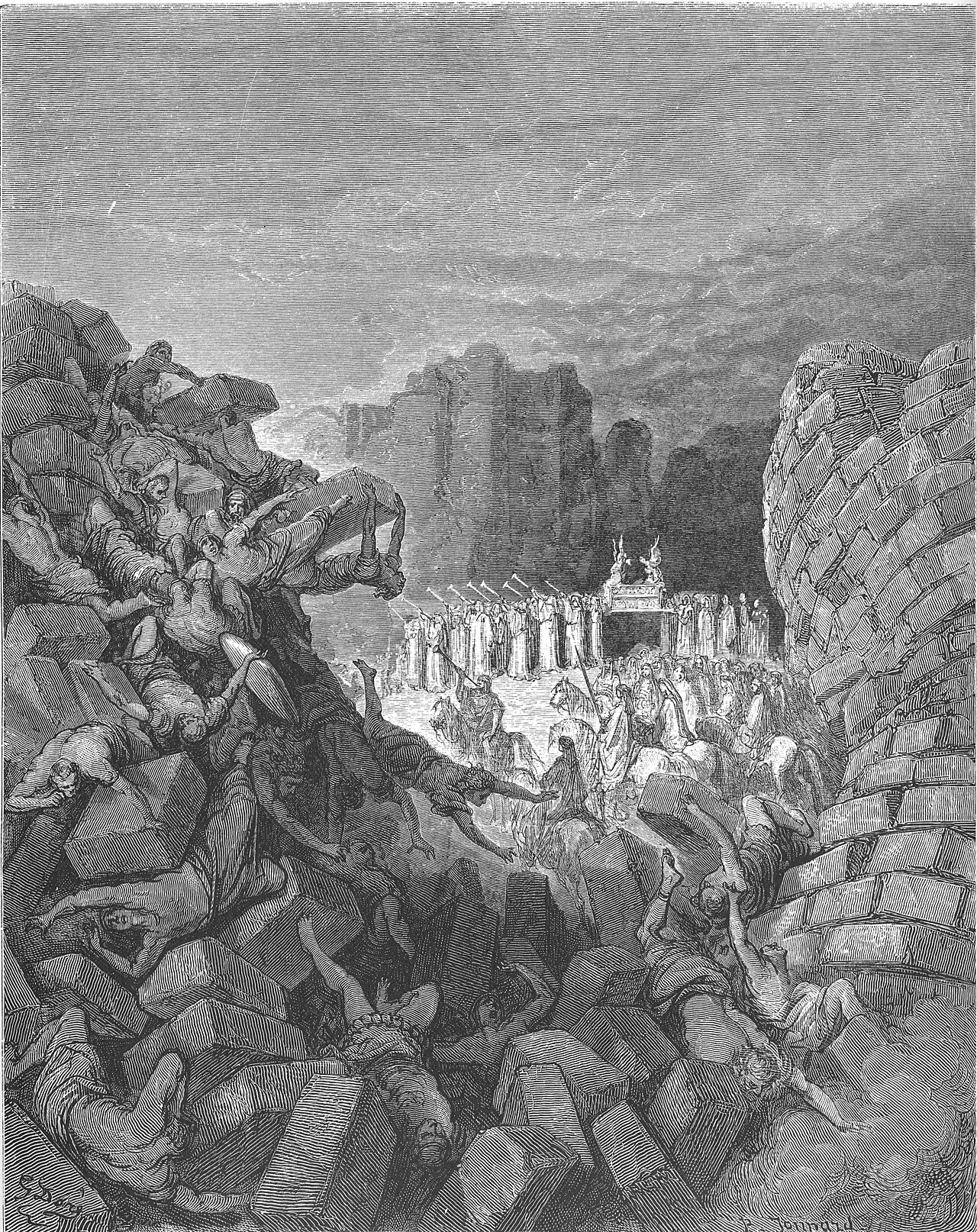
- The wall of Jericho collapsesJoshua 6:20So when the rams’ horns sounded, the people shouted. When they heard the blast of the horn, the people gave a great shout, and the wall collapsed. Then all the people charged straight into the city and captured it.
- After the losses at Ai he lies on his face until eveningJoshua 7:6Then Joshua tore his clothes and fell facedown before the ark of the LORD until evening, as did the elders of Israel; and they all sprinkled dust on their heads.
- He stops the war and reads the whole law aloud at EbalJoshua 8:35There was not a word of all that Moses had commanded that Joshua failed to read before the whole assembly of Israel, including the women, the little ones, and the foreigners who lived among them.
- The treaty with Gibeon, made without asking the LORDJoshua 9:14Then the men of Israel sampled their provisions, but did not seek the counsel of the LORD.
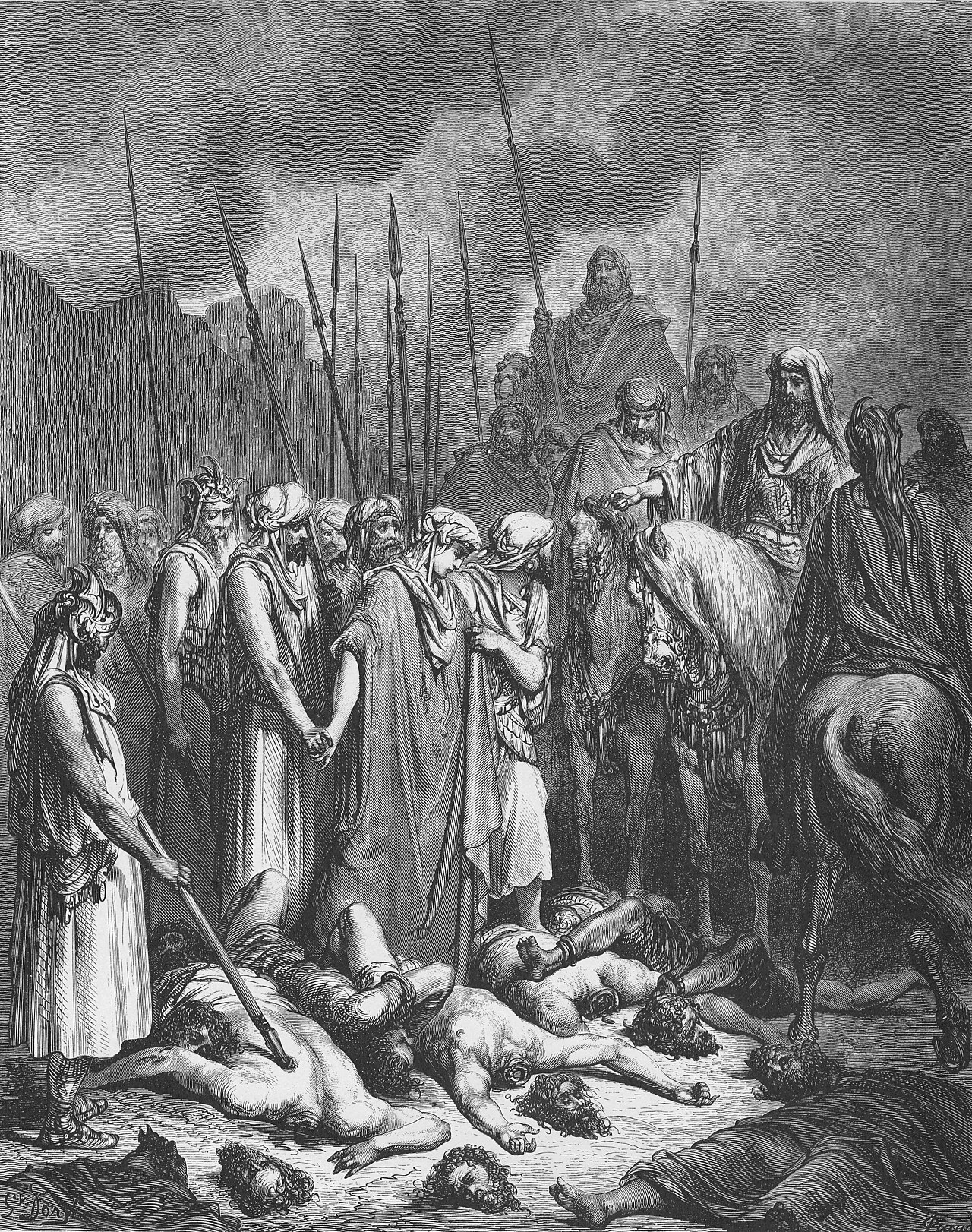
- The day the LORD listened to the voice of a manJoshua 10:14There has been no day like it before or since, when the LORD listened to the voice of a man, because the LORD fought for Israel.
- The Anakim are cleared out, and survive in Gaza, Gath and AshdodJoshua 11:22No Anakim were left in the land of the Israelites; only in Gaza, Gath, and Ashdod did any survive.
- He is old, and much of the land is still unpossessedJoshua 13:1Now Joshua was old and well along in years, and the LORD said to him, “You are old and well along in years, but very much of the land remains to be possessed.
- He gives Caleb the hill country Caleb asked forJoshua 14:13Then Joshua blessed Caleb son of Jephunneh and gave him Hebron as his inheritance.
- He takes his own inheritance last, and rebuilds itJoshua 19:50as the LORD had commanded. They gave him the city of Timnath-serah in the hill country of Ephraim, as he requested. He rebuilt the city and settled in it.
- He puts the choice to the nation in front of witnessesJoshua 24:15But if it is unpleasing in your sight to serve the LORD, then choose for yourselves this day whom you will serve, whether the gods your fathers served beyond the Euphrates, or the gods of the Amorites in whose land you are living. As for me and my house, we will serve the LORD!”
- He dies at a hundred and ten, called the servant of the LORDJoshua 24:29Some time later, Joshua son of Nun, the servant of the LORD, died at the age of 110.
Why Joshua matters
Joshua son of Nun is the man who took Israel into the land. He was born in Egypt under slavery, came out with the Exodus generation, and served Moses for about forty years before he commanded anything of his own. Scripture first shows him with an army at Rephidim, and Moses hands it to him without a word about his experience. His birth name was Hoshea, which means salvation. Moses put the divine name in front of it and made it Joshua, the LORD saves (Numbers 13:16). The renaming happened on the way out to spy the land, before anyone knew what his report would be. Ten of the twelve spies came back frightened. Joshua and Caleb came back saying the land was good and that God would give it, and the congregation threatened to stone them for saying so. That report cost them nothing on the day and everything for the next forty years. Their whole generation died in the wilderness, and the two of them alone walked in. He crossed the Jordan at about eighty. The campaign that followed ran roughly seven years by the arithmetic of Joshua 14:10, and the book is honest about how it went. He was tricked into a treaty because he did not ask (Joshua 9:14). Thirty-six men died in the first attempt on Ai because someone in the camp had stolen. He took the whole land and he did not finish it, and Joshua 11:23 and Joshua 13:1 stand in the same book. The habits the book records are small and repeated. He stayed in the tent when Moses walked away from it (Exodus 33:11). He stopped a war to read every word of the law aloud to a crowd that included the women, the children and the foreigners (Joshua 8:35). He kept an oath two of his men had sworn to a Canaanite woman, and he kept a second oath he had been tricked into swearing. He gave Caleb the hardest ground and took his own portion last, a town that needed rebuilding. The New Testament argues from him once, at Hebrews 4:8, and it argues from the name. Joshua really did bring Israel into the land and really did give them rest, and Scripture still speaks afterward of a rest to be entered. Two men in Scripture carry that name. One brings a nation into a land, and one brings a people to God. He is called the servant of the LORD a single time, at his death (Joshua 24:29). That is the title Moses carried all along, and Joshua is given it at the end as a verdict on the whole life. Judges 2:10 then records what came next. The generation that watched him do everything raised a generation that did not know the LORD, and Joshua had commissioned no successor.
Biography
Joshua son of Nun was Moses' servant and successor, chosen by God to lead Israel across the Jordan and conquer the Promised Land. His original name Hoshea ("salvation") was changed by Moses to Joshua ("Yahweh saves"), foreshadowing his role as deliverer. Joshua first appears as the military commander who defeated the Amalekites while Moses' raised hands ensured victory. He was one of twelve spies sent into Canaan, and with Caleb gave the only faithful report, urging Israel to trust God. For this faithfulness, only Joshua and Caleb of their generation would enter the land. After Moses' death, God commissioned Joshua with the words "Be strong and courageous" repeated four times. He led Israel across the miraculously parted Jordan, conquered Jericho when its walls fell at the shout, and systematically subdued the land through brilliant military campaigns—though the victory was always God's. Joshua's leadership combined military prowess with spiritual devotion. He renewed the covenant at Mount Ebal and Gerizim, read all of Moses' law to the people, and divided the land among the tribes. His farewell address challenged Israel with the famous declaration: "As for me and my house, we will serve the LORD."
Have I not commanded you to be strong and courageous? Do not be afraid; do not be discouraged, for the LORD your God is with you wherever you go.”
God's command to be strong and courageous
Jericho
Joshua 5:13 to 6:27, in the order it happens
- A man in the road with a drawn swordJoshua 5:13Now when Joshua was near Jericho, he looked up and saw a man standing in front of him with a drawn sword in His hand. Joshua approached Him and asked, “Are You for us or for our enemies?”
- Asked whose side He is on, He answers neitherJoshua 5:14“Neither,” He replied. “I have now come as Commander of the LORD’s army.” Then Joshua fell facedown in reverence and asked Him, “What does my Lord have to say to His servant?”
- Take off your sandals, the words Moses heard at the bushJoshua 5:15The Commander of the LORD’s army replied, “Take off your sandals, for the place where you are standing is holy.” And Joshua did so.
- The city is shut and nobody is movingJoshua 6:1Now Jericho was tightly shut up because of the Israelites. No one went out and no one came in.
- The city is handed over before a blow is struckJoshua 6:2And the LORD said to Joshua, “Behold, I have delivered Jericho into your hand, along with its king and its mighty men of valor.
- The battle plan is priests, horns and a circuitJoshua 6:4Have seven priests carry seven rams’ horns in front of the ark. Then on the seventh day, march around the city seven times, while the priests blow the horns.
- The seventh day, seven times aroundJoshua 6:15Then on the seventh day, they got up at dawn and marched around the city seven times in the same manner. That was the only day they circled the city seven times.
- One household is named and exempted before the shoutJoshua 6:17Now the city and everything in it must be devoted to the LORD for destruction. Only Rahab the prostitute and all those with her in her house will live, because she hid the spies we sent.
- The wall collapsesJoshua 6:20So when the rams’ horns sounded, the people shouted. When they heard the blast of the horn, the people gave a great shout, and the wall collapsed. Then all the people charged straight into the city and captured it.
- Joshua sends the same two men to keep their promiseJoshua 6:22Meanwhile, Joshua told the two men who had spied out the land, “Go into the house of the prostitute and bring out the woman and all who are with her, just as you promised her.”
The march was not silent. The priests blew the horns every day (Joshua 6:4), and what the people withheld was their own shout until the seventh day. The silver and the gold went into the treasury of the LORD instead of to the soldiers, because the soldiers had not taken the city. Joshua 6:21 then reports the ban carried out on Jericho, and the ethics of the conquest are set out at full strength on the Joshua study guide rather than here.
The fall of Jericho: the full studyKey events
- 1Defeated AmalekitesExodus 17:8-14→
Joshua led Israel's first military victory
Read the verse here
Exodus 17:8-14After this, the Amalekites came and attacked the Israelites at Rephidim.
- 2Faithful spy reportNumbers 14:6-9→
With Caleb, urged Israel to trust God for victory
Read the verse here
Numbers 14:6-9Joshua son of Nun and Caleb son of Jephunneh, who were among those who had spied out the land, tore their clothes
- 3Commissioned as leaderJoshua 1:1-9→
God commanded Joshua to be strong and courageous
Read the verse here
Joshua 1:1-9Now after the death of His servant Moses, the LORD spoke to Joshua son of Nun, Moses’ assistant, saying,
- 4Crossed the JordanJoshua 3:14-17→
Led Israel across the Jordan on dry ground
Read the verse here
Joshua 3:14-17So when the people broke camp to cross the Jordan, the priests carried the ark of the covenant ahead of them.
- 5Conquered JerichoJoshua 6:1-21→
The walls fell after Israel marched and shouted
Read the verse here
Joshua 6:1-21Now Jericho was tightly shut up because of the Israelites. No one went out and no one came in.
- 6Farewell addressJoshua 24:14-28→
Joshua challenged Israel to choose whom to serve
Read the verse here
Joshua 24:14-28Now, therefore, fear the LORD and serve Him in sincerity and truth; cast aside the gods your fathers served beyond the Euphrates and in Egypt, and serve the LORD.
More key verses
Text: Berean Standard Bible.
But if it is unpleasing in your sight to serve the LORD, then choose for yourselves this day whom you will serve, whether the gods your fathers served beyond the Euphrates, or the gods of the Amorites in whose land you are living. As for me and my house, we will serve the LORD!”
What they got right, and what they got wrong
Strengths
Unwavering courage, faithful service to Moses, military genius, devotion to God's word, strong leadership
Weaknesses
Deceived by the Gibeonites, did not fully drive out all Canaanites
Lessons
Courage is commanded, not optional. Obedience to God's word brings success. Victory belongs to the LORD. Leaders must choose whom they will serve.
Spiritual significance
Joshua demonstrates that God keeps His promises and gives victory to those who trust Him. His leadership shows the importance of courage rooted in God's word.
How Joshua points to Jesus
The New Testament makes one argument from Joshua, and it makes it from his name. Hoshea means salvation. Moses put the divine name in front of it and made it Joshua, the LORD saves (Numbers 13:16). The Greek Old Testament renders that name Iesous, and that is the name the angel gives to Mary's son at Matthew 1:21, for the reason the same verse states, because He will save His people from their sins. The older English versions make the collision visible almost by accident. The King James prints Jesus at Acts 7:45 and Hebrews 4:8 where the modern versions print Joshua, and Adam Clarke objected to that choice in his note on Hebrews 4:8. Eusebius of Caesarea, early in the fourth century, had already noticed that the name was given to this man first, and given by Moses. Hebrews 4:8 reads, For if Joshua had given them rest, God would not have spoken later about another day. The argument runs forward rather than backward. Joshua really did bring Israel into the land and really did give them rest, and Joshua 21:45 says that not one of the good promises of the LORD had failed. Generations later God still speaks through David of a rest to be entered today, so the rest Joshua gave was not the last one. Albert Barnes puts it in one sentence, that Joshua gave them a rest in the promised land but it was not all that was intended and it did not shut out the promise of another. Nothing in that argument says Joshua failed, and nothing in it says Israel was replaced. A real rest given to a real people is the ground the whole argument stands on. Joshua 5:13 to 5:15 is the passage the earliest Christian readers reached for first. The figure carries a drawn sword, calls Himself Commander of the army of the LORD, accepts Joshua's prostration, and calls the ground holy in the words Moses heard at the bush. Justin Martyr, in the middle of the second century, names Him as the one who calls Himself Captain when He appeared in human form to Joshua. Origen of Alexandria, preaching at Caesarea late in his life, asks who else is chief of the army of the powers of God except our Lord Jesus Christ. Eusebius, early in the fourth century, says the identity of words shows this is no other than the one who spoke to Moses. Ambrose of Milan, late in the same century, opens with the question whether Joshua erred in recognizing the leader of the heavenly host. This site teaches that reading, as it teaches the fourth man in the fire at Daniel 3. Albert Barnes read the figure as the prince of the angelic host sent to lead Israel into the coming fight, and he is honored here as a teacher who read the same verses differently. The old readings of the campaign are readings, and this page gives them as readings. Origen took the fall of Jericho as the fall of this world at the end of the age, with the trumpets of the priests as the preaching of the apostles. Ambrose read the same event as a war brought to an end by faith rather than by engines of war. The Jordan crossing has been read since antiquity as a figure of baptism, and of death passed through into life. Matthew Henry, on Joshua 11:23, states the rest plainly: there is a rest from war remaining for the people of God, into which they enter when their warfare is accomplished. Canaan in that reading is the inheritance given, with a larger inheritance still promised. Rahab belongs here because Joshua is the man who kept the promise that put her where she stands. Two spies swore an oath to her at Joshua 2:14, and at Joshua 6:22 Joshua sent those same two men to honor it inside a city under the ban. She stands in the genealogy of Jesus at Matthew 1:5, is commended for faith at Hebrews 11:31, and for works at James 2:25. Origen read her joining to Israel through the image Paul uses at Romans 11:17 and 11:18, where a branch of the wild olive is grafted into the root of a good olive and the root carries the branch. The direction of that image is the point. The nations are brought in to a root that was never theirs, and the root is not displaced. The strongest form of this section is also the most restrained. The New Testament does not call Joshua a type of Christ in so many words, and this page does not put words in its mouth. What the text gives is enough. The name is the same name, and Scripture explains what it means in both cases (Numbers 13:16; Matthew 1:21). A people were brought into an inheritance they had not worked for, and Joshua 24:13 says so in God's own voice. One man went face down in the road before a commander whom the earliest Christian readers named. Matthew Henry closes the life at Joshua 24:31 by calling Christ our Joshua, still with His church by His Spirit. Where this site teaches a reading it teaches it as this site's tradition, and the founder's own slot on this page stays his to fill.
Joshua and Jesus share the same name. Joshua led Israel through death (Jordan) into life (Canaan), as Christ leads believers through death into resurrection life.
The voices
each quoted from the work named
NO doubt God had spoken to Joshua before. He had been a man of faith for many years and his faith enabled him to distinguish himself by such simple truthfulness of character and thoroughly faithful obedience to the Lord's will, that he and another were the only two left of the whole generation that came up out of Egypt. "Faithful among the faithless found," he survived where all else died.
Oshea signifies a prayer for salvation, Save thou; Joshua signifies a promise of salvation, He will save, in answer to that prayer: so near is the relation between prayers and promises.
There stood a man over against him - It has been a very general opinion, both among the ancients and moderns, that the person mentioned here was no other than the Lord Jesus in that form which, in the fullness of time, he was actually to assume for the redemption of man. That the appearance was supernatural is agreed on all hands; and as the name Jehovah is given him, (Jos 6:2), and he received from Joshua Divine adoration, we may presume that no created angel is intended.
4 more teachers on these versesOrigen of Alexandria · Ambrose of Milan · John Wesley · Albert Barnes
What is it that Jesus [Joshua] teaches us through this? That, doubtless, which the apostle says: "Do not believe every spirit, but test if it is from God." Therefore, Jesus [Joshua] recognized not only something from God but that which is God; for certainly he would not have worshiped unless he had recognized God. For who else is chief of the army of the powers of God except our Lord Jesus Christ?
And did Joshua, the son of Nun, err in recognizing the leader of the heavenly host? But after he believed, he forthwith conquered, being found worthy to triumph in the battle of faith. Again, he did not lead forth his armed ranks into the fight, nor did he overthrow the ramparts of the enemy's walls, with battering rams or other engines of war, but with the sound of the seven trumpets of the priests. Thus the blare of the trumpet and the badge of the priest brought a cruel war to an end.
For though it is probable, if God had been consulted, he would have consented to the sparing of the Gibeonites; yet it should have been done with more caution, and an obligation upon them to embrace the true religion. In every business of importance, we should stay to take God along with us, and by the word and prayer consult him.
Joshua “did” give them a rest in the promised land; but it was not all which was intended, and it did not exclude the promise of another and more important rest.
Joshua in Scripture
Open a book to read its mentions here. Text: Berean Standard Bible. Names repeat in Scripture, so some of these verses may speak of another person called Joshua. The two marks are drawn from the chapters this page's own references stand in.
Old TestamentNew Testamentsegment width = share of mentions
Old Testament12 books · 206 mentions
Exodus7 mentions
- Exodus 17:9So Moses said to Joshua, “Choose some of our men and go out to fight the Amalekites. Tomorrow I will stand on the hilltop with the staff of God in my hand.”
- Exodus 17:10Joshua did as Moses had instructed him and fought against the Amalekites, while Moses, Aaron, and Hur went up to the top of the hill.
- Exodus 17:13So Joshua overwhelmed Amalek and his army with the sword.
- Exodus 17:14Then the LORD said to Moses, “Write this on a scroll as a reminder and recite it to Joshua, because I will utterly blot out the memory of Amalek from under heaven.”
- Exodus 24:13So Moses set out with Joshua his attendant and went up on the mountain of God.
2 further mentions in Exodus, read them in the book.
Numbers12 mentions
- Numbers 11:28Joshua son of Nun, the attendant to Moses since youth, spoke up and said, “Moses, my lord, stop them!”
- Numbers 13:16These were the names of the men Moses sent to spy out the land; and Moses gave to Hoshea son of Nun the name Joshua.
- Numbers 14:6Joshua son of Nun and Caleb son of Jephunneh, who were among those who had spied out the land, tore their clothes
- Numbers 14:10But the whole congregation threatened to stone Joshua and Caleb. Then the glory of the LORD appeared to all the Israelites at the Tent of Meeting.
- Numbers 14:30Surely none of you will enter the land in which I swore to settle you, except Caleb son of Jephunneh and Joshua son of Nun.
7 further mentions in Numbers, read them in the book.
Deuteronomy9 mentions
- Deuteronomy 1:38Joshua son of Nun, who stands before you, will enter it. Encourage him, for he will enable Israel to inherit the land.
- Deuteronomy 3:21And at that time I commanded Joshua: “Your own eyes have seen all that the LORD your God has done to these two kings. The LORD will do the same to all the kingdoms you are about to enter.
- Deuteronomy 3:28But commission Joshua, encourage him, and strengthen him, for he will cross over ahead of the people and enable them to inherit the land that you will see.”
- Deuteronomy 31:3The LORD your God Himself will cross over ahead of you. He will destroy these nations before you, and you will dispossess them. Joshua will cross ahead of you, as the LORD has said.
- Deuteronomy 31:7Then Moses called for Joshua and said to him in the presence of all Israel, “Be strong and courageous, for you will go with this people into the land that the LORD swore to their fathers to give them, and you shall give it to them as an inheritance.
4 further mentions in Deuteronomy, read them in the book.
Joshua154 mentions
- Joshua 1:1Now after the death of His servant Moses, the LORD spoke to Joshua son of Nun, Moses’ assistant, saying,
- Joshua 1:10Then Joshua commanded the officers of the people:
- Joshua 1:12But to the Reubenites, the Gadites, and the half-tribe of Manasseh, Joshua said,
- Joshua 1:16So they answered Joshua, “Everything you have commanded us we will do, and everywhere you send us we will go.
- Joshua 2:1Then Joshua son of Nun secretly sent two spies from Shittim, saying, “Go, inspect the land, especially Jericho.” So they went and entered the house of a prostitute named Rahab and stayed there.
149 further mentions in Joshua, read them in the book.
Judges6 mentions
- Judges 1:1After the death of Joshua, the Israelites inquired of the LORD, “Who will be the first to go up and fight for us against the Canaanites?”
- Judges 2:6After Joshua had dismissed the people, the Israelites went out to take possession of the land, each to his own inheritance.
- Judges 2:7And the people served the LORD throughout the days of Joshua and of the elders who outlived him, who had seen all the great works that the LORD had done for Israel.
- Judges 2:8And Joshua son of Nun, the servant of the LORD, died at the age of 110.
- Judges 2:21I will no longer drive out before them any of the nations Joshua left when he died.
1 further mention in Judges, read them in the book.
1 Samuel2 mentions
- 1 Samuel 6:14The cart came to the field of Joshua of Beth-shemesh and stopped there near a large rock. The people chopped up the cart and offered the cows as a burnt offering to the LORD.
- 1 Samuel 6:18The number of gold rats also corresponded to the number of Philistine cities belonging to the five rulers—the fortified cities and their outlying villages. And the large rock on which they placed the ark of the LORD stands to this day in the field of Joshua of Beth-shemesh.
1 Kings1 mention
2 Kings1 mention
1 Chronicles1 mention
Nehemiah1 mention
Haggai5 mentions
- Haggai 1:1In the second year of the reign of Darius, on the first day of the sixth month, the word of the LORD came through Haggai the prophet to Zerubbabel son of Shealtiel, governor of Judah, and to Joshua son of Jehozadak, the high priest, stating
- Haggai 1:12Then Zerubbabel son of Shealtiel and Joshua son of Jehozadak, the high priest, as well as all the remnant of the people, obeyed the voice of the LORD their God and the words of the prophet Haggai, because the LORD their God had sent him. So the people feared the LORD.
- Haggai 1:14So the LORD stirred the spirit of Zerubbabel son of Shealtiel, governor of Judah, and the spirit of Joshua son of Jehozadak, the high priest, as well as the spirit of all the remnant of the people. And they came and began the work on the house of the LORD of Hosts, their God,
- Haggai 2:2“Speak to Zerubbabel son of Shealtiel, governor of Judah, and to Joshua son of Jehozadak, the high priest, and also to the remnant of the people. Ask them,
- Haggai 2:4But now be strong, O Zerubbabel, declares the LORD. Be strong, O Joshua son of Jehozadak, the high priest. And be strong, all you people of the land, declares the LORD. Work! For I am with you, declares the LORD of Hosts.
Zechariah7 mentions
- Zechariah 3:1Then the angel showed me Joshua the high priest standing before the angel of the LORD, with Satan standing at his right hand to accuse him.
- Zechariah 3:3Now Joshua was dressed in filthy garments as he stood before the angel.
- Zechariah 3:4So the angel said to those standing before him, “Take off his filthy clothes!” Then he said to Joshua, “See, I have removed your iniquity, and I will clothe you with splendid robes.”
- Zechariah 3:6Then the angel of the LORD gave this charge to Joshua:
- Zechariah 3:8Hear now, O high priest Joshua, you and your companions seated before you, who are indeed a sign. For behold, I am going to bring My servant, the Branch.
2 further mentions in Zechariah, read them in the book.
New Testament3 books · 3 mentions
Luke1 mention
Acts1 mention
Common questions
Why is Joshua's name important?
His birth name was Hoshea, which means salvation. Moses changed it to Joshua, which puts the divine name in front and means the LORD saves (Numbers 13:16). In Greek that name is Iesous, the name given to Jesus at Matthew 1:21 for the same stated reason, that He will save His people.
Hebrews 4:8 builds an argument on the two men sharing it, and the older English versions print Jesus in that verse because the Greek word is the same. Matthew Henry read the change as a prayer turned into a promise. Hoshea asks God to save; Joshua says He will.
Who was the man with the drawn sword at Jericho?
He identified Himself as Commander of the army of the LORD, accepted Joshua's prostration, and told him to take off his sandals because the ground was holy, which is what Moses heard at the burning bush (Joshua 5:13-15; Exodus 3:5). Two things in the text carry the weight: He receives worship, and He calls the ground holy in the words spoken at the bush.
Justin Martyr in the second century, Origen in the third, Eusebius in the early fourth and Ambrose late in the fourth all read Him as the pre-incarnate Christ, and Adam Clarke, John Wesley and others followed them. Albert Barnes read Him as the prince of the angelic host. This site teaches the Christophany reading and names the other without setting the teachers against each other.
Did Joshua really make the sun stand still?
Readers differ; the positions are named
The text says Joshua spoke, the sun stood still, and that there has been no day like it before or since, because the LORD listened to the voice of a man (Joshua 10:12-14). Joshua asked for it. The passage presents an answered prayer rather than a power he held.
Readers have taken the event in more than one way for a long time. Adam Clarke read a real astronomical miracle and explained the military reason behind the request. Albert Barnes reports that the older Jewish authorities, the Christian fathers and many commentators ancient and modern read it literally, notes that the passage quotes the poetic Book of Jashar, and sets out the reading that takes the language as poetry. Ben Sira, writing in the second century BC, already read it as a real solar event.
This site names the positions and settles nothing. The fuller treatment is on the Joshua study guide.
Is the structure on Mount Ebal the altar Joshua built?
Readers differ; the positions are named
Joshua 8:30-31 says Joshua built an altar of uncut stones on Mount Ebal, offered on it, wrote a copy of the law on stones, and read every word aloud. That is what the text says, and it is the starting point.
Adam Zertal of the University of Haifa located a site on the mountain during his Manasseh Hill Country Survey in 1980 and excavated it from 1982 to 1989. The central structure is a rectangular installation of unhewn field stones with a ramp, filled with ash, animal bone and Iron Age I pottery, and Zertal identified it as Joshua's altar. Aharon Kempinski answered in Biblical Archaeology Review in 1986, reading the structure as a filled-in house serving as the base of a watchtower, and Zertal replied in the same issue. The identification never won broad acceptance among archaeologists, and many who reject it still accept that the site was used for early Israelite worship of some kind.
In 2022 Scott Stripling and his team announced a small folded lead object recovered by wet-sifting Zertal's discarded dump material, and read it as a Late Bronze proto-alphabetic curse text carrying the divine name. Aren Maeir and Christopher Rollston answered in the Israel Exploration Journal that the high-resolution images show no discernible letters and that the object is most reasonably an uninscribed lead weight. Stripling has replied. The dispute is live and this page reports it as a dispute.
Was Joshua right to keep the treaty with the Gibeonites?
He should never have made it. Joshua 9:14 says the men of Israel sampled the provisions and did not seek the counsel of the LORD, and the instrument for asking had been given to him at Numbers 27:21, where Eleazar the priest inquires by the Urim.
Having sworn by the LORD, the leaders kept the oath instead of breaking it (Joshua 9:19-20), and centuries later 2 Samuel 21 shows that word still binding on Israel. John Wesley reads the treaty as right in substance and wrong in method, and says that in every business of importance we should stay to take God along with us. Ambrose of Milan names the failure and refuses to sneer at it in the same paragraph, observing that a promised word was held so sacred in those days that nobody expected to be deceived.
Gibeon itself has no page on this site yet, so it is named here in words rather than linked.
How old was Joshua, and how long did the conquest take?
Scripture gives his age at death as 110 (Joshua 24:29). It never says how old he was at the Jordan and it never says how long he led.
Caleb supplies the only arithmetic the text offers. He was forty when Moses sent him from Kadesh-barnea, he was eighty-five when he asked for Hebron, and forty-five years lie between (Joshua 14:7-10). Thirty-eight of those years were the wandering, which leaves about seven years for the campaign. Joshua and Caleb were of the same generation, which puts Joshua at about eighty when he crossed the river.
For the length of his rule the Bible supplies nothing. Jamieson, Fausset and Brown report that Lightfoot computed seventeen years after the entry into Canaan and that others computed twenty-seven. Those are reckonings by later readers, not statements of Scripture.
Did Joshua conquer the whole land or not?
Both statements stand in the same book and this page holds them together instead of choosing one. Joshua 11:23 says he took the entire land, and Joshua 21:43-45 says the LORD gave Israel all the land He had sworn to give and that not one good promise failed. Joshua 13:1 says he was old and that very much of the land remained to be possessed. Joshua 11:22 says no Anakim were left in Israel's land, and that some survived in Gaza, Gath and Ashdod.
The land was given and the taking of it was not finished. Joshua 23:12-13 warns about exactly that, and Judges opens with the work unfinished.
That surviving remnant matters later. The Anakim the spies feared at Numbers 13:33 are the Anakim Joshua cleared from the hill country, and the text names where the survivors went. Goliath comes out of Gath (1 Samuel 17:4), and 2 Samuel 21:22 says the men of Gath were born to the Rapha. The line runs from Genesis 3:15 through Numbers 13:33 and Joshua 11:22 to Gath, on the text and the evidence and no further. Gath and Gibeon have no pages on this site yet and are named here in words.
Was Joshua married? Did he have children?
Scripture never says. No wife and no child is named for him anywhere, and the record on this site leaves both fields unknown because the text does.
A rabbinic tradition preserved in the Babylonian Talmud at Megillah 14b holds that Rahab converted and married Joshua, and that eight prophets who were also priests came from her. The Babylonian Talmud was completed between about AD 500 and 600, and this is a tradition rather than a biblical statement. It is reported here with its source named and is not presented as biography.
The famous line about his house at Joshua 24:15 has no household described anywhere in the text behind it. He is speaking as the head of a family the Bible never lists.
What happened after Joshua died, and where is he buried?
Israel served the LORD as long as Joshua and the elders who outlived him were alive (Joshua 24:31; Judges 2:7). Then Judges 2:10 says another generation rose up who did not know the LORD or the works He had done. Joshua commissioned no successor, and Judges opens with Israel asking the LORD who should go up first.
The burial place is given as Timnath-serah in the hill country of Ephraim, north of Mount Gaash (Joshua 24:30), which Judges 2:9 spells Timnath-heres. The two consonants are transposed and the commentators note it without resolving it. Two sites carry the tradition. Khirbet Tibnah, a ruin in the southwestern hill country of Samaria, is the identification many geographers have preferred, described by Victor Guerin in 1863 and again in 1870, and an excavation began there in 2022. The village of Kifl Hares carries a long-standing Jewish tradition placing the tombs of Joshua, Caleb and Nun, and a Samaritan tradition recorded in 1877 placing Joshua and Caleb there. Neither is proven, and both are given here as traditions with their witnesses named.
No inscription, seal, stele or annal from the ancient world names Joshua, and no excavated object has been shown to belong to him.
Notable art
8 verified pieces depicting Joshua
Sources cited
- Berean Standard BibleEvery verse quoted on this page, taken byte for byte from the site's verses table. Public domain since 2023.
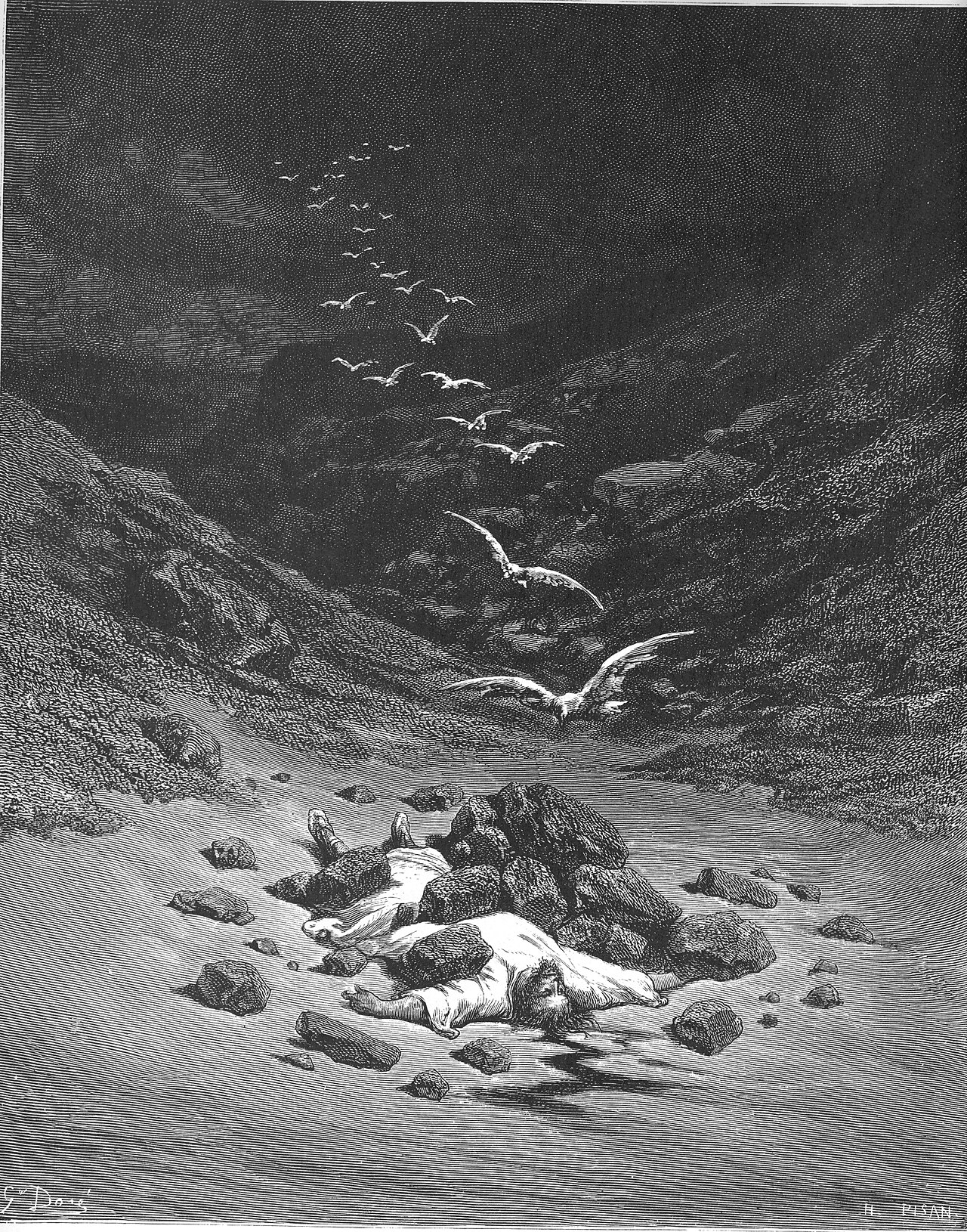
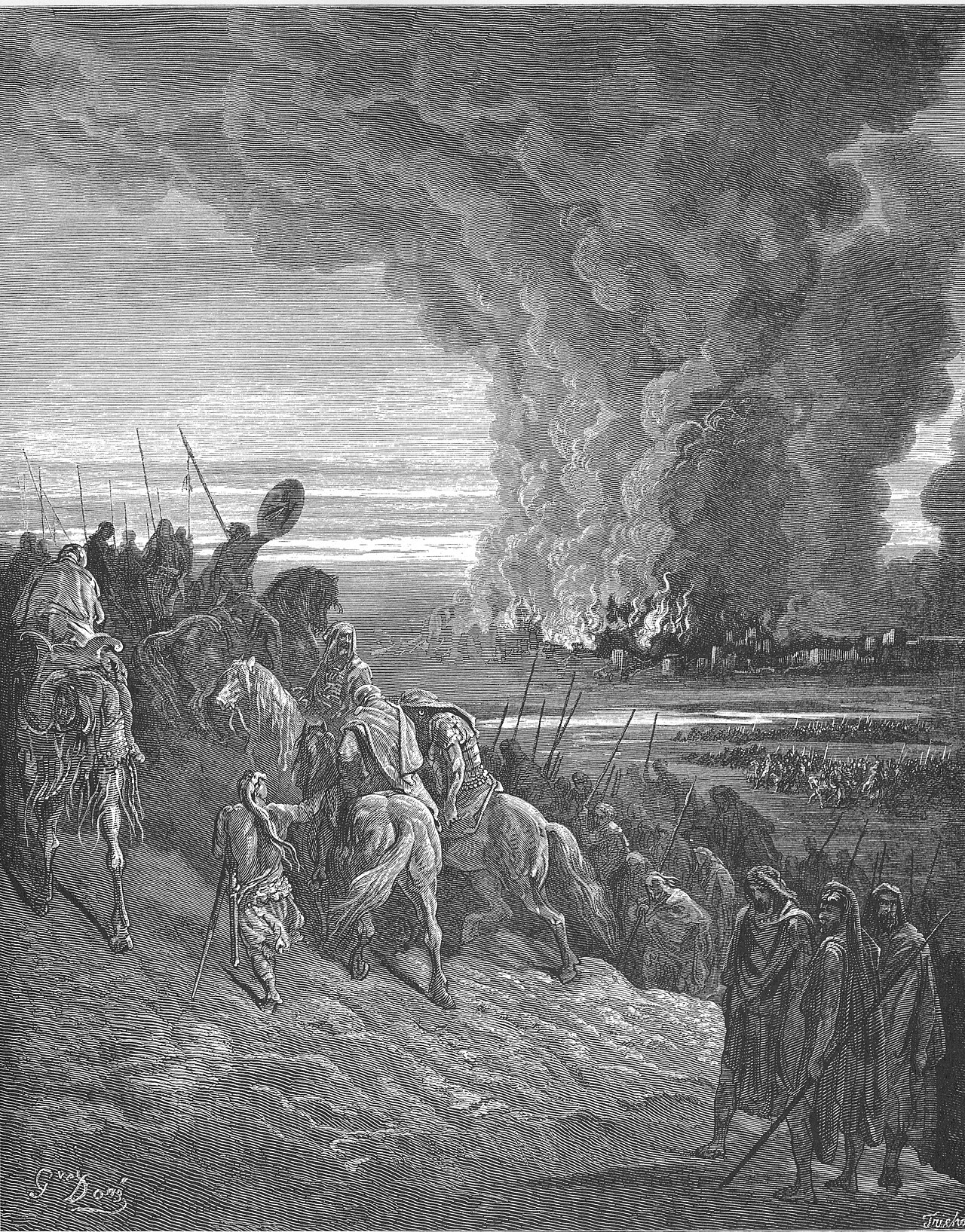
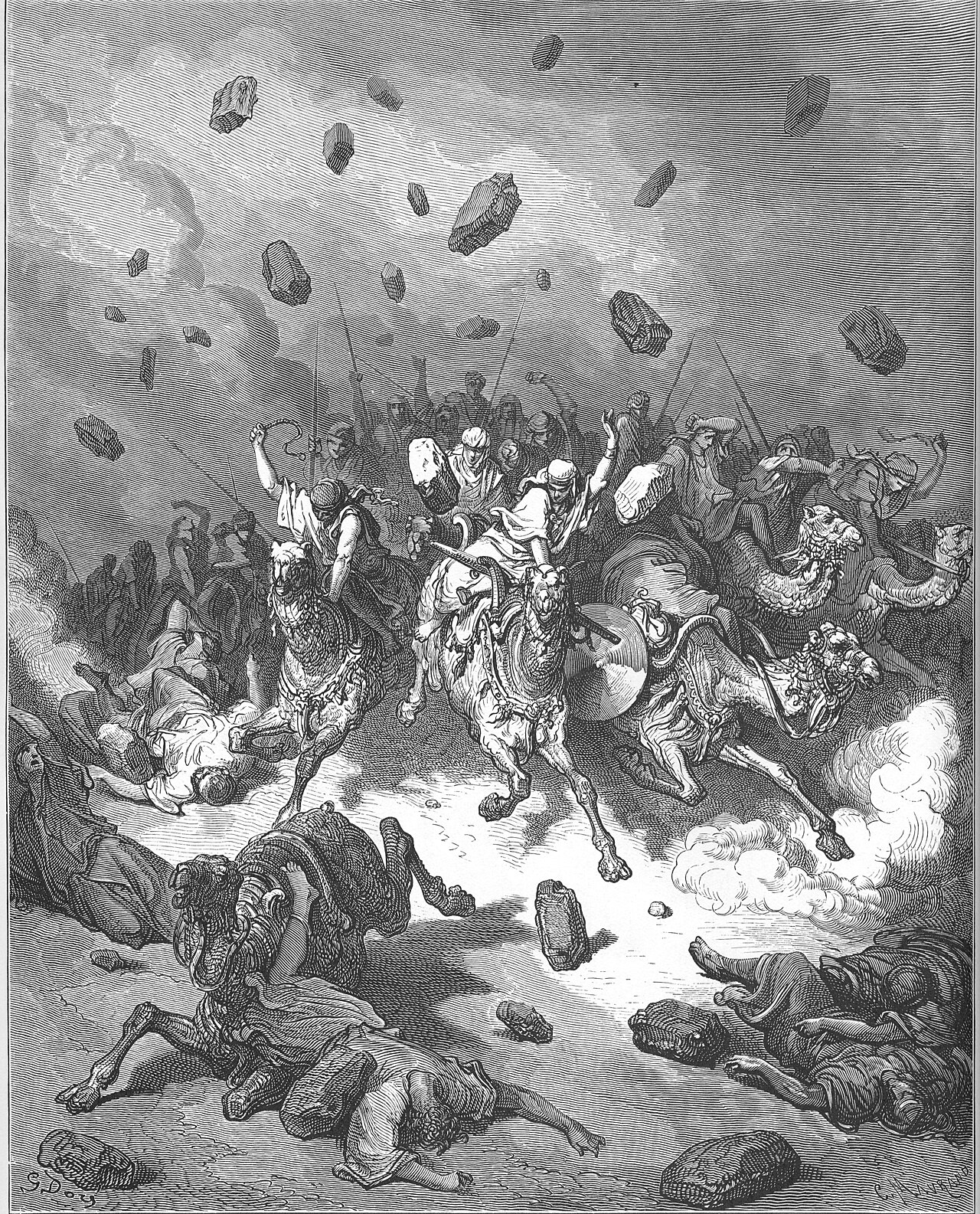
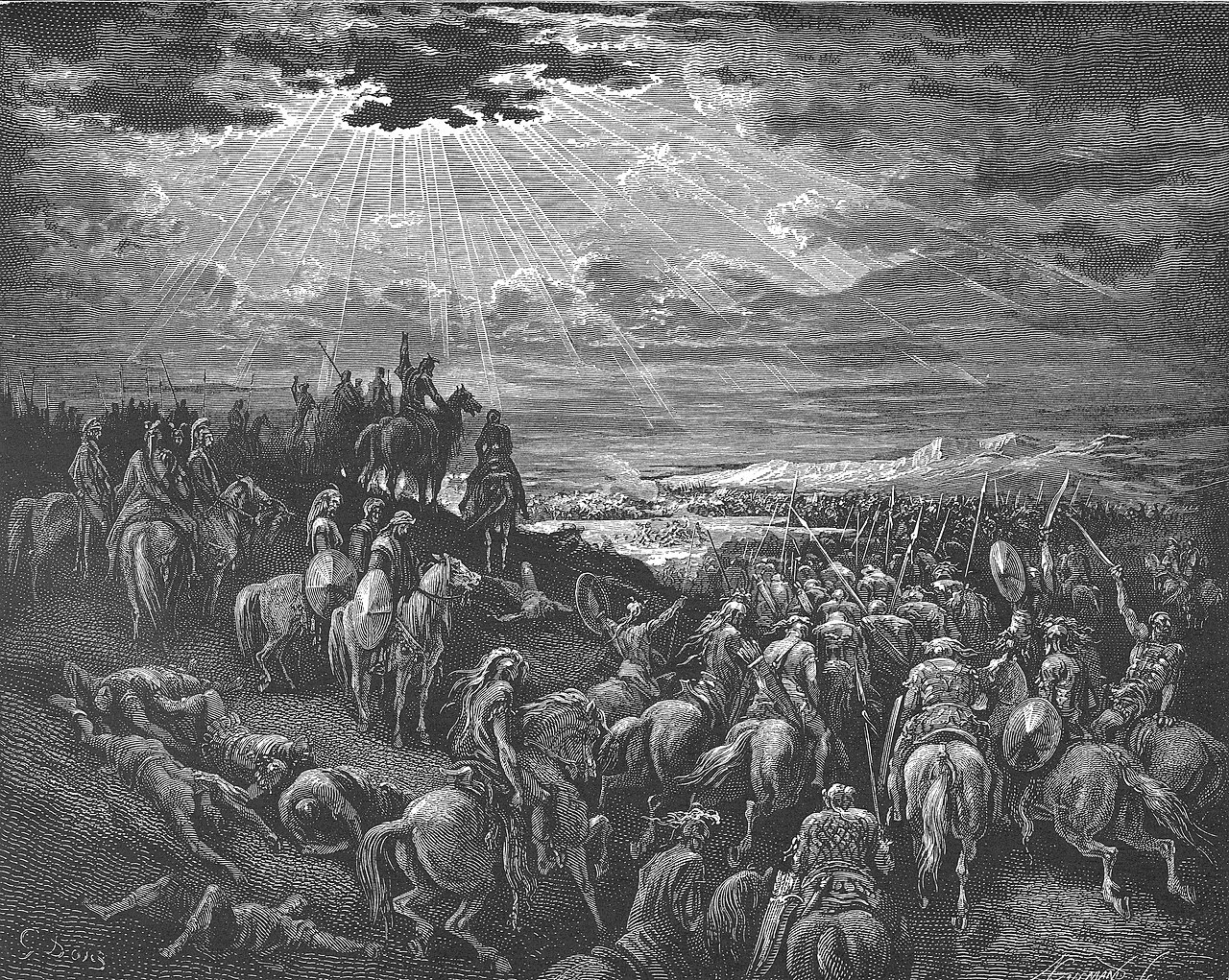
- Gustave Doré, The Holy Bible with Illustrations by Gustave Doré (1866)Plates 041b and 044 to 051 on this page, covering the spy report, the Jordan, Jericho, Achan, Ai and the day at Gibeon. Public domain.
- Charles H. Spurgeon, The Metropolitan Tabernacle PulpitSermon no. 1214, Strengthening Medicine For God's Servants (1875), quoted on Joshua 1:5. He also preached sermon no. 796 on Joshua's obedience and sermon no. 1229 on the choice at Shechem. Public domain, CCEL edition.
- Matthew Henry, Commentary on the Whole Bible (1710)Quoted on Numbers 13:16 for the two names, and reported on Joshua 11:23 for the rest that remains and on Joshua 24:31 for what held after his death. Public domain.
- John Wesley, Explanatory Notes upon the Old Testament (1765)Quoted on Joshua 9:14, and reported on Joshua 3:15 for the barley harvest that dates the crossing. Public domain.
- Adam Clarke, Commentary on the Bible (1832)Quoted on Joshua 5:13, and reported on Numbers 13:16, Joshua 10:12, Joshua 24:30 and Hebrews 4:8. Public domain.
- Albert Barnes, Notes, Explanatory and Practical, on the Old and New Testaments (1832-1869)Quoted on Hebrews 4:8, and reported on Joshua 3:15 for the flooded river and Joshua 10:12 for the readings of the long day. The work was published across nearly forty years, so a single year is not printed. Public domain.
- Jamieson, Fausset & Brown, Commentary Critical and Explanatory on the Whole Bible (1871)Reported on Joshua 24:29 for the computations of how long Joshua led, and on Joshua 10:12-15 for the reading of his command as a prayer. Public domain.
- Origen of Alexandria, Homilies on JoshuaHomily 6.2 quoted on Joshua 5:14, with homilies 6.3, 6.4 and 7.5 reported on the holy ground, the trumpets and Rahab. Preached at Caesarea and preserved in Rufinus's Latin translation. Named by century, since the delivery dates are not established. Public domain translation.
- Adam Zertal and the Manasseh Hill Country Survey, with Aharon Kempinski's responseThe site on Mount Ebal located in 1980 and excavated from 1982 to 1989; Kempinski's Joshua's Altar: An Iron Age I Watchtower in Biblical Archaeology Review, January and February 1986, with Zertal's reply in the same issue.
- The Mount Ebal lead object, 2022, and the responses to itScott Stripling and colleagues in Heritage Science, 2022; Aren Maeir and Christopher Rollston, The So-Called Mount Ebal Curse Tablet: A Critical Response, in the Israel Exploration Journal, one of three replies. The reading of the object is disputed and this page carries it as disputed.
- Babylonian Talmud, Megillah 14bThe tradition that Rahab converted and married Joshua. The Babylonian Talmud was completed between about AD 500 and 600. Carried as reception history with its source named, never as biography.
- Ben Sira, called Ecclesiasticus, chapter 46, in the site's apocrypha collectionThe earliest extended portrait of Joshua outside the Bible, written in the second century BC, and the source Barnes cites for an early literal reading of the long day. A labelled study resource, never presented as Scripture.
- Victor Guerin's descriptions of Khirbet Tibnah, 1863 and 1870The traveller's account behind the identification of Timnath-serah with Khirbet Tibnah. An excavation began at the site in 2022 and no findings are reported here.
- The Joshua study guide on this siteThe book itself, the fourfold campaign, the archaeology of Jericho, Ai and Hazor, the conquest date, the Amarna letters, the models of Israel's arrival, the ethics of the conquest, and the Hebrew words. This page defers to it on every question of book, date and archaeology.
Keep studying
On this page
Studies15
Every page that names them1
Books14
Doorway1
Keep this page