
Joshua 6 to 8 · Subject · Featured Study
The devoted thing (herem)
The Law of Moses used herem for a thing given wholly to the LORD, and Israel carried out the ban from Hormah in the Negev to Saul's war on Amalek.
Joshua told Israel that Jericho and everything in it must be devoted to the LORD, and that only Rahab and those in her house would live.
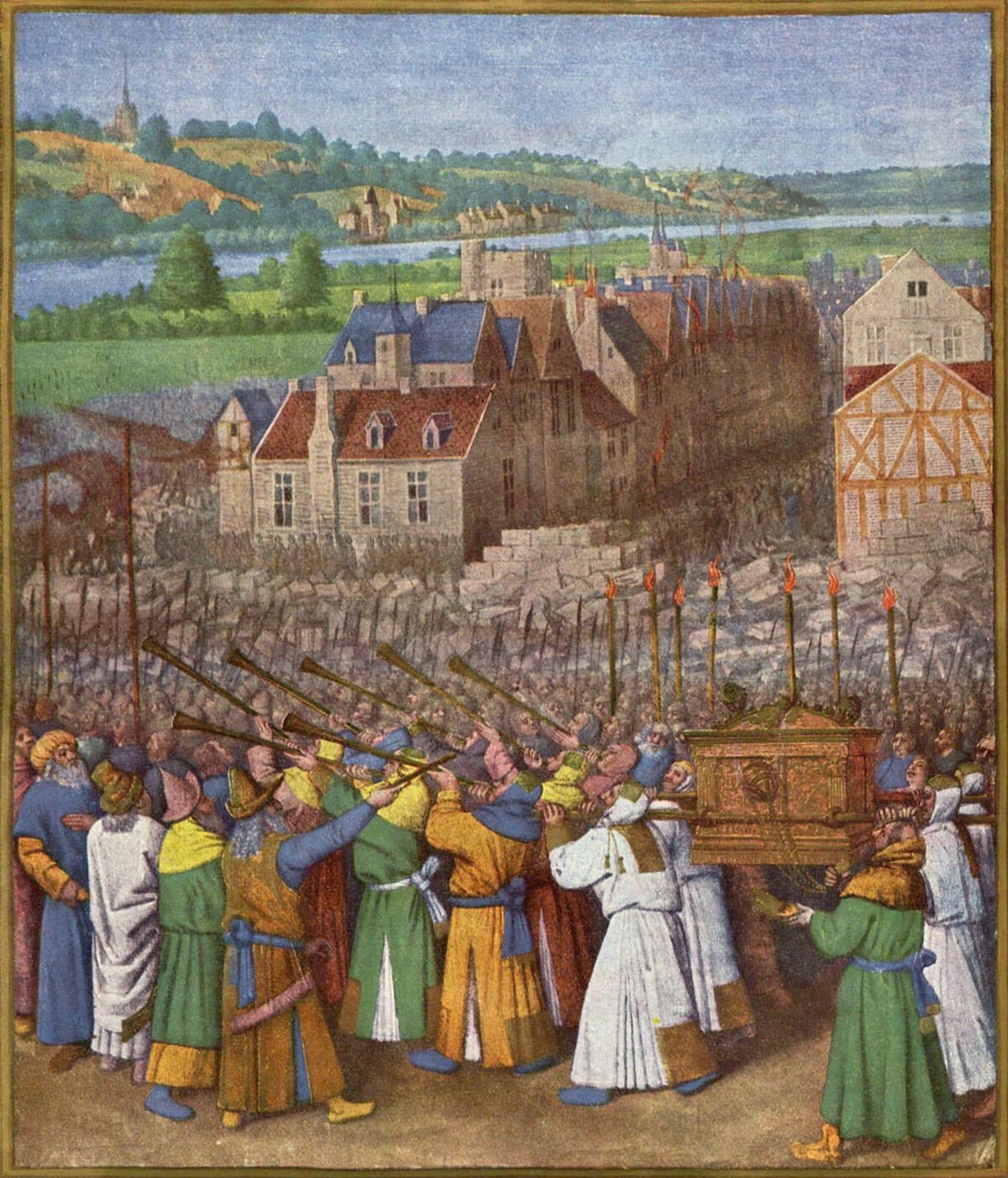
Jean Fouquet, The Taking of Jericho, miniature in Flavius Josephus, Antiquités judaïques, about 1470 to 1475, Paris, Bibliothèque nationale de France, Français 247, folio 89. Public domain (published before 1930), via Wikimedia Commons, File:Jean_Fouquet_001.jpg.
THE ARTWORKFouquet painted the priests bearing the ark and the trumpeters sounding their horns as the wall of Jericho lies in ruins, and he set fire on the roofs beyond it. Joshua 6:24 says that Israel burned the city and everything in it, so the painting shows the first city of Canaan given over to the ban.
Summary
Herem is the Hebrew word for a thing devoted, which belonged to the LORD alone and could never be taken back.
- In Leviticus 27 a man, an animal or a field set apart to the LORD was most holy, and it could not be sold or redeemed.
- A person or a city devoted to destruction could not be ransomed, and Deuteronomy 20:18 gives the reason for the ban on the cities of Canaan.
- At Ai the LORD let Israel keep the livestock and plunder, and at Amalek Saul lost his throne for sparing what was devoted.
- Rahab's household and the Gibeonites were spared, and the same law fell on any Israelite town that served other gods.
The Two Senses in the Law
Leviticus, Numbers and Deuteronomy use one word for a gift given wholly to the LORD and for a people given over to destruction.
The Hebrew noun herem names a thing devoted to the LORD, and the verb haram means to devote it.
Nothing that a man sets apart to the LORD from all he owns—whether a man, an animal, or his inherited land—can be sold or redeemed; everything so devoted is most holy to the LORD.This verse gives the first sense, a man's own possession given to the LORD, which became most holy and could never be redeemed.
No person set apart for destruction may be ransomed; he must surely be put to death.The next verse gives the second sense, a person set apart for destruction, for whom no ransom could be paid.
However, in the cities of the nations that the LORD your God is giving you as an inheritance, you must not leave alive anything that breathes. For you must devote them to complete destruction—the Hittites, Amorites, Canaanites, Perizzites, Hivites, and Jebusites—as the LORD your God has commanded you, so that they cannot teach you to do all the detestable things they do for their gods, and so cause you to sin against the LORD your God.Moses names the six nations to be devoted to destruction, and verse 18 gives the reason, that they would teach Israel the detestable things they did for their gods.
Deuteronomy 7:2 gives the same command for the seven nations of Canaan and forbids any treaty with them. A city far away was first offered peace, and only a city that refused it was besieged (Deuteronomy 20:10 to 15).
The devoted fieldLeviticus 27:21 and Numbers 18:14
When the field is released in the Jubilee, it will become holy, like a field devoted to the LORD; it becomes the property of the priests.This verse shows the first sense at work in the law of land, since a field its owner left unredeemed passed to the priests at the Jubilee.
Every devoted thing in Israel belongs to you.The LORD gives every devoted thing to Aaron and his sons, so a devoted gift went to the priests of Israel.
Matthew Henry explains why a devoted thing passed beyond the giver's reach.
“They were of the same nature with those sacrifices which were called most holy, which none might touch but only the priests themselves. The difference between these and other sanctified things arose from the different expression of the vow.”
Matthew Henry · Commentary on the Whole Bible · on Leviticus 27:28Puritan
The ban on an Israelite townDeuteronomy 13:12 to 17 and Exodus 22:20
you must surely put the inhabitants of that city to the sword. Devote to destruction all its people and livestock. And you are to gather all its plunder in the middle of the public square, and completely burn the city and all its plunder as a whole burnt offering to the LORD your God. The city must remain a mound of ruins forever, never to be rebuilt.The law of the ban turns here on Israel itself, on any town of Israel led away to serve other gods.
Exodus 22:20 had already set apart for destruction anyone who sacrificed to another god. John Wesley, on Deuteronomy 13:15, held it just that a town which made itself equal to the Canaanites in sin should be equal to them in punishment.
Where the Ban Fell
The text puts eleven cities under the ban, from Hormah in the Negev to Hazor in the north, and Gibeon made peace and lived.
Jericho, Ai, Lachish and Hebron stand on the plate, and the key gives each city with its verse.
- Located: the site is known
- Proposed: one candidate among several
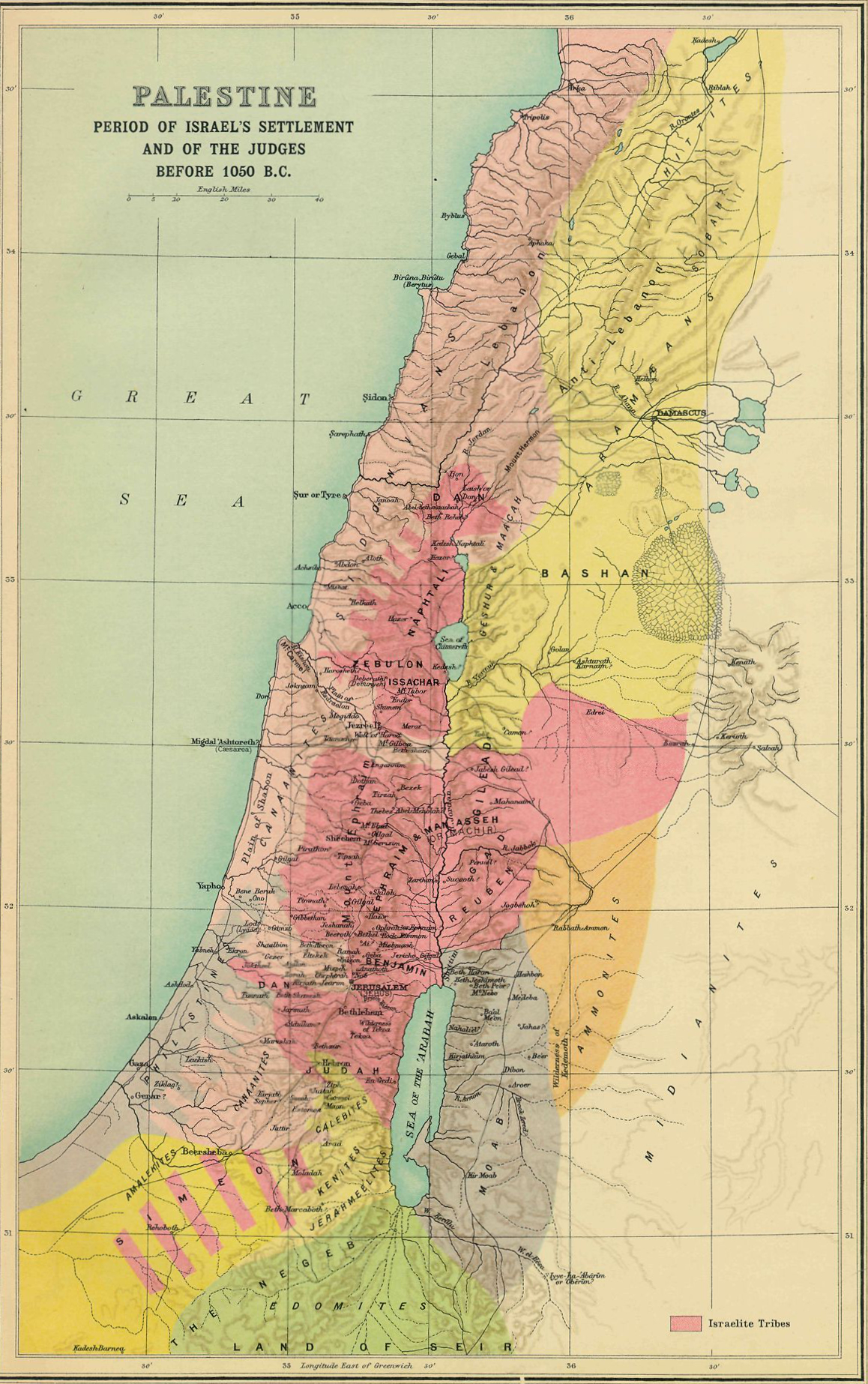
about 50 km (31 miles)
- 1Hormah, Israel devoted the Canaanite cities and named the place Hormah. Numbers 21:3
- 2Jericho, The city and everything in it were devoted. Joshua 6:17
- 3Ai, All who lived in Ai were devoted. Joshua 8:26
- 4Makkedah, Joshua took it with its king and left no survivors. Joshua 10:28
- 5Libnah, The LORD gave it and its king into the hand of Israel. Joshua 10:30
- 6Lachish, Joshua captured it on the second day. Joshua 10:32
- 7Eglon, Israel captured it in a single day. Joshua 10:35
- 8Hebron, Joshua devoted Hebron and everyone in it. Joshua 10:37
- 9Debir, Israel captured it with its king and its villages. Joshua 10:39
- 10Hazor, Joshua burned it, the only city of the north he burned. Joshua 11:11 to 13
- 11Jabesh-gilead, The congregation devoted it for sending no one to Mizpah. Judges 21:11
- 12Gibeon (spared), Joshua made a treaty of peace with it. Joshua 9:15
Not placed: Hormah (1), Makkedah (4), Libnah (5), Eglon (7), Debir (9), Hazor (10), Jabesh-gilead (11), Gibeon (spared) (12).
Base map: Israel's settlement and the period of the Judges, George Adam Smith, Atlas of the Historical Geography of the Holy Land (1915), public domain. Each place stands at its place page's coordinates, set on the plate by Jerusalem and Damascus, as the plate prints them.
The plate is George Adam Smith's map of the settlement and the judges, printed in 1915.
The Cases, One by One
Israel carried out the ban in eight recorded cases from Numbers 21 to 1 Samuel 15.
| Case | What was devoted | Spared or kept |
|---|---|---|
| Hormah, Numbers 21:1 to 3 | The cities of the king of Arad, by Israel's vow | None named |
| Jericho, Joshua 6:17 to 24 | The city, its people and its oxen, sheep and donkeys | Rahab's household; the metals, given to the LORD's treasury |
| Achan, Joshua 7:24 to 25 | Achan, his sons and daughters and all he had | None |
| Ai, Joshua 8:26 to 27 | All who lived in the city | The livestock and plunder, by the LORD's leave |
| The southern cities, Joshua 10:28 to 40 | Makkedah, Libnah, Lachish, Eglon, Hebron and Debir, with their people | None named |
| Hazor and the north, Joshua 11:11 to 14 | The people of Hazor and of the cities of the northern kings | The plunder and livestock; the cities on their mounds |
| Jabesh-gilead, Judges 21:10 to 12 | Every male, and every woman who had been with a man | Four hundred young women, brought to Shiloh |
| Amalek, 1 Samuel 15:3 to 9 | All that belonged to Amalek, by the LORD's command | Agag and the best animals, kept by Saul against the command |
Jericho, the first cityJoshua 6:18 to 19
But keep away from the things devoted to destruction, lest you yourself be set apart for destruction. If you take any of these, you will set apart the camp of Israel for destruction and bring disaster upon it. For all the silver and gold and all the articles of bronze and iron are holy to the LORD; they must go into His treasury.”Joshua warns that anyone who took a devoted thing would bring the ban on the whole camp, and he sends the metals to the LORD's treasury.
Albert Barnes, in his Notes on Joshua 6:17, held that Jericho was devoted as firstfruits to God, a token that Israel received the whole land from Him.
Achan and the Valley of AchorJoshua 7:1 to 26, 1 Chronicles 2:7 and Hosea 2:15
Israel has sinned; they have transgressed My covenant that I commanded them, and they have taken some of what was devoted to destruction. Indeed, they have stolen and lied, and they have put these things with their own possessions. This is why the Israelites cannot stand against their enemies. They will turn their backs and run from their enemies, because they themselves have been set apart for destruction. I will no longer be with you unless you remove from among you whatever is devoted to destruction.The LORD counts Achan's theft as the sin of Israel and says that Israel itself had been set apart for destruction until the devoted things were removed.
Adam Clarke, on Joshua 7:12, drew the rule from this verse: whoever took a thing doomed to destruction fell under the same condemnation. Joshua asked Achan why he had brought trouble on Israel, and the place was named the Valley of Achor. Clarke notes the play on achar, to trouble, and 1 Chronicles 2:7 names the man Achar, who brought trouble upon Israel by violating the ban on devoted things.
“But also we should not let it be passed over without comment that by one sinner wrath comes upon all the people.…But let us also see what sort of sin this person did. He stole, it says, ‘a tongue of gold’ and placed it in his own tent. I do not think so great a force of sin was in that theft of a little gold that it defiled the innumerable church of the Lord. But let us see if a deeper understanding does not reveal the enormity and severity of the sin.”
Origen of Alexandria · Homilies on Joshua 7.6-7 · on Joshua 7:1Patristic
There I will give back her vineyards and make the Valley of Achor into a gateway of hope. There she will respond as she did in the days of her youth, as in the day she came up out of Egypt.Hosea turns the valley named for Achan's trouble into a promise, so the place of the ban becomes a gateway of hope.
Ai, where the spoil was givenJoshua 8:2 and 8:27
And you shall do to Ai and its king as you did to Jericho and its king, except that you may carry off their plunder and livestock for yourselves. Set up an ambush behind the city.”The command comes straight after Achan was stoned, so the change for Ai follows at once on the cost of Jericho.
John Gill notes on this verse that Israel had not been allowed the spoil at Jericho.
Brown, Driver and Briggs observe that when a city was devoted its people were put to death, and the spoil was destroyed or kept according to the gravity of the occasion.
Hormah and Jabesh-gileadJudges 1:17 and 21:11
Then the men of Judah went with their brothers the Simeonites, attacked the Canaanites living in Zephath, and devoted the city to destruction. So it was called Hormah.Judah and Simeon devoted Zephath to destruction, and it took the name Hormah, as the place of Numbers 21:3 had.
Albert Barnes reads the name Hormah as Ban, and he takes Judges 1:17 as the destruction vowed in Numbers 21:2, now carried out.
This is what you are to do: Devote to destruction every male, as well as every female who has had relations with a man.”The congregation turns the ban on an Israelite town because none of its men had come to the assembly at Mizpah.
Saul and Amalek1 Samuel 15:1 to 33
Now go and attack the Amalekites and devote to destruction all that belongs to them. Do not spare them, but put to death men and women, children and infants, oxen and sheep, camels and donkeys.’”Samuel gives Saul the full ban on Amalek, for the ambush of Israel on the way up from Egypt that verse 2 recalls.
But Samuel declared: “Does the LORD delight in burnt offerings and sacrifices as much as in obedience to His voice? Behold, obedience is better than sacrifice, and attentiveness is better than the fat of rams.Samuel answers Saul's plea of sacrifice and sets obedience to the voice of the LORD above it.
Saul spared Agag and the best of the sheep and cattle, and he destroyed only what was despised and worthless. When Samuel confronted him, he said the troops had spared the animals for sacrifice.
“There is something thoroughly mean in his attempt to shift the responsibility of what was done from his own kingly shoulders to those of the people. Every word uttered by Saul seems to indicate the breaking down of his moral character.”
Albert Barnes · Notes, Explanatory and Practical, on the Old and New Testaments (1832-1869) · on 1 Samuel 15:15Evangelical
Who Was Spared
Rahab's household lived at Jericho, and the Hivites of Gibeon lived by a treaty sworn in the LORD's name.
And Joshua spared Rahab the prostitute, with her father’s household and all who belonged to her, because she hid the men Joshua had sent to spy out Jericho. So she has lived among the Israelites to this day.Joshua kept the promise the spies had made to her, so the ban on Jericho did not reach her house (Joshua 6:22).
No city made peace with the Israelites except the Hivites living in Gibeon; all others were taken in battle.Gibeon alone among the cities made peace, and the next verse says the others were hardened to meet Israel in battle.
The Gibeonites won their treaty by deceit, telling Joshua that they came from a distant land. They had heard that the LORD commanded Moses to wipe out all the inhabitants of the land (Joshua 9:24). The leaders had sworn an oath to them by the LORD, so Israel let them live and made them woodcutters and water carriers (Joshua 9:19 to 21).
Terms the other cities could have hadJoshua 11:19 to 20
“It is intimated that other cities might have made as good terms for themselves, without ragged clothes and clouted shoes, if they would have humbled themselves, but they never so much as desired conditions of peace. We here are told whence this unaccountable infatuation came: It was of the Lord to harden their hearts,”
Matthew Henry · Commentary on the Whole Bible · on Joshua 11:19Puritan
Rahab and the exception to the commandJoshua 6:22 to 25
John Wesley, on Joshua 6:25, took Rahab as a sign that the command against the Canaanites had an exception for any who cast off their wickedness and submitted to Israel. Matthew Henry joins her rescue to the faith that Hebrews 11:31 praises.
“The preservation of Rahab the harlot, or inn-keeper, who perished not with those that believed not, Heb. xi. The public faith was engaged for her safety by the two spies, who acted therein as public persons; and therefore, though the hurry they were in at the taking of the town was no doubt very great, yet Joshua took effectual care for her preservation.”
Matthew Henry · Commentary on the Whole Bible · on Joshua 6:24Puritan
The Kenites at Amalek1 Samuel 15:6
And he warned the Kenites, “Since you showed kindness to all the Israelites when they came up out of Egypt, go on and get away from the Amalekites. Otherwise I will sweep you away with them.” So the Kenites moved away from the Amalekites.The Kenites stand beside Rahab and Gibeon as a third people kept from a ban, spared at Amalek for the kindness they had shown Israel.
The Word on the Moabite Stone
Mesha, king of Moab, used the same verb for his own war on an Israelite town.
Mesha is the king of Moab who rebelled against the king of Israel after the death of Ahab (2 Kings 3:4 to 5). His inscription, commonly known as the Moabite Stone, tells how his god Chemosh sent him to take Nebo from Israel.
In S. R. Driver's translation, Mesha says that he slew the whole town, seven thousand men and male sojourners, women and female sojourners, and female slaves, for he had devoted it to Ashtor-Chemosh.
The lines of the inscriptionLines 14 to 18, in Driver's numbering
Brown, Driver and Briggs cite line 17 of the inscription in their entry for the verb haram.
| Line | What Mesha says | Joshua |
|---|---|---|
| 14 | Chemosh said to him, Go, take Nebo against Israel. | Joshua 8:1 |
| 15 | He went by night and fought against the town from the break of dawn until noon. | Joshua 8:3 |
| 17 to 18 | He took the vessels of Yahweh and dragged them before Chemosh. | Joshua 6:24 |
The Words of the Ban
Two Hebrew words and one Greek word carry the subject.
HEREM
The noun means a thing devoted, and Brown, Driver and Briggs give it two senses: a thing given to the LORD, and the ban that gave a thing over to destruction.
HARAM
The verb stands in the causative stem, the Hiphil, and means to devote or to put under the ban. It is the verb of the command in Deuteronomy and of the cities of Joshua 10 and 11.
ANATHEMA
The Septuagint renders herem by the Greek anathema, a thing devoted, and Paul takes up the word when he wishes himself cut off from Christ for Israel's sake.
The word in Ezra and the prophetsEzra 10:8, Zechariah 14:11 and Malachi 4:6
Whoever failed to appear within three days would forfeit all his property, according to the counsel of the leaders and elders, and would himself be expelled from the assembly of the exiles.The Berean word forfeit renders the verb here, and Brown, Driver and Briggs read it of property given over to the temple treasury.
People will live there, and never again will there be an utter destruction. So Jerusalem will dwell securely.Zechariah sees a Jerusalem on which the ban will never fall again, and the Berean text renders the noun as utter destruction.
And he will turn the hearts of the fathers to their children, and the hearts of the children to their fathers. Otherwise, I will come and strike the land with a curse.”Malachi closes with the ban held over the land unless the hearts of fathers and children turn, and the word the Berean text gives as curse is herem.
What the Text Leaves Unsaid
The text is silent on three matters of the ban at Jericho and Ai.
Joshua 6 gives no count of the dead at Jericho, while Joshua 8:25 counts twelve thousand at Ai. Joshua 8:2 gives the LORD's leave to keep the spoil of Ai, and the text gives no reason why the spoil of Jericho was barred.
Joshua 7:21 says the goods were hidden in the ground inside Achan's tent, and the text does not say whether his household knew of them.
What the Ban Taught Israel
Deuteronomy ties the ban to Israel's holiness and turns it on any Israelite who kept a detestable thing.
For you are a people holy to the LORD your God. The LORD your God has chosen you to be a people for His prized possession out of all peoples on the face of the earth.Moses grounds the ban in Israel's calling as a people holy to the LORD, chosen to be His prized possession.
And you must not bring any detestable thing into your house, or you, like it, will be set apart for destruction. You are to utterly detest and abhor it, because it is set apart for destruction.A man who brought a detestable thing into his house would himself be set apart for destruction, so the ban could fall on an Israelite.
The nations' wickedness and the promise to the fathersGenesis 15:16, Leviticus 18:24 to 25 and Deuteronomy 9:4 to 5
Genesis 15:16 told Abraham that the iniquity of the Amorites was not yet complete, and Leviticus 18:24 to 25 says the nations defiled the land by their practices. Deuteronomy 9:4 to 5 forbids Israel to credit its own righteousness, since the LORD drove the nations out for their wickedness and to keep His promise to Abraham, Isaac and Jacob.
Voices on the Devoted Thing
Origen of Alexandria and Matthew Henry each drew a lesson from the ban for the people of God.
Origen read the warning of Joshua 6:18 as a charge to keep the ways of the world out of the church.
“This is what is indicated by these words: Take heed that you have nothing worldly in you, that you bring down with you to the church neither worldly customs nor faults nor equivocations of the age. But let all worldly ways be anathema to you. Do not mix mundane things with divine; do not introduce worldly matters into the mysteries of the church.This is what John also sounds with the trumpet of his epistle, saying, ‘Do not love the world or the things that are in the world.’ And likewise Paul: ‘Do not,’ he says, ‘be conformed to this world.’”
Origen of Alexandria · Homilies on Joshua 7.4 · on Joshua 6:18Patristic
What Israel owed after the conquestJoshua 10:40
“When the heathen are to be cast out to make room for this vine ( Ps. lxxx. 8 ) divine justice appears more prodigal than ever of human blood, that the Israelites might find themselves for ever obliged to spend their lives to the glory of that God who had sacrificed so many of the lives of his creatures to their interest.”
Matthew Henry · Commentary on the Whole Bible · on Joshua 10:40Puritan
How the Totals of Joshua Are Read
Readers have taken the words leaving no survivors in Joshua 10 and 11 in three ways.
The words report what was doneJohn Gill; Jamieson, Fausset and Brown
John Gill, in his Exposition on Joshua 6:21 and Deuteronomy 20:16, held that the cities were destroyed for capital crimes such as idolatry and incest, when the measure of their iniquities was full.
“If they were to be swept away like the antediluvians or the people of Sodom and Gomorrah, as incorrigible sinners who had filled up the measure of their iniquities, it mattered not to them in what way the judgment was inflicted; and God, as the Sovereign Disposer, had a right to employ any instruments that pleased Him for executing His judgments.”
Jamieson, Fausset & Brown · Commentary Critical and Explanatory on the Whole Bible · on Deuteronomy 7:2 to 6Reformed
The objection rests on Joshua 10:20, where survivors retreated to the fortified cities, and on Joshua 11:22, which leaves Anakim in Gaza, Gath and Ashdod. It also rests on Joshua 13:1, where very much of the land remains to be possessed.
The words are the stock language of war reportsAdam Clarke; K. Lawson Younger Jr.; Paul Copan
Adam Clarke, on Joshua 10:40, held that those destroyed were the people found in arms who kept resisting, that those who submitted were spared, and that many escaped. On Deuteronomy 20:17 he proposed to read the command as utterly subdue, by slaying those who resisted or by driving them out of the land.
The debate page on the Canaanite conquest gives the modern form of this reading from K. Lawson Younger Jr., Ancient Conquest Accounts (1990), and from Paul Copan in his 2011 book Is God a Moral Monster?
The objection rests on Deuteronomy 20:16, which forbids Israel to leave alive anything that breathes, and on Joshua 6:21, which names man and woman, young and old.
A softer reading leaves the moral question standingEric A. Seibert; Randal Rauser
The same debate page sets out the reading of Eric A. Seibert, The Violence of Scripture (2012), that the portrayals of God commanding these killings do not represent His character. It gives Randal Rauser, in Philosophia Christi 11.1 (2009), as arguing that forcibly clearing a people under threat of destruction is still what modern usage calls ethnic cleansing.
The objection rests on Rahab and the Gibeonites, spared in the same chapters, and on Deuteronomy 9:5, which grounds the conquest in the wickedness of the nations.
Christ Became a Curse for Us
Galatians 1 and 3 and Revelation 22 tell of the curse pronounced, borne and ended.
Paul uses the Septuagint's word for the ban when he says that anyone who preaches a gospel contrary to the one he preached is under a curse (Galatians 1:8 to 9).
So the ban asks the reader to give God all that is His, where Achan took some of what was devoted, and to see the curse a sinner deserves carried by Christ.
Christ redeemed us from the curse of the law by becoming a curse for us. For it is written: “Cursed is everyone who is hung on a tree.”Paul quotes Deuteronomy 21:23 on the man hung on a tree, the death Joshua gave the king of Ai at Joshua 8:29, and says Christ became that curse for us.
No longer will there be any curse. The throne of God and of the Lamb will be within the city, and His servants will worship Him.John sees the city where God's servants worship Him and the curse is gone for ever.
Keep studying
Studies8
Doctrines8
Peoples and groups2