
Exodus 28 · Numbers 27 · 1 Samuel 28 · Subject · Featured Study
The Urim and Thummim and Inquiring of the LORD
The objects in the high priest's breastpiece, from Aaron's ordination at Sinai to the governor's order on the priests in Jerusalem.
On the night before his last battle Saul asked the LORD for an answer, and none came by dreams or Urim or prophets.
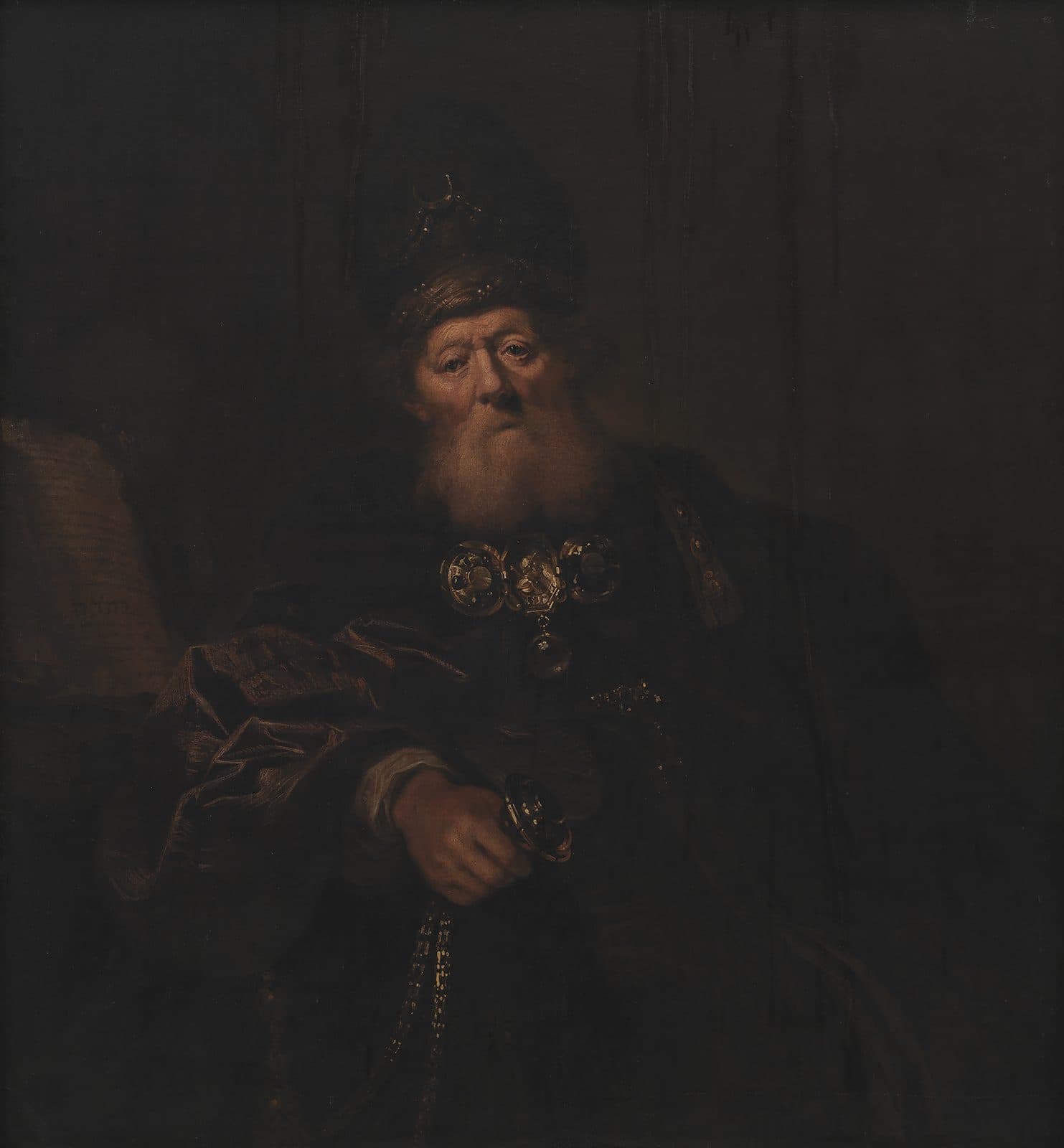
Karel van Mander III, Aaron as High Priest, between 1624 and 1670, Statens Museum for Kunst, Copenhagen. Public domain by date (painted before 1930), via Wikimedia Commons.
THE ARTWORKVan Mander painted Aaron in the dress of the high priest, with a breastplate of gold settings over his heart. Exodus 28:30 places the Urim and Thummim in the breastpiece, so that they are over Aaron's heart whenever he comes before the LORD.
Summary
The Urim and Thummim were objects the high priest carried in the breastpiece of judgment, by which Israel sought counsel from the LORD.
- Exodus 28 places them in the breastpiece that Aaron wore before the LORD.
- Joshua was to receive the LORD's counsel through Eleazar the priest by the judgment of the Urim.
- In the Berean text of 1 Samuel 14:41, Saul asks the LORD to respond with Urim or with Thummim.
- After the exile the governor waited for a priest who could consult them, and no later verse names one.
Six Verses on the Urim
The breastpiece, the ordination, Joshua, Levi, Saul and the return
Four of the six verses are in the books of Moses, and two in the history after them, from Saul to the return from Babylon.
And place the Urim and Thummim in the breastpiece of judgment, so that they will also be over Aaron’s heart whenever he comes before the LORD. Aaron will continually carry the judgment of the sons of Israel over his heart before the LORD.Every later mention of the Urim looks back to this command.
Then he put the breastpiece on him and placed the Urim and Thummim in the breastpiece.Moses does at Aaron's ordination what Exodus 28 commanded.
He shall stand before Eleazar the priest, who will seek counsel for him before the LORD by the judgment of the Urim. At his command, he and all the Israelites with him—the entire congregation—will go out and come in.”Joshua receives the LORD's counsel through the priest, where Moses heard the LORD directly.
Concerning Levi he said: “Give Your Thummim to Levi and Your Urim to Your godly one, whom You tested at Massah and contested at the waters of Meribah.Moses gives the Thummim and Urim to Levi in his last blessing.
He inquired of the LORD, but the LORD did not answer him by dreams or Urim or prophets.Saul's last inquiry meets silence by every means the LORD had used.
The governor ordered them not to eat the most holy things until there was a priest to consult the Urim and Thummim.The returned priests' claim to office hangs on an answer from the Urim.
From Joshua to the Return
The command, seven inquiries and the wait, each with its verse
- Eleazar for JoshuaThe priest seeks counsel by the judgment of the Urim, Numbers 27:21
- The Israelites after JoshuaThey ask who will go up first, and the LORD answers Judah, Judges 1:1
- The Israelites at BethelPhinehas serves before the ark, and the LORD answers Fight, Judges 20:28
- Saul at nightSaul inquires of God and God does not answer him that day, 1 Samuel 14:37
- Saul and the lotSaul asks for Urim or Thummim, and Jonathan and Saul are selected, 1 Samuel 14:41
- David at KeilahThe LORD tells David that Saul will come down to the city, 1 Samuel 23:11
- Saul before GilboaNo reply comes on the eve of the battle with the Philistines, 1 Samuel 28:6
- David at ZiklagDavid is told to pursue the raiders who took the captives, 1 Samuel 30:8
- The governor of JudahPriests without records wait for a priest with Urim and Thummim, Ezra 2:63
A sequence of nine verses on seeking the LORD's counsel in canon order, from the command for Joshua to the wait after the exile, each with who is named and its verse.
From the Breastpiece to the Silence
The law of Moses, the days of the judges, Saul and David, and the return
After 1 Samuel 28 no verse names the Urim again until the return from exile in Ezra.
The breastpiece of judgmentExodus 28:15 to 16 and 29
You are also to make a breastpiece of judgment with the same workmanship as the ephod. Construct it with gold, with blue, purple, and scarlet yarn, and with finely spun linen. It must be square when folded over double, a span long and a span wide.These are the measures of the piece that would hold the Urim.
Whenever Aaron enters the Holy Place, he shall bear the names of the sons of Israel over his heart on the breastpiece of judgment, as a continual reminder before the LORD.Aaron carries the tribes' names over his heart beside the Urim and Thummim.
Rashi says the breastpiece was named for judgment because it made its statements clear and its promise true.
The judges ask the LORDJudges 1:1 to 2 and 20:27 to 28
After the death of Joshua, the Israelites inquired of the LORD, “Who will be the first to go up and fight for us against the Canaanites?” “Judah shall go up,” answered the LORD. “Indeed, I have delivered the land into their hands.”Judges opens with an answer from the LORD.
And the Israelites inquired of the LORD. (In those days the ark of the covenant of God was there, and Phinehas son of Eleazar, the son of Aaron, served before it.) The Israelites asked, “Should we again go out to battle against our brothers the Benjamites, or should we stop?” The LORD answered, “Fight, for tomorrow I will deliver them into your hand.”The LORD answers through a priest who is the grandson of Israel's first high priest.
Saul and David1 Samuel 14:41 to 42 and 23:9 to 11
The Berean text of 1 Samuel 14:41 follows the longer reading of the Greek and Latin versions, which Clarke reports from the Septuagint and the Vulgate.
So Saul said to the LORD, the God of Israel, “Why have You not answered Your servant this day? If the fault is with me or my son Jonathan, respond with Urim; but if the fault is with the men of Israel, respond with Thummim.” And Jonathan and Saul were selected, but the people were cleared of the charge. Then Saul said, “Cast the lot between me and my son Jonathan.” And Jonathan was selected.Saul's prayer is followed by the casting of lots between him and Jonathan.
When David learned that Saul was plotting evil against him, he said to Abiathar the priest, “Bring the ephod.” And David said, “O LORD, God of Israel, Your servant has heard that Saul intends to come to Keilah and destroy the city on my account. Will the citizens of Keilah surrender me into his hand? Will Saul come down, as Your servant has heard? O LORD, God of Israel, please tell Your servant.” “He will,” said the LORD.The priest who escaped the slaughter at Nob serves David with the ephod.
The return from exileEzra 2:62
These men searched for their family records, but they could not find them and so were excluded from the priesthood as unclean.The governor's order in the next verse answers this case.
What the Text Says of the Urim
Three things often said, each with the verse that tests it
MADE AT SINAI
Exodus 28 gives the making of the breastpiece and its twelve stones, and tells Moses only to place the Urim and Thummim in it.
TWO ANSWERS
In the Berean text Saul asks for Urim if the fault is his and Thummim if it is the people's.
A GAME OF CHANCE
Proverbs says every decision of the lot comes from the LORD.
The Words of the Urim
Six Hebrew words from the lexicon, each in the verse where it stands
URIM, URIM (HEBREW, H224)
The STEP gloss gives simply the name Urim, the first of the two objects Moses places.
TUMMIM, THUMMIM (HEBREW, H8550)
Strong's gloss gives perfections, an emblem of complete truth, a word the lexicon counts 5 times.
CHOSHEN, BREASTPIECE (HEBREW, H2833)
Strong's gloss gives perhaps a pocket holding the Urim and Thummim, used only of the high priest's piece.
MISHPAT, JUDGMENT (HEBREW, H4941)
Strong's gloss gives a verdict pronounced judicially, the word that names the breastpiece of judgment.
EPHOD, EPHOD (HEBREW, H646)
Strong's gloss gives the high priest's shoulder-piece, the garment David calls for at Keilah.
SHAAL, TO ASK (HEBREW, H7592)
The lexicon gives to inquire or request, the verb Saul uses when he inquires of the LORD.
What the Text Leaves Unsaid
Three questions the verses leave open
No verse describes the Urim and Thummim or says how an answer was read from them. Clarke wrote that what they were had never been discovered.
Then they tied the rings of the breastpiece to the rings of the ephod with a cord of blue yarn, so that the breastpiece was above the waistband of the ephod and would not swing out from the ephod, just as the LORD had commanded Moses.This verse ends the account of the high priest's dress in Exodus 39.
No verse records how or when the Urim and Thummim were lost.
For the Israelites must live many days without king or prince, without sacrifice or sacred pillar, and without ephod or idol.Hosea foretells many days for Israel without an ephod, and names no Urim.
David calls for the ephod at Keilah and at Ziklag, and the text there does not name the Urim.
Then David said to Abiathar the priest, the son of Ahimelech, “Bring me the ephod.” So Abiathar brought it to him, and David inquired of the LORD: “Should I pursue these raiders? Will I overtake them?” “Pursue them,” the LORD replied, “for you will surely overtake them and rescue the captives.”The ephod comes to David, and the answer follows his question.
The Son Through Whom God Speaks
Hebrews 1, and Henry's readings of Exodus 28 and Ezra 2
On many past occasions and in many different ways, God spoke to our fathers through the prophets. But in these last days He has spoken to us by His Son, whom He appointed heir of all things, and through whom He made the universe.The writer sets every earlier means of revelation beside the One who is now heir of all things.
Matthew Henry reads the Urim as a shadow fulfilled in Christ, through whom God makes Himself known.
“But it was a shadow of good things to come, and the substance is Christ. He is our oracle; by him God in these last days makes known himself and his mind to us, Heb. i. Divine revelation centres in him, and comes to us through him; he is the light, the true light, the faithful witness, the truth itself, and from him we receive the Spirit of truth, who leads into all truth.”
Matthew Henry · Commentary on the Whole Bible · on Exodus 28:30Puritan
On Ezra 2, Henry adds that the want of the oracle after the exile taught Israel to look for the Messiah.
“This, it seems, was expected and desired, but it does not appear that ever they were blessed with it under the second temple. They had the canon of the Old Testament complete, which was better than Urim; and, by the want of that oracle, they were taught to expect the Messiah the great Oracle, which the Urim and Thummim was but a type of.”
Matthew Henry · Commentary on the Whole Bible · on Ezra 2:59 to 60Puritan
Teachers on the Breastpiece and the Lot
Gregory the Great and Matthew Henry, each with the work named
Gregory the Great, known in the East as Gregory the Dialogist, wrote for bishops about 590 and reads the engraved names as a pastor's duty.
“On this breastplate it is further carefully prescribed that the names of the twelve patriarchs should be engraved. For to carry always the fathers registered on the breast is to think without intermission on the lives of the ancients. For the priest then walks blamelessly when he pores continually on the examples of the fathers that went before him, when he considers without cease the footsteps of the Saints, and keeps down unlawful thoughts, lest he advance the foot of his conduct beyond the limit of order.”
Gregory the Dialogist · The Book of Pastoral Rule, Part 2, Chapter 2 · on Exodus 28:29Patristic
Henry finds Christ's care for His people in the same names.
“How near should Christ's name be to our hearts, since he is pleased to lay our names so near his! and what a comfort it is to us, in all our addresses to God, that the great high priest of our profession has the names of all his Israel upon his breast before the Lord for a memorial, presenting them to God as the people of his choice, who were to be made accepted in the beloved!”
Matthew Henry · Commentary on the Whole Bible · on Exodus 28:29Puritan
Gregory ties Saul's lot to Jonah and to Matthias.
“Those who cast lots often discover hidden things through conjectures drawn from visible things. Thus indeed Jonah is identified while fleeing (Jon. 1); thus Matthias the Apostle is found worthy of apostolic eminence (Acts 1). We therefore cast spiritual lots when, through the outward signs of works, we arrive at knowledge of hidden things. For the lot of each person is his own manner of life.”
Gregory the Dialogist · Commentary on 1 Kings, Book 5, Chapter 4 · on 1 Samuel 14:42Patristic
Henry explains why the LORD gave Saul no answer before Gilboa.
“He did not enquire in faith, but with a double unstable mind. He enquired of the Lord when it was too late, when the days of his probation were over and he was finally rejected. Seek the Lord while he may be found, for there is a time when he will not be found.”
Matthew Henry · Commentary on the Whole Bible · on 1 Samuel 28:6Puritan
What the Urim and Thummim Were
Three readings, each with its case and the strongest objection
Two lots, each standing for one answerThe Septuagint translators, whose longer text of 1 Samuel 14:41 the Berean text prints
This reading takes the Urim and the Thummim as two objects, each standing for one answer, drawn from the breastpiece.
The objection: the shorter Hebrew text of this verse, which the King James follows, names no Urim.
A brightness in the breastplateJames Strong, A Concise Dictionary of the Words in the Hebrew Bible, 1890, on H224
This reading gives Urim the sense of an oracular brilliancy in the breastplate, as the gloss of H224 does.
The objection: no verse of Exodus or Samuel says the stones gave light.
A means no longer knownAdam Clarke, Commentary on the Bible, on Exodus 28:30 and 1 Samuel 28:6
This reading holds that the means is lost, and Clarke wrote on 1 Samuel 28:6 that how they gave an answer is not well known.
The objection: Numbers 27:21 and 1 Samuel 28:6 speak of the Urim as a known and working means of counsel.
Books on the Urim
Three works to read whole, earliest first
The Book of Pastoral Rule
Gregory the Great · 590
Gregory reads the high priest's dress, the breastpiece among it, as a pattern for pastors.
Commentary on the Whole Bible
Matthew Henry · 1710
Henry writes on Exodus 28, 1 Samuel 28 and Ezra 2 with Christ in view.
Commentary on the Bible
Adam Clarke · 1826
Clarke gathers the versions and the older readings on Exodus 28:30 and 1 Samuel 14:41.
He Always Lives to Intercede
Aaron carried Israel's names over his heart and the means of the LORD's counsel with them. The priest of the new covenant needs no successor, and the reader who draws near through Him waits for no other.
But because Jesus lives forever, He has a permanent priesthood. Therefore He is able to save completely those who draw near to God through Him, since He always lives to intercede for them.Hebrews draws its contrast with the priests who died and were replaced, in the verse before.
Keep studying
Read it4
Studies5
Peoples and groups3
Places1
Symbols2