
Deuteronomy 12 · Subject · Featured Study
The high places
Deuteronomy 12 sets one place for Israel's offerings, and 1 and 2 Kings follow the hilltop shrines from Solomon to Josiah.
Six kings of Judah did what was right in the eyes of the LORD, and Kings says of each that the high places were not removed.
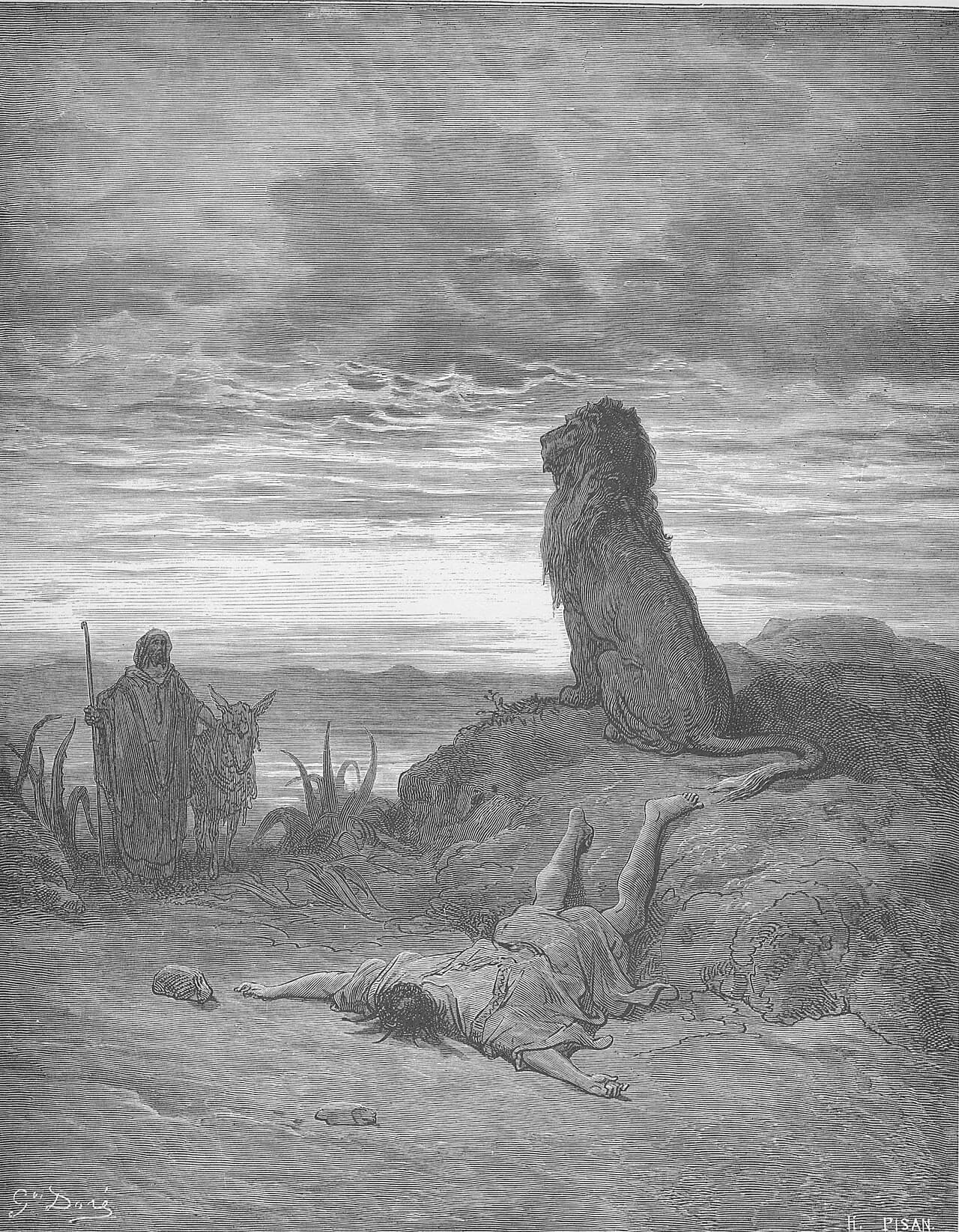
Gustave Doré, The Disobedient Prophet Is Slain by a Lion, 1866, from Doré's English Bible. Public domain by date, via Wikimedia Commons (File:088.The_Disobedient_Prophet_Is_Slain_by_a_Lion.jpg).
THE ARTWORKDoré drew the end of the man of God whom the LORD sent from Judah to cry out against Jeroboam's altar at Bethel and the shrines of its high places. He lies dead in the road after disobeying the word that sent him, and the lion sits beside the body without eating it, as 1 Kings 13:28 records.
Summary
A high place was a site of worship on raised ground, and Deuteronomy 12 commanded Israel to destroy the nations' high places and to worship the LORD only at the place He would choose.
- Solomon sacrificed at Gibeon, the great high place, in the years before the temple stood.
- Jeroboam built shrines on the high places of the northern kingdom, and a man of God from Judah foretold their end.
- Hezekiah removed the high places, Manasseh rebuilt them, and Josiah desecrated them from Geba to Beersheba.
- Readers divide over whether the law of the one place bound Israel from the entry into the land or was written for Josiah's reform.
The Command of Deuteronomy 12
Deuteronomy 12:1 to 14 sets the law of worship for Israel's life in the land.
Destroy completely all the places where the nations you are dispossessing have served their gods—atop the high mountains, on the hills, and under every green tree. Tear down their altars, smash their sacred pillars, burn up their Asherah poles, cut down the idols of their gods, and wipe out their names from every place.Moses names where the nations worshiped and what Israel was to destroy in each of those places.
You shall not worship the LORD your God in this way. Instead, you must seek the place the LORD your God will choose from among all your tribes to establish as a dwelling for His Name, and there you must go.The command turns from the nations' many places to the one place the LORD will choose for His Name.
You are not to do as we are doing here today, where everyone does what seems right in his own eyes. For you have not yet come to the resting place and the inheritance that the LORD your God is giving you.Moses admits that Israel has not kept this order in the wilderness, and he ties it to the rest the land will give.
Be careful not to offer your burnt offerings in just any place you see; you must offer them only in the place the LORD will choose in one of your tribal territories, and there you shall do all that I command you.This is the rule the books of Kings apply to every king who left the high places.
The Verdict of Kings on the High Places
Solomon reigned over all Israel, and the eleven kings after him in the figure reigned over Judah.
Only Hezekiah and Josiah removed the high places.
- Built or served them
- Left them standing
- Removed them
The 12 reigns as a table
| King | Reigns | What he did with the high places | Verse |
|---|---|---|---|
| Solomon | 40 | Built or served them | 1 Kings 11:7 |
| Rehoboam | 17 | Built or served them | 1 Kings 14:23 |
| Asa | 41 | Left them standing | 1 Kings 15:14 |
| Jehoshaphat | 25 | Left them standing | 1 Kings 22:43 |
| Joash | 40 | Left them standing | 2 Kings 12:3 |
| Amaziah | 29 | Left them standing | 2 Kings 14:4 |
| Azariah | 52 | Left them standing | 2 Kings 15:4 |
| Jotham | 16 | Left them standing | 2 Kings 15:35 |
| Ahaz | 16 | Built or served them | 2 Kings 16:4 |
| Hezekiah | 29 | Removed them | 2 Kings 18:4 |
| Manasseh | 55 | Built or served them | 2 Kings 21:3 |
| Josiah | 31 | Removed them | 2 Kings 23:8 |
Twelve bars in the order of the reigns, each as long as a reign in years and coloured by the verdict of Kings.
The refrain, king by king6 passages
The high places were not removed, but Asa’s heart was fully devoted to the LORD all his days.Asa burned his grandmother's Asherah pole in the Kidron Valley yet the high places of his reign were not removed.
And Jehoshaphat walked in all the ways of his father Asa; he did not turn away from them, but did what was right in the eyes of the LORD. The high places, however, were not removed; the people still sacrificed and burned incense on the high places.The son kept his father's verdict, and Kings now names the worshipers who kept the shrines in use.
Nevertheless, the high places were not removed; the people continued sacrificing and burning incense there.Joash did right while Jehoiada the priest instructed him, and the people kept sacrificing at the high places.
Nevertheless, the high places were not taken away, and the people continued sacrificing and burning incense on the high places.Amaziah did right, though not as David had done, and Kings repeats his father's verdict over him.
Nevertheless, the high places were not taken away; the people continued sacrificing and burning incense there.Azariah reigned fifty-two years, the longest of the six kings who did right, with the people still burning incense on the high places.
Nevertheless, the high places were not taken away; the people continued sacrificing and burning incense there. Jotham rebuilt the Upper Gate of the house of the LORD.Jotham's building at the temple did not reach the shrines outside it.
From Gibeon to Josiah
Five verses mark where the shrines were used, multiplied, removed, rebuilt and finally torn down.
The people, however, were still sacrificing on the high places because a house for the Name of the LORD had not yet been built. And Solomon loved the LORD and walked in the statutes of his father David, except that he sacrificed and burned incense on the high places.Solomon's reign opens with worship on the hilltops, before the temple was begun.
Jeroboam also built shrines on the high places and appointed from every class of people priests who were not Levites.After the kingdom divided, Jeroboam gave the north its own shrines and priests who were not Levites.
He removed the high places, shattered the sacred pillars, and cut down the Asherah poles. He also demolished the bronze snake called Nehushtan that Moses had made, for up to that time the Israelites had burned incense to it.Hezekiah is the first king whom Kings credits with removing the high places.
For he rebuilt the high places that his father Hezekiah had destroyed, and he raised up altars for Baal. He made an Asherah pole, as King Ahab of Israel had done, and he worshiped and served all the host of heaven.Manasseh undid his father's reform and added altars for Baal.
Then Josiah brought all the priests from the cities of Judah and desecrated the high places, from Geba to Beersheba, where the priests had burned incense. He tore down the high places of the gates at the entrance of the gate of Joshua the governor of the city, which was to the left of the city gate.This verse gives the reach of the reform across Judah, from its northern border town to its southern one.
The man of God at Bethel3 passages, 1 quotation
Suddenly, as Jeroboam was standing beside the altar to burn incense, there came a man of God from Judah to Bethel by the word of the LORD. And he cried out against the altar by the word of the LORD, “O altar, O altar, this is what the LORD says: ‘A son named Josiah will be born to the house of David, and upon you he will sacrifice the priests of the high places who burn incense upon you, and human bones will be burned upon you.’” That day the man of God gave a sign, saying, “The LORD has spoken this sign: ‘Surely the altar will be split apart, and the ashes upon it will be poured out.’”The prophet names the king and the deed, so the later reform can be checked against this word.
Now when King Jeroboam, who was at the altar in Bethel, heard the word that the man of God had cried out against it, he stretched out his hand and said, “Seize him!” But the hand he stretched out toward him withered, so that he could not pull it back. And the altar was split apart, and the ashes poured out, according to the sign that the man of God had given by the word of the LORD. Then the king responded to the man of God, “Intercede with the LORD your God and pray that my hand may be restored.” So the man of God interceded with the LORD, and the king’s hand was restored to him as it was before.Jeroboam is struck in his own hand while he stands at his new altar.
Matthew Henry reads the split altar as a token of the ruin Josiah would complete.
“How could the gift be acceptable when the altar that should sanctify it was an abomination? It was a reproach to the people, whose hearts were harder than these stones and rent not under the word of the Lord. It was a specimen of what should be done to it in the accomplishment of this prophecy by Josiah; it was now rent, in token of its being then ruined.”
Matthew Henry · Commentary on the Whole Bible · on 1 Kings 13:5Puritan
Even after these events, Jeroboam did not repent of his evil ways, but again he appointed priests for the high places from every class of people. He ordained anyone who desired to be a priest of the high places. And this was the sin of the house of Jeroboam that led to its extermination and destruction from the face of the earth.The episode closes with the king unchanged and his dynasty doomed.
The reform of 2 Kings 234 passages
Josiah also did away with the idolatrous priests ordained by the kings of Judah to burn incense on the high places of the cities of Judah and in the places all around Jerusalem—those who had burned incense to Baal, to the sun and moon, to the constellations, and to all the host of heaven.The reform begins with the men who served the shrines.
The king also desecrated the high places east of Jerusalem, to the south of the Mount of Corruption, which King Solomon of Israel had built for Ashtoreth the abomination of the Sidonians, for Chemosh the abomination of the Moabites, and for Milcom the abomination of the Ammonites.This verse closes the account that 1 Kings 11:7 opened.
He even pulled down the altar at Bethel, the high place set up by Jeroboam son of Nebat, who had caused Israel to sin. Then he burned the high place, ground it to powder, and burned the Asherah pole.The reform reaches the altar Jeroboam set up at Bethel in 1 Kings 12:32.
John Gill, in his Exposition of the Old Testament, reads the breaking of this altar as the fulfilment of the prophecy of 1 Kings 13 and of Amos 9:1.
Just as Josiah had done at Bethel, so also in the cities of Samaria he removed all the shrines of the high places set up by the kings of Israel who had provoked the LORD to anger. On the altars he slaughtered all the priests of the high places, and he burned human bones on them. Then he returned to Jerusalem.The reform crosses the old border into the land of the former northern kingdom.
Adam Clarke holds that Josiah, of the royal line of Judah, had the right to reform the cities of Samaria, since Israel then had no king.
The High Places of the LORD and of Other Gods
Kings and Jeremiah record high places where Judah worshiped the LORD and high places built for other gods.
John Wesley, in his Explanatory Notes upon the Old Testament on 1 Kings 3:2, says the Gentiles sacrificed to idols in the high places and the Hebrews sacrificed there to the true God.
But if you say to me, ‘We trust in the LORD our God,’ is He not the One whose high places and altars Hezekiah has removed, saying to Judah and Jerusalem: ‘You must worship before this altar in Jerusalem’?The Assyrian officer calls the altars Hezekiah removed the LORD's own high places.
Adam Clarke, in his Commentary on the Bible, notes that many of the people had sacrificed to the LORD on the high places, and he calls the officer's argument artfully malicious.
At that time on a hill east of Jerusalem, Solomon built a high place for Chemosh the abomination of Moab and for Molech the abomination of the Ammonites.Solomon's shrine for Chemosh and Molech is the earliest of its kind that Kings records.
They have built the high places of Topheth in the Valley of Hinnom so they could burn their sons and daughters in the fire—something I never commanded, nor did it even enter My mind.Jeremiah ties the worst practice of Judah's shrines to a named valley.
The High Places in the Land
Nine places in Kings and Jeremiah held a high place or bounded the land of Josiah's reform.
The high places Kings names stood from Dan in the north to Beersheba in the south.
- Located: the site is known
- Identified: the point stands for an area, or is rounded
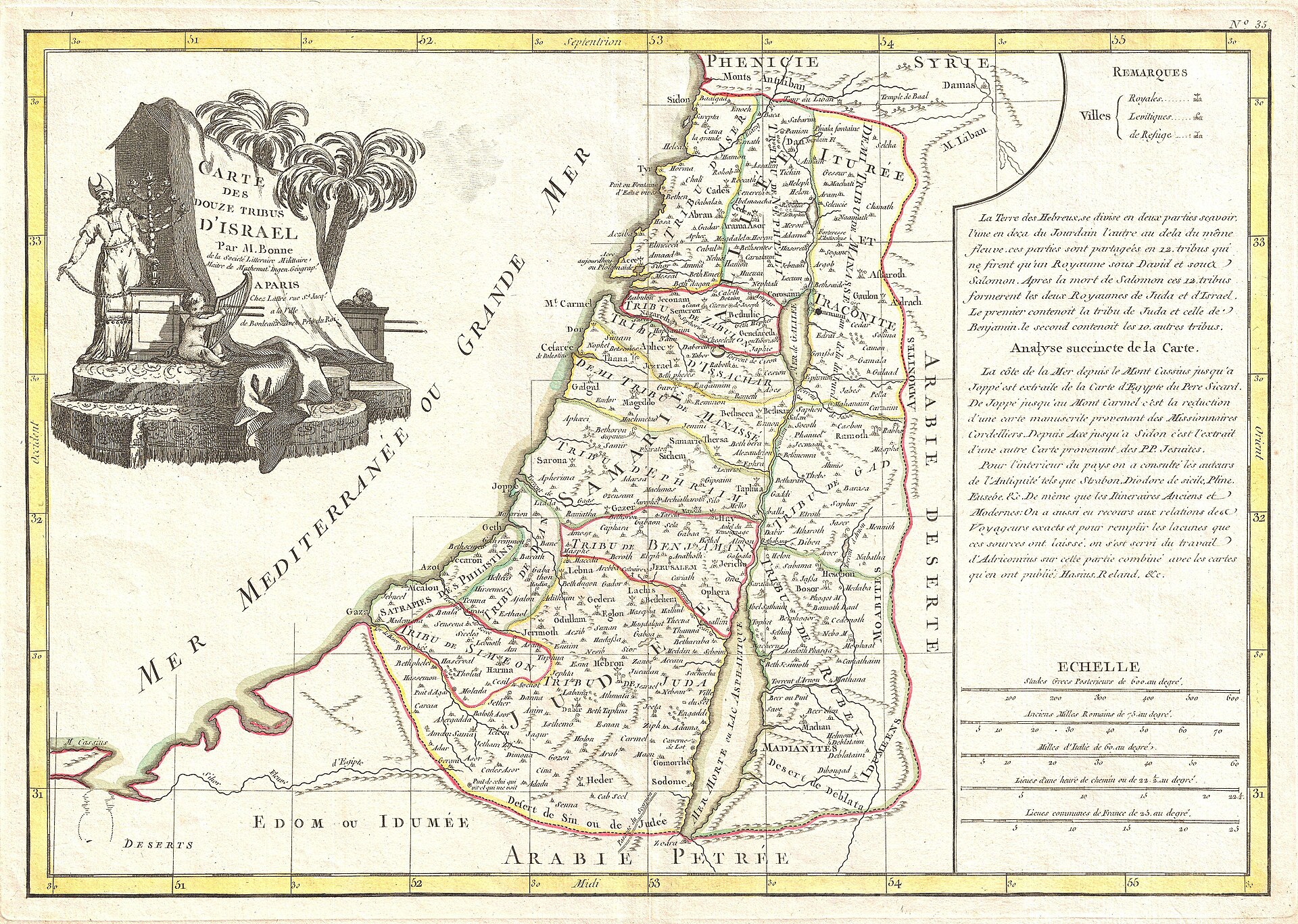
- 1Dan, One of Jeroboam's two golden calves stood here. 1 Kings 12:29
- 2The cities of Samaria, Josiah removed the shrines of the kings of Israel there. 2 Kings 23:19
- 3Bethel, Jeroboam's altar and high place, broken down by Josiah. 2 Kings 23:15
- 4Geba, The northern limit of Josiah's desecration in Judah. 2 Kings 23:8
- 5Gibeon, The great high place, where Solomon offered a thousand burnt offerings. 1 Kings 3:4
- 6Jerusalem, The high places of the gates, at the gate of Joshua. 2 Kings 23:8
- 7Mount of Olives, Solomon's high places for Ashtoreth, Chemosh and Milcom. 2 Kings 23:13
- 8Valley of Hinnom, The high places of Topheth. Jeremiah 7:31
- 9Beersheba, The southern limit of Josiah's desecration. 2 Kings 23:8
Not placed: Geba (4), Gibeon (5), Valley of Hinnom (8).
Base map: The Twelve Tribes of Israel, Rigobert Bonne (1770), public domain. Each place stands at its place page's coordinates, set on the plate by Jerusalem and Dan, as the plate prints them.
Geba and Beersheba mark the bounds of Josiah's reform in Judah, and the other seven places held shrines, each with its verse.
Albert Barnes, in his Notes on 1 Kings 3:4, says the tent of meeting and the bronze altar of burnt offering had been moved to Gibeon from Nob. That, he says, made it more sacred than any other high place unless it were Mount Zion, where David had brought the ark.
Adam Clarke reports that Jarchi, the Latin name for Rashi, following the Chaldee, took the Mount of Corruption of 2 Kings 23:13 to be the Mount of Olives. He also places public altars near the gate of Joshua, where the governor heard cases, and says the true God and false gods were honoured there by turns.
The Words for the High Places
Four Hebrew words of Deuteronomy 12 and Kings name the shrines and what stood at them.
BÂMÂH (HEBREW, H1116)
A noun meaning an elevation and rendered high place, which stands in 92 verses, 31 of them in 1 and 2 Kings; Deuteronomy uses it only in the poems of chapters 32 and 33.
MÂQÔWM (HEBREW, H4725)
A noun meaning a standing or a spot, used for the place the LORD will choose.
MATSTSÊBÂH (HEBREW, H4676)
A noun meaning a pillar or memorial stone, and by analogy an idol.
ʼĂSHÊRÂH (HEBREW, H842)
The goddess Asherah and an image of her, which the Berean text renders Asherah pole.
Bamah in the Torah4 passages
I will destroy your high places, cut down your incense altars, and heap your lifeless bodies on the lifeless remains of your idols; and My soul will despise you.The LORD warns that He will destroy Israel's own high places if Israel breaks the covenant.
you must drive out before you all the inhabitants of the land, destroy all their carved images and cast idols, and demolish all their high places.Israel is told to demolish the Canaanites' high places on entering the land.
He made him ride on the heights of the land and fed him the produce of the field. He nourished him with honey from the rock and oil from the flinty crag,The song uses the word for the heights of the land over which the LORD made Israel ride.
Blessed are you, O Israel! Who is like you, a people saved by the LORD? He is the shield that protects you, the sword in which you boast. Your enemies will cower before you, and you shall trample their high places.”The last words of Moses' blessings put the nations' shrines under Israel's feet.
Albert Barnes reads the trampling of Deuteronomy 33:29 as holding the commanding positions of the land, and John Wesley reads the heights of Deuteronomy 32:13 as the strongholds of the mountains.
Matthew Henry reads Leviticus 26:30 as a judgment: since Israel would not destroy its high places, God would.
What the Text Leaves Unsaid
Three questions the text leaves open.
Scripture gives no measures, plan or list of furnishings for a high place.
Kings gives no reason why the six kings who did right left the high places standing.
Deuteronomy 12 leaves the place the LORD will choose unnamed.
Why One Place
Deuteronomy ties the one place to the Name of the LORD and to the purity of Israel's worship.
then the LORD your God will choose a dwelling for His Name. And there you are to bring everything I command you: your burnt offerings and sacrifices, your tithes and special gifts, and all the choice offerings you vow to the LORD.This is the second statement of the command in the chapter, after verse 5, and it names the offerings the place receives.
Albert Barnes explains what the Name at the place meant and why one centre mattered to the whole law.
“‘To put his name there’ means to manifest to men His divine presence. The Targumists rightly refer to the Shechinah; but the expression comprehends all the various modes in which God vouchsafed to reveal Himself and His attributes to men. The purpose of the command of the text is to secure the unity, and through unity the purity of the worship of God. That there should be one national center for the religion of the people was obviously essential to the great ends of the whole dispensation.”
Albert Barnes · Notes, Explanatory and Practical, on the Old and New Testaments (1832-1869) · on Deuteronomy 12:5Evangelical
When Did the Law of One Place Take Hold?
Three readings, each with its holders and the objection it must answer.
Binding from the entry, with the high places a lapseJohn Gill; Jamieson, Fausset & Brown; Albert Barnes · Reformed and evangelical commentary
John Gill, in his Exposition of the Old Testament on Deuteronomy 12:5, reads the place as the one where God would set His tabernacle and cause His divine Majesty to dwell. Jamieson, Fausset & Brown, in their Commentary Critical and Explanatory, name the place in turn as Mizpeh, Shiloh and Jerusalem.
Albert Barnes explains why the order was not kept before the entry.
“Moses points out that heretofore they had not observed the prescribed order in their worship, because during their migratory life in the wilderness it had been impossible to do so. During their wanderings there were doubtless times when the tabernacle was not set up for days together, and when the daily sacrifice Num 28:3, together with many other ordinances, were necessarily omitted (compare Jos 5:5). This consideration must be carefully borne in mind throughout Deuteronomy.”
Albert Barnes · Notes, Explanatory and Practical, on the Old and New Testaments (1832-1869) · on Deuteronomy 12:8Evangelical
Adam Clarke objects, in his Commentary on the Bible on 1 Kings 3:2, that prophets, judges and the kings before Solomon sacrificed on high places such as Gibeon, Gilgal, Shiloh and Hebron.
Permitted until the chosen houseRashi; Adam Clarke · Rabbinic and evangelical commentary
Rashi, Rabbi Shlomo Yitzchaki of Troyes (1040 to 1105), in his commentary on Deuteronomy in the translation of M. Rosenbaum and A. M. Silbermann, holds that once Israel crossed the Jordan, offerings on a bamah were permitted through the fourteen years of conquering and dividing the land. He reads the dwelling of verse 5 as the tabernacle at Shiloh and the place of verse 11 as the chosen house in Jerusalem.
Adam Clarke asks whether sacrifice on the high places was unlawful before the temple was built, and he holds that once the temple stood it was sinful to sacrifice anywhere else.
The objection to this reading is 1 Kings 3:3, which faults Solomon for sacrificing on the high places while no house had yet been built. Clarke himself notes that the verse sets it down as an exceptionable trait in Solomon's character.
Written for Josiah's reformS. R. Driver; Julius Wellhausen · Critical scholarship
S. R. Driver, in An Introduction to the Literature of the Old Testament (1891), held that Deuteronomy was written considerably later than the age of Moses. He dated it before 621 BC, the year Hilkiah found the book of the law in the temple. Julius Wellhausen, in the Prolegomena to the History of Israel (English 1885), took up Karl Heinrich Graf's view that the law came later than the prophets.
Then Hilkiah the high priest said to Shaphan the scribe, “I have found the Book of the Law in the house of the LORD!” And he gave it to Shaphan, who read it.The critical reading takes this discovery as the moment the law of the one place entered Judah's history.
Albert Barnes answers, in his Notes on Deuteronomy 12:6, those who held that the command could not have been carried out until Judah was a small kingdom. He holds that Moses was regulating institutions long in existence and took much for granted.
Worship in Spirit and in Truth
Deuteronomy gathered Israel's offerings to the place where the LORD set His Name.
Our fathers worshiped on this mountain, but you Jews say that the place where one must worship is in Jerusalem.” “Believe Me, woman,” Jesus replied, “a time is coming when you will worship the Father neither on this mountain nor in Jerusalem.The Samaritan woman raises the old question of the right mountain, and Jesus answers that the time of both places is ending.
But a time is coming and has now come when the true worshipers will worship the Father in spirit and in truth, for the Father is seeking such as these to worship Him. God is Spirit, and His worshipers must worship Him in spirit and in truth.”Jesus names the worship the Father seeks, and He tells the woman two verses later that He is the Messiah.
These texts ask the reader to come to God through the Christ who spoke with the woman at the well. They ask for the undivided worship that the law of the one place required, now given wherever He is honoured.
Keep studying
Studies8
People13
Places8
Symbols1
Doctrines10
Peoples and groups2