

Place
Mount Nebo
Also known as Pisgah · Jebel Neba
Gustave Doré, engraving for the New Testament (1866). Public domain.
Summary
The peak in Moab from which Moses saw the whole land he would not enter, and where he died and was buried by God.
- Mount Nebo is the headland in Moab, across from Jericho, where Moses was shown the whole land and told he would not enter it.
- He died there at a hundred and twenty, still strong, under a sentence passed at Meribah roughly thirty-eight years earlier.
- God buried him in a valley facing Beth-peor, and Deuteronomy says plainly that no one knows where the grave is.
- Balaam stood on the same summit first, hired to curse Israel and given a blessing instead.
- Three things in Scripture carry the name Nebo: this mountain, a Moabite town, and a Babylonian god.
On this page
In Scripture
- Verses
- 9
- Books
- 3
Near Mount Nebo
- Bethany beyond the Jordan20 km · 12 mi NW
- Gilgal24 km · 15 mi NW
- Ammon27 km · 17 mi NE
- Jericho31 km · 19 mi NW
- Bethany46 km · 28 mi W
- Mount of Olives47 km · 29 mi W
Straight-line distances, computed from the gazetteer coordinates.
Where it is
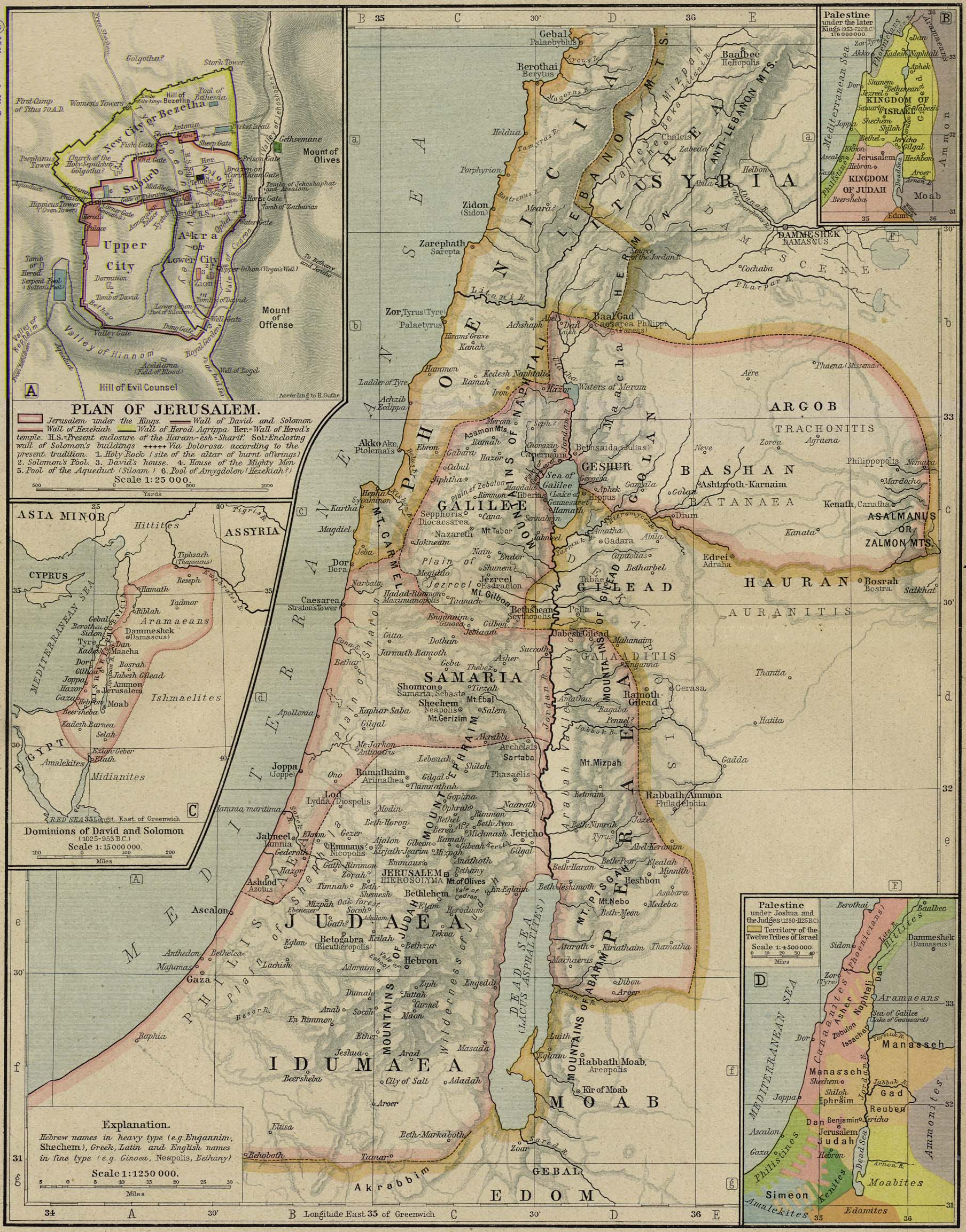
the country around it
- Coordinates
- 31.7614° N, 35.7461° Efind it on the Atlas →
- Region
- Moab, east of the Jordan
- Kind of place
- Mountain
- Located: the gazetteer fixes one site
- Placed: the point stands for an area, or is rounded
Not located: Moab. The gazetteer records no location for it, so it is not marked.
Why Mount Nebo matters
What has been found
the evidence, and where it is disputed
The death of Moses on Mount Nebo
Deuteronomy 32:48 to 34:9, in the order it happens
Read Deuteronomy 32:48 to 34:9, in the order it happens
- The command, on the day the song endedDeuteronomy 32:49“Go up into the Abarim Range to Mount Nebo, in the land of Moab across from Jericho, and view the land of Canaan, which I am giving to the Israelites as their own possession.
- There you will die, as Aaron diedDeuteronomy 32:50And there on the mountain that you climb, you will die and be gathered to your people, just as your brother Aaron died on Mount Hor and was gathered to his people.
- You will see it from a distanceDeuteronomy 32:52Although you shall see from a distance the land that I am giving the Israelites, you shall not enter it.”
- Moses goes up, and the LORD shows him the landDeuteronomy 34:1Then Moses went up from the plains of Moab to Mount Nebo, to the top of Pisgah, which faces Jericho. And the LORD showed him the whole land—from Gilead as far as Dan,
- The sight reaches the Negev and ZoarDeuteronomy 34:3the Negev, and the region from the Valley of Jericho (the City of Palms) all the way to Zoar.
- The promise named, and the refusalDeuteronomy 34:4And the LORD said to him, “This is the land that I swore to give Abraham, Isaac, and Jacob when I said, ‘I will give it to your descendants.’ I have let you see it with your own eyes, but you will not cross into it.”
- The servant of the LORD dies thereDeuteronomy 34:5So Moses the servant of the LORD died there in the land of Moab, as the LORD had said.
- God buries him, and no one knows whereDeuteronomy 34:6And He buried him in a valley in the land of Moab facing Beth-peor, and no one to this day knows the location of his grave.
- A hundred and twenty, and not worn outDeuteronomy 34:7Moses was a hundred and twenty years old when he died, yet his eyes were not weak, and his vitality had not diminished.
- Thirty days of mourning on the plainsDeuteronomy 34:8The Israelites grieved for Moses in the plains of Moab thirty days, until the time of weeping and mourning for Moses came to an end.
The sentence was not passed here. It was passed at the waters of Meribah in Numbers 20:12, roughly thirty-eight years before this climb. Aaron had already died the same way on Mount Hor, and Deuteronomy 32:50 ties the two deaths together in one sentence.
Deuteronomy: the book that ends on this mountainWhat happened here, in order
in the order the canon tells it
- The sentence passed at the waters of MeribahNumbers 20:12But the LORD said to Moses and Aaron, “Because you did not trust Me to show My holiness in the sight of the Israelites, you will not bring this assembly into the land that I have given them.”
- Pisgah named for the first timeNumbers 21:20and from Bamoth to the valley in Moab where the top of Pisgah overlooks the wasteland.
- Balak takes Balaam up to the top of PisgahNumbers 23:14So Balak took him to the field of Zophim, to the top of Pisgah, where he built seven altars and offered a bull and a ram on each altar.
- Go up this mountain of the Abarim rangeNumbers 27:12Then the LORD said to Moses, “Go up this mountain of the Abarim range and see the land that I have given the Israelites.
- Joshua chosen while Moses is still aliveNumbers 27:18And the LORD replied to Moses, “Take Joshua son of Nun, a man with the Spirit in him, and lay your hands on him.
- Reuben builds up the town called NeboNumbers 32:38as well as Nebo and Baal-meon (whose names were changed), and Sibmah. And they renamed the cities they rebuilt.
- The camp in the Abarim mountains facing NeboNumbers 33:47They set out from Almon-diblathaim and camped in the mountains of Abarim facing Nebo.
- Moses pleads to be allowed to crossDeuteronomy 3:25Please let me cross over and see the good land beyond the Jordan—that pleasant hill country as well as Lebanon!”
- Go to the top of Pisgah and lookDeuteronomy 3:27Go to the top of Pisgah and look to the west and north and south and east. See the land with your own eyes, for you will not cross this Jordan.
- The camp in the valley opposite Beth-peorDeuteronomy 3:29So we stayed in the valley opposite Beth-peor.
- A hundred and twenty years old, and told he will not crossDeuteronomy 31:2he said to them, “I am now a hundred and twenty years old; I am no longer able to come and go, and the LORD has said to me, ‘You shall not cross the Jordan.’
- Moses dies on the mountain in MoabDeuteronomy 34:5So Moses the servant of the LORD died there in the land of Moab, as the LORD had said.
- The office passes to JoshuaDeuteronomy 34:9Now Joshua son of Nun was filled with the spirit of wisdom because Moses had laid his hands on him. So the Israelites obeyed him and did as the LORD had commanded Moses.
- Moses My servant is dead, now cross the JordanJoshua 1:2“Moses My servant is dead. Now therefore arise, you and all these people, and cross over the Jordan into the land that I am giving to the children of Israel.
- The town of Nebo named in the burden against MoabIsaiah 15:2Dibon goes up to its temple to weep at its high places. Moab wails over Nebo, as well as over Medeba. Every head is shaved, every beard is cut off.
- The Babylonian god Nebo, a different thing entirelyIsaiah 46:1Bel crouches; Nebo cowers. Their idols weigh down beasts and cattle. The images you carry are burdensome, a load to the weary animal.
- Woe to Nebo, in the oracle against MoabJeremiah 48:1Concerning Moab, this is what the LORD of Hosts, the God of Israel, says: “Woe to Nebo, for it will be devastated. Kiriathaim will be captured and disgraced; the fortress will be shattered and dismantled.
- Moses stands in the land at the TransfigurationMatthew 17:3Suddenly Moses and Elijah appeared before them, talking with Jesus.
- Joshua brought them in, and it was still not the restHebrews 4:8For if Joshua had given them rest, God would not have spoken later about another day.
- Michael disputes with the devil over the body of MosesJude 1:9But even the archangel Michael, when he disputed with the devil over the body of Moses, did not presume to bring a slanderous charge against him, but said, “The Lord rebuke you!”
Where it points
The voices
each quoted from the work named
WHAT an honorable title! Moses is distinguished as "the servant of Jehovah." He was this of choice, for he willed to be the servant of God rather than to be great in the land of the Pharaohs. Such he was most perseveringly throughout the whole of his life. Such he was most intensely, for he waited upon God for his directions, as a servant waits upon his master, and he endeavored to do all things according to the pattern which was shown him in the holy mountain.
Get thee up into the top of Pisgah,.... Which was the highest eminence of Mount Nebo, and so a very proper place to take a prospect from; see Deu 32:49.
Immediately below him was "the circle" of the plain of Jericho, with its oasis of palm trees; and far away on his left, the last inhabited spot before the great desert "Zoar." The foreground of the picture alone was clearly discernible. There was no miraculous power of vision imparted to Moses.
4 more teachers on these versesAlbert Barnes · Aphrahat the Persian Sage · Clement of Alexandria · John Wesley
I have caused thee to see it - The sight thus afforded to Moses, like that of “all the kingdoms of the world in a moment of time” Luk 4:5, was no doubt supernatural.
Two godly benefits did his Lord accomplish for Moses in not making known his tomb to the children of Israel. He rejoiced that his adversaries should not know it and cast forth his bones from his tomb; and in the second place, that the children of his people should not know it and make his tomb a place of worship, for he was accounted as God in the eyes of the children of his people.
"When Michael, the archangel, disputing with the devil, debated about the body of Moses." Here he confirms the assumption of Moses. He is here called Michael, who through an angel near to us debated with the devil.
But as far as the other prophets came short of him, our Lord Jesus went beyond him. Moses was faithful as a servant, but Christ as a son: his miracles more illustrious, his communion with the father more intimate: for he is in his bosom from eternity. Moses lies buried: but Christ is sitting at the right-hand of God, and of the increase of his government there shall be no end.
Mount Nebo in Scripture
9 verses name it, or one of its other names (Pisgah, Jebel Neba), in 3 books
Open a book to read its mentions here. Text: Berean Standard Bible.
Old TestamentNew Testamentsegment width = share of mentions
Old Testament3 books · 9 mentions
Numbers2 mentions
Deuteronomy5 mentions
- Deuteronomy 3:17The Jordan River in the Arabah bordered it from Chinnereth to the Sea of the Arabah (the Salt Sea) with the slopes of Pisgah to the east.
- Deuteronomy 3:27Go to the top of Pisgah and look to the west and north and south and east. See the land with your own eyes, for you will not cross this Jordan.
- Deuteronomy 4:49including all the Arabah on the east side of the Jordan and as far as the Sea of the Arabah, below the slopes of Pisgah.
- Deuteronomy 32:49“Go up into the Abarim Range to Mount Nebo, in the land of Moab across from Jericho, and view the land of Canaan, which I am giving to the Israelites as their own possession.
- Deuteronomy 34:1Then Moses went up from the plains of Moab to Mount Nebo, to the top of Pisgah, which faces Jericho. And the LORD showed him the whole land—from Gilead as far as Dan,
The account
Read the account as one telling
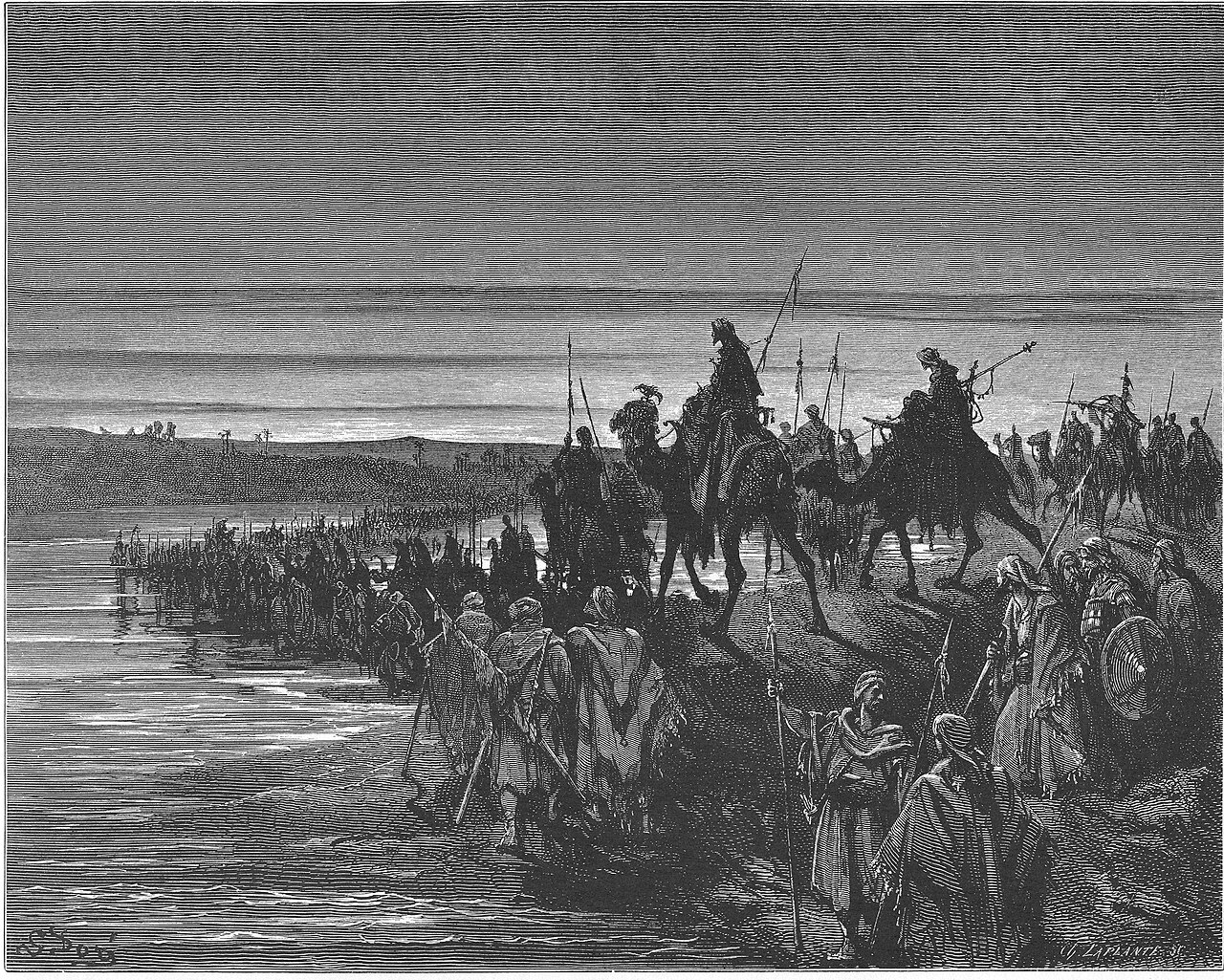
Israel came up the east side of the Dead Sea, around Edom and past the Arnon, and the camp settled under a headland. Numbers 21:20 names the top of Pisgah for the first time, looking out over the wasteland. From there the people moved down to the plains of Moab by the Jordan, across from Jericho, and everything that follows in Numbers and Deuteronomy happens within sight of that headland.
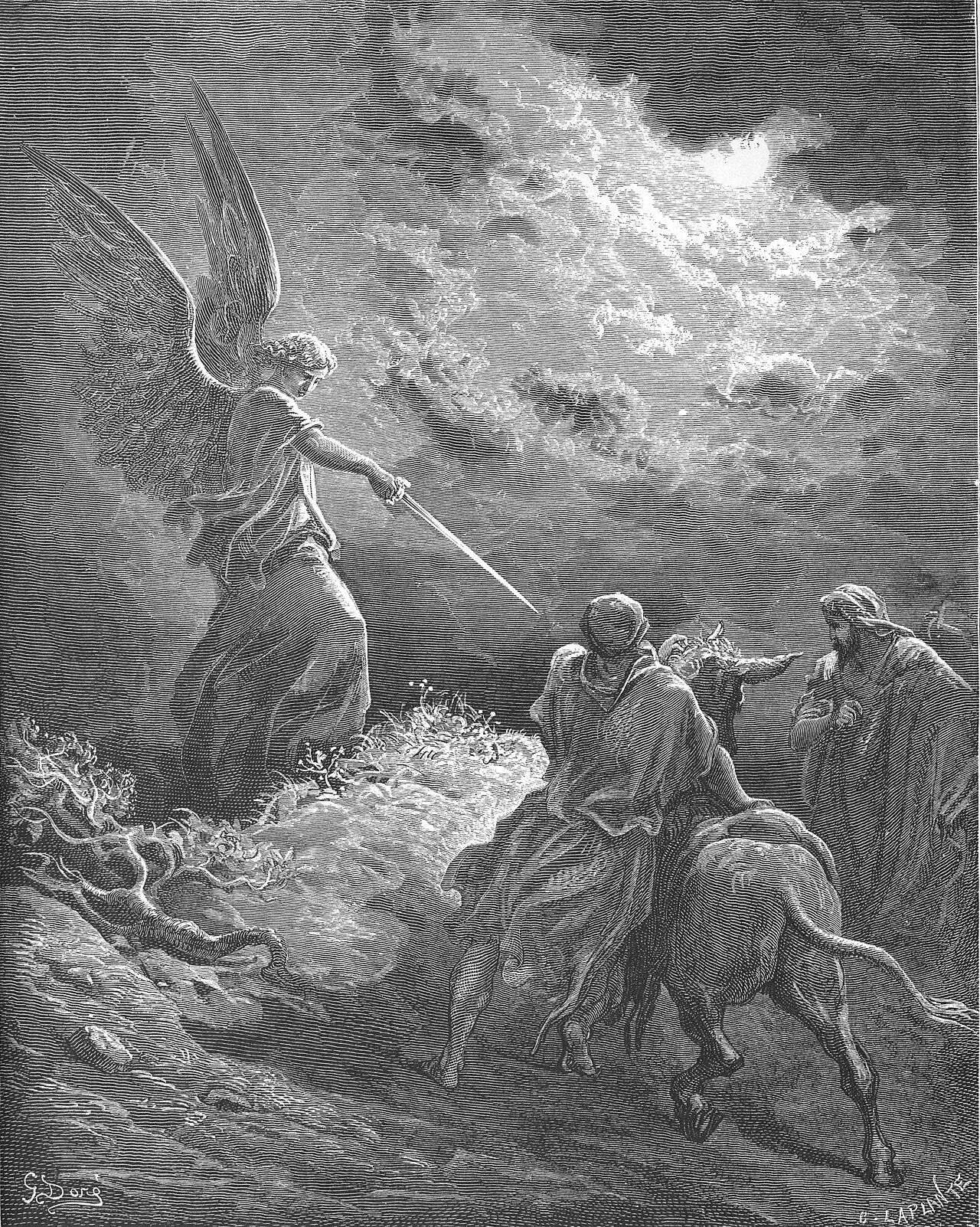
Balak king of Moab hired Balaam to curse the camp. When the first attempt failed, Balak moved him to a better vantage, the field of Zophim on the top of Pisgah, and built seven altars there. What Balaam was given on that summit was a blessing and a statement that God does not lie and does not change His mind about what He has promised. Retellings of Mount Nebo almost never mention that this happened on the same ground.
Reuben and Gad asked for the pastureland east of the Jordan, and a Moabite town called Nebo is in the list Reuben rebuilt. Numbers 32:38 adds a parenthesis: the names were changed. Jamieson, Fausset and Brown read the change as Israel refusing to keep the names of other gods in its mouth, on the ground of Exodus 23:13. Adam Clarke reads it as the ordinary practice of conquerors, who renamed captured towns after themselves. This page gives both readings and chooses neither.
The sentence on Moses had been passed years before, at the waters of Meribah in the Wilderness of Zin. Aaron died first under it, on Mount Hor, with Moses conducting the funeral and putting the priestly garments on Eleazar. Numbers 27 then tells Moses to go up the Abarim range and see the land, and his answer is to ask God for a successor so the people will not be left like sheep without a shepherd. He laid his hands on Joshua in front of Eleazar and the whole congregation.
Moses did ask to cross. Deuteronomy 3 records the prayer in his own words and the refusal in God’s. He was told that was enough and not to raise the matter again, and then to climb Pisgah and look in all four directions. Verse 29 places the camp in the valley opposite Beth-peor, which is the same valley Deuteronomy 34:6 names as the burial place.
The end came in a single day. Moses finished the song, finished the blessing over the tribes, and was told on that same day to go up the mountain and die on it. The climb, the sight of the land, the death, the burial and the thirty days of mourning are told above.
Joshua was filled with the spirit of wisdom because Moses had laid hands on him, and the people obeyed him. The book of Joshua opens on the far side of the death with the fact stated as an order: Moses My servant is dead, now cross the Jordan. The people Moses had led for forty years went into the land without him.
The town of Nebo did not stay in Israelite hands. It is back in Moabite hands by the time of Isaiah’s burden against Moab and Jeremiah’s oracle, named in both among the towns under judgment. Jerome, writing about 420, reports that the idol Chemosh was consecrated at Nebo under a second name. The Moabite Stone, a royal inscription of about 840 BC now in the Louvre, names Nebo as well, which places the town in a ninth-century record written outside the Bible.
Common questions
Why was Moses not allowed into the promised land?
Because of what happened at the waters of Meribah in the Wilderness of Zin, where God told him and Aaron plainly that they had not trusted Him to show His holiness in the sight of the Israelites, and so would not bring the assembly into the land. Deuteronomy 32:51 names the same event on the day Moses was told to climb. Speaking to the people, Moses puts it three times on their account rather than his own, and Albert Barnes explains the difference: Deuteronomy says it that way because Moses is addressing the people, while Numbers 27 and Deuteronomy 32 say it the other way because God is addressing Moses.
Where is Mount Nebo, and is Pisgah a different mountain?
Nebo is in the Abarim range, in Moab, east of the Jordan and across from Jericho. Pisgah is not a second mountain. Deuteronomy 34:1 puts the two in one phrase, to Mount Nebo, to the top of Pisgah. John Gill calls Pisgah the highest eminence of Mount Nebo, and Albert Barnes calls Pisgah a ridge of the Abarim mountains. Abarim is the range, Nebo the mountain, Pisgah its head.
Could Moses really see all of that from one summit?
Readers differ; the positions are named
Readers have long disagreed, and this page names both positions. Jamieson, Fausset and Brown hold that what he saw was the natural view from that height, with the foreground clearly discernible and no more, and say there was no miraculous power of vision imparted to Moses. Albert Barnes holds the opposite, that the sight was supernatural, comparable to the showing of all the kingdoms of the world in a moment of time in Luke 4:5. The verse says only that the LORD showed him the whole land, and it does not say how.
Who buried Moses, and why is his grave hidden?
The text gives no human agent. It says that He buried him in a valley in the land of Moab facing Beth-peor, and that no one to this day knows the location of his grave. Two early readings of the reason are quoted on this page. Aphrahat, writing about 345, gives two: that his enemies could not disturb his bones, and that his own people could not make the tomb a place of worship. Adam Clarke, in 1832, gives the second reason in almost the same words and notes that almost all the gods of antiquity were deified men.
What is Jude talking about when Michael disputes with the devil over the body of Moses?
Readers differ; the positions are named
Jude reports the dispute in one sentence and explains nothing. Clement of Alexandria, about 215, connected the verse to an assumption of Moses, and a Second Temple Jewish work of that description is known from antiquity and survives only in part. This site does not hold that work and quotes nothing from it. Jamieson, Fausset and Brown take the strict line that Jude as an inspired writer could tell which part of the tradition was true while we cannot, so we "can be sure of no tradition, save that which is in the written word." Albert Barnes records how much trouble the verse has given expositors. The words Michael speaks are the words spoken over Joshua the high priest in Zechariah 3:2.
Is the Nebo of Isaiah 46 the same Nebo?
No, and neither is the Nebo of Numbers 32. Three different things carry the name. There is this mountain in Moab, where Moses died. There is a Moabite town, given to Reuben and renamed, later back in Moabite hands and named under judgment by Isaiah and Jeremiah. And there is a Babylonian deity, paired with Bel and pictured bowing under his own weight. This site’s lexicon entry for the word carries all three senses in one gloss.
Did Moses ever get into the land?
Yes, much later. At the Transfiguration, on a mountain inside the land, Moses and Elijah appeared and talked with Jesus. Luke adds that they appeared in glory and spoke about the departure He was about to accomplish at Jerusalem. John Wesley’s line on the close of Deuteronomy is the other half of the answer: Moses lies buried, and Christ is sitting at the right hand of God.
Who wrote Deuteronomy 34, since it records the death of Moses?
Readers differ; the positions are named
Almost no reader has ever held that Moses wrote his own obituary, including those most committed to Mosaic authorship of the book. The Babylonian Talmud records a discussion of the question, with the view that Joshua wrote the closing verses and a minority view that Moses wrote them at God’s dictation. Abraham ibn Ezra, in the twelfth century, pointed to the phrase rendered "to this day" as looking past the lifetime of Moses, and the critical tradition reads the chapter with the book’s later editorial layers. The positions and their holders, with the Talmud passage named and dated, are set out on this site’s Deuteronomy study rather than argued here.
Is the ark of the covenant hidden on Mount Nebo?
Second Maccabees says Jeremiah took the tabernacle, the ark and the altar of incense to the mountain where Moses climbed up and saw the heritage of God, laid them in a cave and stopped the door. That book is a labelled study resource on this site and not Scripture, it never uses the name Nebo, and it presents itself as a report of what a writing contained rather than as a record of what happened. Scripture itself never says the ark was hidden, moved or buried. This site’s study of the ark sets out the whole question and ends where the evidence ends.
Notable art
3 verified pieces depicting Mount Nebo
Sources cited
- OpenBible.info Bible Geocoding: Mount Neboread 2026-09-02The coordinates on this page. Used under CC-BY with attribution to OpenBible.info.
- Berean Standard BiblePublic domain since 2023. All Scripture quoted on this page, from the site’s own verse store.
- 2 Maccabees 2:4 to 2:8A labelled study resource on this site rather than Scripture. The tradition of the cave on the mountain where Moses climbed up.
- R. H. Charles, translator, The Book of Enoch (1917)Searched on this site for Nebo, Pisgah, Abarim, Moses, Moab, Peor and Jordan. It holds nothing on this mountain, which this page states plainly.
- Charles H. Spurgeon, The Metropolitan Tabernacle Pulpit, Sermon No. 1966, “The Death of Moses” (1887)Public domain, CCEL edition.
- Jamieson, Fausset & Brown, Commentary Critical and Explanatory on the Whole Bible (1871)Public domain. Quoted on the sight from the summit, on the renaming of the town, and on Jude 9.
- Albert Barnes, Notes, Explanatory and Practical, on the Old and New Testaments (1832 to 1869)Public domain. Quoted on the sight from the summit, on Beth-peor, and on the field of Zophim.
- Adam Clarke, Commentary on the Bible (1832)Public domain. Cited on the hidden grave, on the renaming of the town, and on the prophet like Moses.
- John Wesley, Explanatory Notes upon the Old Testament (1765)Public domain.
- John Gill, Exposition of the Old Testament (1748 to 1763)Public domain. The note that settles Pisgah as the head of Mount Nebo.
- Aphrahat the Persian Sage, Demonstration 8.9 (about 345)Public domain translation. The two reasons the grave was hidden.
- Clement of Alexandria, comments on Jude, from the Latin translation of Cassiodorus (about 215)Public domain translation. The earliest witness this site holds connecting Jude 9 to an assumption of Moses.
- Origen of Alexandria, Homilies on Joshua 1.3 and Homilies on Numbers 27 (about 253)Public domain translations. Cited as his own reading of the death of Moses and the law.
- John Chrysostom, Homilies on Hebrews 6 and 27 (407)Public domain translation. The rest that Joshua did not give.
- Jerome, Commentary on Isaiah (about 420)Public domain translation. The report that Chemosh was consecrated at the town of Nebo.
- Cyril of Alexandria, Commentary on Luke, Homily 51 (444)Public domain translation. What Moses and Elijah were speaking of at the Transfiguration.
- The Mesha Stele (the Moabite Stone), about 840 BC, Musée du LouvreNamed on this page and not quoted. The site’s own entry is on the archaeology study.
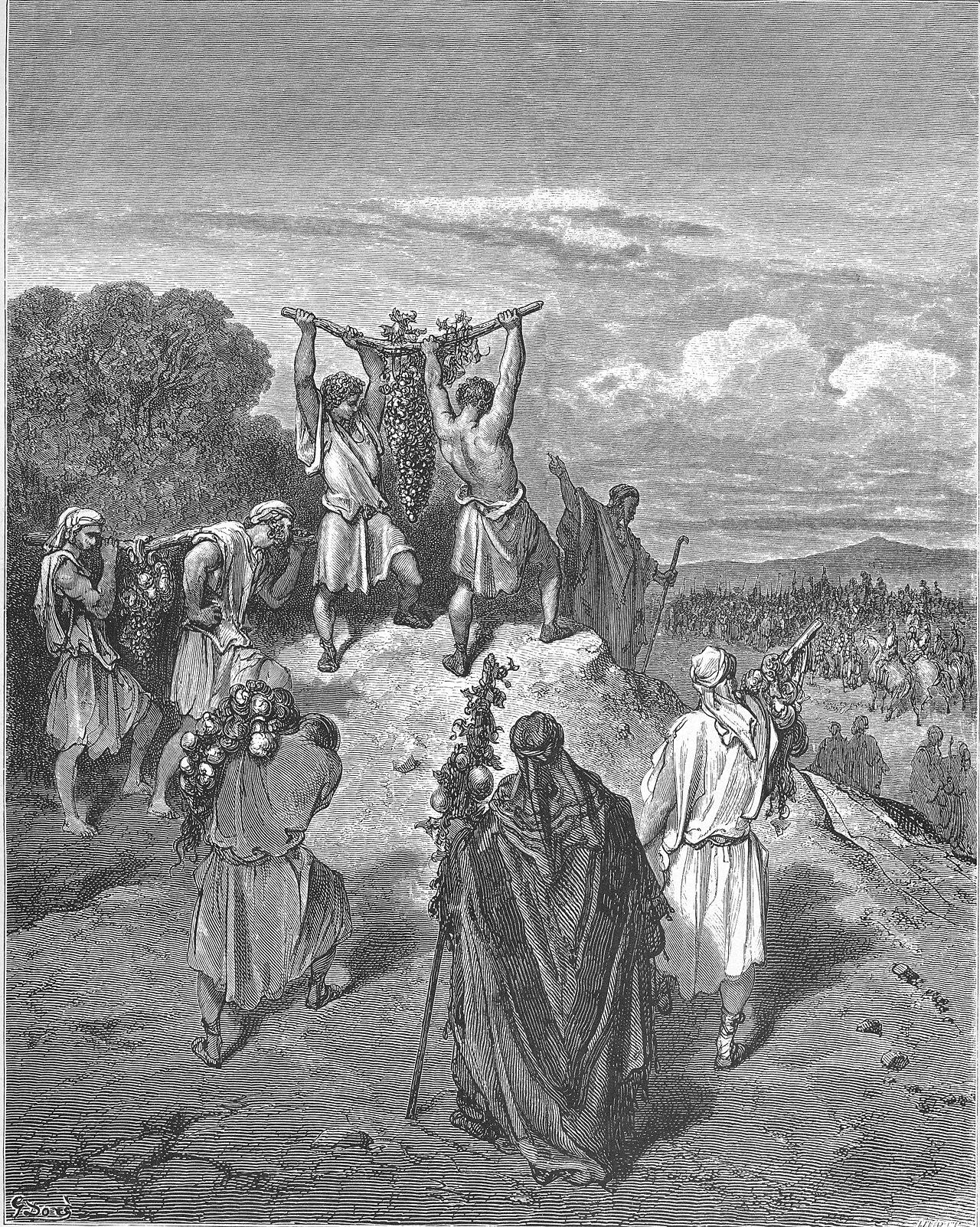
- Gustave Doré, La Sainte Bible (Tours: Alfred Mame et fils, 1866)The engravings on this page, plates 041b, 043 and 044 with the New Testament Transfiguration. Public domain.
- Biblical Archaeology Society, "What Does the Mesha Stele Say?"The standard scholarly translation of lines 14 to 18, on the taking of Nebo, quoted on this page.
- Egeria, Itinerarium (Pilgrimage), the Mount Nebo chapters, McClure and Feltoe translationPublic domain. Quoted on the church already standing on the summit and the view from its door, dated about 383 to 384.
- Custodia di Terra Santa and Pilgrimaps, on Sylvester Saller's excavation of Mount NeboSaller's three seasons, 1933 to 1937, his 1941 publication The Memorial of Moses on Mount Nebo, and Piccirillo's 1976 uncovering of the Diakonikon-Baptistery mosaic.
- Wikipedia, Mount NeboThe elevations of Ras Siyagha (about 710 m) and Khirbet el-Mukhayyat (about 790 m). No published survey or excavation report giving these figures was found in this pass, so the encyclopedia is cited directly rather than a source behind it.
Keep studying
On this page
Studies22
Every page that names it1
Doorway2
Lives that run through it1
Keep this page