
Judges 17 to 18 · Subject · Featured Study
Micah's idol and the migration of Dan
Judges 17 and 18, with the loss of Dan's land in Joshua 19:47 and the later worship at Dan in Kings and Amos.
Micah said, “Now I know that the LORD will be good to me, because a Levite has become my priest.”
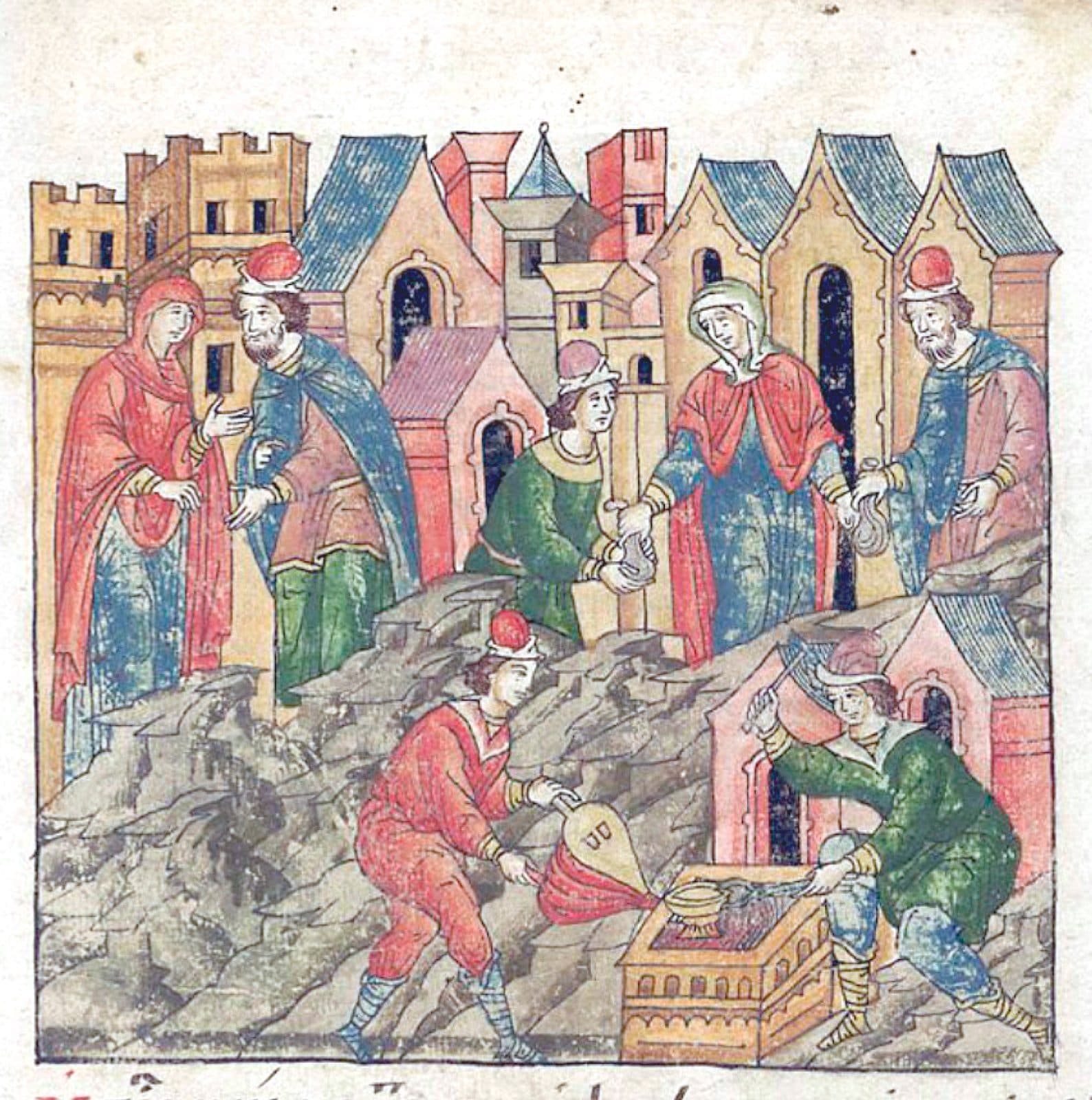
Anonymous Russian illuminators, Micah's idolatry, miniature in the Illustrated Chronicle of Ivan the Terrible (the Facial Chronicle), book 2, page 585, 1560s to 1570s. Public domain (published before 1930), via Wikimedia Commons, File:Facial_Chronicle_-_b.02%2C_p.585_-_Micah%27s_idolatry.jpg.
THE ARTWORKThe illuminators painted the silver of Judges 17:1 to 4 passing from hand to hand. Two figures talk at the left, and at the centre a woman gives a bag of silver to a young craftsman. In the foreground two workmen blow the bellows and beat the metal at the furnace where the image is made.
Summary
Judges 17 and 18 tell how an idol made in one man's house became the sanctuary of a whole tribe.
- Micah's mother had two hundred of her eleven hundred shekels of silver made into a graven image and a molten idol, and Micah added an ephod and household idols.
- Micah hired a young Levite from Bethlehem in Judah as his priest for ten shekels of silver a year, a suit of clothes and his provisions.
- Six hundred armed men of Dan, looking for land, stood at Micah's gate while their five scouts went in and took the image, the ephod and the household idols.
- They burned Laish, rebuilt it under the name Dan and set up the image there, with Jonathan son of Gershom as its priest.
The Shrine in Micah's House
Judges 17 sets a private shrine in the years when Israel had no king.
In those days there was no king in Israel; everyone did what was right in his own eyes.The narrator explains the shrine by the lack of a king, so the fault lies with the age as well as with one house.
Numbers 3:10 gave the duties of the priesthood to Aaron and his sons. A Levite outside that line had no right to the office, yet Micah ordained one.
The Shrine and the March, Drawn
Two numbered sequences, the making of the shrine and the march of Judges 18, and an atlas plate with five places of the story.
The silver passed through six steps in Judges 17, from a theft to a hired priest.
- The silver takenMicah admits to his mother that he took the eleven hundred shekels she had cursed.Judges 17:2
- The silver dedicatedShe dedicates the silver to the LORD for her son, to make a graven image and a molten idol.Judges 17:3
- The silversmithShe gives two hundred shekels to a silversmith, who makes the image and the idol.Judges 17:4
- The shrineMicah has a shrine, makes an ephod and household idols, and ordains one of his sons.Judges 17:5
- The Levite hiredA young Levite from Bethlehem agrees to stay for ten shekels a year, clothes and provisions.Judges 17:10 to 11
- The Levite ordainedMicah ordains the Levite, who becomes his priest and lives in his house.Judges 17:12 to 13
Six numbered steps, each with the verse that records it.
The six hundred went from Zorah and Eshtaol by Kiriath-jearim and Micah's house to Laish.
- Zorah and EshtaolSix hundred men armed for war set out from the towns of the tribe's first inheritance.Judges 18:11
- Kiriath-jearim in JudahThey camp west of the town, and the place keeps the name Mahaneh-dan.Judges 18:12
- Micah's house in the hill country of EphraimMicah and his neighbours overtake the army and turn back home, since the Danites are too strong for them.Judges 18:22 to 26
- Laish, renamed DanThey burn the city, rebuild it and give it the name of their forefather.Judges 18:27 to 29
Four numbered stops of the march in Judges 18, each with its verse.
Five places of the story stand on the plate, from Bethlehem in the south to Dan in the north.
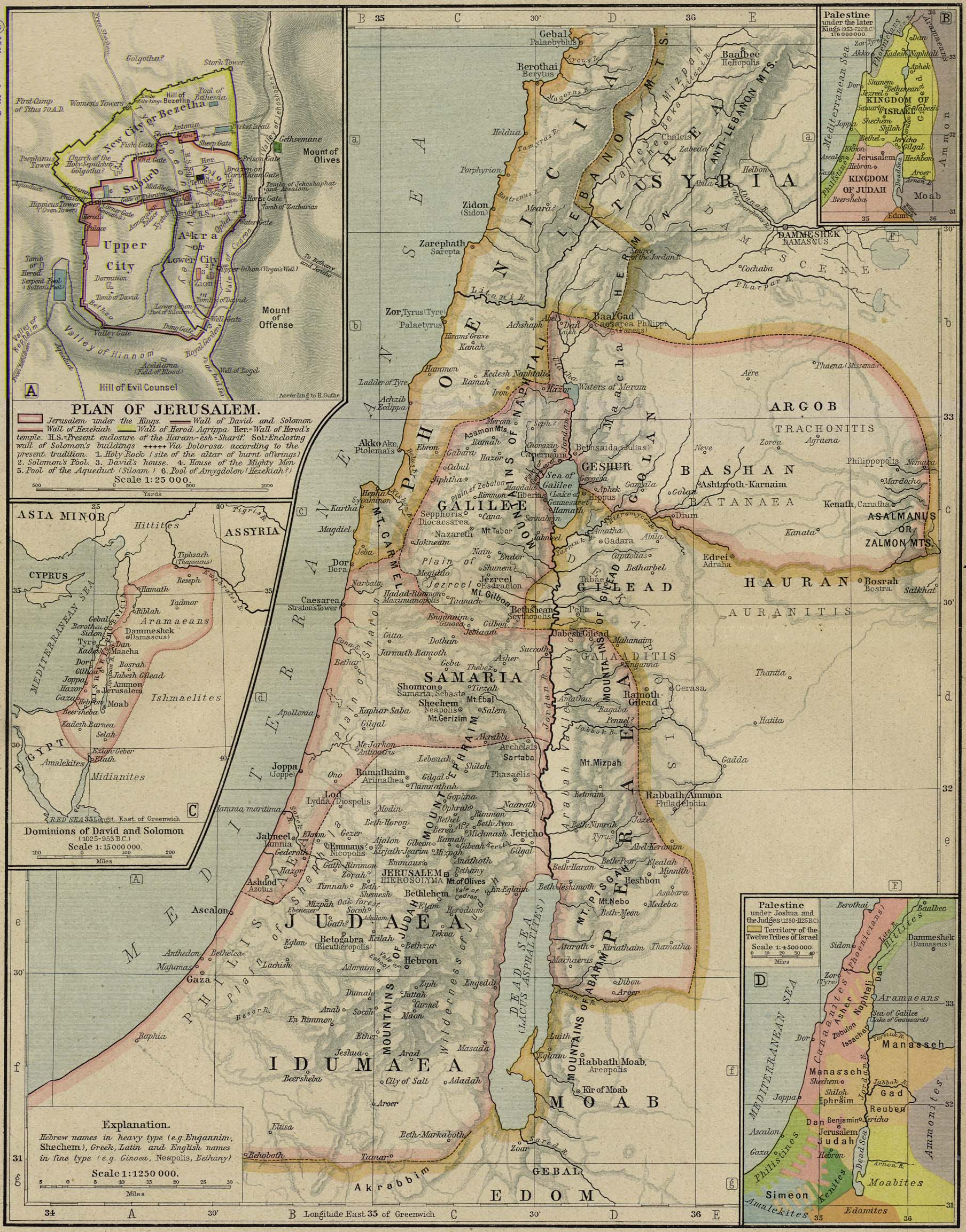
- 1Bethlehem, The young Levite came from Bethlehem in Judah. Judges 17:7 to 9
- 2Jerusalem, Jeroboam feared that Israel would go up to the house of the LORD here. 1 Kings 12:27
- 3Bethel, John Gill places the town on the border of Ephraim and Benjamin. 1 Kings 12:29
- 4Shiloh, Psalm 78:60 calls the sanctuary here the tabernacle of Shiloh. Psalm 78:60
- 5Dan, The city stood in a valley near Beth-rehob. Judges 18:28
Base map: Reference map of ancient Palestine, Rand McNally reference map (1926), public domain. Each place stands at its place page's coordinates, set on the plate by Jerusalem and Damascus, as the plate prints them.
Bethlehem, Jerusalem, Bethel, Shiloh and Dan marked on the plate, each with its verse.
The Danites Take the Shrine
Judges 18:1 to 29 tells why the Danites moved north and what they carried with them.
Joshua 19:40 to 46 gave Dan towns such as Zorah, Eshtaol, Aijalon and Ekron. Judges 1:34 says that the Amorites forced the Danites into the hill country and kept them out of the plain.
In those days there was no king in Israel, and the tribe of the Danites was looking for territory to occupy. For up to that time they had not come into an inheritance among the tribes of Israel.The refrain of the king returns as the Danites begin to look for land, so the two stories are told as one.
Then they said to him, “Please inquire of God to determine whether we will have a successful journey.” And the priest told them, “Go in peace. The LORD is watching over your journey.”The scouts ask the hired priest to inquire of God, and his answer is the only inquiry the expedition makes.
The priest won overJudges 18:19 to 20
“Be quiet,” they told him. “Put your hand over your mouth and come with us and be a father and a priest to us. Is it better for you to be a priest for the house of one person or a priest for a tribe and family in Israel?” So the priest was glad and took the ephod, the household idols, and the graven image, and went with the people.The Danites win the priest with a larger post, and he carries the sacred objects himself.
Laish taken and renamedJudges 18:7 and 18:24
So the five men departed and came to Laish, where they saw that the people were living securely, like the Sidonians, tranquil and unsuspecting. There was nothing lacking in the land and no oppressive ruler. And they were far away from the Sidonians and had no alliance with anyone.The scouts report a quiet city with no ruler and no allies, and verse 28 repeats that no one came to deliver it.
He replied, “You took the gods I had made, and my priest, and went away. What else do I have? How can you say to me, ‘What is the matter with you?’”Micah's question, “What else do I have?”, shows how much of his worship the six hundred carried away.
Adam Clarke, on Judges 18:29, notes that the new city became one of the two ends of the land, so that the phrase from Dan to Beersheba named the whole of it.
The road northJoshua 19:47; Judges 18:11 to 21
(Later, when the territory of the Danites was lost to them, they went up and fought against Leshem, captured it, and put it to the sword. So they took possession of Leshem, settled there, and renamed it after their father Dan.)The book of Joshua records the taking of Leshem in a parenthesis, and Judges 18 tells the same capture at length.
Jamieson, Fausset and Brown trace the route north from the camp near Kiriath-jearim.
“Their journey led them through the territory of Judah, and their first halting place was ‘behind,’ that is, on the west of Kirjath-jearim, on a spot called afterwards ‘the camp of Dan.’ Prosecuting the northern route, they skirted the base of the Ephraimite hills.”
Jamieson, Fausset & Brown · Commentary Critical and Explanatory on the Whole Bible · on Judges 18:11 to 21Reformed
The camp of Dan and SamsonJudges 13:25 and 18:12
And the Spirit of the LORD began to stir him at Mahaneh-dan, between Zorah and Eshtaol.Samson's story already uses the name Mahaneh-dan, which Judges 18:12 explains by the camp of the six hundred.
Adam Clarke, in his Commentary on Judges 18:12, took the name in Samson's story as some proof that the march came before the days of Samson.
The Priest at Dan and the Raised Letter
Judges 18:30 names the priest's grandfather, and the witnesses to the verse read the name two ways.
The Danites set up idols for themselves, and Jonathan son of Gershom, the son of Moses, and his sons were priests for the tribe of Dan until the day of the captivity of the land.The verse gives the shrine a priestly line and an end date, and its grandfather's name is the one disputed word.
The Hebrew text writes the grandfather's name with the letters of Moses and one more letter, a nun, set above the line. Read with the nun, the name is Manasseh; read without it, the name is Moses, whose son Gershom is named in Exodus 2:22 and 1 Chronicles 23:15.
| Witness | What it writes | The grandfather named |
|---|---|---|
| The Hebrew text | בֶּן־מְנַשֶּׁה | Manasseh as written |
| The Latin Vulgate | filii Moysi | Moses |
| The Greek text printed on New Advent | υἱοῦ Μωυσῆ | Moses |
| The Babylonian Talmud, Bava Batra 109b | Names Moses and explains why Manasseh is written | Moses |
| Rashi's commentary | Explains the raised letter as a mark of honour to the lawgiver | Moses |
| The King James Version | the son of Manasseh | Manasseh |
| Young's Literal Translation | son of Manasseh | Manasseh |
| The American Standard Version and the Berean Standard Bible | the son of Moses | Moses |
What the Talmud and Rashi sayBava Batra 109b; Rashi on the verse
The Talmud asks in Bava Batra 109b how the priest could be the son of Manasseh when 1 Chronicles 23:15 names Gershom among the sons of Moses. Its answer is that he was the son of Moses, and because he acted as King Manasseh acted, the verse linked him to Manasseh.
Rashi wrote on the verse that the nun was put in out of deference to Moses and written suspended to show that the priest was not a son of Manasseh. Matthew Henry follows the Latin reading and draws a lesson from it.
“The vulgar Latin reads it Moses. And if indeed Moses had a grandson that was rakish, and was picked up as a fit tool to be made use of in the setting up of idolatry, it is not the only instance (would to God it were!) of the unhappy degenerating of the posterity of great and good men.”
Matthew Henry · Commentary on the Whole Bible · on Judges 18:30Puritan
Adam Clarke on the nameCommentary on Judges 18:30
Adam Clarke allowed that Jonathan might be the young Levite of chapter 17 or a priest who replaced him. Of the name Manasseh he wrote that no one can tell who this Manasseh was, and that the reading does not appear to be genuine.
The Sanctuary at Dan after Judges
Texts from Judges to Amos follow the worship at Dan to the captivity of the land.
Worship at Dan began with Micah's image and was still sworn by in the days of Amos.
- The days of the judgesThe image made from the silver of Micah's mother becomes the image of the sanctuary at Dan.Judges 18:31
- Jeroboam's reignJeroboam sets one golden calf in Bethel and the other in Dan, and the people walk as far as Dan to worship.1 Kings 12:28 to 30
- Jehu's reignJehu does not turn away from the worship of the golden calves at Bethel and Dan.2 Kings 10:29
- The prophecy of AmosThose who swear by the god of Dan will fall, never to rise again.Amos 8:14
- Hoshea's ninth yearThe king of Assyria captures Samaria and carries the Israelites away to Assyria.2 Kings 17:6
A timeline of five texts on the sanctuary at Dan, each with its verse.
Jeroboam's calf at Dan1 Kings 12:28 to 29
Jeroboam's words over the calves in 1 Kings 12:28 repeat the words spoken over the calf at Sinai in Exodus 32:4.
John Gill, in his Exposition on Judges 18:30, thought it very probable that the Danites built a house for the image in the same place where Jeroboam later set up one of his calves. Matthew Henry gives the reason for the choice of the two cities.
“He set up these two at Dan and Beth-el (one the utmost border of his country northward), the other southward, as if they were the guardians and protectors of the kingdom. Beth-el lay close to Judah. He set up one there, to tempt those of Rehoboam's subjects over to him who were inclined to image-worship, in lieu of those of his subjects that would continue to go to Jerusalem.”
Matthew Henry · Commentary on the Whole Bible · on 1 Kings 12:28Puritan
When the story happenedJudges 17:1, 18:31 and 20:28
Judges places these chapters near its end, but the commentators date them early. Rashi, on Judges 17:1, set the story in the days of Othniel, the first of the judges, because Judges 18:31 has the image standing through all the years of the sanctuary at Shiloh.
“See the introduction to the Book of Judges. The only point of contact with the preceding history of Samson is, that we are still concerned with the tribe of Dan. See Jdg 18:1-2, note. Josephus combines in one narrative what we read here and in Jdg 1:34, and places it, with the story in Judg. 18–21, immediately after the death of Joshua.”
Albert Barnes · Notes, Explanatory and Practical, on the Old and New Testaments (1832-1869) · on Judges 17:1Evangelical
and Phinehas son of Eleazar, the son of Aaron, served before it.) The Israelites asked, “Should we again go out to battle against our brothers the Benjamites, or should we stop?” The LORD answered, “Fight, for tomorrow I will deliver them into your hand.”Phinehas, Aaron's grandson, still serves before the ark in the next story, and John Wesley, on Judges 17:1, took this as proof that these chapters happened soon after Joshua.
The Words of the Shrine
Four Hebrew words name the objects in Micah's house.
PESEL
The graven image comes from the verb pasal, to hew, and Brown, Driver and Briggs define the noun as idol or image.
MASSEKAH
The molten idol is a thing poured, and the lexicon gives molten metal, molten image and molten gods among its senses.
EPHOD
The ephod was a priestly garment, a shoulder cape worn by the priests and in a costlier form by the high priest.
TERAPHIM
The household gods of Judges 18:14 render the plural teraphim, which the Klein dictionary defines as a kind of household idols.
Gideon's ephodJudges 8:27
From all this Gideon made an ephod, which he placed in Ophrah, his hometown. But soon all Israel prostituted themselves by worshiping it there, and it became a snare to Gideon and his household.This is the first misuse of the priestly garment in the book, and Micah's shrine repeats it in a private house.
What the Text Leaves Unsaid
The two chapters are silent on four matters.
Judges does not say where Micah's house stood. It does not say whether the young Levite of chapter 17 is the Jonathan named at the end of chapter 18.
The text does not describe the household idols or say what the image looked like. It reports the priest's answer to the scouts in Judges 18:6 and does not say whether the LORD gave it.
Dan from Genesis to Revelation
Jacob and Moses each bless Dan in one saying, and John's list of the sealed tribes leaves Dan out.
Dan shall provide justice for his people as one of the tribes of Israel. He will be a snake by the road, a viper in the path that bites the horse’s heels so that its rider tumbles backward. I await Your salvation, O LORD.Jacob gives Dan a place among the tribes and a picture of a snake by the road, and then breaks off to wait for the LORD's salvation.
Concerning Dan he said: “Dan is a lion’s cub, leaping out of Bashan.”Moses gives Dan one line of blessing, and Jamieson, Fausset and Brown read the lion's leap as the sudden move that set a colony of Dan in the far north.
Jacob's cry for salvationGenesis 49:18
Matthew Henry reads the cry of Genesis 49:18 as a prayer lifted up in the middle of the blessings.
“It is no absurdity, when we are speaking to men, to lift up our hearts to God. The salvation he waited for was Christ, the promised seed, whom he had spoken of,”
Matthew Henry · Commentary on the Whole Bible · on Genesis 49:18Puritan
Where the refrain comes fromDeuteronomy 12:8 and Judges 21:25
You are not to do as we are doing here today, where everyone does what seems right in his own eyes.Moses forbade worship where everyone does what seems right in his own eyes, the words the refrain of Judges 17:6 takes up.
In those days there was no king in Israel; everyone did what was right in his own eyes.The last verse of Judges repeats the refrain of Micah's story and closes the book on it.
Dan missing from Revelation 7Revelation 7:5 to 8; Irenaeus, Against Heresies 5.30.2
From the tribe of Judah 12,000 were sealed, from the tribe of Reuben 12,000, from the tribe of Gad 12,000, from the tribe of Asher 12,000, from the tribe of Naphtali 12,000, from the tribe of Manasseh 12,000, from the tribe of Simeon 12,000, from the tribe of Levi 12,000, from the tribe of Issachar 12,000, from the tribe of Zebulun 12,000, from the tribe of Joseph 12,000, and from the tribe of Benjamin 12,000.John hears twelve tribes sealed, with Levi and Joseph among them and no tribe of Dan.
Irenaeus of Lyons, in Against Heresies 5.30.2, joined Jeremiah 8:16, where enemy horses are heard from Dan, to the coming of the Antichrist. He gave that as the reason the tribe is not reckoned in the Apocalypse among those who are saved. Revelation 7 itself gives no reason for the omission.
Voices on the Shrine
Albert Barnes on the worship in Micah's house, and Matthew Henry on how long the image stood.
The worship of the ageAlbert Barnes on Judges 17:13
Albert Barnes reads Micah's words as a sign of his age.
“This shows the ignorance as well as the superstition of the age (compare 2Ki 18:22), and gives a picture of the lawlessness of the times. The incidental testimony to the Levitical priesthood is to be noted; but the idolatrous worship in the immediate neighborhood of Shiloh is passing strange.”
Albert Barnes · Notes, Explanatory and Practical, on the Old and New Testaments (1832-1869) · on Judges 17:13Evangelical
How long the image stoodMatthew Henry on Judges 18:31
Matthew Henry measures the life of the image by the years of the ark at Shiloh.
“That these images continued till Samuel's time, for so long the ark of God was at Shiloh; and it is probable that in him time effectual care was taken to suppress and abolish this idolatry.”
Matthew Henry · Commentary on the Whole Bible · on Judges 18:31Puritan
What Micah Worshipped
Two readings of the shrine in Micah's house, each with its holders and the objection to it
Micah meant to worship the LORD by an imageAdam Clarke; John Wesley; Albert Barnes
Adam Clarke, in his Commentary on Judges 17:5, translated the house of gods as a house of God, a private chapel for the worship of the true God. On Judges 18:24 he read Micah's gods as symbols of the divine presence such as the teraphim and the ephod. John Wesley, on Judges 17:3, held that mother and son never meant to forsake the true God and only meant to worship Him by an image.
“Such a superstitious and unlawful mode of worshipping Yahweh is quite of a piece with Jdg 8:27; Jdg 11:31; 1Ki 12:28, etc. It argues but slight acquaintance with the Ten Commandments, which, from the ignorance of reading and writing, were probably not familiar to the Israelites in those unsettled times. The mother intimates that the consecration of the silver was for the benefit of her son and his house, not for her own selfish advantage: and that she adheres to her original design of consecrating this silver for her son’s benefit.”
Albert Barnes · Notes, Explanatory and Practical, on the Old and New Testaments (1832-1869) · on Judges 17:3Evangelical
The objection rests on Exodus 20:4, which forbids an idol of any form, and on Micah's own words in Judges 18:24, which call the objects the gods he had made.
Micah's shrine was a temple of idolsRashi
Rashi, on Judges 17:5, read the house of gods as a temple of idol worship. He held that the word god is profane throughout the chapter, except where Judges 18:31 names the house of God at Shiloh. On Judges 18:5 he read the inquiry of the scouts as an inquiry through the figurines, and on verse 6 he called the figurines worthless.
The objection rests on Judges 17:3 and 17:13, where the mother and the son both speak of the LORD by name and look to Him for blessing.
Books on Judges 17 and 18
Four works a reader can open on the shrine, the priest and the tribe of Dan.
Notes, Explanatory and Practical, on the Old and New Testaments
Albert Barnes · 1832 to 1869
Barnes comments verse by verse and sets the shrine beside Gideon's ephod and Jeroboam's calves.
Commentary on the Whole Bible
Matthew Henry · 1710
Henry reads each passage for its use in the reader's own life.
Rashi on Judges
Rashi, in the Metsudah translation · about 1100
The Metsudah translation of Rashi on Judges is free on Sefaria, chapter by chapter.
Read on SefariaAgainst Heresies
Irenaeus of Lyons · about 180
Irenaeus wrote against the false teachers of his own day, and the last book of the work turns to the end of the age.
Read on New AdventKeep Yourselves from Idols
Two texts of John answer the shrine at Dan.
Micah tried to secure the LORD's favour with silver, an image and a hired priest, and the Danites carried his shrine to the edge of the land. The two chapters ask the reader to worship God as He has said, and to give up any object or office that promises His favour on easier terms.
But a time is coming and has now come when the true worshipers will worship the Father in spirit and in truth, for the Father is seeking such as these to worship Him. God is Spirit, and His worshipers must worship Him in spirit and in truth.”Jesus names the worship the Father seeks, in spirit and in truth, and verse 21 sets it free of any one mountain or city.
Little children, keep yourselves from idols.John closes his letter with the command Micah's house broke, given to believers who know the true God in His Son.
Keep studying
Doctrines6
Peoples and groups3