

Bartolomé Esteban Murillo, Laban Searching for his Stolen Household Gods, 1665 to 1670. CC0.
Genesis 31 · Place · Featured Study
Gilead
A region of Israel's eastern tribes, named in 130 verses of the Berean text.
Laban searched every tent in Gilead for his household gods and found none.
So he fled with all his possessions, crossed the Euphrates, and headed for the hill country of Gilead.
- Today
- north-western Jordan
- Region
- Transjordan
- First named
- Genesis 31:21 “…for the hill country of Gilead.”
- Last named
- Zechariah 10:10 “…I will bring them to Gilead and Lebanon…”
Laban searched every tent in Gilead for his household gods and found none.
Summary
Gilead is the hill country east of the Jordan that runs from the edge of the plateau of Moab to the Yarmuk river.
- Jacob and Laban made their last covenant in its hills.
- Moses gave its land to Reuben, Gad and half the tribe of Manasseh.
- Its balm was carried to Egypt, and Jeremiah asked whether there was no balm in Gilead.
Where Gilead Stands in Scripture
The first verse to name it and the last.
Joshua and Judges hold 40 of the verses that name Gilead, and the name stands both alone and in place names such as Ramoth-gilead and Jabesh-gilead.
So he fled with all his possessions, crossed the Euphrates, and headed for the hill country of Gilead.The region enters Scripture as the place Jacob made for when he fled from Laban.
I will bring them back from Egypt and gather them from Assyria. I will bring them to Gilead and Lebanon until no more room is found for them.The last verse to name Gilead promises that God will bring His scattered people back to it.
Joshua and Judges hold 40 of the verses that name Gilead, and the name stands both alone and in place names such as Ramoth-gilead and Jabesh-gilead.
I will bring them back from Egypt and gather them from Assyria. I will bring them to Gilead and Lebanon until no more room is found for them.The last verse to name Gilead promises that God will bring His scattered people back to it.
Gilead on the Map
The places of Jacob's return and of the tribes, each with its verse.
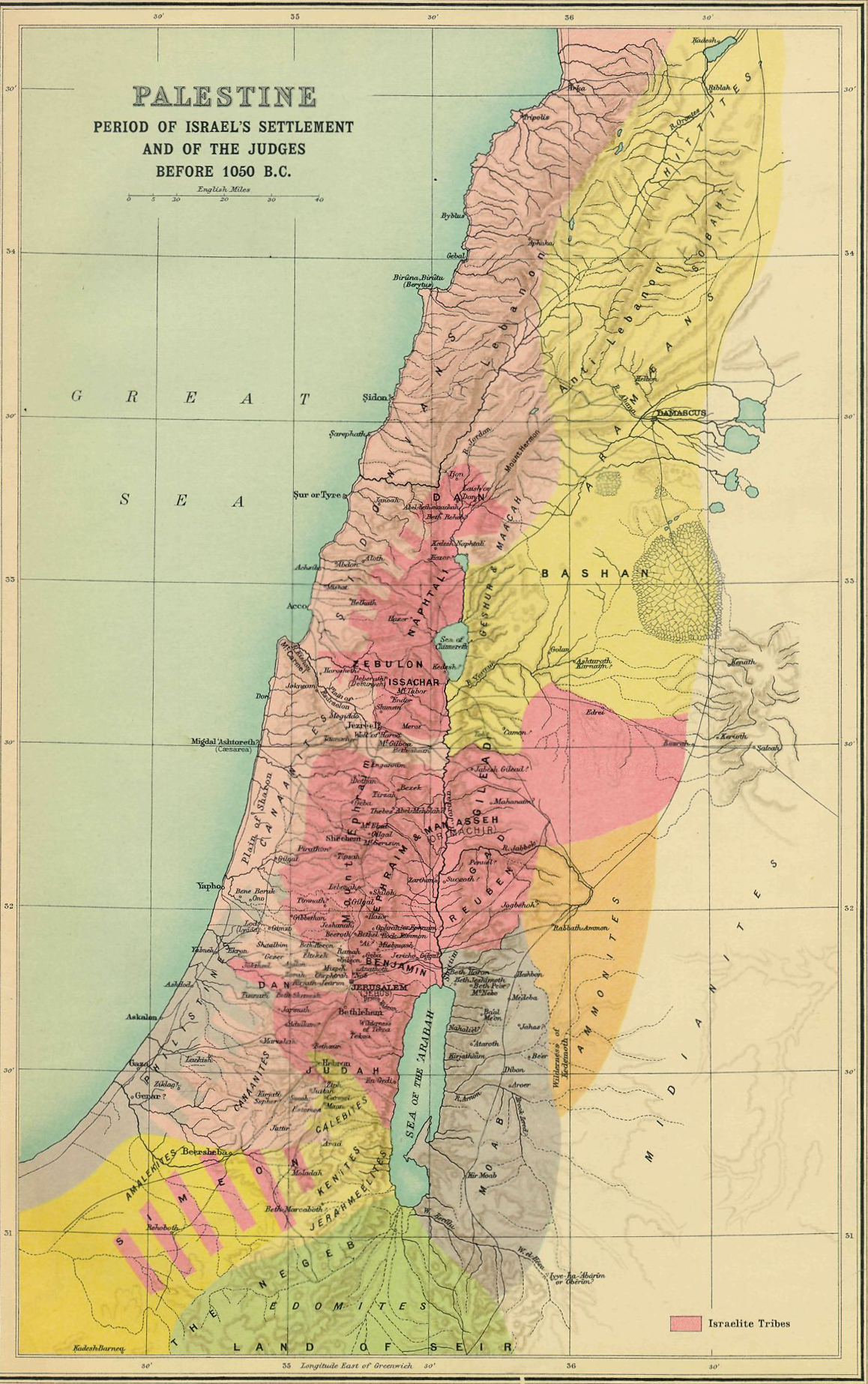
Smith's plate prints GILEAD along the east bank of the Jordan, with the Jabbok running through it.
about 50 km (31 miles)
- Located: the site is known
- Probable: OpenBible scores 500 to 799
- Proposed: OpenBible scores under 500
- 1?Mizpah of Gilead, Jephthah came home to Mizpah after his victory over the Ammonites. Judges 11:34
- 2Mahanaim, The angels of God met Jacob here, and he named the place two camps. Genesis 32:2
- 3Peniel, Jacob wrestled here until daybreak by the ford of the Jabbok. Genesis 32:30
- 4Succoth, Jacob built a house here and shelters for his livestock. Genesis 33:17
- 5?Jabesh-gilead, Nahash the Ammonite besieged the town, and Saul came to its rescue. 1 Samuel 11:1
- 6Ramoth-gilead, Moses set it apart as a city of refuge for the Gadites. Deuteronomy 4:43
Base map: Israel's settlement and the period of the Judges, George Adam Smith, Atlas of the Historical Geography of the Holy Land (1915), public domain. Places with a place page stand at its coordinates and the others at the point cited for each, set on the plate by Jerusalem and Damascus, as the plate prints them.
Six places, from Ramoth-gilead in the north-east to Succoth near the river.
The Heap of Witness
Genesis 31:44 to 50, and the words often read as a blessing.
Laban gave the heap an Aramaic name, Jegar-sahadutha, and Jacob a Hebrew one, Galeed. Adam Clarke, in his Commentary of 1832, notes that the two names mean the same thing, the heap of witness. The Hebrew Bible explains the name Gilead from Galeed.
It was also called Mizpah, because Laban said, “May the LORD keep watch between you and me when we are absent from each other.The covenant's oath is spoken here, in Laban's words to Jacob.
Readers often take these words as a blessing between friends. In Genesis they guard a treaty: Laban warns Jacob not to mistreat his daughters or to take other wives, with God as witness when no one else is there to see.
Gilead and the Tribes
The tribes east of the Jordan and three men of Gilead.
Reuben and Gad asked Moses for the land east of the Jordan because their herds were large. Moses granted it on condition that their fighting men crossed over with the other tribes until the land west of the river was taken.
So at that time we took possession of this land. To the Reubenites and Gadites I gave the land beyond Aroer along the Arnon Valley, and half the hill country of Gilead, along with its cities. To the half-tribe of Manasseh I gave the rest of Gilead and all of Bashan, the kingdom of Og. (The entire region of Argob, the whole territory of Bashan, used to be called the land of the Rephaim.)Moses sets the line between the tribes across the middle of Gilead.
JEPHTHAH
The elders of Gilead made him their head against the Ammonites, and he was buried in one of its cities.
BARZILLAI
A Gileadite of Rogelim, he brought beds, bowls and food to David at Mahanaim in the flight from Absalom.
ELIJAH
The prophet from Tishbe came from among the settlers of Gilead to speak to Ahab.
Gilead Outside Scripture
Assyria made it a province, and Arabic keeps its name.
Tiglath-pileser III of Assyria made Gilead his province of Gal'azu about 733 BC. In Arabic the name Jalʿad still names the hills north and south of the Jabbok.
In the days of Pekah king of Israel, Tiglath-pileser king of Assyria came and captured Ijon, Abel-beth-maacah, Janoah, Kedesh, Hazor, Gilead, and Galilee, including all the land of Naphtali, and he took the people as captives to Assyria.The verse is Scripture's record of the Assyrian conquest of Gilead.
What Scripture Leaves Unsaid
Two questions the text leaves open.
Where on the hills did the heap stand?Genesis 31:45 to 52
Genesis names the heap and the pillar beside it and gives no landmark that fixes the spot. OpenBible scores its proposal for Mizpah of Gilead at 150 of 1,000.
Did Jacob and Laban meet again?Genesis 31:55
Laban kissed his grandchildren and his daughters at dawn and went home, and Genesis records no later meeting.
Where It Points
Two verses of Jeremiah, one for Judah and one for Egypt.
Gilead was famous for its balm, and Jeremiah used it to ask about his own people.
Is there no balm in Gilead? Is no physician there? Why then has the health of the daughter of my people not been restored?The question stands at the end of Jeremiah's lament over Judah's coming ruin.
Go up to Gilead for balm, O Virgin Daughter of Egypt! In vain you try many remedies, but for you there is no healing.Jeremiah turns the same picture on Egypt, whose many remedies fail.
Voices on Gilead
Three teachers on Jacob's flight, the balm and the tribes' border, from Cyril of Alexandria to Albert Barnes.
died 444 · Cyril of Alexandria
GLAPHYRA ON Genesis, 5.5
Laban's pursuit read as the world's anger at Christ
The quotation1 quotation
“The fact that the world should have been offended because of Christ, after the increase in the flocks of believers, and that it, excited by its anger, would have reacted, does not need to be confirmed with a long speech. Just see how Laban, together with his sons, pursued Jacob, who was running away, and recalled him. Christ himself, in a sense, departed from the world with his brides, that is, the churches, and moved out with the entire household by spiritually addressing his companions with these words: ‘Arise, let us go from here.’”
Cyril of Alexandria · GLAPHYRA ON Genesis, 5.5 · on Genesis 31:21Patristic
1662 to 1714 · Matthew Henry
Commentary on the Whole Bible
Christ's blood as the balm of Gilead
The quotation1 quotation
“The physician and physic were both ready, but the patient was wilful and irregular, would not be tied to rules, but must be humoured. Note, If sinners die of their wounds, their blood is upon their own heads. The blood of Christ is balm in Gilead, his Spirit is the physician there, both sufficient, all-sufficient, so that they might have been healed, but would not.”
Matthew Henry · Commentary on the Whole Bible · on Jeremiah 8:22Puritan
1798 to 1870 · Albert Barnes
Notes, Explanatory and Practical, on the Old and New Testaments (1832-1869)
Reuben and Gad held the land between the Jabbok and the Arnon
The quotation1 quotation
“The sense is that the Reubenites and Gadites were to possess the district from the Jabbok on the north to the Arnon on the south, including the middle part of the valley of the Arnon, and the territory (‘coast’ or ‘border’) thereto pertaining.”
Albert Barnes · Notes, Explanatory and Practical, on the Old and New Testaments (1832-1869) · on Deuteronomy 3:16Evangelical
What Was the Balm of Gilead?
Two readings of the Hebrew word tsori, each with its holders.
And as they sat down to eat a meal, they looked up and saw a caravan of Ishmaelites coming from Gilead. Their camels were carrying spices, balm, and myrrh on their way down to Egypt.The first mention of the balm sets it among the costly goods of a caravan bound for Egypt.
The lexicon gives tsori as a distillation, a balsam. The Wikipedia article on the balm of Gilead reports that no identification of the plant is conclusive.
The balsam, Pliny's opobalsamumJamieson, Fausset and Brown, 1871, on Jeremiah 8:22
Jamieson, Fausset and Brown name it first as the opobalsamum of Pliny, the sap of the balsam shrub, and say that many physicians settled in Gilead where it abounded.
The objection: John Gill, in his Exposition of 1748 to 1763, says the balsam grew near Jericho and En-gedi, on the west side of the Jordan, and not in Gilead.
The resin of the terebinth or the pineSamuel Bochart, as Jamieson, Fausset and Brown report him; John Gill
Jamieson, Fausset and Brown give Bochart's alternative, the resin drawn from the terebinth. Gill takes the balm as turpentine or rosin, a gum that drops from pine trees and is good for healing, and the Septuagint renders the word as pine resin.
The objection: the Samaritan Pentateuch and the Syriac Bible read the word as wax, so the ancient versions do not agree on it.
Books to Read Next
Two works, each free to read online.
The Historical Geography of the Holy Land, chapter 27
George Adam Smith · 1894
Smith gives a chapter to Israel in Gilead and Bashan and to the part the region played in Israel's history.
Read at archive.orgCommentary on the Whole Bible
Matthew Henry · 1710
Henry reads the covenant at the heap and Jeremiah's balm for their lessons to the reader.
Read at CCELThe Heap and the Balm
Gilead is remembered for a covenant made between two wary men and for its healing balm.
Peter writes of Christ, “By His stripes you are healed” (1 Peter 2:24), and Jeremiah's question asks the reader to come to Him for that healing.
Sources
Scripture is the Berean Standard Bible.
- Strong's Hebrew dictionary, h1568, h1567 and h6875.
- George Adam Smith, The Historical Geography of the Holy Land, 1894, chapter 27, Israel in Gilead and Bashan (the archive.org copy printed 1897), public domain.
- Wikipedia, Gilead, revision 1380369824, read on 20 October 2026.
- Wikipedia, Balm of Gilead, revision 1376030376, read on 20 October 2026.
- OpenBible.info, Bible Geocoding Data, ancient.jsonl, CC BY.
- Adam Clarke, Commentary on the Bible, 1832, on Genesis 31:47.
- Jamieson, Fausset and Brown, Commentary Critical and Explanatory on the Whole Bible, 1871, on Jeremiah 8:22.
- John Gill, Exposition of the Old Testament, 1748 to 1763, on Jeremiah 8:22.
- Cyril of Alexandria, Glaphyra on Genesis 5.5, on Genesis 31:21.
- Matthew Henry, Commentary on the Whole Bible, 1710, on Jeremiah 8:22.
- Albert Barnes, Notes, Explanatory and Practical, on the Old and New Testaments, on Deuteronomy 3:16.
Keep Studying
Read it4