
Deuteronomy 18 · Subject · Featured Study
The forbidden arts
The law of Deuteronomy 18:9 to 14 names nine practices of the peoples of Canaan and forbids every one of them.
Where the nations listened to diviners, Israel was to listen to the prophet the LORD would raise up.
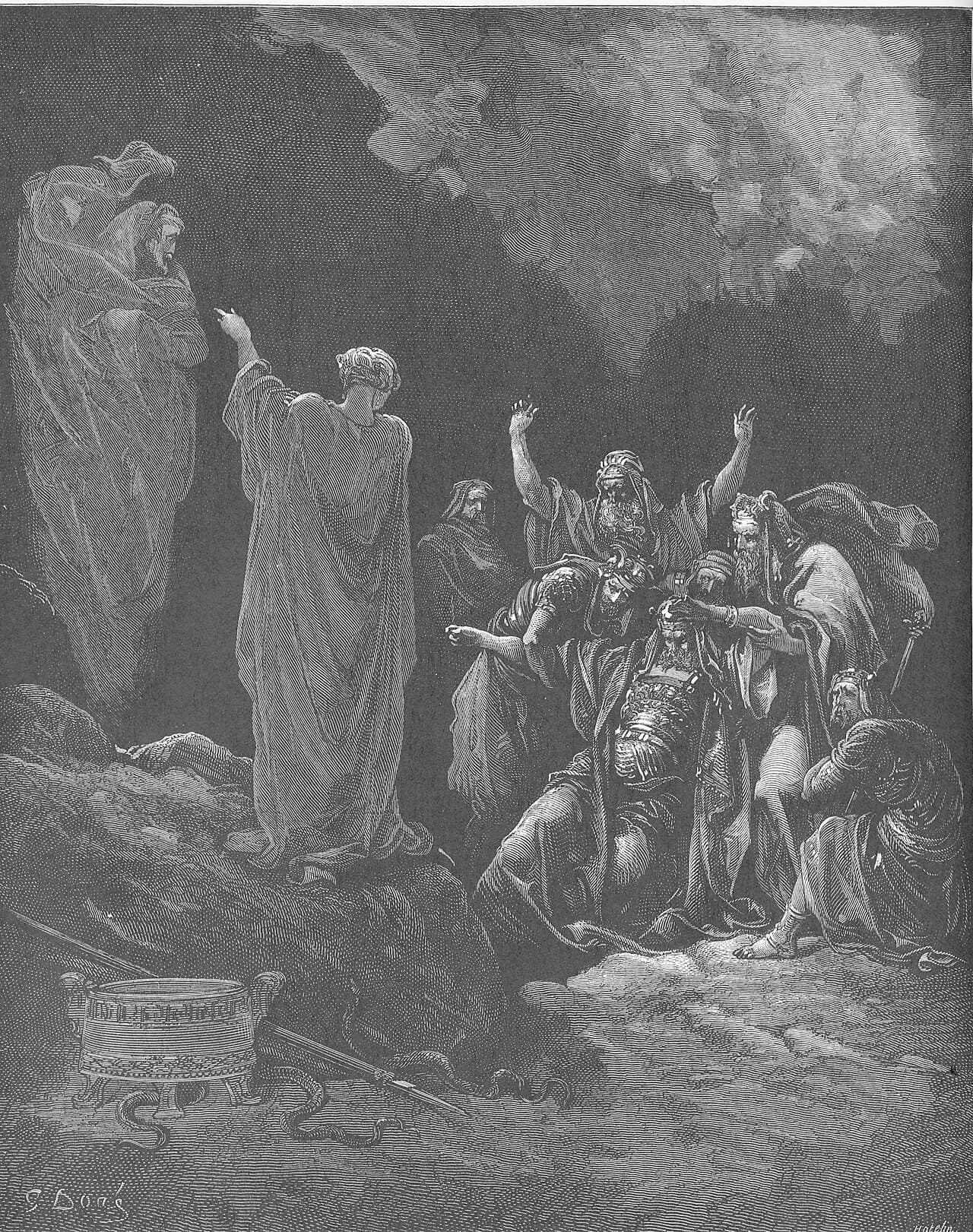
Gustave Doré, Saul and the Witch of Endor, 1866, from Doré's English Bible. Public domain (published before 1930), via Wikimedia Commons.
THE ARTWORKDoré drew the night of 1 Samuel 28 as the woman points to the old man in a robe who is coming up. Saul lies fallen with his crown still on, and his two men and others stand over him in fear.
Summary
The practices sought hidden knowledge or power apart from God, from reading omens to calling up the dead.
- The law calls whoever does any of these things detestable to the LORD.
- Kings of both Israel and Judah turned to these practices.
- The New Testament meets the same practices at Philippi and Ephesus and counts sorcery among the acts of the flesh.
The Law in Deuteronomy 18
Moses gives the ban, the list, the reason and the command in six verses
Moses gave this law in the land of Moab, east of the Jordan, before Israel crossed into Canaan. The chapter first sets out the portion of the priests and the Levites, and then it turns to the ways of the nations Israel would find in the land.
When you enter the land that the LORD your God is giving you, do not imitate the detestable ways of the nations there.The next two verses name the practices one by one, beginning with a parent who gives a child to the fire.
Let no one be found among you who sacrifices his son or daughter in the fire, practices divination or conjury, interprets omens, practices sorcery, casts spells, consults a medium or spiritist, or inquires of the dead.The reason follows, and it reaches back to the nations who already lived in the land.
For whoever does these things is detestable to the LORD. And because of these detestable things, the LORD your God is driving out the nations before you.Against the whole list Moses sets one command for Israel.
You must be blameless before the LORD your God.Verse 14 names the guides the nations trusted and closes the passage.
Though these nations, which you will dispossess, listen to conjurers and diviners, the LORD your God has not permitted you to do so.What Israel might study of the practicesRashi on Deuteronomy 18:9
Rashi, Rabbi Shlomo Yitzchaki of Troyes (1040 to 1105), the standard medieval Jewish commentator on the Torah, reads the verb of Deuteronomy 18:9 closely. The verse forbids Israel to learn to do these things. Rashi takes the wording to allow learning the practices in order to understand them and to teach others. He gives Sifrei Devarim and the Talmud, Sanhedrin 68a, for the reading, so that a parent can tell a child why the practices are forbidden.
One practice is enoughRashi on Deuteronomy 18:12
Rashi notes that Deuteronomy 18:12 speaks of all who do these things, and he takes the wording to mean that a person who does even one of them is detestable to the LORD. He cites Sifrei Devarim and the Talmud, Makkot 24a.
What the Arts Sought, and What the LORD Gave
The nations' guides beside the LORD's own answers, need by need
| What was sought | The nations' way | What the LORD set in its place | Verse |
|---|---|---|---|
| To learn what lies ahead | Signs read in lots, clouds and omens | A prophet like Moses, with the LORD's words in his mouth | Deuteronomy 18:18 |
| To decide a matter for the nation | Arrows shaken and a liver examined, as by the king of Babylon | The Urim, consulted by the priest before the LORD | Numbers 27:21 |
| To seek counsel in trouble | Mediums, spiritists and the dead | Their God, His law and His testimony | Isaiah 8:19 to 20 |
| To gain power against harm | Sorcery and the casting of spells | The LORD's blessing, against which no spell can stand | Numbers 23:23 |
| To drive out an evil spirit | A name borrowed from another man's preaching, as by the sons of Sceva | The name of Jesus Christ, spoken by His servant | Acts 16:18 |
| To win a god's favour | A child offered to Molech | A heart blameless before the LORD | Deuteronomy 18:13 |
Why Israel needed no divinerRashi on Deuteronomy 18:14
Rashi reads Deuteronomy 18:14 as the reason for the ban. Israel had no need of conjurers and diviners, he explains, because the LORD had made His presence rest on the prophets and on the Urim and Thummim.
The three ways Saul triedAdam Clarke on 1 Samuel 28:6
Adam Clarke, in his Commentary on the Bible of 1832, names dreams, the Urim and the prophets as the three ways by which an answer from God ordinarily came.
From Endor to Ephesus
From Saul to the fall of the north, Manasseh, Josiah and Isaiah, then Philippi, Ephesus and Galatia
Saul had removed the mediums and spiritists from the land himself, and then the Philistines camped against him at Shunem.
He inquired of the LORD, but the LORD did not answer him by dreams or Urim or prophets. Then Saul said to his servants, “Find me a woman who is a medium, so I can go and consult her.” “There is a medium at Endor,” his servants replied.Manasseh, king of Judah, did almost every practice on the list, beginning with his own son.
He sacrificed his own son in the fire, practiced sorcery and divination, and consulted mediums and spiritists. He did great evil in the sight of the LORD, provoking Him to anger.In Isaiah's day men urged the people of Judah to ask the dead for guidance, and the prophet sent them back to God and to His word.
When men tell you to consult the spirits of the dead and the spiritists who whisper and mutter, shouldn’t a people consult their God instead? Why consult the dead on behalf of the living? To the law and to the testimony! If they do not speak according to this word, they have no light of dawn.The gospel reached cities where these practices were a trade.
One day as we were going to the place of prayer, we were met by a slave girl with a spirit of divination, who earned a large income for her masters by fortune-telling. This girl followed Paul and the rest of us, shouting, “These men are servants of the Most High God, who are proclaiming to you the way of salvation!” She continued this for many days. Eventually Paul grew so aggravated that he turned and said to the spirit, “In the name of Jesus Christ I command you to come out of her!” And the spirit left her at that very moment.And a number of those who had practiced magic arts brought their books and burned them in front of everyone. When the value of the books was calculated, the total came to fifty thousand drachmas. So the word of the Lord powerfully continued to spread and prevail.The Chronicler on the death of Saul1 Chronicles 10:13 to 14
The Chronicler names Saul's visit to the medium among the reasons for his death, after the battle on Mount Gilboa.
So Saul died for his unfaithfulness to the LORD, because he did not keep the word of the LORD and even consulted a medium for guidance, and he failed to inquire of the LORD. So the LORD put him to death and turned the kingdom over to David son of Jesse.Sorcery among the acts of the fleshGalatians 5:20
Paul's list in Galatians 5 carries the ban into the churches.
idolatry and sorcery; hatred, discord, jealousy, and rage; rivalries, divisions, factions,Rebellion compared with divination1 Samuel 15:23; Gregory the Dialogist
For rebellion is like the sin of divination, and arrogance is like the wickedness of idolatry. Because you have rejected the word of the LORD, He has rejected you as king.”Gregory the Dialogist, in his Commentary on 1 Kings, explains the comparison. The diviner strove to know hidden things of God, and the rebel resists because he judges that he knows the will of God better.
The northern kingdom and Josiah's reform2 Kings 17:17 and 23:24
Two later passages of Kings record the practices in the northern kingdom before its fall and their removal from Judah under Josiah.
They sacrificed their sons and daughters in the fire and practiced divination and soothsaying. They devoted themselves to doing evil in the sight of the LORD, provoking Him to anger.Furthermore, Josiah removed the mediums and spiritists, the household gods and idols, and all the abominations that were seen in the land of Judah and in Jerusalem. He did this to carry out the words of the law written in the book that Hilkiah the priest had found in the house of the LORD.The seven sons of ScevaActs 19:13 to 17
Before the books were burned, seven sons of Sceva, Jewish exorcists at Ephesus, tried to invoke the name of the Lord Jesus over a man with an evil spirit.
Eventually, one of the evil spirits answered them, “Jesus I know, and I know about Paul, but who are you?” Then the man with the evil spirit jumped on them and overpowered them all. The attack was so violent that they ran out of the house naked and wounded. This became known to all the Jews and Greeks living in Ephesus, and fear came over all of them. So the name of the Lord Jesus was held in high honor.What the Text Says
Two things the verses settle, about the gifts and the test of a word
THE GIFTS COME FROM THE LORD
Paul tells the church to desire spiritual gifts, especially prophecy, and Acts 2:17 gives prophecy to sons and daughters alike.
EVERY WORD IS TESTED
John tells believers to test the spirits, because many false prophets have gone out into the world.
Why Samuel's death is told firstRashi on 1 Samuel 28:3
Balaam's art and IsraelNumbers 22 to 24; Joshua 13:22
The elders of Moab and Midian came to Balaam with the fees for divination in hand, and Joshua 13:22 calls him the diviner. His own oracle in Numbers 23 gives the verdict on his art.
For there is no spell against Jacob and no divination against Israel. It will now be said of Jacob and Israel, ‘What great things God has done!’Every Law and Every Case
Nineteen passages from Exodus to Galatians that forbid the practices or record them
| Who | What the passage records | Passage |
|---|---|---|
| The law | A sorceress is not to be allowed to live | Exodus 22:18 |
| The law | Divination and sorcery are forbidden | Leviticus 19:26 |
| The law | Turning to mediums or spiritists defiles | Leviticus 19:31 |
| The law | The one who turns to them is cut off | Leviticus 20:6 |
| The law | A medium or spiritist is to be stoned | Leviticus 20:27 |
| Balaam | No spell or divination stands against Israel | Numbers 23:23 |
| Moses | Nine practices named and forbidden | Deuteronomy 18:10 to 11 |
| Samuel | Rebellion is likened to the sin of divination | 1 Samuel 15:23 |
| Saul | The land cleared of mediums before his visit | 1 Samuel 28:3 |
| Saul | A woman who is a medium sought at Endor | 1 Samuel 28:7 |
| Israel in the north | Divination practised before the exile | 2 Kings 17:17 |
| Manasseh | Sorcery practised and mediums consulted | 2 Kings 21:6 |
| Josiah | Judah cleared of mediums and spiritists | 2 Kings 23:24 |
| The Chronicler | A medium consulted, and Saul put to death for unfaithfulness | 1 Chronicles 10:13 |
| Isaiah | The prophet's answer to those who whisper and mutter | Isaiah 8:19 |
| Micah | The end of sorceries and fortune-tellers foretold | Micah 5:12 |
| Paul at Philippi | A spirit of divination cast out of a slave girl | Acts 16:18 |
| Ephesus | Magic books worth fifty thousand drachmas set on fire | Acts 19:19 |
| Paul | Sorcery counted among the acts of the flesh | Galatians 5:20 |
The Nine Names in Hebrew
Four Hebrew words and five two-word phrases, with three Greek words of the New Testament
| The Berean words | Hebrew | What the practice was | Where it recurs |
|---|---|---|---|
| Sacrifices his son or daughter in the fire | ma'avir ba'esh (H5674, H784) | An offering to Molech, as Rashi explains | 2 Kings 17:17 |
| Practices divination | qosem qesamim (H7080, H7081) | Seeking the future by lots and auguries, in Clarke's account | Ezekiel 21:21 |
| Conjury | me'onen (H6049) | Foretelling events from the clouds, the planets and present occurrences, in Clarke's account | Micah 5:12 |
| Interprets omens | menachesh (H5172) | Reading omens, perhaps from serpents, as Clarke suggests on Leviticus 19:26 | Genesis 44:5 |
| Practices sorcery | mekhashef (H3784) | Working magic by whispered spells, in the lexicon's gloss | Exodus 7:11 |
| Casts spells | chover chaver (H2266, H2267) | Charming snakes and scorpions into one place, as Rashi explains | Psalm 58:5 |
| Consults a medium | sho'el ob (H7592, H178) | Bringing up the one the inquirer names, as Saul asked at Endor | 1 Samuel 28:7 |
| Spiritist | yidde'oni (H3049) | A knowing one, who in Wesley's account seeks secret things by forbidden ways | Leviticus 19:31 |
| Inquires of the dead | doresh el ha-metim (H1875, H4191) | Seeking counsel from the dead, in Barnes's words one who interrogates the dead | Isaiah 8:19 |
Qasam, to divine, stands 20 times in the Old Testament, and cheber, a spell, stands 4 times.
- Reading signs
- Working spells
- Asking the dead
The 7 word counts as a table
| Hebrew word | Word counts | What the practice sought | Verse |
|---|---|---|---|
| qasam, to divine (H7080) | 20 | Reading signs | Deuteronomy 18:10 |
| anan, conjury (H6049) | 11 | Reading signs | Deuteronomy 18:14 |
| nachash, omens (H5172) | 11 | Reading signs | Leviticus 19:26 |
| kashaph, sorcery (H3784) | 6 | Working spells | Exodus 22:18 |
| cheber, a spell (H2267) | 4 | Working spells | Psalm 58:5 |
| ob, a medium (H178) | 17 | Asking the dead | Leviticus 20:27 |
| yidde'oni, a spiritist (H3049) | 11 | Asking the dead | 2 Kings 23:24 |
Each bar counts a word's uses in the Old Testament, and its colour gives what the practice sought. The count for ob includes the wineskins of Job 32:19.
One Hebrew word, several English wordsDeuteronomy 18:10 and 2 Kings 21:6
The Berean text gives each Hebrew word an English name, and it does not always use the same English for the same word. The word for interpreting omens in Deuteronomy 18:10, nachash, is rendered divination in 2 Kings 21:6, and anan, conjury in Deuteronomy 18:10, is rendered sorcery in the same verse of 2 Kings.
The Greek words in Acts and GalatiansActs 16:16, Acts 19:19 and Galatians 5:20
| Greek word | Its sense | Uses in the New Testament | First verse |
|---|---|---|---|
| puthon (G4436) | A spirit of divination, named after the Python | 1 | Acts 16:16 |
| perierga (G4021) | Magic arts, from a word for meddlesome things | 2, with 1 Timothy 5:13 | Acts 19:19 |
| pharmakeia (G5331) | Sorcery, from the word for a drug | 2, with Revelation 18:23 | Galatians 5:20 |
Adam Clarke, on Galatians 5:20, derives pharmakeia from pharmakon, a drug, because drugs were used in spells and enchantments.
Ob, the medium and the wineskinJamieson, Fausset and Brown on Leviticus 19:31
The lexicon traces ob to a hollow sound, the sound of a water skin, and Job 32:19 uses the word of a new wineskin about to burst. Jamieson, Fausset and Brown, in their commentary of 1871, say the word means the belly and also a leather bottle.
The fire of MolechRashi; John Gill; Adam Clarke on Deuteronomy 18:10
Rashi gives the fire of Deuteronomy 18:10 as the worship of Molech, in which two pyres were built and the child was passed between them. John Gill follows him and calls the rite an initiation of the child into the god's religion. Adam Clarke judges a consecration to Molech more likely here than a death in the fire.
Nachash and the serpentAdam Clarke on Leviticus 19:26
Clarke notes that nachash is also the Hebrew word for a serpent, and he suggests the practice may have been divination by serpents, which the Greeks called ophiomanteia. He offers it as a conjecture.
What the Text Leaves Unsaid
Three questions the passages leave open
The law names the practices and does not describe how any of them was done.
The account of Endor does not say by what power Samuel came up.
Deuteronomy 18 does not say whether a diviner's word could come true. Deuteronomy 13:1 to 3 allows that a sign may come about, and it still forbids Israel to listen to the one who gave it.
Blameless Before the LORD
What Deuteronomy 18:13 asks of Israel, in the Hebrew word and in two readings of it
The Hebrew word for blameless is tamim. The LORD uses it when He tells Abram to walk before Him and be blameless in Genesis 17:1, and the laws of the offerings use it of an unblemished animal in Leviticus 1:3. Of the 85 verses where tamim stands, 50 are in Exodus, Leviticus, Numbers and Ezekiel.
Albert Barnes reads the command as worship kept wholly free of anything taken from idolatry. Rashi reads it as trust. Israel is to walk before God wholeheartedly and hope in Him, he explains, without trying to search out the future, and then accept whatever comes.
Voices on the Forbidden Arts
Matthew Henry, John Wesley and Jamieson, Fausset and Brown, from 1710 to 1871
John Wesley, on Acts 19:13, says what alone can overcome Satan.
“Satan laughs at all those who attempt to expel him either out of the bodies or the souls of men but by Divine faith. All the light of reason is nothing to the craft or strength of that subtle spirit. His craft cannot be known but by the Spirit of God nor can his strength be conquered but by the power of faith.”
John Wesley · Explanatory Notes upon the New Testament · on Acts 19:13Evangelical
Turning to mediums as unfaithfulnessMatthew Henry, Commentary on the Whole Bible, 1710
Leviticus 20:6 calls turning to mediums prostitution, and Matthew Henry explains the word.
“Those do so who turn after those that deal in the black art, and know the depths of Satan. This is spiritual adultery as much as idolatry is, giving that honour to the devil which is due to God only; and the jealous God will give a bill of divorce to those that thus go a whoring from him, and will cut them off, they having first cut themselves off from him.”
Matthew Henry · Commentary on the Whole Bible · on Leviticus 20:6Puritan
The cost of the burned booksJamieson, Fausset and Brown, Commentary Critical and Explanatory, 1871
Jamieson, Fausset and Brown weigh what the burning of the books cost the believers at Ephesus.
“From their nature they would be costly, and books then bore a value above any standard we are familiar with. The scene must have been long remembered at Ephesus, as a strong proof of honest conviction on the part of the sorcerers and a striking triumph of Jesus Christ over the powers of darkness.”
Jamieson, Fausset & Brown · Commentary Critical and Explanatory on the Whole Bible · on Acts 19:19Reformed
The word that prevailsMatthew Henry, Commentary on the Whole Bible, 1710
Henry describes what it looks like when the word prevails.
“To see it prevail extensively, by the advancement in knowledge and grace of those that are added to the church; when strong corruptions are mortified, vicious habits changed, evil customs of long standing broken off, and pleasant, gainful, fashionable sins are abandoned, then it prevails mightily; and Christ in it goes on conquering and to conquer.”
Matthew Henry · Commentary on the Whole Bible · on Acts 19:20Puritan
Where Readers Disagree
Three open questions, each with its holders and the strongest objection
Who came up at EndorAdam Clarke; John Wesley; Origen; Rashi; Matthew Henry; Bede
Adam Clarke, on 1 Samuel 28:12, holds that Samuel did appear and that neither the devil nor the woman's incantations raised him, since what she saw was wholly strange to her. On 1 Samuel 28:14 he takes the figure in the mantle for a second appearance, after an angelic one the woman saw first. John Wesley holds the same, because the text says that the woman saw Samuel and that Saul knew it was Samuel. Jamieson, Fausset and Brown give the reasons for this reading, that the figure came before her arts began and that she was alarmed by it.
Origen, in his homilies on 1 Kings, argues from what the figure foretold.
“Is a little demon capable of prophesying concerning the entire people of God that the Lord is about to deliver Israel?…Can also a little demon know this, that after a king has been appointed with the anointing oil of a prophet, that tomorrow Saul and his sons with him will forfeit their lives?… But I cannot give to a little demon such a great power that he can prophesy concerning Saul and the people of God and he can prophesy concerning David that he will become king.”
Origen of Alexandria · Homilies on 1 Kings 5.5, 5.8 · on 1 Samuel 28:17 to 19Patristic
Rashi, on 1 Samuel 28:12, says the woman cried out because Samuel rose upright, in honour of Saul, and the dead she called up did not rise in that way.
Matthew Henry holds that an evil spirit took the form of Samuel and spoke in his name.
“Yet, to make him believe that he was Samuel, the apparition affirmed that it was God who spoke by him. The devil knows how to speak with an air of religion, and can teach false apostles to transform themselves into the apostles of Christ and imitate their language.”
Matthew Henry · Commentary on the Whole Bible · on 1 Samuel 28:17Puritan
Bede, on 1 Samuel 28:19, reads the words to Saul without deciding who spoke them.
“Tomorrow you and your sons will be with me, whether Samuel said it, or an evil spirit, it is understood no otherwise than without a body, that is, in another life. For by no means could wicked Saul be there after death, where good Jonathan …”
Bede · Commentary on Samuel · on 1 Samuel 28:19Patristic
Real spirits or skilled deceptionAdam Clarke; John Wesley; Jamieson, Fausset and Brown; Albert Barnes
Adam Clarke, on Exodus 22:18, argues that a law against sorcery given under the direction of the Spirit of God proves that the thing existed. John Wesley, on Galatians 5:20, holds that to deny there ever was such a thing is to deny the authority of both Testaments.
Jamieson, Fausset and Brown, on Leviticus 19:31, take the medium for a ventriloquist who pretended to have dealings with the unseen world. On Isaiah 8:19 they note that the Septuagint renders the word as ventriloquists. Albert Barnes, on 1 Samuel 28:3, gives the same sense.
Nine practices or one list of every wordRashi; Adam Clarke; John Wesley; Albert Barnes
Rashi, Adam Clarke and John Wesley explain each word as a practice of its own. Albert Barnes, on Deuteronomy 18:11, reads the verses as gathering together all the known words for these practices, and he compares 2 Chronicles 33:6.
Leviticus 19:26 and 19:31 set the reading of signs and the consulting of mediums in two separate laws.
Books to Read Next
Three commentaries in the public domain that read Deuteronomy 18 and 1 Samuel 28 verse by verse
Commentary on the Bible
Adam Clarke · 1832
Clarke defines the Hebrew words of Deuteronomy 18:10 and writes a note on most verses of 1 Samuel 28.
Explanatory Notes upon the Old Testament
John Wesley · 1765
Wesley gives a short note on the practices of Deuteronomy 18:10 to 11 and on the night at Endor.
Commentary on the Whole Bible
Matthew Henry · 1710
Henry follows Saul from his own law against mediums to the night he consulted one.
The Word in Place of the Arts
Hebrews 1:1 to 2 says that God, who spoke through the prophets, has in these last days spoken to us by His Son. The reader who belongs to Christ brings every question about the unseen and the future to Him and to His word.
Keep studying
Studies6
People8
Doctrines13
Peoples and groups1