MANNAFEST

Redemption's Master-Type · Exodus

Out of the House of Bondage

Exodus is the night God took a slave-people for His own. He hears a groaning He had already promised to answer, tells Moses His Name, empties Egypt of every god it trusted, and buys a nation out of bondage with the blood of a lamb and a divided sea. Then He binds them to Himself at a burning mountain — and comes down to live in the middle of them. The whole Bible, and the cross itself, reads what it means to be saved through this book.

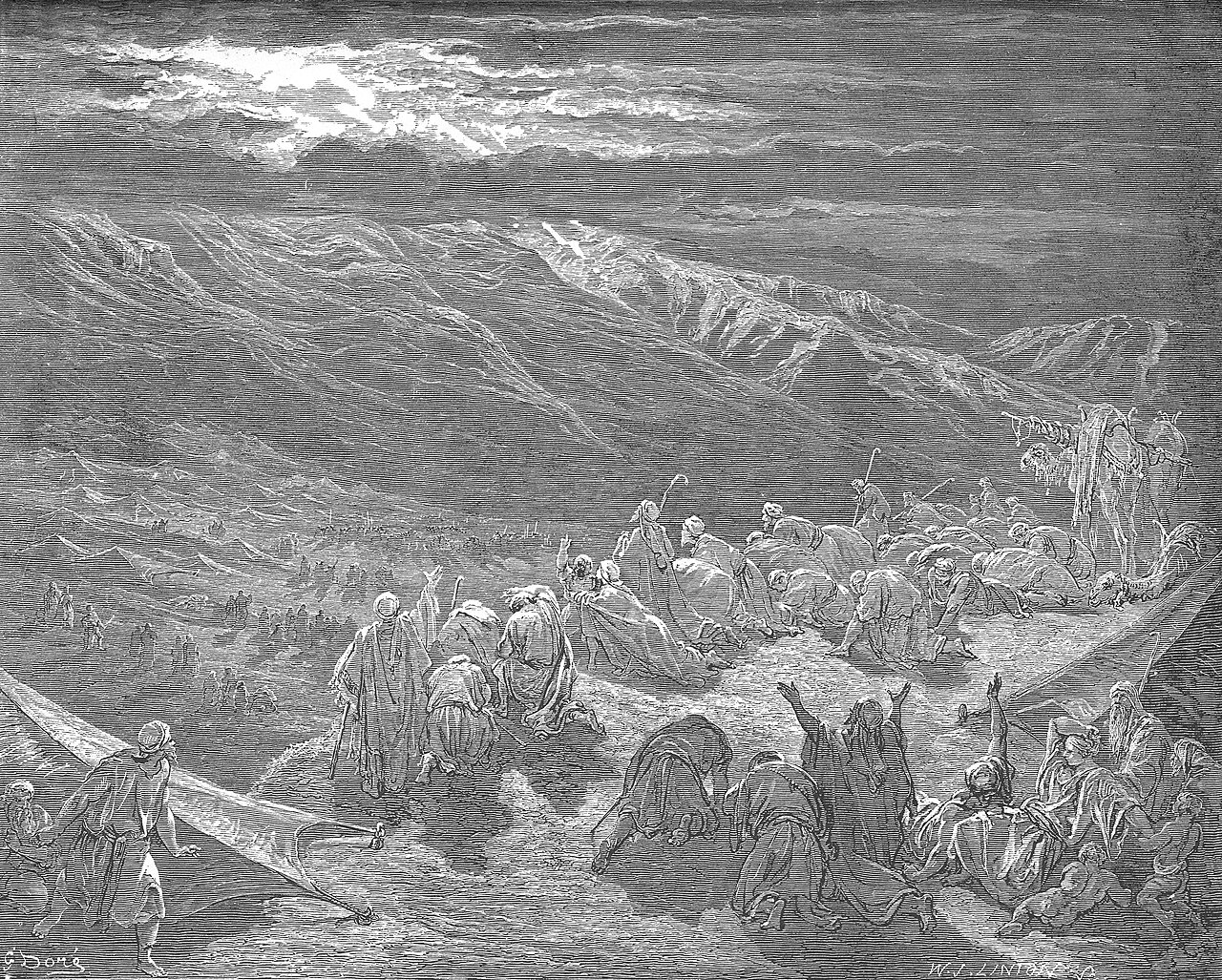
The Giving of the Law on Mount Sinai — Gustave Doré
The mountain burned with fire — the covenant given through Moses at Sinai — Gustave Doré, Doré’s English Bible (1866), public domain · Exodus 19:16-20

The Four-Movement Architecture

bondage → deliverance → covenant → dwelling — a climb out of the dark into the glory

Forty chapters ask four questions in order, and answer them. Does God hear? How does God save? Whose are they now? Will God stay? The colour below is the climb: the slate of the brick-kiln, the crimson of blood and sea, the ember of a mountain that burned with fire, and the gold of a glory that came down and did not leave. Every cell is a door.

BondageDeliveranceCovenantDwellingbright cells are the turning points
  1. I. BondageExodus 111Does God hear?

    A multiplying people under a genocidal king; a baby drawn from the Nile; forty years in Midian; a bush that burns and is not consumed; the Name given; and nine plagues that empty Egypt of every power it trusted.

    • 1–2 · the groaning, and “God remembered his covenant” (2:24)
    • 3–4 · the burning bush and the Name — I AM THAT I AM (3:14)
    • 5–6 · “by my name Jehovah I was not known to them” (6:3)
    • 7–11 · the plagues: judgment on all the gods of Egypt (12:12)
  2. II. DeliveranceExodus 1218How does God save?

    By a lamb. The tenth blow falls, and the only shelter is blood on a doorpost. Then the sea opens, the army drowns, and a nation that went in as slaves comes out singing — and immediately begins to grumble.

    • 12 · the Passover — “when I see the blood, I will pass over you” (12:13)
    • 13 · the firstborn redeemed; unleavened bread
    • 14 · the sea divided; the LORD fights for Israel
    • 15 · the Song of the Sea — the pivot from “out of” to “on to”
    • 16–18 · manna, the rock at Horeb, Amalek, Jethro's counsel
  3. III. CovenantExodus 1924Whose are they now?

    Three months out, at a mountain wrapped in fire and smoke, the Redeemer binds the redeemed to Himself. Grace comes first and law comes second — the deliverance of chapters 1–15 is the preamble to the commands of chapter 20.

    • 19 · “a kingdom of priests, and a holy nation” (19:6)
    • 20 · the Ten Words, opening with what God has already done (20:2)
    • 21–23 · the Book of the Covenant; the Angel in whom the Name is (23:20–21)
    • 24 · ratified in blood — “the blood of the covenant” (24:8)
  4. IV. DwellingExodus 2540Will God stay?

    Sixteen chapters on a tent — because the point of redemption is not escape but presence. The pattern is given, the covenant is shattered at the mountain's foot, mercy re-makes it, and the glory comes down and stays.

    • 25–31 · the pattern shown in the mount; “that I may dwell among them” (25:8)
    • 32 · the golden calf — apostasy at the covenant's own inauguration
    • 33–34 · intercession, and the Name proclaimed (34:6–7)
    • 35–39 · built exactly “as Jehovah commanded Moses” — the refrain of a healed people
    • 40 · “the glory of Jehovah filled the tabernacle” (40:34)

The last verses of the book

“Then the cloud covered the tent of meeting, and the glory of Jehovah filled the tabernacle.”

Exodus 40:34 (ASV) — the book began with a people who could not get out and ends with a God who will not leave. Everything between is how that became possible.

The Argument

the whole book in three sentences
Author
Moses — by the book's own witness (24:4)
Hebrew title
Shemoth — “Names”
Date of the event
c. 1446 BC preferred · late date carried
Genre
Theological history with law and cult inside the story
Shape
40 ch · 4 movements · 10 plagues · 10 words
  1. 1

    The God of the fathers hears the groaning of an enslaved people, reveals His covenant Name, and by ten plagues, a slaughtered lamb, and a divided sea redeems them out of Egypt with an outstretched arm — not because they are strong or good, but because He swore an oath to Abraham.

  2. 2

    At Sinai He binds the redeemed to Himself in covenant, giving the Ten Words and the pattern of a sanctuary, so that the Redeemer becomes the Indweller — grace first, and then the law that answers it.

  3. 3

    When Israel breaks the covenant at its own inauguration, Moses' intercession and God's self-revelation as “merciful and gracious” secure the astonishing ending: the glory fills the tent, and God travels with His people.

The Hebrew name of the book is Shemoth — “Names,” from its opening line. The Greek title the Church inherited is Exodos, “a going out.” Both are right, and together they are the book: a God who gives His Name, and a people who get out because He did.

Christ in Exodus

the richest typological quarry in the Old Testament — and most of it cited by the New

Typology can be made to say anything, so this page keeps an honesty control: each row is marked by its warrant. Gold means the New Testament itself makes the connection, by citation. Ember means an apostolic reading built on explicit teaching. Violet means the identification is contested, and the page carries the objection with it.

Explicit NT citationApostolic readingContested — carried with its critique
The Passover lambEx 12:1–13
1 Corinthians 5:7

“For our passover also hath been sacrificed, even Christ.” Paul's own words. The blood on the doorpost that turns away death is the gospel in miniature — the master-type.

The Passover
Not a bone brokenEx 12:46
John 19:36

John stands at the cross, watches the soldiers pass Jesus by, and cites the Passover rubric as fulfilled prophecy.

The Red SeaEx 14:21–31
1 Corinthians 10:1–2

Israel “were all baptized unto Moses in the cloud and in the sea” — Paul reads the crossing as the church's own baptism, prefigured.

The mannaEx 16:4–35
John 6:31–35, 48–51

Jesus exegetes Exodus 16 of Himself: “I am the bread of life… your fathers ate the manna in the wilderness, and they died.”

The rock at HorebEx 17:6
1 Corinthians 10:4

“And the rock was Christ.” The struck rock that gave water to a complaining people is named, by an apostle, as Him.

The blood of the covenantEx 24:8
Matthew 26:28

Moses throws blood on the people: “Behold the blood of the covenant.” Jesus lifts a cup: “this is my blood of the covenant.” The same sentence.

The tabernacleEx 25:8; 40:34
John 1:14; Hebrews 8:5

The Word “dwelt among us, and we beheld his glory” — Greek eskēnōsen, he pitched his tent: the kavod that filled the tent now tenting in flesh; Hebrews calls the tent “a copy and shadow of the heavenly things.”

The Tabernacle
The mercy seatEx 25:17–22
Romans 3:25; Hebrews 9:5

The Greek Old Testament renders the kapporet with hilastērion — the very word Paul uses of Christ “set forth to be a propitiation.”

The Day of Atonement
The veilEx 26:31–33
Hebrews 10:20

“Through the veil, that is to say, his flesh” — the curtain that barred the Holiest is read as the body torn open to admit us.

Moses the mediatorEx 32:30–32
Deuteronomy 18:15; Acts 3:22; Hebrews 3:1–6

The prophet like unto Moses, fulfilled in Christ — and Hebrews sets Him above Moses: faithful as a Son over the house, not a servant in it.

“I AM”Ex 3:14
John 8:58

“Before Abraham was born, I am” is widely heard as the Greek Old Testament's egō eimi ho ōn on Jesus' lips. The identification is contested — the phrase has ordinary uses too — and the page carries the critique rather than assuming the case.

The Names of God
The Angel in whom the Name isEx 23:20–21
1 Corinthians 10:9; Jude 5

“My name is in him.” Justin, Irenaeus and Tertullian read the Angel as the pre-incarnate Son; Augustine read a created messenger bearing God's word. Both NT verses cited here rest on textual variants — show the apparatus, don't rest doctrine on it.

The Angel of the LORD

Nine of these twelve are the New Testament reading Exodus out loud. That is unusual — most Old Testament typology is inference. Here the apostles did the work, and Colossians 2:17 supplies the grammar: these are the shadow, and the body is Christ.

Themes

eight load-bearing lines through the book
01

Redemption — the defining act

Exodus 6:6; 15:13

Exodus is where the Bible learns the vocabulary of salvation: God takes a people He does not owe, out of bondage, by blood and power, to Himself. Every later rescue in Scripture reads back through this one.

02

The revelation of the Name

Exodus 3:14–15; 6:2–3

The book of the divine self-naming. Redemption is grounded not in Israel's worth but in who God is — the self-existent, covenant-keeping One who will be what He will be for His people.

03

“That ye may know that I am Jehovah”

Exodus 7:5; 8:22; 14:4, 18

The plague cycle's refrain is about knowledge. The exodus is God making Himself known — to Israel, to Egypt, and through both to the watching world.

04

Covenant — grace before law

Exodus 19:5–6; 20:2; 24:8

The Ten Words open with what God has already done: “I am Jehovah thy God, who brought thee out.” Indicative before imperative — a structure the whole Bible keeps.

05

Presence — the goal of redemption

Exodus 25:8; 29:45–46; 40:34

The book does not end at the sea or at Sinai but in a tent. Redemption's purpose is Immanuel: “let them make me a sanctuary, that I may dwell among them.”

06

Holiness — and the problem it creates

Exodus 3:5; 19:12; 33:20

The ground is holy, the mountain must be fenced, the glory is lethal. An entire apparatus of mediation exists so that holiness can live with sinners without consuming them.

07

Mediation and intercession

Exodus 32:11–14, 32; 33:15

Moses stands in the breach — pleading God's own Name, His oath, and finally offering his own place in the book. The intercessor is a load-bearing Exodus office.

08

“Let my people go, that they may serve me”

Exodus 8:1; 9:1; 10:3

The demand is never bare freedom. Israel is delivered from Pharaoh's service into God's — a rescue from slavery and to worship. The word for both is the same.

Original Language

the keynote Hebrew — each a door to the word workbench

Two words for one rescue

ga'al is family language — the kinsman who buys back what his relative lost, the word that will later belong to Boaz. padah is market language — a price paid to release. Exodus uses both, and neither is a metaphor the text apologizes for.

The bridge into Greek

The Greek Old Testament is the hinge on which this vocabulary swings into the New: pesach → pascha, kabod → doxa, mishkan → skēnē, kapporet → hilastērion, ehyeh asher ehyeh → egō eimi ho ōn. When the apostles quote Exodus, this is the wording in their ears.

Literary Design

the integrated architecture of the text

The four-movement macro-structure

Bondage → deliverance → covenant → dwelling. This is not an outline imposed on the book; it is the shape the canon then reuses every time it tells a redemption story, all the way to Revelation 21.

The plague triads (3 × 3 + 1)

The nine plagues before the tenth fall in three groups of three: the first of each triad announced to Pharaoh in the morning, the second announced, the third struck with no warning at all. Ordered escalation, not a list. The tenth stands apart, and Passover answers it.

The suzerain-vassal covenant form

Sinai is widely read as following the second-millennium Hittite suzerainty-treaty pattern — preamble, historical prologue, stipulations, deposit and public reading. A literary observation that also bears on dating, since the treaty shape shifts by the first millennium (Mendenhall; Kitchen, cite-only).

The tabernacle mirror, and the Sabbath inclusio

The instructions (25–31) and the construction (35–40) mirror each other in sequence, and the Sabbath command closes the one (31:12–17) and opens the other (35:1–3) — binding sanctuary and Sabbath into a single frame around the golden calf.

Seven speeches, and a tent like a world

Chapters 25–31 are built of seven divine speeches, each opening “And Jehovah spake unto Moses” — read by some as a creation-patterned seven that makes the tabernacle a microcosm, a world in miniature where God dwells with man (Kearney; Fretheim, cite-only).

The Song of the Sea (15:1–18)

One of the oldest poems in Hebrew, and structurally the hinge of the book: the narrative turns on it from deliverance out of Egypt to journey toward the mountain.

The refrains that mark the seams

“Let my people go, that they may serve me” drives the plague cycle. “That ye may know that I am Jehovah” states its purpose. And “as Jehovah commanded Moses,” repeated relentlessly through 39–40, is the exact reversal of the calf — a people whose obedience has been restored.

The Name-proclamation as a canonical formula

Exodus 34:6–7 becomes the Old Testament's most-quoted self-revelation of God, cited back to Him by Moses, Nehemiah, the Psalms, Joel and Jonah. Exodus does not merely describe God; it generates the liturgy by which Israel addresses Him.

The Approved Voices on Exodus

the roster applied — the specific work named, so you can go to it
Chuck Misslercite-only ≤50w

Learn the Bible in 24 Hours (2002); Cosmic Codes (1999); the KHouse verse-by-verse Exodus study

Marcus Brown's formative teacher, and the load-bearing roster voice here. The integrated-design lens reads the tabernacle's measured pattern “showed thee in the mount” as a blueprint of heavenly things, and the spring feasts as a prophetic calendar fulfilled to the day at Calvary.

R. C. Sproulcite-only ≤50w

The Holiness of God (1985)

The ideal frame for Exodus's holiness drama: the shoes removed at the bush, the fenced mountain, the lethal glory of 33:20, the veiled shining face. Note that his Reformed reading of Pharaoh's hardening differs from the founder's flag — carry his weight on holiness, hold Marcus Brown's flag on hardening.

Derek Princecite-only ≤50w

His Passover, blood and redemption teaching (Atonement: Your Appointment with God)

The roster's deliverance-and-redemption teacher, in a covenantal-Pentecostal register: the exchange at the cross prefigured in the lamb's blood, and deliverance from bondage as the paradigm of the Christian life.

A. W. Tozer · John Bevere · Leonard Ravenhillcite-only ≤50w

The Knowledge of the Holy; The Fear of the Lord; Why Revival Tarries

The fear-of-the-Lord anchors for Sinai (19:16–25; 20:18–21), where a people learn to tremble and are told not to be afraid in the same breath. Holy fear as the precondition of intimacy, not its opposite.

Jonathan Cahn · Jason Sobelcite-only ≤50w

The Book of Mysteries; Aligning with God's Appointed Times

The Messianic-Jewish reading of Exodus 12 as the prophetic template — the appointed times as rehearsals whose spring set is fulfilled in the Passion. Carried with the covenantal and amillennial alternatives presented at full strength.

John Currid · Kenneth Kitchen · James Hoffmeiercite-only ≤50w

Ancient Egypt and the Old Testament; On the Reliability of the Old Testament; Israel in Egypt

The conservative Egyptological tier behind the contested points below: the plagues as a systematic polemic against Egypt's deities, the second-millennium covenant form, and the Delta's Semitic “ring of authenticity.” Kitchen and Hoffmeier hold the late date — a reminder that the dating question is not a test of orthodoxy.

Michael Heisercite-only ≤50w

The Unseen Realm (2015)

The exodus read in the unseen-realm register — Jehovah's war on the elohim of the nations, with Egypt's gods as the defeated party named in 12:12. Carried on the plagues page beside the covenantal-restraint reading.

John Calvinpublic domain

Commentaries on the Four Last Books of Moses Arranged as a Harmony (1563)

The major Reformation exposition of Exodus, and the fullest statement of the sovereign-hardening reading of Pharaoh. Public domain — quotable in full once pulled and confirmed.

John Wesleypublic domain

Explanatory Notes upon the Old Testament (1765)

The founder's home tradition, and the Wesleyan reading of the hardening as judicial confirmation of a heart Pharaoh first hardened himself. Terse, plain, and pastorally aimed.

PD ballastpublic domain

Matthew Henry, Commentary (Exodus); Jamieson-Fausset-Brown; Keil & Delitzsch, The Pentateuch; Spurgeon's Passover sermons; Alfred Edersheim, The Temple and Bible History vol. 2

The public-domain floor beneath every Exodus page — Henry on the destroying angel and on Moses in the breach, K&D on the Hebrew and the cult, Edersheim on the feast as Jesus' own generation kept it. Quotable in full, always with the specific work named.

Marcus Brown's own commentary leads above all; within a tier, all voices are equal.

Contested Points

presented at full strength, then MannaFest's flag

The date of the exodus — early or late?

Early (c. 1446 BC)

1 Kings 6:1 places the exodus 480 years before the fourth year of Solomon; Jephthah's “three hundred years” of occupation (Judg 11:26) coheres with it; and the Merneptah Stele already finds Israel as a people in Canaan by the late thirteenth century. Defended by Bimson and by Wood on Jericho's destruction layer.

Late (c. 1260 BC, Rameses II)

The store-city “Raamses” (1:11) points to the Nineteenth Dynasty; the archaeology of Canaanite destruction layers fits the thirteenth century; and the 480 is read as a schematic twelve generations of forty. Held by Kitchen and Hoffmeier — conservative Egyptologists, not skeptics.

The tension: Both camps affirm a real exodus. The disagreement turns on whether 1 Kings 6:1's number is arithmetic or schematic, and on which Egyptian synchronism carries more weight.

MannaFest flag — The exodus is a real event in real history. The early date coheres best with the plain sense of 1 Kings 6:1 and is the site's lead — with the late-date case carried at full strength beside it. This is a chronological question, not a doctrinal one.

The plagues as judgment on the gods of Egypt

The polemic reading

“Against all the gods of Egypt I will execute judgments” (12:12; cf. Num 33:4). Each blow is read as striking a specific deity's domain — the Nile, the frog, the cattle, the sun, and at last Pharaoh's own claim to divine sonship. Developed by Currid, and in the unseen-realm register by Heiser.

The caution

The text names the theme without supplying a deity-per-plague list. The neat one-to-one mappings are a modern reconstruction assembled from Egyptological sources, and some pairings are far firmer than others.

The tension: The theme is stated by Scripture itself; the specific grid is scholarship built on top of it. Presenting the grid as though the text supplied it would be a quiet overreach.

MannaFest flag — The polemic-against-the-gods reading is sound and textually anchored. The particular god-mappings are carried as illustrative, with the reconstruction marked as reconstruction — walked in full on the plagues study.

Pharaoh's hardened heart — who hardens whom?

The Reformed reading

God announces the hardening before a single plague falls (4:21; 7:3), acts to harden (9:12; 10:1; 14:4), and Paul presses exactly this text: “whom he will he hardeneth” (Rom 9:17–18). Pharaoh's fate serves a sovereign purpose declared in advance (Calvin, Institutes).

The Wesleyan-Arminian reading

Through the first five plagues the narrative says Pharaoh hardened his own heart, or simply that it was hardened; Jehovah's active hardening is first narrated at 9:12, after repeated self-hardening. God confirms a will already set — the judicial giving-over of Romans 1.

The tension: The narrative genuinely alternates, and both readings are reading real verses. The sequence of the two vocabularies is the evidence — and the plagues study lays that sequence out as data rather than assertion.

MannaFest flag — The founder's Wesleyan-Pentecostal home reads the hardening as judicial confirmation of Pharaoh's own resistance, with God's sovereignty fully affirmed. The Reformed reading is carried at full strength beside it — an intramural line between traditions, never flattened.

The “Red Sea” — or the Sea of Reeds?

MannaFest flag: Hebrew yam suph is literally “sea of reeds”; the “Red Sea” reaches English through the Greek Old Testament. Candidate crossings run from the Bitter Lakes to the Gulf of Suez to the Gulf of Aqaba. Hold the miracle as historical — the text describes walls of water, and “reeds” does not entail “shallow” — and leave the geography open.

No Egyptian record of the exodus

MannaFest flag: Stated openly, then answered: Egyptian royal inscription is triumphal propaganda that would not memorialize a national humiliation, from a state that erased its own inconvenient pharaohs. The Delta's Semitic populations, the accurate local color and loanwords, the archaic Song of the Sea, and the second-millennium covenant form all fit an authentic memory.

“By my name Jehovah I was not known to them” (6:3)

MannaFest flag: Yet the patriarchs use the Name in Genesis. The site's lead: to “know” a name here is to know its bearer in covenant-fulfilling act — the fathers had the syllables, the exodus generation met the God behind them. The source-critical reading (a strand withholding the Name until Exodus 6) is set out honestly on the Torah pages.

Mosaic authorship

MannaFest flag: The book claims it (“Moses wrote all the words of Jehovah,” 24:4; cf. 17:14; 34:27) and Jesus cites the bush narrative as “the book of Moses” (Mark 12:26). The site holds substantial Mosaic authorship; the Documentary Hypothesis is presented at full strength in the Torah material rather than dismissed.

Where is Sinai?

MannaFest flag: Traditional Jebel Musa in the southern peninsula, northern-Sinai candidates, and the Midianite/Arabian Jabal al-Lawz all have advocates. Tied to the route question, and adjudicated by no one here.

People & Places

the cast and the map of the great deliverance

Also in the cast, and awaiting their pages: Miriam the prophetess (15:20); Pharaoh, who is never named — the archetypal tyrant rather than a man; Shiphrah and Puah, the midwives who feared God and defied a genocide (1:15–21); Jethro of Midian; Zipporah and the flint knife (4:24–26); Joshua, first seen against Amalek (17:9); and Bezalel and Oholiab, the first men in Scripture said to be filled with the Spirit of God — for craftsmanship (31:1–6). The map runs Goshen · Midian · the sea · Marah · Elim · the wilderness of Sin · Rephidim · Sinai.

Keep studying

— more from The Books of Moses

Artwork: Agnolo Bronzino, The Crossing of the Red Sea — public domain. Drafted from MannaFest's research brief on Exodus — public-domain commentators (Calvin, Wesley, Henry, Keil & Delitzsch, Jamieson-Fausset-Brown, Spurgeon, Edersheim) and the founder's approved-voices roster, cite-only for moderns. Scripture ASV. Every cited work — the sources registry →