
Genesis 1 to 2 · Debate · Featured Study
Creation and Evolution
The readings of Basil, Augustine, Chalmers, Kline, Walton, Ross, Collins and Behe, with their holders, their case and the strongest objection to each.
Christians who confess that God created the heavens and the earth still divide over how long He took to do it.
- The question
- How do Genesis 1 and 2 bear on the age of the earth and on the descent of living things?
- The texts
- Genesis 1:1, Genesis 1:21, Genesis 2:4, Exodus 20:11, Romans 5:12
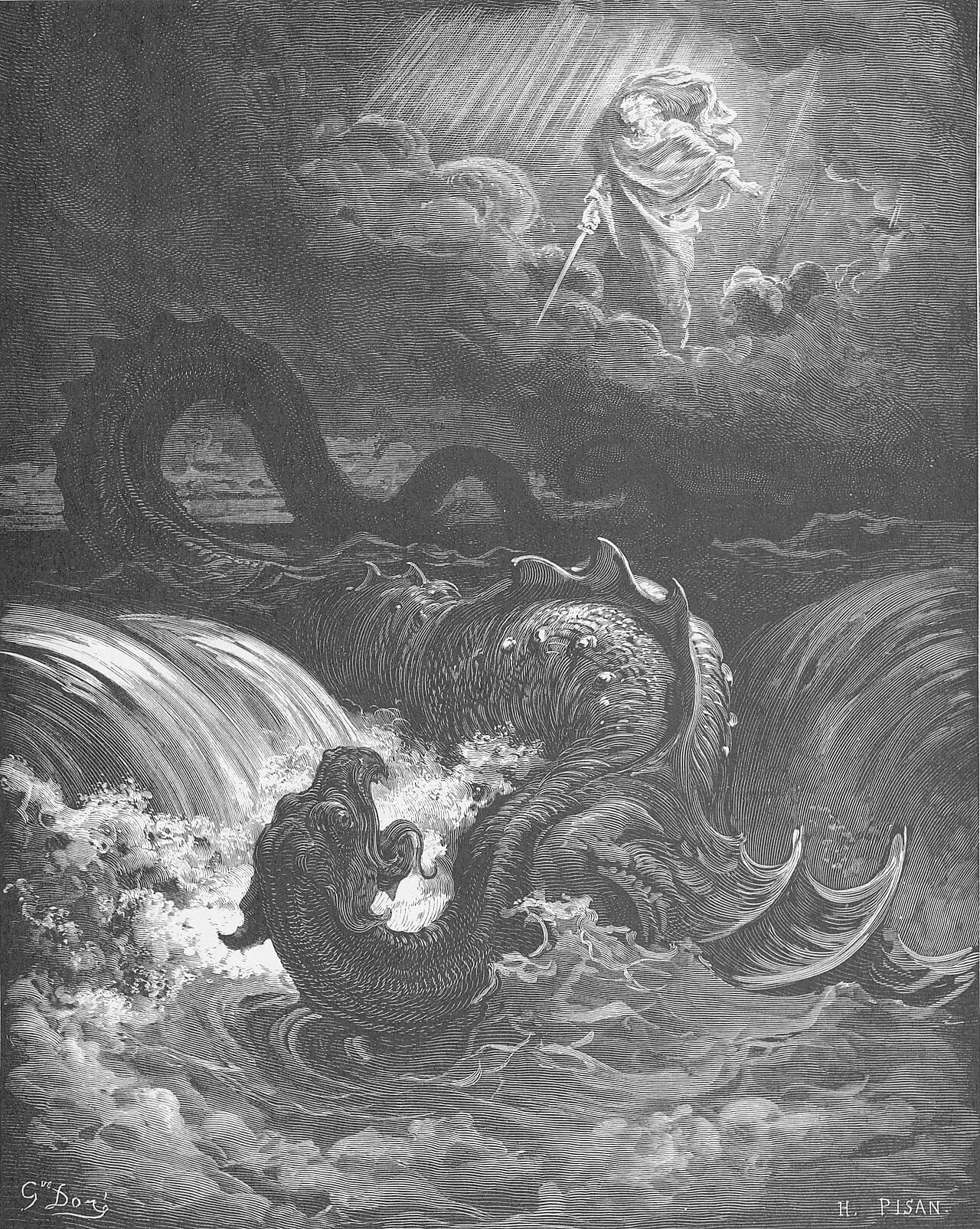
Gustave Doré, The Destruction of Leviathan, La Grande Bible de Tours, 1866. Public domain.
THE ARTWORKDoré engraved the LORD with His sword over Leviathan, the sea serpent of Isaiah 27:1. Genesis 1:21 says that God created the great sea creatures, and Psalm 104:26 says that He formed Leviathan to frolic in the sea.
Summary
Eight readings of Genesis 1 and 2 differ on how old the earth is and on how God made the kinds of living creatures.
- Six ordinary days and a young earth is a widely held belief, given its modern form by Henry Morris and John Whitcomb in The Genesis Flood (1961).
- The day-age, gap, framework and temple readings each allow an old earth.
- Francis Collins holds that living things share common descent under God's providence, and Michael Behe argues for design in biochemistry.
The Texts Every Reading Answers
Every reading of the days and the kinds must account for these four verses from Genesis, Exodus and Romans.
In the beginning God created the heavens and the earth.The account opens with God as the one who creates, before any day is counted.
So God created the great sea creatures and every living thing that moves, with which the waters teemed according to their kinds, and every bird of flight after its kind. And God saw that it was good.Each reading of the origin of species must say how far this phrase about kinds reaches.
For in six days the LORD made the heavens and the earth and the sea and all that is in them, but on the seventh day He rested. Therefore the LORD blessed the Sabbath day and set it apart as holy.At Sinai the LORD grounds the Sabbath on the six days of creation, and each reading must say how Israel's week stands to the week of Genesis 1.
Therefore, just as sin entered the world through one man, and death through sin, so also death was passed on to all men, because all sinned.Paul traces death to one man's sin, and each reading must say what that death includes.
Eight Readings of the Days and the Kinds
The readings part on three questions, and different teachers and movements hold each of them.
| Reading | Held by | The days of Genesis 1 | The age of the earth | The descent of living things |
|---|---|---|---|---|
| Six ordinary days | Basil of Caesarea; Henry Morris and John Whitcomb; John F. Ashton; Answers in Genesis; the Institute for Creation Research | One ordinary week | Some thousands of years | Each kind made by its own act of God |
| Day-age | Hugh Ross; Reasons to Believe, founded 1986 | Six long ages in sequence | Billions of years | Life brought in by successive acts of God across the ages |
| Gap | Thomas Chalmers; G. H. Pember; the Scofield Reference Bible; Chuck Missler | Six days that restore a ruined earth | An old earth before verse 2 and a recent week after it | The living kinds of today made in that week |
| Framework | Meredith G. Kline; Henri Blocher | A literary frame of forming and filling | Left open by the text | Left open by the text |
| Cosmic temple | John H. Walton | The inauguration of a cosmic temple | Left open by the text | Left open by the text |
| Creation at once | Augustine of Hippo | A teaching order | Made in one moment | Unfolding in time from the first creation |
| Evolutionary creation | Francis Collins | Read with the framework or temple readings | Billions of years | Common descent |
| Intelligent design | Michael Behe; Stephen Meyer; William Dembski | No single reading among its holders | Left open by the argument | Holders differ, and the argument concerns the mechanism |
- Reading
- Six ordinary days
- Held by
- Basil of Caesarea; Henry Morris and John Whitcomb; John F. Ashton; Answers in Genesis; the Institute for Creation Research
- The days of Genesis 1
- One ordinary week
- The age of the earth
- Some thousands of years
- The descent of living things
- Each kind made by its own act of God
- Reading
- Day-age
- Held by
- Hugh Ross; Reasons to Believe, founded 1986
- The days of Genesis 1
- Six long ages in sequence
- The age of the earth
- Billions of years
- The descent of living things
- Life brought in by successive acts of God across the ages
- Reading
- Gap
- Held by
- Thomas Chalmers; G. H. Pember; the Scofield Reference Bible; Chuck Missler
- The days of Genesis 1
- Six days that restore a ruined earth
- The age of the earth
- An old earth before verse 2 and a recent week after it
- The descent of living things
- The living kinds of today made in that week
- Reading
- Framework
- Held by
- Meredith G. Kline; Henri Blocher
- The days of Genesis 1
- A literary frame of forming and filling
- The age of the earth
- Left open by the text
- The descent of living things
- Left open by the text
- Reading
- Cosmic temple
- Held by
- John H. Walton
- The days of Genesis 1
- The inauguration of a cosmic temple
- The age of the earth
- Left open by the text
- The descent of living things
- Left open by the text
- Reading
- Creation at once
- Held by
- Augustine of Hippo
- The days of Genesis 1
- A teaching order
- The age of the earth
- Made in one moment
- The descent of living things
- Unfolding in time from the first creation
- Reading
- Evolutionary creation
- Held by
- Francis Collins
- The days of Genesis 1
- Read with the framework or temple readings
- The age of the earth
- Billions of years
- The descent of living things
- Common descent
- Reading
- Intelligent design
- Held by
- Michael Behe; Stephen Meyer; William Dembski
- The days of Genesis 1
- No single reading among its holders
- The age of the earth
- Left open by the argument
- The descent of living things
- Holders differ, and the argument concerns the mechanism
The Readings in Their Own Words
Each fold sets out one reading's case as its holders make it.
Six ordinary daysHenry Morris and John Whitcomb, The Genesis Flood (1961)
The young-earth reading takes each day as a day of twenty-four hours, numbered and closed with evening and morning, and it counts the age of the earth from the genealogies of Genesis 5 and 11. It reads Exodus 20:11 as proof that the days of creation were days of the same length as Israel's working days. It reads Romans 5:12 and Romans 8:20 as ruling out the death of animals before Adam's sin.
Day-ageHugh Ross, The Genesis Question (1998)
On the day-age reading every day of Genesis 1 is a long age, and the order of the days is the order in which God brought the universe and life into being. Its holders rest the reading on the wider sense the Hebrew word yom can carry and on its use in Genesis 2:4.
The gap readingThomas Chalmers (1814); the Scofield Reference Bible (1909)
The gap reading places the ruin of a first world between Genesis 1:1 and Genesis 1:2, and it reads the six days as a making again after that ruin. Its holders read the verb of Genesis 1:2 as became, so that the earth became formless and void through the ruin. The reading has its own page, The Gap Reading at Genesis 1:2.
The framework readingMeredith G. Kline (1958); Henri Blocher, In the Beginning (1984)
The framework reading takes the six days as two sets of three, ordered by subject. Days one to three make the light, the sky and the seas, and the dry land. Days four to six fill them with the lights, the birds and the fish, and the land creatures and man. Kline drew the title of his article, Because It Had Not Rained, from Genesis 2:5.
The cosmic temple readingJohn H. Walton, The Lost World of Genesis One (2009)
Walton reads Genesis 1 beside the accounts of creation in Israel's world, where to create a thing was to give it its function and its place. On his reading the seven days set up the cosmos as God's temple, and God's rest on the seventh day in Genesis 2:2 is His taking up His rule in it. The account then leaves the age of the material world outside what it teaches.
Creation at onceAugustine, The Literal Meaning of Genesis (about 415)
Augustine taught that God made all things together in one act, and he rested the teaching on Genesis 2:4 to 5 and on Sirach 18:1 as his Latin Bible read it. He held that the six days set out that one work in an order a reader can follow, since things made together cannot be told together. He also held that God placed in the first creation the seminal reasons, the causes from which living things would appear in their own times.
Evolutionary creationFrancis Collins, The Language of God (2006)
Evolutionary creation holds that God made the living kinds through common descent, the process Charles Darwin described in On the Origin of Species (1859), which God upholds as He upholds all things. Its holders read Hebrews 1:3, where the Son upholds all things by His powerful word, and Psalm 104:24, where God made all His works in wisdom.
Intelligent designMichael Behe, Darwin's Black Box (1996)
Intelligent design is a position on how living things came to be, and its holders take no single reading of the days. Behe argues that a system of interacting parts in the cell, such as the bacterial flagellum or the cascade by which blood clots, loses its function when any one part is taken away. He argues that such a system cannot be built by gradual steps of unguided selection and is best explained by design. He accepts the age of the earth that geology gives and common descent in many cases. Young-earth holders such as John F. Ashton welcome these arguments and press beyond their openness on the age of the earth.
The site's tradition is Wesleyan-Pentecostal, and on the days of Genesis 1 it gives no verdict.
the book was written by moses to the jews in the exodus and its purpose was to teach them about YHWH, not explain every little detail and be a perfect account, or else there would have been much more included
Two Hebrew Words the Readings Turn On
The readings divide over the Hebrew noun yom, day, and the verb bara, create.
Yom, day
Strong's dictionary gives yom as a day in the literal sense, from sunrise to sunset or from one sunset to the next. It also gives a figurative sense, a space of time set by the words around it.
God called the light “day,” and the darkness He called “night.” And there was evening, and there was morning—the first day.The word is used twice in this one verse, first for the light alone and then for a span that runs through the dark.
This is the account of the heavens and the earth when they were created, in the day that the LORD God made them.The account of the heavens and the earth uses the word day for the whole of their making.
Bara, create
Strong's dictionary gives bara as to create. The Berean text renders it created in Genesis 1:1, Genesis 1:21 and Genesis 1:27, at the beginning, at the first animal life and at the making of man.
And God said, “Let the earth bring forth living creatures according to their kinds: livestock, land crawlers, and beasts of the earth according to their kinds.” And it was so.The readings weigh whether this command to the earth describes one act of God or a process.
So God created man in His own image; in the image of God He created him; male and female He created them.The Berean text has the verb created three times in this one verse on the making of man in God's image.
What the Text Leaves Unsaid
Genesis 1 and 2 leave three questions of the debate open, and the book of Job sets a limit on every answer.
Genesis gives no date for the creation and no age for the earth. The seventh day of Genesis 2:1 to 3 is given no evening and morning, and the text never says how long it lasted. The account also names no means by which the earth would bring forth living creatures at God's command.
Where were you when I laid the foundations of the earth? Tell Me, if you have understanding. Who fixed its measurements? Surely you know! Or who stretched a measuring line across it? On what were its foundations set, or who laid its cornerstone, while the morning stars sang together and all the sons of God shouted for joy?God's question to Job applies to every reading of the days, since no reader saw the foundations of the earth laid.
What Every Reading Holds
The Christian holders of all eight readings confess three things about the Creator and His work.
GOD MADE ALL THINGS
Each holder confesses that the universe was formed at God's command, so that what is seen was not made out of what was visible.
VERY GOOD
Each holder confesses that God looked upon all that He had made and that it was very good.
THE CREATION SET FREE
Each holder confesses that the creation itself will be set free from its bondage to decay.
How the Teachers Read It
Four teachers, from the fourth century to the twentieth, speak to the days, the curse and the Maker.
Basil on the days before the sunfourth century
“‘Let them serve,’ he says, ‘for the fixing of days,’ not for making days but for ordering the days. For day and night are earlier than the generation of the luminaries.”
Basil of Caesarea · HEXAEMERON 6.8 · on Genesis 1:14 to 15Patristic
“The adornment of the earth is older than the sun, that those who have been misled may cease worshiping the sun as the origin of life.”
Basil of Caesarea · HEXAEMERON 5.1 · on Genesis 1:12Patristic
Athanasius on the works made through the Sonfourth century
“Doubtless the things that came to be through the Word, these are ‘founded in wisdom’ and what are ‘founded in wisdom,’ these are all made by the Hand and came to be through the Son. And we have proof of this, not from external sources, but from the Scriptures; for God says by Isaiah the prophet, ‘My hand also has laid the foundation of the earth, and my right hand has spanned the heavens.’ And again, ‘And I will cover you in the shadow of my hand, by which I planted the heaven, and laid the foundations of the earth.’”
Athanasius of Alexandria · Defense of the Nicene Definition 4:17 · on Psalm 104:24Patristic
Matthew Henry on the creatures under the curseeighteenth century
“When man sinned, the ground was cursed for man's sake, and with it all the creatures (especially of this lower world, where our acquaintance lies) became subject to that curse, became mutable and mortal.”
Matthew Henry · Commentary on the Whole Bible · on Romans 8:20Puritan
G. K. Chesterton on something from nothingtwentieth century
“Nobody can imagine how nothing could turn into something. Nobody can get an inch nearer to it by explaining how something could turn into something else.”
GK Chesterton · The Everlasting Man, Chapter I: The Man in the Cave (1925) · on Genesis 1:1Modern scholar
The Readings Weighed
Each fold states the objection one reading must answer.
The age the sciences give
The young-earth reading must answer mainstream cosmology and geology, which date the universe in billions of years. Its holders explain that evidence by a recent creation and a flood that covered the whole earth.
The order of the days
The day-age reading must answer that vegetation comes on the third day and the sun, the moon and the stars on the fourth, against the order the sciences give.
All that is in them
The gap reading must answer Exodus 20:11, which sets the heavens and the earth and the sea and all that is in them within the week the LORD worked. The page on the gap reading weighs the grammar of Genesis 1:2 in full.
The form of the account
The framework reading must answer the young-earth reading, which holds that Genesis 1 reads as narrative, each day following the one before it.
The first verse
The temple reading must answer Genesis 1:1, which names the heavens and the earth themselves as what God created, so the account speaks of the origin of the material world as well as its functions.
A work spread over a week
Augustine's reading must answer a text that sets the works of creation on separate days, the lights on the fourth and man on the sixth, which a single act of making leaves unexplained.
Adam
Evolutionary creation must answer Genesis 2:7, where the LORD God forms the man from the dust and breathes life into him. Paul's argument in Romans 5:12 and 1 Corinthians 15:21 to 22 rests on one man through whom death came, and a long line of death before Adam must be reconciled with it.
Parts once put to other uses
Intelligent design must answer Francis Collins, who holds that its examples of irreducible complexity, such as the bacterial flagellum, are giving way as science learns more about them.
Read the Great Books
These ten works include at least one from each of the eight readings.
Hexaemeron
Basil of Caesarea · about 370
Its second homily bears the title The Earth Was Invisible and Unfinished.
The Literal Meaning of Genesis
Augustine of Hippo · about 415
Henry Woods studied its teaching on the seminal reasons in Augustine and Evolution (1924).
The Genesis Flood
John C. Whitcomb and Henry M. Morris · 1961
Whitcomb and Morris argue that the flood of Genesis 6 to 9 laid down the rock layers and the fossils.
In print: find it wherever books are sold.
In the Beginning
Henri Blocher · 1984
Blocher reads Genesis 1 to 3 as a theologian and defends the framework reading of the days.
In print: find it wherever books are sold.
Darwin's Black Box
Michael Behe · 1996
Behe introduced irreducible complexity to public discussion and opened the case for design in biochemistry.
In print: find it wherever books are sold.
The Genesis Question
Hugh Ross · 1998
Ross writes as an astrophysicist and holds that Scripture and the natural world are two revelations of one God whose witness agrees.
In print: find it wherever books are sold.
In Six Days
John F. Ashton, editor · 1999
Fifty scientists give their reasons for holding to six days of creation.
In print: find it wherever books are sold.
The Language of God
Francis Collins · 2006
Collins gives his reasons for holding faith in Christ together with common descent.
In print: find it wherever books are sold.
The Scofield Reference Bible
C. I. Scofield, editor · 1909
Its note on Genesis 1:2 sets out the gap reading.
The Lost World of Genesis One
John H. Walton · 2009
Walton argues that Genesis 1 describes the cosmos made ready as God's temple.
In print: find it wherever books are sold.
Through Him All Things Were Made
John and Paul name the Maker of Genesis 1.
Whatever a reader concludes about the days and the kinds, Genesis asks that reader to know the God who made the heavens and the earth. The reader who trusts Jesus Christ, the Word who was with God in the beginning, has met that Creator, however the days are counted.
Through Him all things were made, and without Him nothing was made that has been made.For in Him all things were created, things in heaven and on earth, visible and invisible, whether thrones or dominions or rulers or authorities. All things were created through Him and for Him.Keep studying
Read it2