

Jesus Christ · In His Own Words
Jesus on Himself
Jesus did not leave the question of who He is to His followers to decide. In His own words (spoken to friends, to crowds, to a woman grieving her brother, and to the men who would condemn Him), He named Himself in ways no ordinary teacher dared to. This page gathers those words: what He said, what they meant to the people who first heard them, and what it cost Him to say them.
Unknown, Christ Pantocrator, Saint Catherine's Monastery, 6th century. Public domain.
Summary
This page walks the seven I AM sayings one by one, then the bare before Abraham was, I am claim, the Son of Man title's Daniel 7 background, the trial testimony that convicted Him of blasphemy, and how the crowds who heard Him reacted.
- Seven I AM sayings, each set beside the text, its plain meaning, and the Old Testament background it draws on.
- Why before Abraham was, I am reads as a timeless-existence claim in Greek, not just an age comparison, and why the crowd reached for stones.
- The Son of Man title traced to Daniel 7:13-14, and the four claims Jesus attached to it: authority over sin, over the Sabbath, over the clouds, over all things.
- The trial testimony before the Sanhedrin, and why combining Daniel 7 with Psalm 110 tipped the charge to blasphemy rather than false messiahship.
- Three named scholarly positions on when Jesus's divine identity was first understood, Bauckham, Hurtado, and Dunn, held without a site verdict.
Four Gospels, One Claim
each Gospel writer draws out a different facet of the same figure
Jesus rarely says the bare words “I am God.” His identity claims come mostly through action and indirection: forgiving sins, commanding a storm, receiving worship without correcting the worshiper, claiming authority no faithful Jew would claim for a mere man.
Serious interpreters, evangelical and critical alike, agree on this pattern4 Gospels
Mark discloses Jesus gradually, building to the cross; Matthew weaves the claim into fulfilled prophecy, ending on the flatly explicit “All authority… has been given to Me” (Matt 28:18); Luke opens with Jesus reading a messianic text about Himself, aloud, in His hometown synagogue (Luke 4:18–21); John is the most direct of all: seven “I AM” statements and open claims to pre-existence and oneness with the Father, “written that you may believe” (John 20:31). Different emphasis, one figure.
The I Am Wall
seven doors, and the bare claim standing over them
BEFORE ABRAHAM WAS, I AM
““Truly, truly, I tell you,” Jesus declared, “before Abraham was born, I am!””
John 8:58 — the claim with no predicate, no image to soften it. They picked up stones for it (8:59).
In His Own Words: The I AM Sayings
ἐγώ εἰμι: echoing the Name God gave Moses
Seven times in John's Gospel, Jesus completes the phrase “I am” with an image drawn from everyday life: bread, light, a door, a shepherd, a vine, resurrection, the way itself. In Greek, ἐγώ εἰμι (“I am”) echoes the name God gave Moses at the burning bush (Exodus 3:14). Whether every hearer caught that echo every time is part of what these sections explore.
God said to Moses, “I AM WHO I AM. This is what you are to say to the Israelites: ‘I AM has sent me to you.’”The Name God gives Himself at the burning bush.
“I am the light of the world” (John 8:12)
The text. Jesus said this in the temple, near the treasury, during or just after the Feast of Tabernacles: a feast that closed each night with a spectacular lamp-lighting ceremony said to light up the whole city.
Plain meaning.Jesus is claiming to be the source of spiritual light for everyone, not just for Israel, and He is doing it standing in the very place where the festival's own light-symbol burned.
Once again, Jesus spoke to the people and said, “I am the light of the world. Whoever follows Me will never walk in the darkness, but will have the light of life.”You may bring these words against Nestorius: for our Lord does not say, In Me is the light of the world, but, I am the Light of the world: He who appeared man, was both the Son of God, and the Light of the world; not, as Nestorius fondly holds, the Son of God dwelling in a mere man.
Theophylact · Catena Aurea, John 8:12
In "the treasury" where it was spoken… stood two colossal golden lamp-stands, on which hung a multitude of lamps, lighted after the evening sacrifice (probably every evening during the feast of tabernacles), diffusing their brilliancy, it is said, over all the city.
Jamieson, Fausset & Brown · Commentary Critical and Explanatory on the Whole Bible, John 8:12
The visible light of the world is the sun, and Christ is the Sun of righteousness. One sun enlightens the whole world, so does one Christ, and there needs no more.
Matthew Henry · Commentary on the Whole Bible, John 8:12
The Tabernacles backgroundSukkot
Sukkot commemorated Israel's wilderness years and the pillar of fire that guided them by night (Exodus 13:21–22). “The LORD is my light” (Psalm 27:1); the Servant Songs promise “a light to the nations” (Isaiah 42:6; 49:6), a text Simeon applies to the infant Jesus (Luke 2:32). By claiming the title at the festival that celebrated that very pillar of fire, Jesus is applying an Old Testament picture of God's own guiding presence to Himself.
“I am the door” / “I am the good shepherd” (John 10:1–18)
The text.Two linked pictures in one discourse: the sheepfold's one legitimate opening (“I am the door of the sheep,” 10:7, 9), and the shepherd who lays down his life for the flock he owns (“I am the good shepherd,” 10:11).
Plain meaning. A first-century sheepfold had one entrance; a shepherd sometimes lay across it at night, becoming, in effect, the door himself. Jesus claims to be the one and only safe way in, and the one who will die, willingly, rather than abandon the flock.
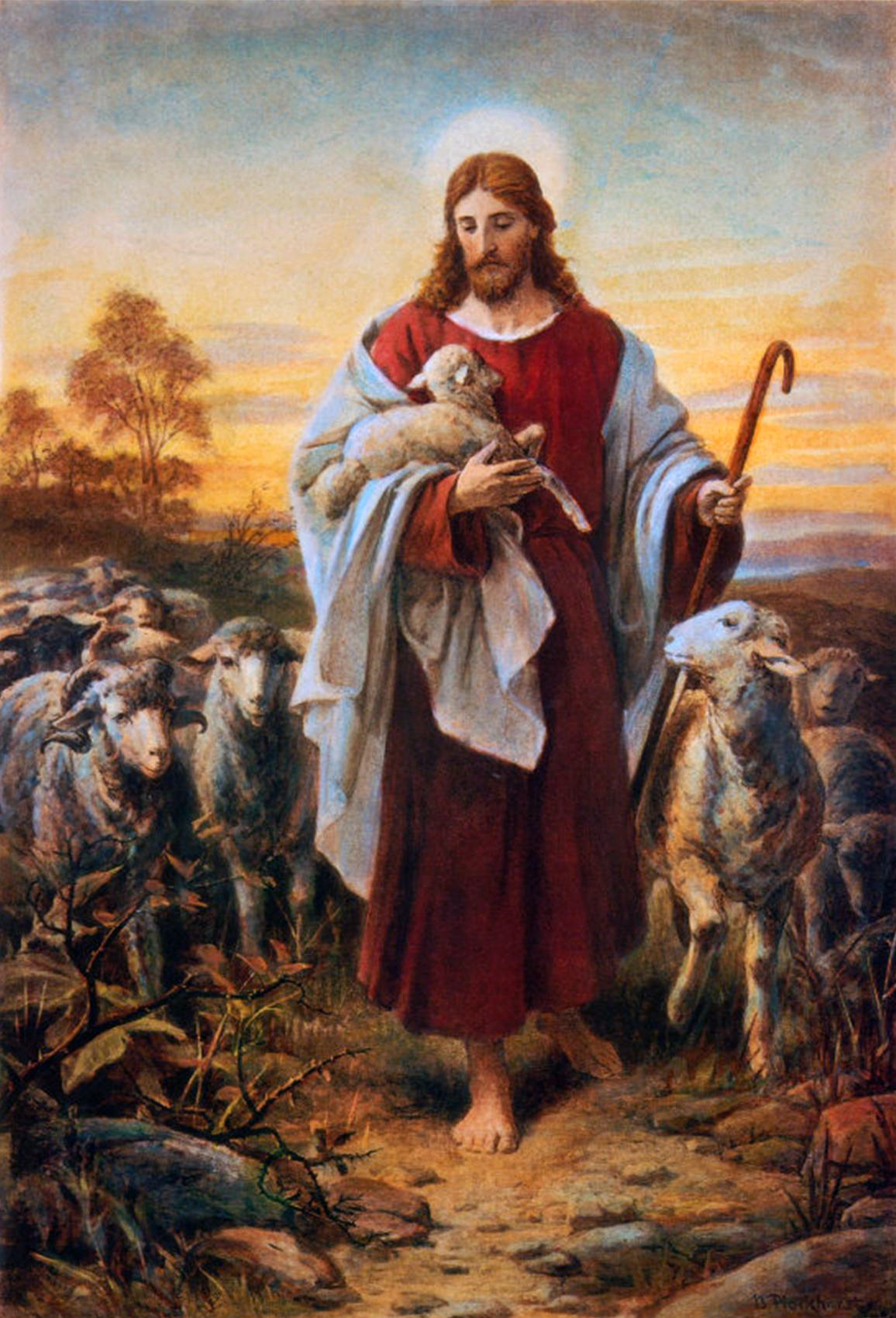
So He said to them again, “Truly, truly, I tell you, I am the gate for the sheep.I am the gate. If anyone enters through Me, he will be saved. He will come in and go out and find pasture.I am the good shepherd. The good shepherd lays down His life for the sheep.Jesus told them in these words a parable, or comparison, and used obscure speech in order to make them more attentive. When He has achieved this, He resolves the obscurity and says: "I am the Door."
Theophylact · Commentary on John, John 10:7
I am the door of the sheep — It is through me only that a man can have a lawful entrance into the ministry; and it is through me alone that mankind can be saved.
Adam Clarke · Commentary on the Bible, John 10:7
By this, then, which the Lord hath explained, that He Himself is the door, let us find entrance to what He has set forth… I am better pleased that the Truth Himself, like a good Shepherd, and therefore a good Teacher, hath in a certain measure reminded us how we ought to understand His words.
Augustine · Tractates on John 45, John 10:9
Then He speaks also of the sufferings and says: "I lay down My life for the sheep," expressing by this that He goes to His sufferings not by compulsion, but voluntarily. By the word "lay down" He shows that no one takes it from Me…
Theophylact · Commentary on John, John 10:11
“No one takes it from me” (John 10:17–18). Jesus adds a claim with no real parallel among ordinary human deaths: total, voluntary control over His own dying and rising.
The reason the Father loves Me is that I lay down My life in order to take it up again. No one takes it from Me, but I lay it down of My own accord. I have authority to lay it down and authority to take it up again. This charge I have received from My Father.”I lay down my life — I give myself to die for my people… This proves that the salvation of man was an object dear to God, and that it was a source of special gratification to him that his Son was willing to lay down his life to accomplish his great purposes of benevolence.
Albert Barnes · Notes, Explanatory and Practical, John 10:17
Here lay the glory of His sacrifice, that it was purely voluntary. The claim of "power to take it again" is no less important, as showing that His resurrection… was nevertheless His own assertion of His own right to life as soon as the purposes of His voluntary death were accomplished.
Jamieson, Fausset & Brown · Commentary Critical and Explanatory on the Whole Bible, John 10:18
Ezekiel 34 behind the Shepherd claimEzek 34
God indicts Israel's failed shepherd-leaders (Ezekiel 34:1–10), then promises to shepherd His people Himself (34:11–16) andto set “one shepherd,” His servant David, over them (34:23–24). By taking the title, Jesus claims both roles at once: the role Ezekiel reserves for God, and the role Ezekiel reserves for a coming Davidic king.
“I am the resurrection and the life” (John 11:25–26)
The text. Spoken to Martha, grieving her brother Lazarus, days after his death and before the tomb.
Plain meaning.Two promises answering two fears: “though he die, yet shall he live” (bodily resurrection for those who have already died in faith), and “shall never die” (the believer's life in Christ is never actually interrupted by physical death at all). Martha expects a future event; Jesus relocates the hope into a present Person.
Jesus said to her, “I am the resurrection and the life. Whoever believes in Me will live, even though he dies. And everyone who lives and believes in Me will never die. Do you believe this?”Jesus said unto her, I am the resurrection and the life… Signifying, that he was able of himself to raise men from death to life, without asking it of his Father; and that he could do it now, as well as at the general resurrection.
John Gill · Exposition of the New Testament, John 11:25
Our Lord is Himself the resurrection, as He does Himself declare, "I am the resurrection and the life."
Irenaeus · Against Heresies 4.5.2, on John 11:25
As death comes by sin, it is His to dissolve it; and as life flows through His righteousness, it is His to communicate and eternally maintain it (Ro 5:21). The temporary separation of soul and body is here regarded as not even interrupting, much less impairing, the new and everlasting life imparted by Jesus to His believing people.
Jamieson, Fausset & Brown · Commentary Critical and Explanatory on the Whole Bible, John 11:25
2 more voices on this versefurther commentary
The Father, therefore, who raised Him up, will also raise us up through Him, apart from whom no one will attain to true life. For says He, "I am the life; he that believeth in me, even though he die, shall live."
Ignatius of Antioch · Epistle to the Trallians, on John 11:25
"He that believeth in me, though he were dead," just as Lazarus is dead, "yet shall he live;" for He is not the God of the dead, but of the living. Believe then, and though thou wert dead, yet shalt thou live: but if thou believest not, even while thou livest thou art dead.
Augustine · Tractates on John 49, John 11:25–26
Followed immediately by the raising of Lazarus (11:38–44): the sign authenticating the claim, the same pattern as the healing of the blind man authenticating “I am the light of the world” (9:5).
“I am the way, the truth, and the life” (John 14:6)
Introduced briefly here as one of the seven; unpacked further, alongside Matthew 11:27–28, in its own section below.
“I am the true vine” (John 15:1, 5)
The text.“I am the true vine, and My Father is the vinedresser” (15:1); “I am the vine, you are the branches” (15:5).
Plain meaning. In the Old Testament, Israel-as-vine is always a picture of failure to bear the fruit God wanted (Psalm 80:8–16; Isaiah 5:1–7; Jeremiah 2:21; Hosea 10:1). By calling Himself the true vine, Jesus claims to be what Israel was supposed to be and was not: belonging to Him, not mere ethnic descent, is what makes a branch fruitful.
“I am the true vine, and My Father is the keeper of the vineyard.I am the vine and you are the branches. The one who remains in Me, and I in him, will bear much fruit. For apart from Me you can do nothing.The spiritual oneness of Christ and His people, and His relation to them as the Source of all their spiritual life and fruitfulness, are here beautifully set forth by a figure familiar to Jewish ears (Isa 5:1, &c.). I am the true vine--of whom the vine of nature is but a shadow. my Father is the husbandman--the great Proprietor of the vineyard, the Lord of the spiritual kingdom.
Jamieson, Fausset & Brown · Commentary Critical and Explanatory on the Whole Bible, John 15:1–8
I am the vine, ye are the branches - Our Lord in this whole passage speaks of no branches but such as are, or at least were once, united to him by living faith.
John Wesley · Explanatory Notes upon the New Testament, John 15:5
Without me ye can do nothing - The expression without me denotes the same as separate from me. As the branches, if separated from the parent stock, could produce no fruit, but would immediately wither and die, so Christians, if separate from Christ, could do nothing.
Albert Barnes · Notes, Explanatory and Practical, John 15:5
Before Abraham Was, I Am
John 8:58–59: the bare, unqualified claim
This is the most direct of all Jesus's identity claims in John, and it belongs with the I AM sayings even though it isn't one of the seven pictures: it's the bare, unqualified “I am,” and it is the one that got stones picked up on the spot.
The text.Answering Jewish leaders who objected that He was “not yet fifty years old” and could not have seen Abraham, Jesus said this.
“Truly, truly, I tell you,” Jesus declared, “before Abraham was born, I am!”Plain meaning.In Greek, “was” (past tense, describing something that came into being) is set against “am” (present tense, describing something that simply is). Jesus is not claiming to be older than Abraham the way one person is older than another. He is claiming to exist outside of time the way only God does.
"Before Abraham was, I am." See, He did not say "before Abraham was, I was," but "I am." For this expression "am" is more proper to God, because it signifies continuous and eternal existence.
Theophylact · Commentary on John, John 8:58
Before Abraham was I AM — Even from everlasting to everlasting. This is a direct answer to the objection of the Jews, and shows how much greater he was than Abraham.
John Wesley · Explanatory Notes upon the New Testament, John 8:58
There is a remarkable similarity between the expression employed by Jesus in this place and that used in Exodus to denote the name of God… Jesus replied to that that he existed before Abraham. As in his human nature he was not yet 50 years old, and could not, as a man, have existed before Abraham, this declaration must be referred to another nature.
Albert Barnes · Notes, Explanatory and Practical, John 8:58
3 more voices on this versefurther commentary
Our gracious Redeemer draws them away from gazing at His flesh and leads them to the contemplation of His divinity, saying: "Amen, amen, I say to you, before Abraham was made, I am." For "before" belongs to past time, "I am" to present time. And because the Divinity has neither past nor future time, but always has being, He did not say "Before Abraham I was," but "Before Abraham I am."
Gregory the Great · Forty Gospel Homilies, Homily 18, John 8:58
The one clause means, "Abraham was brought into being"; the other, "I exist." The statement therefore is not that Christ came into existence before Abraham did… but that He never came into being at all, but existed before Abraham had a being; in other words, existed before creation, or eternally.
Jamieson, Fausset & Brown · Commentary Critical and Explanatory on the Whole Bible, John 8:58
I am from all eternity. I have existed before all ages. You consider in me only the person who speaks to you… But besides this human nature, which ye think ye know, there is in me a Divine and eternal nature.
Adam Clarke · quoting Calmet, Commentary on the Bible, John 8:58
What happened next.
At this, they picked up stones to throw at Him. But Jesus was hidden and went out of the temple area.Then they took up stones to cast at him… Supposing that he had spoken blasphemy; for they well understood that he, by so saying, made himself to be the eternal God, the unchangeable Jehovah.
John Gill · Exposition of the New Testament, John 8:59
Then took they up stones, etc. — It appears that the Jews understood him as asserting his Godhead; and, supposing him to be a blasphemer, they proceeded to stone him, according to the law.
Adam Clarke · Commentary on the Bible, John 8:59
The Exodus 3:14 background, and a contested readingExo 3:14
In Exodus 3:14, God tells Moses His name is “I AM WHO I AM.” Jesus's use of the same bare formula, in the present tense, applied to Himself, is why the crowd reached for stones rather than shrugging off a strange boast. This reading: that Jesus is deliberately invoking the divine Name: is the majority reading among the commentators quoted above, ancient and more recent alike. It is not universally undisputed in wider scholarship (some critical readers treat “I am” here as simply emphatic self-reference rather than a Name-claim), but the reaction it provoked: an on-the-spot stoning attempt, the penalty for blasphemy: is itself evidence for how the first hearers understood it.
The Son of Man
Jesus's own favorite self-designation: used roughly eighty times
Jesus's own favorite self-designation in the Gospels was not “Messiah” or “Son of God” but “the Son of Man”: a title He used of Himself roughly eighty times, and which almost no one else in the Gospels uses of Him. It sounds humble. It isn't only that.
The background: Daniel 7:13–14. In Daniel's vision, “one like a son of man” comes on the clouds of heaven into the presence of “the Ancient of Days” and is given “dominion and glory and a kingdom, that all peoples, nations, and languages should serve him” — worship-language elsewhere reserved for God alone. Riding the clouds was, in Second Temple Jewish reading, understood as a divine mode of coming (compare Psalm 104:3 and Isaiah 19:1, “the LORD rides on a swift cloud”). When Jesus calls Himself “the Son of Man,” He is reaching for a figure who is given what only God gives and receives what only God receives.
In my vision in the night I continued to watch, and I saw One like the Son of Man coming with the clouds of heaven. He approached the Ancient of Days and was led into His presence. And He was given dominion, glory, and kingship, that the people of every nation and language should serve Him. His dominion is an everlasting dominion that will not pass away, and His kingdom is one that will never be destroyed.What the title carried in His hands, textually anchored:
- Authority over sin— “the Son of Man has authority on earth to forgive sins” (Mark 2:10), spoken to a paralyzed man, with the healing offered as visible proof of an otherwise invisible claim. The scribes present object, rightly, that only God can forgive sins (Mark 2:7) — Jesus does not correct their theology. He claims the prerogative.
- Authority over the Sabbath— “the Son of Man is lord even of the Sabbath” (Mark 2:28; Matthew 12:8; Luke 6:5) — authority over an institution God Himself instituted at creation.
- Coming on the clouds— at His trial (below), the Son of Man saying is the specific claim that tips the charge from “false messiah” to blasphemy.
- All authority— the Great Commission's foundation, “All authority in heaven and on earth has been given to Me” (Matthew 28:18), echoing Daniel 7:14's “dominion and glory and a kingdom” almost word for word.
But so that you may know that the Son of Man has authority on earth to forgive sins...” He said to the paralytic,Therefore, the Son of Man is Lord even of the Sabbath.”Then Jesus came to them and said, “All authority in heaven and on earth has been given to Me.But that ye may know that the Son of man hath power on earth to forgive sins--that forgiving power dwells in the Person of this Man, and is exercised by Him while on this earth and going out and in with you.
Jamieson, Fausset & Brown · Commentary Critical and Explanatory on the Whole Bible, Mark 2:10
Whenever there was need to punish or to honor, to forgive sins or to make laws, Christ was fully authorized to do it. Whenever Christ had to do any of these much greater things, you will not characteristically find him praying or calling on his Father for assistance. All these things, as you discover in the text, he did on his own authority.
John Chrysostom · On the Incomprehensible Nature of God 10.19, on Mark 2:10
Moreover the Son of man is Lord even of the Sabbath - Being the supreme Lawgiver, he hath power to dispense with his own laws; and with this in particular.
John Wesley · Explanatory Notes upon the New Testament, Mark 2:28
Contested point, named.Whether “Son of God” language in the Gospels started out purely functional (a royal-messianic title, echoing Psalm 2 and 2 Samuel 7: a human king uniquely commissioned) or carried ontological weight (essential divine sonship) from the outset is a real, long-running scholarly question. Richard Bauckham (Jesus and the God of Israel) argues the functional/ontological split is the wrong lens altogether: the earliest Christians included Jesus within the unique identity of the God of Israel from the start, so that “earliest Christology was already the highest Christology.” Larry Hurtado (Lord Jesus Christ) argues independently for an explosively early devotional worship of Jesus, within years of the crucifixion. James D. G. Dunn has argued for a more gradual, developmental trajectory across the New Testament documents. The site does not adjudicate between them; all three are named positions in an active scholarly conversation.
No One Comes to the Father But by Me
John 14:6 and Matthew 11:27–28
The text, and the Greek.“I am the way, and the truth, and the life. No one comes to the Father except through Me” (John 14:6). In Greek, each noun carries the definite article (ἡ ὁδὸς, ἡ ἀλήθεια, ἡ ζωή) — the way, not a way among several. ὁδός (hodos) is a road or journey — Jesus is not pointing to the way, He is the way itself. The exclusion clause uses εἰ μή(“if not”), about as absolute a negation as Koine Greek offers.
Function in context.Thomas has just asked a destination-and-access question: “where” and “how” (14:5), not an abstract philosophical one. Jesus answers pastorally: He is Himself the way believers already have, since they already know and have seen the Father in Him (14:7).
Jesus answered, “I am the way and the truth and the life. No one comes to the Father except through Me.As if He said, I am the way, whereby thou wouldest go; I am the truth, whereto thou wouldest go; I am the life, in which thou wouldest abide… Even the philosophers of the world have seen that God is the life eternal, the truth which is the end of all knowledge. And the Word of God… by taking upon Him human nature, is made the way. Walk by the Man, and thou wilt arrive at God.
Augustine · Catena Aurea, on John 14:6
For Jesus says, "I am the way, and the truth and the life"; that is, by me men and women come. To me they come, in me they rest. For when we come to him, we come to the Father also, because through an equal an equal is known.
Augustine · On Christian Instruction 1.34.38, on John 14:6
He who is the way does not lead us into by-paths or trackless wastes. He who is the truth does not mock us with lies. He who is the life does not betray us into delusions… As the way, he will guide us to the truth. As the truth, he will establish us in the life… "No one comes to the Father except through me." The way to the Father is through the Son.
Hilary of Poitiers · On the Trinity 7.33, on John 14:6
3 more voices on this versefurther commentary
Christ is not only God but true God indeed — true God of true God — and I approach the true one inasmuch as he himself is the truth. If, then, we inquire his name, it is "the truth."
Ambrose · Exposition of the Christian Faith 1.17.108, on John 14:6
I am the way — That leads so [sic] the Father: — the Truth that teaches the knowledge of God, and directs in the way: — the Life that animates all those who seek and serve him… Christ is the Way: 1. By his doctrine… 2. By his example… 3. By his sacrifice… 4. By his Spirit.
Adam Clarke · Commentary on the Bible, John 14:6
No man cometh to the Father but by me — To come to the Father is to obtain his favor, to have access to his throne by prayer, and finally to enter his kingdom. No man can obtain any of these things except by the merits of the Lord Jesus Christ.
Albert Barnes · Notes, Explanatory and Practical, John 14:6
Contested point, named. The grammar of exclusivity in John 14:6 is not seriously disputed among interpreters. What isdebated, as an ongoing pastoral and missiological question among professing evangelicals, is how this verse relates to the unevangelized and to general revelation: exclusivist, inclusivist, and “wider hope” positions all exist. The traditional (exclusivist) reading leads here, named as such, with the wider debate flagged rather than erased.
Matthew 11:27–28. This pairs the same mutual, exclusive Father-and-Son knowledge claimed in John 14:6 with an invitation as wide and plain as any Jesus ever gave.
All things have been entrusted to Me by My Father. No one knows the Son except the Father, and no one knows the Father except the Son and those to whom the Son chooses to reveal Him. Come to Me, all you who are weary and burdened, and I will give you rest.All things are delivered unto me of my Father--He does not say, They are revealed--as to one who knew them not, and was an entire stranger to them save as they were discovered to Him--but, They are "delivered over," or "committed," to Me of My Father; meaning the whole administration of the kingdom of grace.
Jamieson, Fausset & Brown · Commentary Critical and Explanatory on the Whole Bible, Matt 11:27
Come to me - Here he shows to whom he is pleased to reveal these things to the weary and heavy laden; ye that labour - After rest in God: and are heavy laden - With the guilt and power of sin: and I will give you rest - I alone (for none else can) will freely give you (what ye cannot purchase) rest from the guilt of sin by justification, and from the power of sin by sanctification.
John Wesley · Explanatory Notes upon the New Testament, Matt 11:28
What gentleness, what sweetness is there in the very style of the invitation--"Hither to Me"; and in the words, "All ye that toil and are burdened," the universal wretchedness of man is depicted, on both its sides--the active and the passive forms of it.
Jamieson, Fausset & Brown · Commentary Critical and Explanatory on the Whole Bible, Matt 11:28
The Trial
Mark 14:61–64
The text.Under oath before the Sanhedrin, the high priest demands whether He is the Christ, the Son of the Blessed. Jesus answers, then adds a claim built from two Old Testament texts fused together: Daniel 7:13 and Psalm 110:1 combined. The high priest tears his robes and pronounces it blasphemy. (The parallel in Matthew 26:64 and Luke 22:70 has the more indirect Jewish oath-formula “You have said so” / “You say that I am.”)
But Jesus remained silent and made no reply. Again the high priest questioned Him, “Are You the Christ, the Son of the Blessed One?” “I am,” said Jesus, “and you will see the Son of Man sitting at the right hand of Power and coming with the clouds of heaven.” At this, the high priest tore his clothes and declared, “Why do we need any more witnesses? You have heard the blasphemy. What is your verdict?” And they all condemned Him as deserving of death.Why blasphemy, specifically.A false messianic claim, on its own, was not a capital blasphemy charge under Jewish law: men who falsely claimed to be the Messiah were executed by Rome as political rebels, not stoned by their own people as blasphemers. What tips this answer from “false messianic claimant” to blasphemy, in the judgment of interpreters who have studied the charge closely, is the specific content: riding the clouds of heaven, in Second Temple Jewish reading of Daniel 7 and Psalm 110, was a divine prerogative. Jesus is not merely saying “I am the Messiah.” He is saying He will sit where God sits and come the way God comes. That is what the high priest hears as blasphemy.
If you will not learn Who Christ is from those that know Him, learn it at least from those that know Him not. So shall the confession, which their ignorance is forced to make, rebuke your blasphemy. The Jews did not recognise Christ, come in the body, though they knew that the true Christ must be the Son of God.
Hilary of Poitiers · On the Trinity 6.50, on Mark 14:61
Now, in the Gospel according to Mark, the Lord being interrogated by the chief of the priests if He was the Christ, the Son of the blessed God, answering, said, "I am; and you shall see the Son of man sitting at the right hand of power."
Clement of Alexandria · From the Latin Translation of Cassiodorus, on Mark 14:62
For He knew that they would not believe, nevertheless He answered them, lest they should afterwards say, If we had heard any thing from Him, we would have believed on Him; but this is their condemnation, that they heard and did not believe.
Theophylact of Ohrid · Catena Aurea, on Mark 14:62
Not itself a capital chargethe wider record
As some scholars researching the trial note (Bart Ehrman among them), messianic claims alone were not typically treated as blasphemy in Second Temple Judaism: figures like Bar Kokhba, later, were executed by Rome as rebels, not stoned by fellow Jews for blasphemy. The charge here turns specifically on Jesus's claim to share YHWH's throne and YHWH's own mode of coming, not on the messianic claim by itself.
What Did the Listeners Hear?
the crowd's own reaction, twice
Twice in John, a crowd that had just heard Jesus speak reached immediately for stones: the legal penalty for blasphemy (Leviticus 24:14–16). Their own reaction is some of the strongest evidence for how a high, divine claim actually registered on first-century Jewish ears.
After “before Abraham was, I am” (John 8:58–59):
Then they took up stones to cast at him… Supposing that he had spoken blasphemy; for they well understood that he, by so saying, made himself to be the eternal God, the unchangeable Jehovah.
John Gill · Exposition of the New Testament, John 8:59
After “I and the Father are one” (John 10:30–33):
I and the Father are one.”“We are not stoning You for any good work,” said the Jews, “but for blasphemy, because You, who are a man, declare Yourself to be God.”I and my Father are one - The word translated one is not in the masculine, but in the neuter gender. It expresses union, but not the precise nature of the union. … The question in debate was (not about his being united with the Father in plan and counsel, but in power. He affirmed that he was able to rescue and keep his people from all enemies, or that he had power superior to men and devils that is, that he had supreme power over all creation. He affirmed the same of his Father. In this, therefore, they were united. But this was an attribute only of God, and they thus understood him as claiming equality to God in regard to omnipotence. … The Jews understood him as affirming his equality with God, for they took up stones to punish him for blasphemy
Albert Barnes · Notes, Explanatory and Practical, John 10:30
You see here that the Jews understood what the Arians understand not. For they were angry on this account, that they felt it could not be said, "I and my Father are one," save where there was equality of the Father and the Son.
Augustine · Tractates on John 48, John 10:31
for a blasphemy — whose legal punishment was stoning… thou, being a man — that is, a man only. makest thyself God — Twice before they understood Him to advance the same claim, and both times they prepared themselves to avenge what they took to be the insulted honor of God.
Jamieson, Fausset & Brown · Commentary Critical and Explanatory on the Whole Bible, John 10:33
But for blasphemy — I have elsewhere shown that the original word… when applied to God… signifies to speak impiously… Thou, being a man — That is, only a man — makest thyself God. When Christ said before… I and the Father are one, had the Jews understood him… as only saying he had a unity of sentiments with the Father, they would not have attempted to treat him for this as a blasphemer… But what irritated them so much was that they understood him as speaking of a unity of nature.
Adam Clarke · Commentary on the Bible, John 10:33
Jesus's own defense (John 10:34–36). Jesus does not retract the claim; He defends His right to make it, arguing from the lesser to the greater. Quoting Psalm 82:6 (“I said, you are gods”), He points out that if Scripture can call mere human judges “gods” because the word of God came to them, how much more the One the Father “sanctified and sent into the world.”
I have said, ‘You are gods; you are all sons of the Most High.’Jesus replied, “Is it not written in your Law: ‘I have said you are gods’? If he called them gods to whom the word of God came—and the Scripture cannot be broken— then what about the One whom the Father sanctified and sent into the world? How then can you accuse Me of blasphemy for stating that I am the Son of God?In your law - Psa 82:6. The word law here, is used to include the Old Testament. … Ye are gods - This was said of magistrates on account of the dignity and honor of their office, and it shows that the Hebrew word translated god, אלהים ̀elohiym, in that place might be applied to man. … If, therefore, the Scripture uses the word god אלהים ̀elohiym as applied to magistrates, it settles the question that it is right to apply the term to those in office and authority. If applied to them, it may be to others in similar offices. It cannot, therefore, be blasphemy to use this word as applicable to a personage so much more exalted than mere magistrates as the Messiah.
Albert Barnes · Notes, Explanatory and Practical, John 10:34–36
Contested reading, named.This is the same episode discussed under “Son of Man” above — whether the underlying claim is best read as primarily functional/messianic or as carrying ontological weight from the outset is the live scholarly question (Bauckham, Hurtado, Dunn). What is not seriously disputed is that the Jewish hearers themselves — hostile, technically trained readers of Torah, motivated to convict — heard something more than a royal-messianic title. John records their inference without correcting it.
Closing
Jesus's own words about Himself run in one direction: from the ordinary pictures of bread, light, a door, a shepherd, a vine, to the bare and total claim: “before Abraham was, I am”: made under a sky full of raised stones, and repeated, changed only in tense, before the men who would crucify Him for it.
Keep studying
On this page
Studies2
Symbols1
Doctrines18