
Leviticus 2 · Symbol · Featured Study
The Covenant of Salt
Leviticus 2:13, Numbers 18:19 and 2 Chronicles 13:5 are the three verses of the Hebrew Bible where salt and covenant stand together.
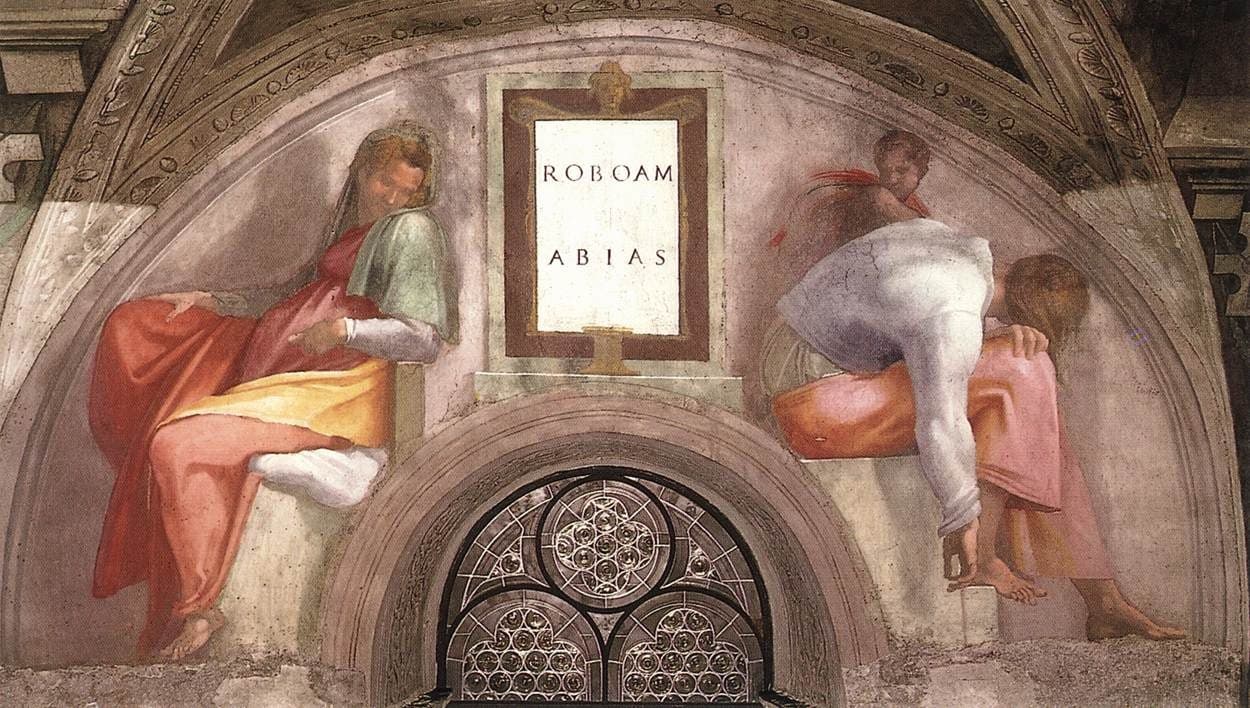
Michelangelo, Rehoboam and Abijah, lunette of the ancestors of Christ, 1508 to 1512, Sistine Chapel, Vatican. Public domain by date, via the Internet Archive.
THE ARTWORKMichelangelo painted the ancestors of Christ in the half-moons above the windows of the Sistine Chapel, and the tablet of this one names Rehoboam and Abijah. Abijah is the king of Judah who spoke of the covenant of salt in 2 Chronicles 13:5.
Every gift Israel laid on God's altar went up with salt.
Summary
Salt seasoned Israel's offerings, and Scripture gives its name to two grants of God that are said to last.
- Leviticus 2:13 calls it the salt of the covenant of your God.
- Numbers 18:19 gives Aaron's household its share of the holy offerings for all time.
- King Abijah of Judah rests the throne of David's house on a covenant of salt (2 Chronicles 13:5).
- The tabernacle's incense was seasoned with salt, and Ezekiel's priests salt the burnt offerings.
- Jesus calls His disciples the salt of the earth and tells them to have salt among themselves.
The Salt of Every Offering
Leviticus 2 sets out the grain offering, and its last law is a law of salt.
The grain offering of Leviticus 2 was fine flour with olive oil and frankincense. The priest burned a handful of it on the altar as a memorial portion, and the remainder belonged to Aaron and his sons (Leviticus 2:1 to 3).
And you shall season each of your grain offerings with salt. You must not leave the salt of the covenant of your God out of your grain offering; you are to add salt to each of your offerings.In this verse the law first joins salt to the covenant, two verses after it shuts leaven and honey out of the offering (Leviticus 2:11).
Three Texts of the Covenant of Salt
The phrase moves from the altar in Leviticus to the priests in Numbers and the throne in 2 Chronicles.
- What it adds
- salt on every offering of the altar, called the salt of the covenant
- What it adds
- the priests' share of the holy offerings, for their sons and daughters
- What it adds
- the kingship of Israel, for David and his descendants
Three numbered cards joined by arrows, each with its verse and what it adds.
Salt in Israel's Worship
The altar of burnt offering stood in front of the entrance to the tent (Exodus 40:6).
A plan of the tabernacle points out the three places a salted offering went, each with its verse.
10 cubits, about 4.5 m (15 feet)
- The altar of burnt offeringthe memorial portion burned, from the grain offering salted in Leviticus 2:13Leviticus 2:2
- The courtyardthe priests eat the rest of it, the share Numbers 18:19 calls a covenant of saltLeviticus 6:16
- In front of the Testimonythe salted incense set in the Tent of MeetingExodus 30:35 to 36
10 cubits, about 4.5 m (15 feet)
The court is 100 by 50 cubits and the altar 5 by 5 (Exodus 27:18 and 27:1). A cubit is about 18 inches.
Drawn to scale with east to the right, the tent placed as the common reconstruction sets it.
The salted incenseExodus 30:35 to 36
and make a fragrant blend of incense, the work of a perfumer, seasoned with salt, pure and holy.The Hebrew verb for seasoned here is the verb Leviticus 2:13 uses for salting the grain offering.
Grind some of it into fine powder and place it in front of the Testimony in the Tent of Meeting, where I will meet with you. It shall be most holy to you.God names this as the place where He will meet with Moses, and He calls the incense most holy.
Salt in the life of Israel4 verses
Is tasteless food eaten without salt, or is there flavor in the white of an egg?Job takes salt as the thing that makes plain food fit to eat.
and Elisha went out to the spring, cast the salt into it, and said, “This is what the LORD says: ‘I have healed this water. No longer will it cause death or unfruitfulness.’”Elisha throws salt into the spring at Jericho, and the LORD heals the water.
And all that day Abimelech fought against the city until he had captured it and killed its people. Then he demolished the city and sowed it with salt.The salt that kept food served as a mark of ruin when it was spread on a conquered town.
On the day of your birth your cord was not cut, nor were you washed with water for cleansing. You were not rubbed with salt or wrapped in cloths.A newborn was rubbed with salt, and Ezekiel pictures Jerusalem as a child left without that care.
Berit Melach, a Covenant of Salt
The Hebrew phrase is berit melach, and Numbers 18:19 adds olam, which the Berean text renders permanent.
The Hebrew words3 words
| Word | Sense | Where it stands |
|---|---|---|
| melach, H4417 | powder, and so salt | Leviticus 2:13 three times, Numbers 18:19, 2 Chronicles 13:5, Ezekiel 43:24 |
| malach, H4414 | to salt, to season with salt | Leviticus 2:13 and Exodus 30:35 |
| berit, H1285 | a compact, a covenant | Leviticus 2:13, Numbers 18:19, 2 Chronicles 13:5 |
The Greek words3 words
| Word | Sense | Where it stands |
|---|---|---|
| halas, G217 | salt | Matthew 5:13, Mark 9:50, Colossians 4:6 |
| halizo, G233 | to salt | Matthew 5:13 and Mark 9:49 |
| artuo, G741 | to season | Mark 9:50 and Colossians 4:6 |
What the Text Leaves Unsaid
Of the 25 verses where the Hebrew word for salt stands, 13 name the Salt Sea or the Valley of Salt.
Leviticus 2:13 commands the salt and gives no reason for it.
Numbers 18:19 and 2 Chronicles 13:5 use the phrase covenant of salt without saying what the salt means in it.
God's promise to David in 2 Samuel 7 names no salt, so the words covenant of salt for David's throne stand only in Abijah's speech.
Salt Among the Disciples
Jesus and Paul speak of salt in Mark 9, Matthew 5 and Colossians 4.
For everyone will be salted with fire. Salt is good, but if the salt loses its saltiness, with what will you season it? Have salt among yourselves, and be at peace with one another.”Jesus ends a talk that began with the disciples arguing over which of them was the greatest (Mark 9:34) with salt and peace.
You are the salt of the earth. But if the salt loses its savor, how can it be made salty again? It is no longer good for anything, except to be thrown out and trampled by men.In the Sermon on the Mount Jesus gives the name salt to the disciples themselves.
Let your speech always be gracious, seasoned with salt, so that you may know how to answer everyone.Paul gives this rule for speech right after telling the church to act wisely toward outsiders (Colossians 4:5).
Salted with fire in Mark 9:49John Wesley, Jamieson, Fausset and Brown
John Wesley, in his Explanatory Notes upon the New Testament, takes everyone in Mark 9:49 to be the one cast into hell, salted with fire that preserves him without consuming him. Every acceptable sacrifice, he adds, is salted with the grace of God. Jamieson, Fausset and Brown, in their Commentary Critical and Explanatory, take everyone to be every follower of Jesus and the fire to be a fiery trial that seasons him.
Voices on the Salt
Jerome, Gregory the Dialogist, John Wesley and Jamieson, Fausset and Brown on salt in the offering and among the disciples.
“Salt is good, and every offering must be sprinkled with it. Therefore also the apostle has given the commandment: ‘Let your speech be always with grace, seasoned with salt.’ But ‘if the salt have lost his savor,’ it is cast out.”
Jerome · LETTER 125.1 · on Leviticus 2:13Patristic
“But, when the ruler prepares himself for speaking, let him bear in mind with what studious caution he ought to speak, lest, if he be hurried inordinately into speaking, the hearts of hearers be smitten with the wound of error and, while he perchance desires to seem wise he unwisely sever the bond of unity. For on this account the Truth says, ‘Have salt in yourselves, and have peace one with another.’ Now by salt is denoted the word of wisdom.”
Gregory the Dialogist · The Book of Pastoral Rule, Part 2, Chapter 4 · on Mark 9:50Patristic
“But as salt if it loses its saltness is fit for nothing, so ye, if ye lose your faith and love, are fit for nothing but to be utterly destroyed. See therefore that grace abide in you, and that ye no more contend, Who shall be greatest.”
John Wesley · Explanatory Notes upon the New Testament · on Mark 9:50Evangelical
“The restoration or non-restoration of grace, or true living Christianity, to those who have lost it, has, in our judgment, nothing at all to do here. The question is not, If a man lose his grace, how shall that grace be restored to him? but, Since living Christianity is the only ‘salt of the earth,’ if men lose that, what else can supply its place?”
Jamieson, Fausset & Brown · Commentary Critical and Explanatory on the Whole Bible · on Matthew 5:13 to 16Reformed
What the Salt Signifies
Commentators read the salt as a sign that the covenant lasts or as a pledge made by eating together.
A sign of permanenceAdam Clarke, Albert Barnes, John Wesley
Adam Clarke, in his Commentary on Numbers 18:19, calls the covenant of salt an incorruptible, everlasting covenant: salt keeps food from decay, so it became the emblem of permanence. On 2 Chronicles 13:5 he glosses the phrase as for ever and quotes the Targum, which compares the rule of David's house to the sea that never grows sweet. Albert Barnes, in his Notes on Leviticus 2:13, reads the salt on every offering as a sign of the imperishable love of the LORD for His people. He also calls salt the contrary of leaven, because its nature does not alter.
You must present them before the LORD; the priests are to sprinkle salt on them and sacrifice them as a burnt offering to the LORD.John Wesley, in his Explanatory Notes upon the Old Testament, says the salt of this verse may allude to the perpetuity of the covenant made by sacrifice.
The objection to this reading is that Numbers 18:19 and 2 Chronicles 13:5 already say permanent and forever in words, and H. Clay Trumbull holds that the salt names how the covenant was made.
The bond of a shared mealH. Clay Trumbull, Matthew Henry, Jamieson, Fausset and Brown
H. Clay Trumbull, in The Covenant of Salt (1899), gathers reports from travellers in the East that a covenant of salt between two parties is generally made by eating bread and salt together. He holds that the salt itself binds the covenant and the bread only carries it. Jamieson, Fausset and Brown, in their Commentary Critical and Explanatory on Numbers 18:19, call the eating of salt a pledge of fidelity in the East. They note that the priests ate their share of the altar's food with salt.
Matthew Henry, in his Commentary on Leviticus 2:13, says men confirmed their covenants by eating and drinking together, with salt at every such meal. God, he writes, confirmed His covenant in the same way, by accepting His people's gifts and feasting them on His sacrifices.
The objection to this reading is that its evidence for the custom comes from travellers of later centuries. Leviticus 2:13 also salts the burnt offering, which was burned whole and never eaten (Leviticus 1:9).
Books on the Covenant of Salt
Trumbull's study of 1899 and the commentaries of Clarke and Henry are free to read online.
The Covenant of Salt
H. Clay Trumbull · 1899
Its chapters move from the Bible's references to the rite to salt in sacrifices and the breaking of a bond of salt.
Read at the Internet ArchiveThe Holy Bible with a Commentary and Critical Notes, volume 1
Adam Clarke · 1810 to 1826
Clarke sets his notes and marginal references under each chapter of the King James text.
Read at the Internet ArchiveCommentary on the Whole Bible
Matthew Henry · 1706
Henry treats the priests' share in Numbers 18 as the wages of their service at the altar.
Read at CCELSalt and the Son of David
The covenant of salt gave the kingship to David's line forever, and Matthew opens his Gospel by naming Jesus Christ the son of David (Matthew 1:1). At His last supper Jesus reclined at the table with His apostles (Luke 22:14) and bestowed a kingdom on them.
And I bestow on you a kingdom, just as My Father has bestowed one on Me, so that you may eat and drink at My table in My kingdom, and sit on thrones, judging the twelve tribes of Israel.The promise ties the kingdom to a meal shared with the King.
Keep studying
Read it3
Symbols2
Doctrines6
Peoples and groups1