
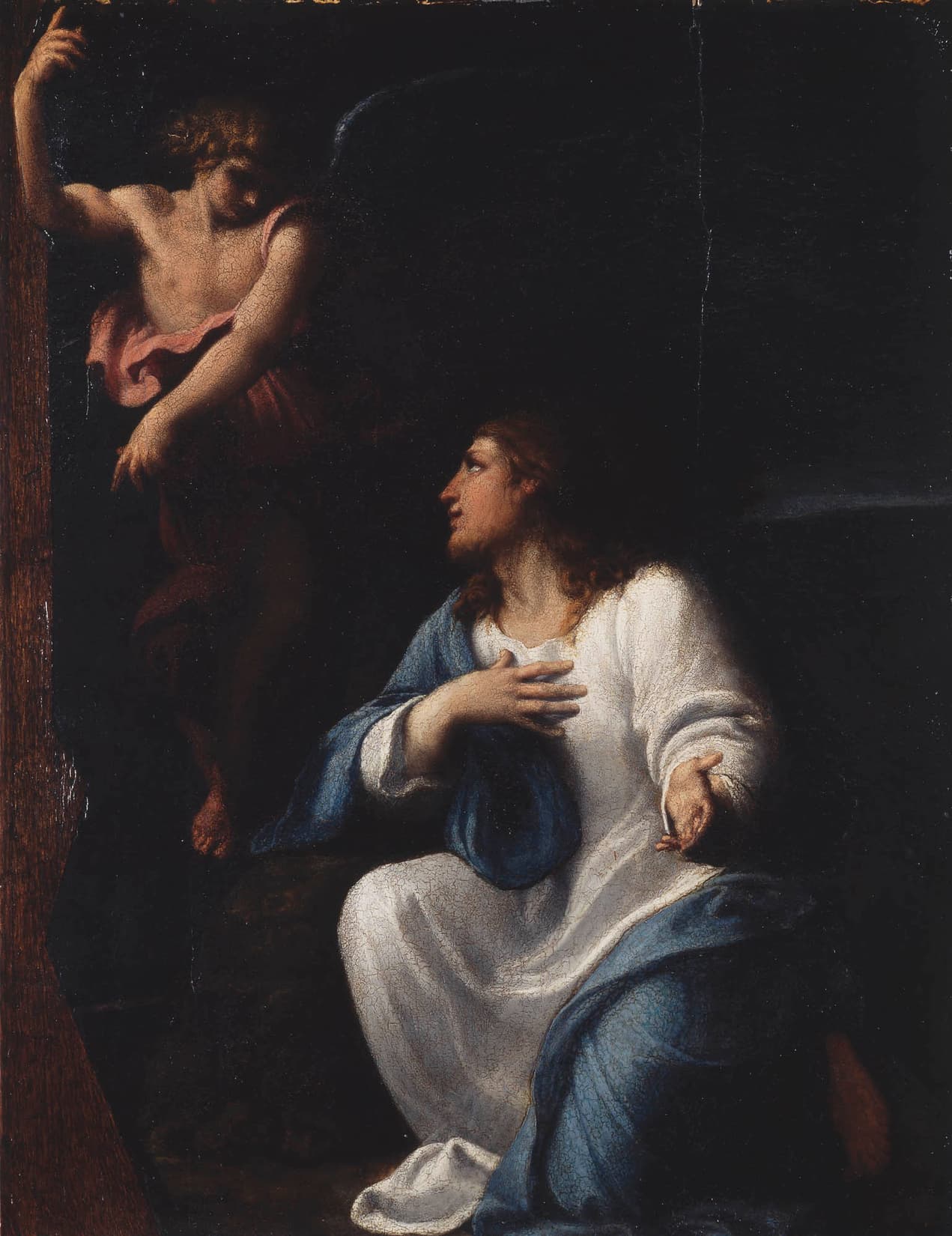
Exodus 18:18 · Symbol · Stress and Weariness
The Words Kaved and Bareo
Hebrew kaved and Greek bareo both mean to be heavy, and Scripture uses them for a load too great to carry.
The famine that drove Abram down to Egypt is the first thing in Scripture called kaved (Genesis 12:10).
We do not want you to be unaware, brothers, of the hardships we encountered in the province of Asia. We were under a burden far beyond our ability to endure, so that we despaired even of life.
- The word
- כָּבֵד (kaved), H3515
- First appears
- Genesis 12:10 “Now there was a famine in the land.…”
Summary
Scripture describes the weariness of its people in words of weight. The Hebrew adjective kaved names what presses on a body, a leader and a heart, and the Greek verb bareo names a person weighed down from outside or from within. Each word takes its exact sense from the verse it stands in, so a study of the words is a study of their verses.
- Kabod, the Hebrew word for glory, shares its root letters with kaved, and each verse settles which sense it carries.
- Paul uses bareo when he tells the Corinthians of a burden in Asia that made him despair even of life.
- The Greek of the New Testament adds words for a load and for the weariness of labor.
Weight and Weariness in Both Testaments
The vocabulary of Exodus 18:18 and 2 Corinthians 1:8 and the words around it.
The Words Kaved and Bareo studies the Hebrew and Greek words that Scripture uses for weight, load and weariness. These are the words behind the trial of stress and weariness, so they show how the Bible itself describes a person pressed beyond his strength.
The question it answers is what each word means in its verses and how far a shared root reaches. It counts the uses of nine words and follows kaved from a tired body to a task too great. It sets the glory word kabod beside it with a caution and gives the Greek words for weight, load and toil. It also sets out three readings of the burden Paul carried in the province of Asia.
Where the Words Stand
The Hebrew words of the kaved family far outnumber the Greek words of weight.
Kabod, glory, is the most frequent word of the kaved family, and the Greek words of weight are rare.
| Word | Sense in the STEP Bible lexicon | Uses | One use in the Berean words |
|---|---|---|---|
| Hebrew | |||
| kabad, כָּבַד, H3513, verb | to be heavy; to honor | 113 | Exodus 20:12, "Honor your father and mother" |
| kaved, כָּבֵד, H3515, adjective | heavy | 41 | Exodus 17:12, "When Moses' hands grew heavy" |
| kabod, כָּבוֹד, H3519, noun | glory | 200 | Exodus 16:10, "the glory of the LORD appeared" |
| massa, מַשָּׂא, H4853, noun | burden | 66 | Exodus 23:5, "fallen under its load" |
| Greek | |||
| bareo, βαρέω, G916, verb | to weigh down | 6 | Matthew 26:43, "for their eyes were heavy" |
| baros, βάρος, G922, noun | weight | 5 | 2 Corinthians 4:17, "an eternal weight of glory" |
| phortion, φορτίον, G5413, noun | a load | 6 | Galatians 6:5, "each one should carry his own load" |
| kopiao, κοπιάω, G2872, verb | to feel fatigue | 22 | John 4:6, "Jesus, weary from His journey" |
| kopos, κόπος, G2873, noun | toil | 18 | Revelation 2:2, "I know your deeds, your labor" |
bareo, βαρέω, G916, verb, baros, βάρος, G922, noun, phortion, φορτίον, G5413, noun, kopiao, κοπιάω, G2872, verb, kopos, κόπος, G2873, noun
Kaved, Heavy
From Eli's chair to the psalmist's lament, the adjective names what presses down.
Kaved can name the weight of a body. Eli was “old and heavy” when he fell backward from his chair at the news of the ark (1 Samuel 4:18).
Kaved also describes a stubborn heart. Exodus 7:14 calls Pharaoh's heart kaved, and the Berean text renders it unyielding.
Surely you and these people with you will wear yourselves out, because the task is too heavy for you. You cannot handle it alone.Jethro's verdict is the use of kaved that names this trial, said of a man's work and the strength it drains.
Moses uses the same adjective when he tells the LORD he cannot carry all the people by himself (Numbers 11:14).
For my iniquities have overwhelmed me; they are a burden too heavy to bear.The lament joins massa, a burden, to kaved and to its verb kabad, so the psalmist feels his sin as a load he cannot lift.
Bareo and the Greek Words of Weight
The Greek verb is passive in its uses, and a load and a weariness stand beside it.
Bareo means to be weighed down. Matthew uses its perfect passive participle, bebaremenoi, for the disciples whom Jesus found asleep in Gethsemane (Matthew 26:43).
In 2 Corinthians 1:8 the verb is the aorist passive ebarethemen, glossed we were weighed.
So while we are in this tent, we groan under our burdens, because we do not wish to be unclothed but clothed, so that our mortality may be swallowed up by life.Paul uses the present passive of bareo for the groaning of believers in the body, a weight carried until mortality is swallowed up by life.
But watch yourselves, or your hearts will be weighed down by dissipation, drunkenness, and the worries of life—and that day will spring upon you suddenly like a snare.Jesus warns that the worries of life can weigh the heart down, so bareo names an inward weight as well as an outward hardship.
The noun baros stands in Galatians 6:2, where believers carry one another's burdens. Three verses later Paul uses phortion, a load, for what each one carries for himself.
The Tyndale House lexicon gives kopiao the fuller meaning to labor. John uses its perfect participle for Jesus at Jacob's well, and Matthew uses its present participle for the weary whom Jesus calls to come to Him (Matthew 11:28).
Kabod, Glory, and the Limit of a Root
Strong's gloss for kabod and the verse of Pharaoh's heart show where a root's reach ends.
Strong's gloss calls kabod “properly, weight, but only figuratively in a good sense, splendor or copiousness”.
Kaved and kabod come from one root. The root tells where the words come from, and the verse tells what each one means. Pharaoh's kaved heart in Exodus 7:14 is stubborn, and reading glory into it would reverse the sentence.
In Greek Paul sets baros, weight, beside doxa, glory, in one phrase of 2 Corinthians 4:17, where the weight is the glory to come.
The Burden in Asia
Three readings of the hardship of 2 Corinthians 1:8, each with its holder and the objection to it.
The riot at EphesusJohn Wesley
John Wesley, in his Explanatory Notes upon the New Testament (1755), wrote of the trouble in Asia, “Probably the same which is described in the nineteenth chapter of the Acts.”
The objection: in Acts 19:30 to 31 the disciples and some officials of the province would not let Paul go into the theatre.
The beasts at EphesusTertullian
Tertullian, in On the Resurrection of the Flesh, read Paul's fight with beasts at Ephesus (1 Corinthians 15:32) as the same danger. He wrote of “those beasts which caused him such peril and trouble in Asia”.
The objection: the Corinthians had already read of the beasts in the first letter, while 2 Corinthians 1:8 is written as news Paul does not want them to be unaware of.
A trouble the record does not nameMatthew Henry
Matthew Henry, in his Commentary on the Whole Bible (1710), judged that “It is not certain what particular troubles in Asia are here referred to”.
The objection: Paul places the hardship in the province of Asia, the region where Acts 19 and 20 set his long stay at Ephesus.
The Weight a Person Carries
The words that name weariness also name the people who carry it.
Where these words speak of weariness, a person carries the weight: a leader at his work, a sufferer in his body, a disciple whose eyes will not stay open. Scripture names each of these loads plainly.
Sources
Scripture is the Berean Standard Bible.
- STEP Bible, Translators Amalgamated Hebrew Old Testament and Greek New Testament (Tyndale House, Cambridge), CC BY 4.0.
- STEP Bible TBESH and TBESG lexicons (Tyndale House, Cambridge), CC BY 4.0, with the definitions of James Strong, Strong's Exhaustive Concordance of the Bible (1890)
- John Wesley, Explanatory Notes upon the New Testament (1755), 2 Corinthians 1:8.
- Tertullian, On the Resurrection of the Flesh (Ante-Nicene Fathers, volume 3)
- Matthew Henry, Commentary on the Whole Bible (1710), 2 Corinthians 1:8.
Keep Studying
People and groups8
Show the next 2 titles
Places1
Symbols5
Words4
Doctrines1