
Exodus 40 · 1 Kings 8 · Ezekiel 43 · Subject · Featured Study
The Glory That Filled the House
The cloud and the glory in Scripture, from the tent in the wilderness and Solomon's temple to the visions of Ezekiel and the Gospel of John.
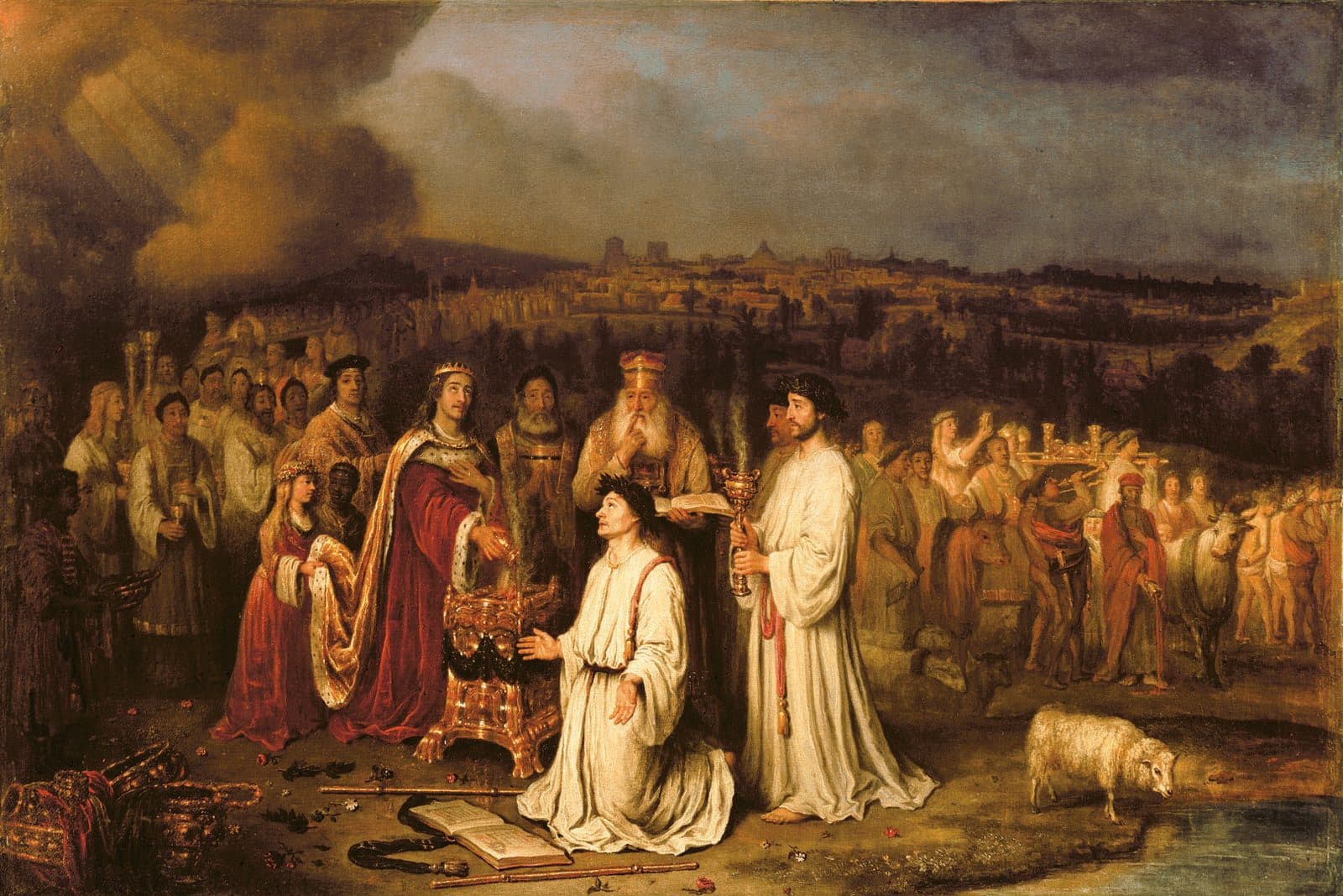
Philips Koninck, Solomon Dedicating the Temple outside Jerusalem, about 1664. Public domain, via Wikimedia Commons.
THE ARTWORKKoninck set Solomon in red at a golden altar before the walls of Jerusalem, with priests around him and a figure in white kneeling at his feet. A procession with oxen comes in from the right, and light breaks through a dark cloud at the upper left.
Ezekiel watched the glory leave the temple by its east gate, and nineteen years later he watched it come back the same way.
Summary
The glory of the LORD is the brightness of His presence, which Scripture shows as a cloud that fills a house.
- Moses could not go into the tent, and the priests could not stand to serve in the temple.
- Chronicles tells of the house filled twice, once when the ark came in and once after Solomon prayed.
- In Ezekiel the glory stops at the door of the temple, at the east gate and on the mountain east of the city.
- No verse says the cloud filled the second temple, and John writes that the glory was seen in Jesus.
Five Verses on the Glory
The tent, the temple, the departure, the return and the Word, in the order Scripture gives them
Two of the five verses are visions Ezekiel saw in Babylon, far from the house they describe.
Then the cloud covered the Tent of Meeting, and the glory of the LORD filled the tabernacle. Moses was unable to enter the Tent of Meeting because the cloud had settled on it, and the glory of the LORD filled the tabernacle.This is the first time Scripture tells of a house filled with the glory.
And when the priests came out of the Holy Place, the cloud filled the house of the LORD so that the priests could not stand there to minister because of the cloud; for the glory of the LORD filled the house of the LORD.The second filling comes at Solomon's temple, nearly five hundred years later.
Then the glory of the LORD moved away from the threshold of the temple and stood above the cherubim. As I watched, the cherubim lifted their wings and rose up from the ground, with the wheels beside them as they went. And they stopped at the entrance of the east gate of the house of the LORD, with the glory of the God of Israel above them.The glory leaves the house the second verse saw filled.
and the glory of the LORD entered the temple through the gate facing east. Then the Spirit lifted me up and brought me into the inner court, and the glory of the LORD filled the temple.The return answers the departure of the verse before.
The Word became flesh and made His dwelling among us. We have seen His glory, the glory of the one and only Son from the Father, full of grace and truth.The other four verses lead to this one, written of Jesus.
The Road of the Glory in Ezekiel
Ezekiel 1, 8 to 11 and 43, in the order the prophet saw them
- By the River KebarEzekiel sees the likeness of the glory of the LORD, Ezekiel 1:28
- In the templeThe glory of the God of Israel stands in the vision of Jerusalem, Ezekiel 8:4
- The thresholdThe glory rises from the cherubim and stands over the threshold, Ezekiel 10:4
- The east gateThe second stop on the way out of the house, Ezekiel 10:19
- The mountain east of the cityThe glory rises from the city and stands over the mountain, Ezekiel 11:23
- The east gate againThe first stop on the way back into the house, Ezekiel 43:4
- The inner courtThe last stop, inside the house the glory had left, Ezekiel 43:5
The seven places where Ezekiel sees the glory, each with the reference of its verse.
From the Tent to the Measured House
What each filling adds, from Exodus to Ezekiel
Each filling comes when the work is finished: Moses finishes the tent, the priests set the ark in its place, and the man measuring Ezekiel's house finishes his measuring.
The tent in the wildernessExodus 29 and 40
I will also meet with the Israelites there, and that place will be consecrated by My glory. So I will consecrate the Tent of Meeting and the altar, and I will consecrate Aaron and his sons to serve Me as priests. Then I will dwell among the Israelites and be their God.Moses heard this promise on the mountain, long before the work began.
Whenever the cloud was lifted from above the tabernacle, the Israelites would set out through all the stages of their journey. If the cloud was not lifted, they would not set out until the day it was taken up. For the cloud of the LORD was over the tabernacle by day, and fire was in the cloud by night, in the sight of all the house of Israel through all their journeys.Exodus closes on these verses, with the cloud still at work after the filling.
Solomon's temple in Kings1 Kings 8
Then Solomon declared: “The LORD has said that He would dwell in the thick cloud. I have indeed built You an exalted house, a place for You to dwell forever.”These are the first words spoken in the filled house.
But will God indeed dwell upon the earth? Even heaven, the highest heaven, cannot contain You, much less this temple I have built.The whole subject turns on this question.
Solomon's temple in Chronicles2 Chronicles 5 to 7
Kings records one filling of the temple, and Chronicles records two, the first while the singers praise.
When Solomon had finished praying, fire came down from heaven and consumed the burnt offering and the sacrifices, and the glory of the LORD filled the temple. The priests were unable to enter the house of the LORD, because the glory of the LORD had filled it. When all the Israelites saw the fire coming down and the glory of the LORD above the temple, they bowed down on the pavement with their faces to the ground, and they worshiped and gave thanks to the LORD: “For He is good; His loving devotion endures forever.”Fire on the offering marks this filling, as it marked the first sacrifices at the tent in Leviticus 9:24.
The measured house in EzekielEzekiel 43
and He said to me, “Son of man, this is the place of My throne and the place for the soles of My feet, where I will dwell among the Israelites forever. The house of Israel will never again defile My holy name—neither they nor their kings—by their prostitution and by the funeral offerings for their kings at their deaths.The LORD speaks this promise from inside the measured house.
What the Text Says of the Glory
Two things often said, each with the reference that tests it
GLORY AS WEIGHT
The lexicon gives kabod the root sense of weight and the use of splendor. In Ezekiel's vision of the return it names a brightness that makes the earth shine.
SHEKINAH AS A WORD OF SCRIPTURE
The word comes from the Targums, the Aramaic translations of the Hebrew Bible.
The Dates the Text Gives
Six dates from Exodus, Kings and Ezekiel
Scripture dates the tent by the years after Egypt, the temple by Solomon's reign, and Ezekiel's visions by the exile of King Jehoiachin.
The tent and the templeExodus 40:17, 1 Kings 6:1
Kings sets the dedication of the temple at the feast of the seventh month.
So the tabernacle was set up on the first day of the first month of the second year.This is the date of the first filling.
In the four hundred and eightieth year after the Israelites had come out of the land of Egypt, in the month of Ziv, the second month of the fourth year of Solomon’s reign over Israel, he began to build the house of the LORD.This dates the start of the work on Solomon's house.
Ezekiel's visions and the fireEzekiel 8:1, Ezekiel 40:1, 2 Kings 25:8 to 9
In the sixth year, on the fifth day of the sixth month, I was sitting in my house, and the elders of Judah were sitting before me; and there the hand of the Lord GOD fell upon me.This verse dates chapters 8 to 11, the vision of the departure.
In the twenty-fifth year of our exile, at the beginning of the year, on the tenth day of the month—in the fourteenth year after Jerusalem had been struck down—on that very day the hand of the LORD was upon me, and He took me there.Ezekiel 43 falls inside the vision this verse dates.
On the seventh day of the fifth month, in the nineteenth year of Nebuchadnezzar’s reign over Babylon, Nebuzaradan captain of the guard, a servant of the king of Babylon, entered Jerusalem. He burned down the house of the LORD, the royal palace, and all the houses of Jerusalem—every significant building.This is the burning that falls between the two visions.
The Words of the Glory
Six words from the lexicon, each in the verse where it stands
KABOD, GLORY (HEBREW, H3519)
The lexicon counts 200 uses, and here the word stands joined to the LORD's name as the glory of the LORD.
ANAN, CLOUD (HEBREW, H6051)
The lexicon gives the common word for a cloud covering the sky, and Kings uses it for the cloud that filled the house.
ARAFEL, THICK CLOUD (HEBREW, H6205)
The lexicon gives gloom, as of a lowering sky, and Solomon uses it for the cloud the LORD dwells in.
SHAKAN, TO DWELL (HEBREW, H7931)
The lexicon gives to reside or permanently stay, the verb used of the cloud that settled on the tent.
MISHKAN, TABERNACLE (HEBREW, H4908)
The lexicon gives a residence, and specifically the Tabernacle, the house the glory filled.
SKENOO, TO MAKE A DWELLING (GREEK, G4637)
John uses this Greek verb for the Word's dwelling, and the lexicon gives it as to tent or encamp, as God did in the tabernacle.
What the Text Leaves Unsaid
Four questions the verses leave open
The second temple was dedicated with offerings and joy, and the account names no cloud and no glory filling it.
Then the people of Israel—the priests, the Levites, and the rest of the exiles—celebrated the dedication of the house of God with joy. For the dedication of the house of God they offered a hundred bulls, two hundred rams, four hundred lambs, and a sin offering for all Israel of twelve male goats, one for each tribe of Israel.This is the whole dedication account, so the silence can be checked.
The medieval commentator Rashi, on Haggai 1:8, cites Tractate Yoma 21b of the Talmud for five things of the first temple that the second lacked, and the Shekinah is one of them.
‘Who is left among you who saw this house in its former glory? How does it look to you now? Does it not appear to you like nothing in comparison?’The prophet of the rebuilding admits the loss himself.
Ezekiel 11 ends the departure at its last stop and does not say where the glory went from there. No verse says when the return Ezekiel 43 describes will take place.
Then the cherubim, with the wheels beside them, spread their wings, and the glory of the God of Israel was above them. And the glory of the LORD rose up from within the city and stood over the mountain east of the city.These verses are the last sight of the glory in Ezekiel until the vision of chapter 43.
An earlier loss of the glory is recorded in 1 Samuel 4, and no cloud is named there.
And she named the boy Ichabod, saying, “The glory has departed from Israel,” because the ark of God had been captured and her father-in-law and her husband had been killed. “The glory has departed from Israel,” she said, “for the ark of God has been captured.”It ties the glory to the ark, long before the temple was built.
The Word Who Made His Dwelling
John 2 and Revelation 21, and Haggai's promise to the second temple
Jesus answered, “Destroy this temple, and in three days I will raise it up again.” “This temple took forty-six years to build,” the Jews replied, “and You are going to raise it up in three days?” But Jesus was speaking about the temple of His body.The reading of Ezekiel 43 as fulfilled in Christ starts from this verse.
But I saw no temple in the city, because the Lord God Almighty and the Lamb are its temple. And the city has no need of sun or moon to shine on it, because the glory of God illuminates the city, and the Lamb is its lamp.The last vision of Scripture ends the line of houses.
Jamieson, Fausset and Brown read Haggai's promise to the rebuilt house as kept by the presence of the Messiah, who taught daily in that house.
The latter glory of this house will be greater than the former, says the LORD of Hosts. And in this place I will provide peace, declares the LORD of Hosts.”The promise names this house, which settles where the greater glory must be found.
Four Teachers on the Glory
Matthew Henry, John Wesley, Jamieson, Fausset and Brown, and Albert Barnes, each with the work named
Writing in 1710, Henry answers why the glory came veiled.
“A concealment of the tabernacle, and the glory of God in it. God did indeed dwell among them, but he dwelt in a cloud: Verily thou art a God that hidest, thyself. Blessed be God for the gospel of Christ, in which we all with open face behold as in a glass, not in a cloud, the glory of the Lord.”
Matthew Henry · Commentary on the Whole Bible · on Exodus 40:38Puritan
In his notes of 1765, Wesley explains why the glory paused at the threshold.
“The glory - The visible token of the presence of the God of glory. Went up - In token of his departure from the temple. And stood - Shewing his unwillingness to leave, and giving them time to return to him, he stands where he might he seen, both by priests and people, that both might be moved to repentance.”
John Wesley · Explanatory Notes upon the Old Testament · on Ezekiel 10:4Evangelical
Jamieson, Fausset and Brown, in their commentary of 1871, explain why the departure came in stages.
“The departure of the symbol of God's presence from the temple preparatory to the destruction of the city. Woe be to those from whom God departs (Ho 9:12)! 4:21: ‘I-chabod, Thy glory is departed.’ Successive steps are marked in His departure; so slowly and reluctantly does the merciful God leave His house.”
Jamieson, Fausset & Brown · Commentary Critical and Explanatory on the Whole Bible · on Ezekiel 10:18Reformed
Barnes names the cloud that filled Solomon's house.
“The cloud - the visible symbol of the divine presence - the Shechinah of the Targums - which halt been promised before the ark was begun Exo 29:43, and had filled the tabernacle as soon as it was completed Exo 40:34, and which had probably been seen from time to time during the long interval when we have no express mention of it, now once more appeared in full magnificence, and took, as it were, possession of the building which Solomon was dedicating. The presence of God in the temple henceforth was thus assured to the Jews, and His approval of all that Solomon had done was signified.”
Albert Barnes · Notes, Explanatory and Practical, on the Old and New Testaments (1832-1869) · on 1 Kings 8:10Evangelical
Where Ezekiel 43 Is Fulfilled
Three readings of the return, each with its case and the strongest objection
A temple in the reign of the MessiahJamieson, Fausset and Brown, Commentary Critical and Explanatory, 1871
This reading takes the house, its gates and its borders as a future temple in the land, entered by the returning Lord. Jamieson, Fausset and Brown tie that return to the mountain where the departure ended.
“So it was from it that Jesus ascended to heaven when about to send His judgments on the Jews; and from it He predicted its overthrow before His crucifixion (Mt 24:3). It is also to be the scene of His return in person to deliver His people (Zec 14:4), when He shall come by the same way as He went, ‘the way of the east’ (Eze 43:2).”
Jamieson, Fausset & Brown · Commentary Critical and Explanatory on the Whole Bible · on Ezekiel 11:23Reformed
The objection: Ezekiel 43 restores a sacrifice for sin at the altar, which Hebrews counts as finished.
And where these have been forgiven, an offering for sin is no longer needed.Hebrews draws this conclusion from the single offering of Christ, set out in Hebrews 10:14.
Fulfilled in Christ and the churchMatthew Henry, Commentary on the Whole Bible, 1710
This reading takes the house as a figure fulfilled in Jesus and in the last city of Revelation. Matthew Henry finds the return of the glory fulfilled in the gospel church.
The objection: this reading must take as figures the design Israel is told to carry out, from the measured courts and their offerings to the tribal borders.
This is what the Lord GOD says: “These are the boundaries by which you are to divide the land as an inheritance among the twelve tribes of Israel; Joseph shall receive two portions.Joseph's two portions show how exact the borders are.
A plan for the returned exilesWalther Zimmerli, Ezekiel 2, Hermeneia, 1983
This reading takes the house as a programme for the return from exile.
The objection: the exiles built to the measures of Cyrus's decree, and Ezra never names Ezekiel's plan.
As for you, son of man, describe the temple to the people of Israel, so that they may be ashamed of their iniquities. Let them measure the plan, and if they are ashamed of all they have done, then make known to them the design of the temple—its arrangement and its exits and entrances—its whole design along with all its statutes, forms, and laws. Write it down in their sight, so that they may keep its complete design and all its statutes and may carry them out.The reading stands or falls on this command.
In the first year of King Cyrus, he issued a decree concerning the house of God in Jerusalem: Let the house be rebuilt as a place for offering sacrifices, and let its foundations be firmly laid. It is to be sixty cubits high and sixty cubits wide,The second temple's size was set in Persia.
Books on the Glory
Three commentaries to read whole, earliest first
Commentary on the Whole Bible
Matthew Henry · 1710
Henry reads the Old Testament scenes of the glory with the gospel in view.
Explanatory Notes upon the Old Testament
John Wesley · 1765
Wesley gives short notes on the departure in Ezekiel 10 and on the return in Ezekiel 43.
Commentary Critical and Explanatory
Robert Jamieson, A. R. Fausset and David Brown · 1871
The three authors wrote notes on the promise of Haggai 2:9.
We Have Seen His Glory
The subject runs from a house no one could enter to a face people could see. Solomon asked whether God would “indeed dwell upon the earth,” and the Gospel of John answers with Jesus. Paul carries the answer to every believer.
For God, who said, “Let light shine out of darkness,” made His light shine in our hearts to give us the light of the knowledge of the glory of God in the face of Jesus Christ.Paul joins the light of creation to the glory seen in Christ.
Keep studying
Studies6
Places7
Doctrines5
Peoples and groups1