
1 Kings 17 to 2 Kings 2 · Person · Featured Study
Elijah the Tishbite
The prophet who stood against King Ahab, Queen Jezebel and the worship of Baal.
Elijah asked God to take his life under a broom tree, and God took him up in a whirlwind instead.
- The name means
- Yahweh is my God
- Places
- Zarephath, Mount Carmel, Jezreel, Beersheba, Mount Sinai, The Jordan River
- First named
- 1 Kings 17:1
- Last named
- James 5:17
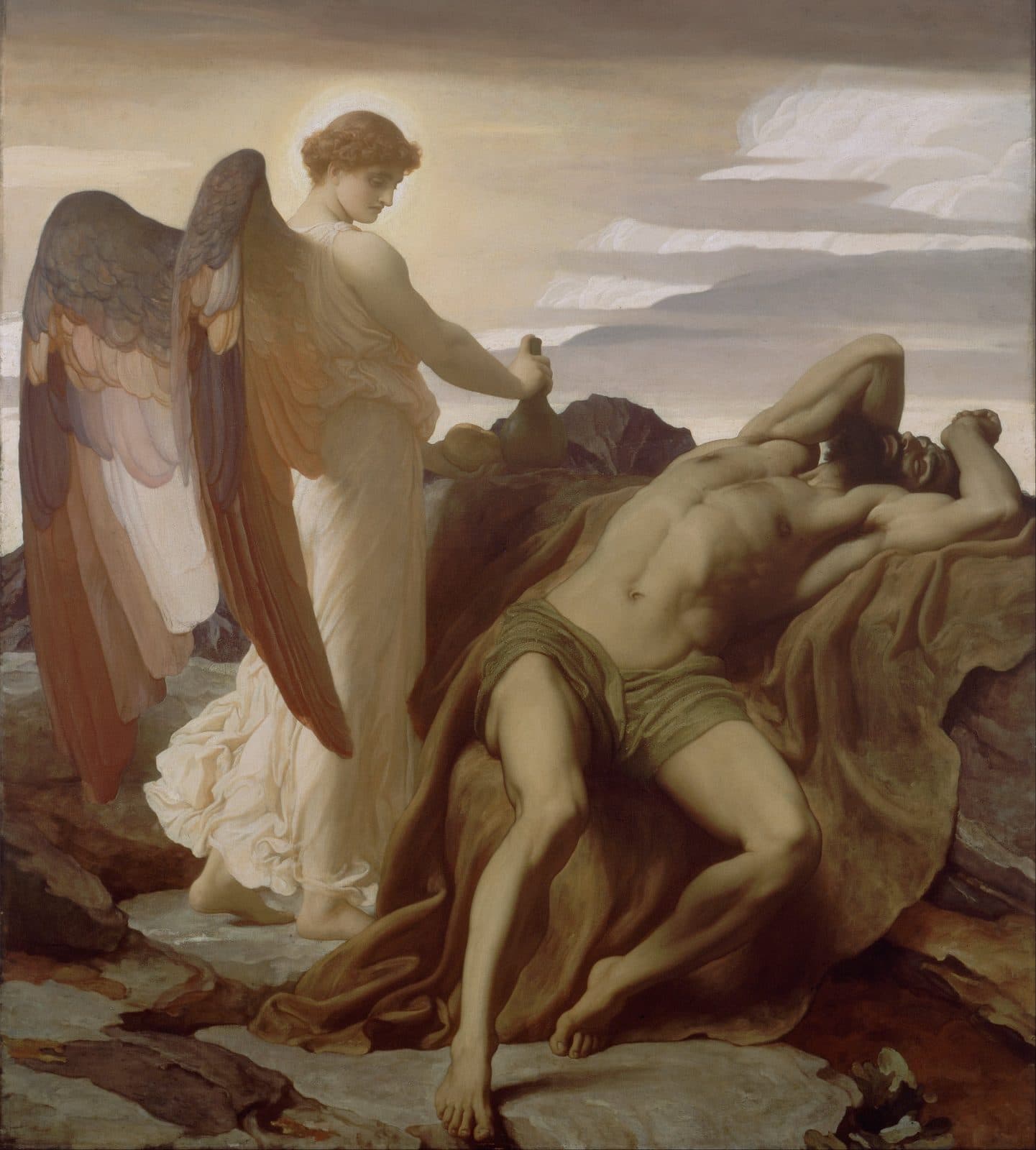
Frederic Leighton, Elijah in the Wilderness, 1877 to 1878, oil on canvas, Walker Art Gallery, Liverpool. Public domain, via Wikimedia Commons.
THE ARTWORKLeighton painted the angel standing over Elijah while he sleeps in the wilderness, with the jar of water and the loaf the angel brought him.
Summary
Elijah the Tishbite was a prophet of northern Israel in the ninth century before Christ, in the reigns of Ahab and his son Ahaziah.
- He comes from Gilead, east of the Jordan.
- On Carmel the fire of the LORD fell on his altar before all Israel.
- At Horeb the LORD spoke to him in a still, small voice.
- Malachi names him as the prophet sent before the Day of the LORD.
- Jesus says John the Baptist is the Elijah who was to come.
Where Elijah Stands in Scripture
From his first sentence in First Kings to the letter of James
The drought Elijah announces has its cause in the chapter before: Ahab married Jezebel of Sidon, served Baal, and built Baal a temple in Samaria.
Now Elijah the Tishbite, who was among the settlers of Gilead, said to Ahab, “As surely as the LORD lives—the God of Israel before whom I stand—there will be neither dew nor rain in these years except at my word!”The oath that sets the drought, the contest on Carmel and the rain in motion.
Baal was worshipped as a god of the storm, so a drought and fire from the sky strike at the ground he was worshipped for. The Kurkh Monolith of Shalmaneser III, inscribed about 853 BC, names Ahab of Israel among the kings who met the Assyrian army at Qarqar. No inscription names Elijah.
As they were walking along and talking together, suddenly a chariot of fire with horses of fire appeared and separated the two of them, and Elijah went up into heaven in a whirlwind.How his life on earth ends, beside the Jordan.
The Gospels, Romans and James all name him.
The Life in Fourteen Turns
From the word of drought to the mountain of the transfiguration
- The drought announced1 Kings 17:1
- Fed by ravens1 Kings 17:6
- The jar and the jug1 Kings 17:16
- The widow's son raised1 Kings 17:22
- The fire falls1 Kings 18:38
- The rain comes1 Kings 18:45
- He asks to die1 Kings 19:4
- The still, small voice1 Kings 19:12
- Elisha called1 Kings 19:19
- Word against Ahab1 Kings 21:19
- Fire on the captains2 Kings 1:10
- Taken up2 Kings 2:11
- Promised againMalachi 4:5
- Seen with JesusMatthew 17:3
Read the cards in the order the books tell them; each opens its verse.
From the Drought to the Whirlwind
The life in five paragraphs, from First Kings 17 to Second Kings 2
The LORD hides Elijah by the Brook of Cherith, where ravens bring him bread and meat morning and evening, and then sends him to a widow of Zarephath. Her flour and oil last until the rain, and when her son dies, Elijah prays and the boy lives.
In the third year he calls Israel to Mount Carmel and asks how long they will waver. The prophets of Baal call on their god all day, Elijah prays two sentences, and the fire of the LORD falls.
Jezebel swears to kill him, and he runs into the wilderness and asks to die. An angel feeds him twice, and he walks forty days to Horeb.
There the LORD asks him twice what he is doing, and twice he gives the same answer. The LORD passes by on the mountain and sends him back with a commission.
After the earthquake there was a fire, but the LORD was not in the fire. And after the fire came a still, small voice.The answer Elijah received after the fire he had called down on Carmel.
What the Text Says
Six details of the account that retellings tend to drop
THE ALTAR WAS REPAIRED
Elijah repaired the altar of the LORD that had been torn down, with twelve stones for the twelve tribes.
THE ALTAR WAS SOAKED
Elijah had four pots of water poured on the offering three times, and the water filled the trench.
THE RAIN CAME AFTER PRAYER
The fire is followed by seven trips to look at the sea before the rain falls.
A HUNDRED PROPHETS WERE HIDDEN
Obadiah had hidden a hundred prophets of the LORD in caves before Elijah said he alone was left.
AHAB REPENTED AND WAS HEARD
The Naboth account ends with the king in sackcloth and the calamity delayed to his son's days.
THE DOUBLE PORTION HAD A CONDITION
Elijah told Elisha he would have a double portion of his spirit only if he saw Elijah taken.
The Prophet in Jewish Reading
Rashi on the drought and the cave, Radak on where Elijah is now, and a midrash on the chair kept for him at a circumcision
Rashi, who wrote in northern France between 1040 and 1105, reads Elijah's chapters through the Talmud.
Radak, David Kimhi, lived in Provence from 1160 to 1235.
Why the drought beganRashi on First Kings 17, from Sanhedrin 113a
In Rashi's telling, Ahab and Elijah visit Hiel to console him in his mourning. Ahab asks why Joshua's curse on Jericho came true while the curse of Moses on idolatry, a sky shut against rain, had not. At once Elijah swears the drought.
In Ahab’s days, Hiel the Bethelite rebuilt Jericho. At the cost of Abiram his firstborn he laid its foundation, and at the cost of Segub his youngest he set up its gates, according to the word that the LORD had spoken through Joshua son of Nun.The verse Rashi reads as the occasion of Elijah's oath.
The cave and the commissionRashi on First Kings 19
Rashi reads the cave at Horeb as the cleft of the rock where Moses stood when the glory passed, citing Megillah 19b. On the commission to anoint Elisha he gives the LORD's reason in sharp words: I do not want your prophecy, because you plead for the prosecution of My children.
and when My glory passes by, I will put you in a cleft of the rock and cover you with My hand until I have passed by.The verse Rashi's reading of the cave rests on.
Where Elijah is nowRashi and Radak on Second Kings 2, Rashi on Malachi 3
On Elisha's cry of my father, my father, Rashi calls Elijah a teacher whose prayers served Israel better than chariots and horsemen. The Metsudah edition's note on Second Kings 2:16 gives Radak's view that Elijah's body was carried whole to the Garden of Eden. There he stays hidden except when he is sent on a mission or appears to the righteous.
The Hebrew text numbers Malachi 4:5 to 6 as Malachi 3:23 to 24, so a Jewish commentary on the promise of Elijah stands at Malachi 3:23. Rashi reads its last line as turning the heart of the fathers back to the Holy One.
The chair of ElijahPirke de Rabbi Eliezer, chapter 29
The midrash Pirke de Rabbi Eliezer reads Elijah's zeal at Horeb as zeal for the covenant of circumcision, which it says the northern kingdom had cast off. In its telling the Holy One answers that Israel will not keep that covenant until Elijah sees it done with his own eyes. From this, it says, the sages set a seat of honour for Elijah at every circumcision, because Malachi calls him the messenger of the covenant.
“Behold, I will send My messenger, who will prepare the way before Me. Then the Lord whom you seek will suddenly come to His temple—the Messenger of the covenant, in whom you delight—see, He is coming,” says the LORD of Hosts.The verse the midrash cites for the custom.
The Places of the Life
Nine places, from the Brook of Cherith to the Jordan
THE BROOK OF CHERITH
The brook east of the Jordan dried up for lack of rain.
ZAREPHATH
A town of Sidon, the home country of Jezebel.
MOUNT CARMEL
Four hundred and fifty prophets of Baal were gathered here.
JEZREEL
Ahab's palace stood here, next to Naboth's vineyard.
BEERSHEBA
Elijah left his servant here.
HOREB
The text calls it the mountain of God.
BETHEL
The company of prophets at Bethel knew Elijah would be taken that day.
JERICHO
The prophets of Jericho told Elisha the same.
THE JORDAN
Elijah parted the river with his cloak.
Questions the Life Raises
Four questions, each with the verses or the readings that bear on it
Was the drought three years or three and a half?First Kings 18, Luke 4, James 5
First Kings says the word came in the third year, and Luke and James both give three years and six months. Matthew Henry, in his Commentary on Luke 4, and John Wesley give one answer, which leaves room for the months at Cherith.
“When the heaven was shut up three years and six months - Such a proof had they that God had sent him. In 1 Kings xviii, 1, it is said, The word of the Lord came to Elijah in the third year: namely, reckoning not from the beginning of the drought, but from the time when he began to sojourn with the widow of Sarepta.”
John Wesley · Explanatory Notes upon the New Testament · on Luke 4:25Evangelical
Did Elijah die?Second Kings 2
Albert Barnes, in his Notes on Second Kings 2, reads the passage as a translation like Enoch's.
But when they pressed him to the point of embarrassment, he said, “Send them.” And they sent fifty men, who searched for three days but did not find Elijah.The verse Barnes's reading of a translation rests on.
Was John the Baptist Elijah come back?Matthew 11, John 1
Gregory the Great answers the question in the seventh of his Forty Gospel Homilies.
“Then who are you?” they inquired. “Are you Elijah?” He said, “I am not.” “Are you the Prophet?” He answered, “No.”The denial Gregory's reading has to answer.
“For the angel says to Zechariah concerning John: ‘He will go before him in the spirit and power of Elijah.’ He is said to be coming in the spirit and power of Elijah because just as Elijah will precede the second coming of the Lord, so John preceded the first. Just as the former will be the precursor of the Judge, so the latter was made the precursor of the Redeemer. John therefore was Elijah in spirit; he was not Elijah in person. What the Lord therefore declares concerning the spirit, John denies concerning the person.”
Gregory the Dialogist · Forty Gospel Homilies, Homily 7 · on Luke 1:17Patristic
How could Elijah write to Jehoram?Second Chronicles 21
Chronicles records a letter from Elijah to Jehoram king of Judah. Adam Clarke, in his Commentary on Second Chronicles 21, states the difficulty: Second Kings seems to place Elijah's departure in the reign of Jehoram's father.
John Wesley, in his Explanatory Notes on Second Chronicles 21, notes that First Kings records Jehoram's accession before it narrates Elijah's departure, and he supposes that Elijah wrote because his departure was near. The objection: Second Kings 3 shows Elisha already serving as prophet in Jehoshaphat's days, so Wesley must hold that Elisha served while his master was still on earth.
Albert Barnes, in his Notes on Second Chronicles 21, takes the letter as proof that Elijah was alive after the death of Jehoshaphat. On that reading the account of the whirlwind stands earlier in Second Kings than it happened. The objection: the reading rests on the letter alone, since Second Kings gives no date for the whirlwind.
What the Text Leaves Unsaid
Three silences the account keeps
The text gives Elijah no father, no tribe and no call.
At Horeb he is told to anoint Hazael, Jehu and Elisha, and the account records only the call of Elisha. Hazael and Jehu come to their thrones later through Elisha and a young prophet Elisha sends, and the text gives no reason.
The text names no grave for him.
Where Elijah Points
Four ways Elijah points ahead: to John the Baptist, to Christ on the mountain, to the ascension and to the remnant
And when they looked up, they saw no one except Jesus.Elijah's last appearance in the Gospels.
Malachi's promise and JohnLuke 1, Matthew 17
Coming down from the mountain, Jesus says that Elijah does come and will restore all things, and that Elijah has already come. The disciples understood that He spoke of John the Baptist.
And he will go on before the Lord in the spirit and power of Elijah, to turn the hearts of the fathers to their children and the disobedient to the wisdom of the righteous—to make ready a people prepared for the Lord.”The angel applies Malachi 4:6 to John before his birth.
Moses and Elijah on the mountainLuke 9, Malachi 4
Malachi names Moses and Elijah together in his last lines, Moses at Malachi 4:4 and Elijah at Malachi 4:5.
Suddenly two men, Moses and Elijah, began talking with Jesus. They appeared in glory and spoke about His departure, which He was about to accomplish at Jerusalem.Luke alone records what the three spoke of.
The whirlwind and the ascensionJohn Wesley
“By translating him, God gave in that dark and degenerate age, a very sensible proof of another life, together with a type of the ascension of Christ, and the opening of the kingdom of heaven to all believers.”
John Wesley · Explanatory Notes upon the Old Testament · on 2 Kings 2:1Evangelical
The two accounts differ: Elijah was taken up alive, and Christ ascended after He had died and risen.
The seven thousand in PaulRomans 11
Paul quotes the LORD's answer at Horeb.
And what was the divine reply to him? “I have reserved for Myself seven thousand men who have not bowed the knee to Baal.” In the same way, at the present time there is a remnant chosen by grace.Paul's proof that God has not rejected His people.
Voices on Elijah
Two teachers of the eighteenth and nineteenth centuries, earliest first
John Wesley names what each witness stood for.
“There appeared Moses and Elijah - Here for the full confirmation of their faith in Jesus, Moses, the giver of the law, Elijah, the most zealous of all the prophets, and God speaking from heaven, all bore witness to him.”
John Wesley · Explanatory Notes upon the New Testament · on Matthew 17:3Evangelical
Wesley returns to Elijah near the end of his New Testament notes.
“Elijah was a man of like passions - Naturally as weak and sinful as we are.”
John Wesley · Explanatory Notes upon the New Testament · on James 5:17Evangelical
Albert Barnes returns to the first verse of the account.
“The name Elijah means ‘Yahweh is my God.’ It is expressive of the truth which his whole life preached. The two words rendered ‘Tishbite’ and ‘inhabitant’ are in the original (setting aside the vowel points) ‘exactly alike.’ The meaning consequently must either be ‘Elijah the stranger, of the strangers of Gilead,’ or (more probably) ‘Elijah the Tishbite, of Tishbi of Gilead.’ Of Tishbi in Gilead there is no further trace in Scripture; it is to be distinguished from another Tishbi in Galilee.”
Albert Barnes · Notes, Explanatory and Practical, on the Old and New Testaments (1832-1869) · on 1 Kings 17:1Evangelical
The Fire on the Captains
Three readings of Second Kings 1:9 to 15, each with its holder
Two captains of fifty and their men are consumed by fire at Elijah's word, and the third captain kneels and lives. Luke records a later scene at a Samaritan village that would not receive Jesus on His way to Jerusalem.
When the disciples James and John saw this, they asked, “Lord, do You want us to call down fire from heaven to consume them?” But Jesus turned and rebuked them.The disciples take the fire on the captains as their pattern.
The fire was God's actAdam Clarke
Adam Clarke answers the prophet's critics.
“And there came down fire - Some have blamed the prophet for destroying these men, by bringing down fire from heaven upon them. But they do not consider that it was no more possible for Elijah to bring down fire from heaven, than for them to do it. God alone could send the fire; and as he is just and good, he would not have destroyed these men had there not been a sufficient cause to justify the act.”
Adam Clarke · Commentary on the Bible · on 2 Kings 1:10Evangelical
The objection: Elijah spoke the words that called the fire, so the act was his as well as God's.
The fire proved his commissionJohn Wesley
John Wesley gives the reason Elijah called the fire.
“Let fire, &c. - Elijah did this, not to secure himself, he could have done that some other way: nor to revenge himself, for it was not his own cause that he acted in: but to prove his mission, and to reveal the wrath of God from heaven against the ungodliness and unrighteousness of men.”
John Wesley · Explanatory Notes upon the Old Testament · on 2 Kings 1:10Evangelical
The objection: the fire on Carmel had already shown all Israel that Elijah was the LORD's servant.
Strict justice under the LawAlbert Barnes
Albert Barnes, in his Notes on Second Kings 1, judges the act by the Law under which Elijah lived. He reads Ahaziah's band of fifty as a challenge to the LORD, Elijah's answer as the Law's full severity, and the fire as strict justice that God confirmed by sending it.
The objection: Second Kings 1 records that Elijah went down with the third captain when the angel told him to.
A Man Just Like Us
James calls Elijah a man just like us and sets his prayer before the reader as a pattern: he prayed, the sky closed, and he prayed again and the rain came. The text asks the reader to pray as he did, with the same persistence he showed on the summit of Carmel.
The one who called down fire was fed and let sleep. On the mountain, the voice from the cloud told the disciples to listen to the Son.
Keep studying
Studies3
People9
Show the next 3 titles
Places14