
Genesis 16 to 48 · Doctrine · Featured Study
The Angel of YHWH
The angel of the LORD appears from Genesis 16 to Zechariah 3, and five readings of who he is run from Justin Martyr in the second century to scholars of the twentieth.
Every reading of the angel of the LORD tries to hold two facts together: he speaks as God, and he is sent by God.
- First taught
- Genesis 16:7 “Now the angel of the…”
- Fullest statement
- Exodus 23:21 “Pay attention to him and listen to his…”
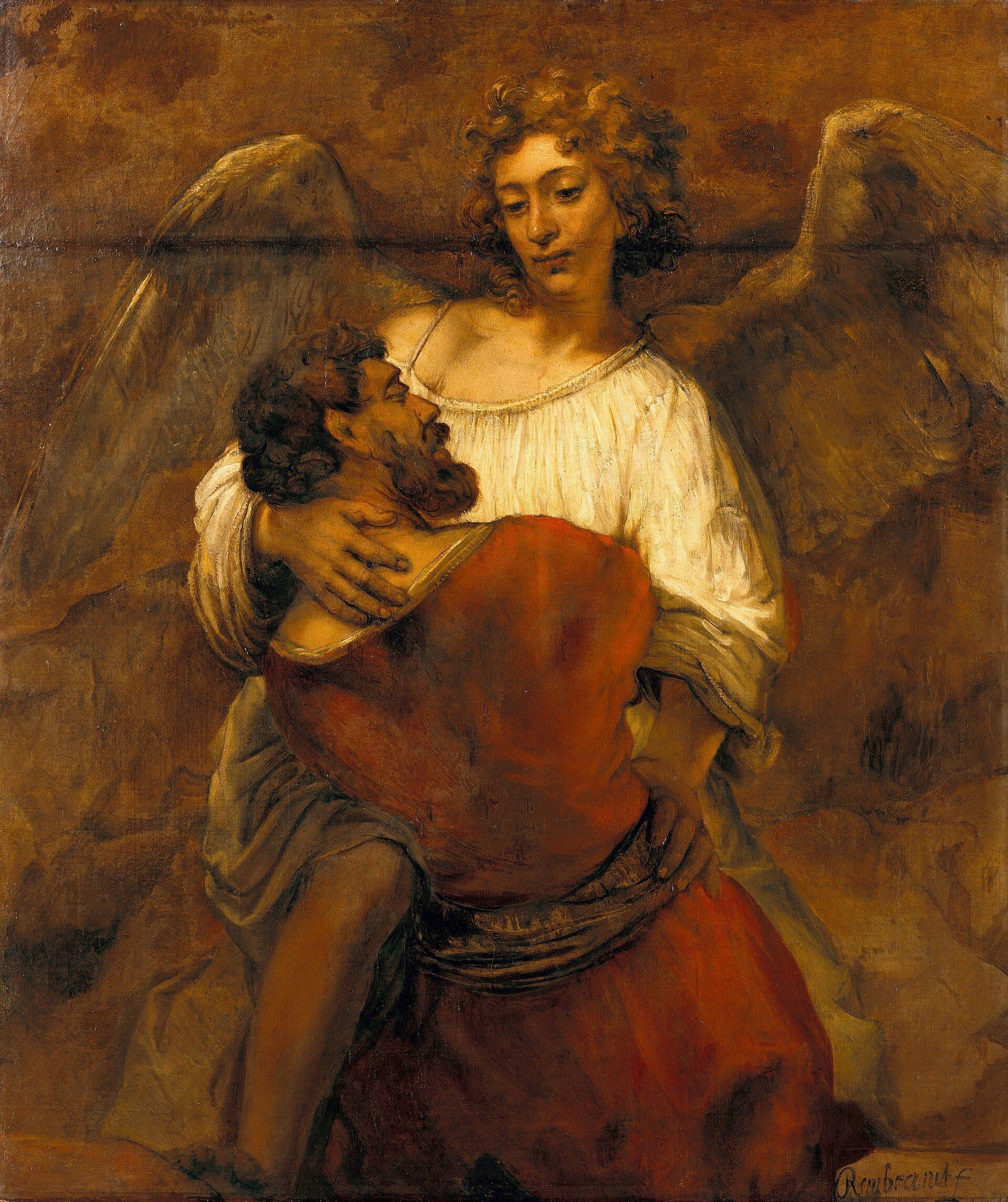
Rembrandt van Rijn, Jacob Wrestling with the Angel, about 1659. Public domain.
Summary
Genesis names the angel at a spring on the road to Shur, on Moriah and in Jacob's dream in the land of Laban, and Jacob invokes him when he blesses Joseph's sons.
- Hagar gives a name to the LORD who had spoken to her, and Jacob says at Peniel that he has seen God face to face.
- In Exodus 23:20 God sends the angel before Israel, and in Zechariah 1:12 the angel pleads with the LORD of Hosts for Jerusalem.
- Justin Martyr read him as the Son before the incarnation, and Augustine read the appearances as the work of created angels.
The Angel Speaks the Promise and the Oath of God
In Genesis 16 the angel gives Hagar a promise, and in Genesis 22 he swears the oath of the LORD.
The Hebrew malʾak means a messenger, one who is sent, so the phrase malʾak YHWH names the messenger of the LORD by his office. Who this messenger is has been argued since Justin Martyr in the second century, and it is one of the oldest hard questions in the doctrine of God.
Then the angel added, “I will greatly multiply your offspring so that they will be too numerous to count.” The angel of the LORD proceeded: “Behold, you have conceived and will bear a son. And you shall name him Ishmael, for the LORD has heard your cry of affliction. He will be a wild donkey of a man, and his hand will be against everyone, and everyone’s hand against him; he will live in hostility toward all his brothers.” So Hagar gave this name to the LORD who had spoken to her: “You are the God who sees me,” for she said, “Here I have seen the One who sees me!”This is the first text in Scripture to name the angel of the LORD.
And the angel of the LORD called to Abraham from heaven a second time, saying, “By Myself I have sworn, declares the LORD, that because you have done this and have not withheld your only son,The holders of the first reading cite this oath, sworn on the speaker's own name.
The Appearances the Five Readings Weigh
These texts carry the question of who the angel is; 2 Kings 19:35, 1 Chronicles 21:16 and 1 Kings 19:7 also name the angel of the LORD.
In most of these texts the angel is identified with God; in Numbers 22 and Zechariah he is set apart from God.
| Text | The scene | What the angel does | The datum |
|---|---|---|---|
| Genesis 16:7 to 13 | Hagar has run from Sarai to a spring on the road to Shur. | He promises in the first person to multiply her offspring, and she names the LORD the God who sees me. | identified with God |
| Genesis 21:17 to 19 | Hagar and the boy are in the wilderness with the water gone. | The angel of God calls from heaven and says, I will make him into a great nation. | identified with God |
| Genesis 22:11 to 16 | Abraham takes the knife to sacrifice Isaac on Moriah. | He stops the knife, speaks of the son not withheld from me, and swears the oath of the LORD by Himself. | identified with God |
| Genesis 31:11 to 13 | Jacob dreams of the flocks of Laban. | The angel of God says, I am the God of Bethel. | identified with God |
| Genesis 32:24 to 30 and Hosea 12:4 | A man wrestles Jacob until daybreak and renames him Israel. | Jacob names the place Peniel for seeing God face to face, and Hosea calls the wrestler the angel. | identified with God |
| Genesis 48:15 to 16 | Jacob blesses Joseph and his sons. | Jacob sets the angel who redeemed him from all harm beside the God who shepherded him. | identified with God |
| Exodus 3:2 to 6 | The angel appears to Moses in a blazing fire within a bush. | God speaks from the bush as the God of Moses' father. | identified with God |
| Exodus 23:20 to 21 | God promises an angel to go before Israel. | The Name of God is in the one sent, and he will not forgive rebellion. | both at once |
| Numbers 22:22 to 35 | Balaam rides his donkey with his two servants. | He stands in the road to oppose Balaam and rebukes him as the messenger of God. | distinguished from God |
| Joshua 5:13 to 15 | A man with a drawn sword meets Joshua near Jericho. | As Commander of the LORD's army he receives Joshua's reverence and gives the command Moses heard at the bush. | identified with God |
| Judges 2:1 to 4 | The angel goes up from Gilgal to Bochim. | He says to all Israel, I brought you up out of Egypt, and names the covenant his own. | both at once |
| Judges 6:11 to 23 | The angel sits under the oak at Ophrah while Gideon threshes wheat in a winepress. | The LORD then speaks, and Gideon fears for his life for seeing the angel face to face. | identified with God |
| Judges 13:3 to 22 | The angel promises a son to the wife of Manoah. | His name is beyond comprehension, and Manoah fears death for having seen God. | identified with God |
| Zechariah 1:12 and Zechariah 3:1 to 5 | Zechariah sees the angel among the myrtle trees and in the court of Joshua the high priest. | He intercedes with the LORD of Hosts, and in the court the LORD rebukes Satan. | distinguished from God |
Exodus 3:2 to 6, Exodus 23:20 to 21, Numbers 22:22 to 35, Joshua 5:13 to 15, Judges 2:1 to 4, Judges 6:11 to 23, Judges 13:3 to 22, Zechariah 1:12 and Zechariah 3:1 to 5
Four Texts to Read Whole
Four texts beyond Genesis carry the weight of the question.
There the angel of the LORD appeared to him in a blazing fire from within a bush. Moses saw the bush ablaze with fire, but it was not consumed. So Moses thought, “I must go over and see this marvelous sight. Why is the bush not burning up?” When the LORD saw that he had gone over to look, God called out to him from within the bush, “Moses, Moses!” “Here I am,” he answered. “Do not come any closer,” God said. “Take off your sandals, for the place where you are standing is holy ground.” Then He said, “I am the God of your father, the God of Abraham, the God of Isaac, and the God of Jacob.” At this, Moses hid his face, for he was afraid to look at God.The angel appears in the fire and then God speaks from the bush, so the whole question stands in five verses.
Behold, I am sending an angel before you to protect you along the way and to bring you to the place I have prepared. Pay attention to him and listen to his voice; do not defy him, for he will not forgive rebellion, since My Name is in him.The readings that hold the angel divine turn most on the Name of God dwelling in the one God sends.
“Why do you ask my name,” said the angel of the LORD, “since it is beyond comprehension?” Then Manoah took a young goat and a grain offering and offered them on a rock to the LORD. And as Manoah and his wife looked on, the LORD did a marvelous thing. When the flame went up from the altar to the sky, the angel of the LORD ascended in the flame. When Manoah and his wife saw this, they fell facedown to the ground. And when the angel of the LORD did not appear again to Manoah and his wife, Manoah realized that it had been the angel of the LORD. “We are going to die,” he said to his wife, “for we have seen God!”Manoah's fear after the angel rises in the altar flame shows what he took the angel to be.
Then the angel of the LORD said, “How long, O LORD of Hosts, will You withhold mercy from Jerusalem and the cities of Judah, with which You have been angry these seventy years?”This prayer is the clearest text in which the angel is set apart from the LORD.
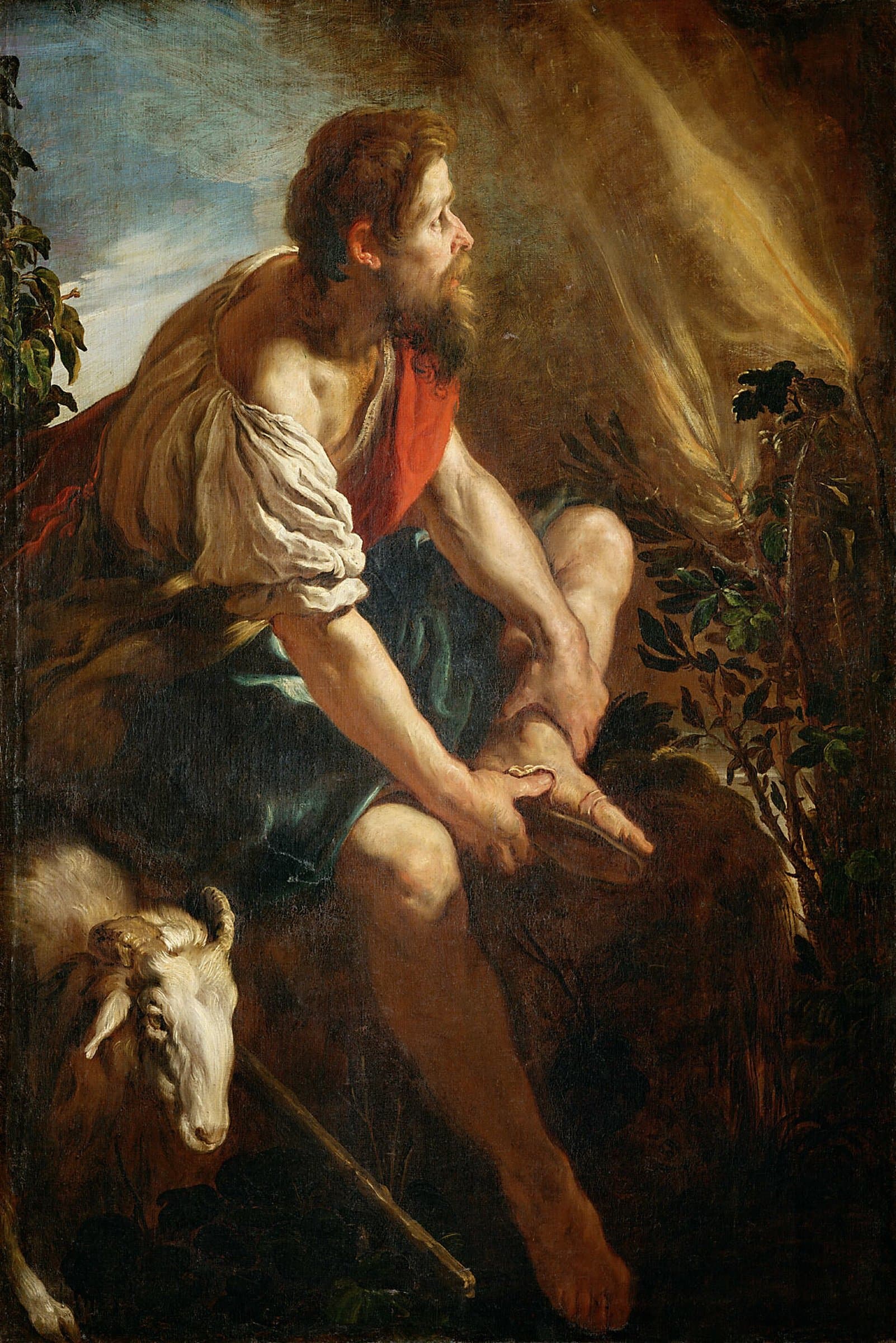
Domenico Fetti, Moses before the Burning Bush, about 1615 to 1617; Wikimedia Commons file Domenico Fetti 004.jpg; public domain by date.
Fetti painted Moses taking off his sandal at the bush, the command God gave him in Exodus 3:5.
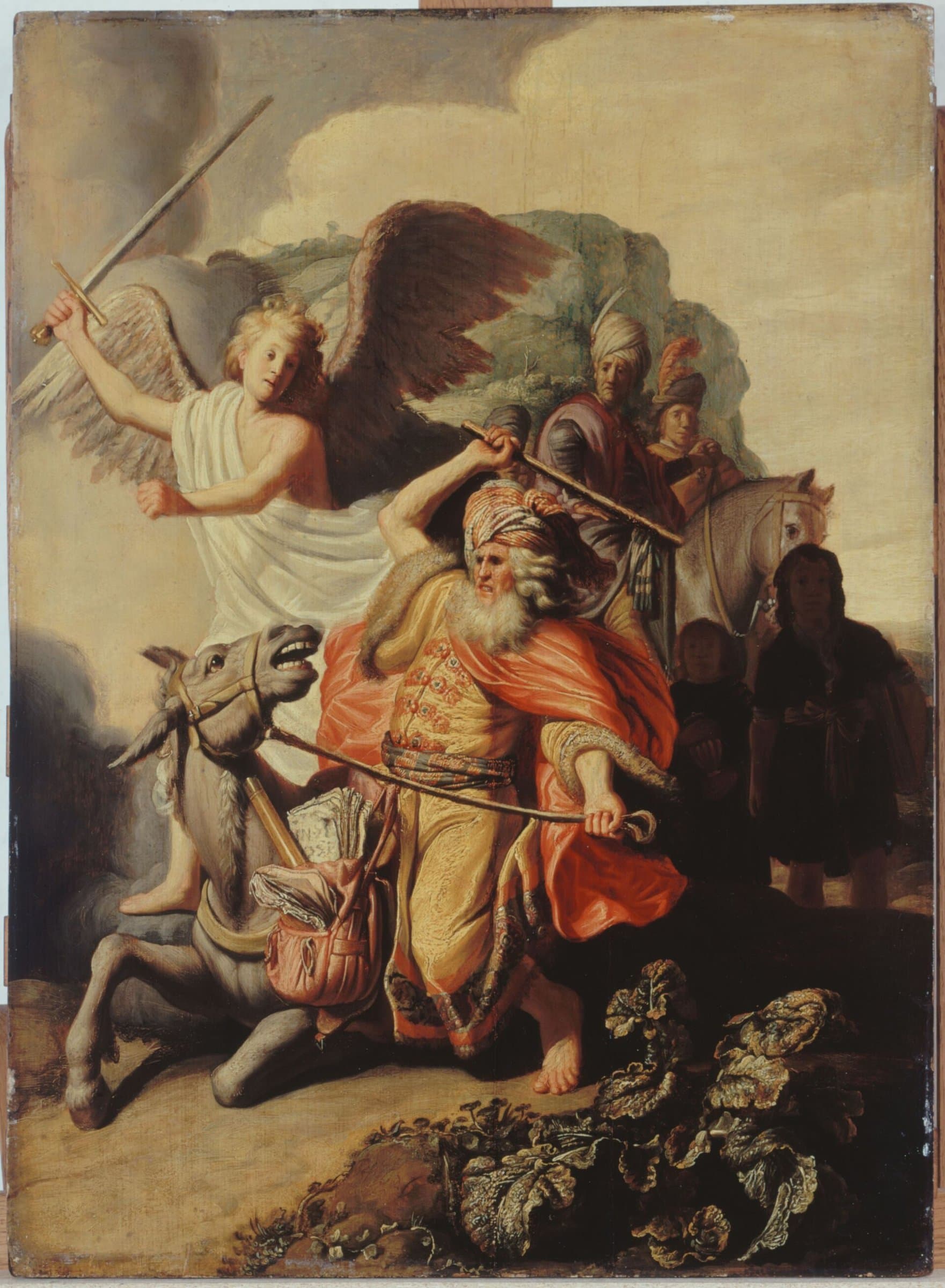
Rembrandt van Rijn, Balaam and the Ass, 1626; Wikimedia Commons file Rembrandt - L'Ânesse du prophète Balaam - J 95 - Musée Cognacq-Jay.jpg; public domain by date.
Rembrandt painted the angel raising a sword over Balaam as the donkey sinks to its knees and Balaam lifts his staff to strike it (Numbers 22:22 to 35).
Judges 13:18 to 22, Zechariah 1:12
What the Text Leaves Unsaid
Genesis records the angel's acts and words and leaves his identity unexplained.
The New Testament Anchors and Their Cautions
Paul, Jude and John are cited for the presence of Christ in the history of Israel.
Jude 1:5 and the manuscripts1 verse
Although you are fully aware of this, I want to remind you that after Jesus had delivered His people out of the land of Egypt, He destroyed those who did not believe.The Berean text reads Jesus here, while other manuscripts read the Lord, so the identification rests on a contested reading.
Paul on the rock in the wilderness2 verses
and drank the same spiritual drink; for they drank from the spiritual rock that accompanied them, and that rock was Christ.Paul places Christ with Israel in the wilderness as the rock that accompanied them.
We should not test Christ, as some of them did, and were killed by snakes.Some manuscripts read the Lord or God in place of Christ, and the cautious reading rests its doubt on that variant.
Jesus on the day of Abraham1 verse
Your father Abraham rejoiced that he would see My day. He saw it and was glad.” Then the Jews said to Him, “You are not yet fifty years old, and You have seen Abraham?” “Truly, truly, I tell you,” Jesus declared, “before Abraham was born, I am!”Jesus claims a life before Abraham in his own voice, and no variant touches the words.
Teachers on the Angel of the LORD
Three teachers, from Clement of Alexandria to Matthew Henry, write on who appeared at the bush and at the well.
died 215 · Clement of Alexandria
The Instructor Book 2
The quotation1 quotation
“When the almighty Lord of the universe began to legislate through the Word and decided to make his power visible to Moses, he sent Moses a divine vision with the appearance of light, in the burning bush. Now a bramble bush is full of thorns. So too when the Word was concluding his legislation and his stay among men as their Lord, again he permitted himself to be crowned with thorns as a mystic symbol.”
Clement of Alexandria · The Instructor Book 2 · on Exodus 3:2Patristic
died 398 · Didymus the Blind
ON GENESIS 249
The quotation1 quotation
“It is well too that the vision of the instructing Word was seen ‘between Kadesh and Bered.’ Kadesh in fact is interpreted to mean ‘holy,’ and Bered, ‘lightning.’”
Didymus the Blind · On Genesis 249 · on Genesis 16:14Patristic
1662 to 1714 · Matthew Henry
Commentary on the Whole Bible
The quotation1 quotation
“It was an angel of the Lord that appeared to him; some think, a created angel, who speaks in the language of him that sent him; others, the second person, the angel of the covenant, who is himself Jehovah. It was an extraordinary manifestation of the divine presence and glory; what was visible was produced by the ministry of an angel, but he heard God in it speaking to him.”
Matthew Henry · Commentary on the Whole Bible · on Exodus 3:2Puritan
Five Readings of Who the Angel Is
Each reading is given with its holders, the works that set it out and the objection raised against it.
The study Christophany sets out the first reading across the Old Testament.
The pre-incarnate Son5 paragraphs
This is the oldest Christian reading. Justin Martyr, in his Dialogue with Trypho 56 to 60 and 127 to 128, writes of the one who appeared to Abraham, Jacob and Moses and is called God. He calls that one distinct from the Maker of all things in number and not in will.
Irenaeus, in Against Heresies 4.10.1, finds the Son of God speaking with Abraham throughout the writings of Moses. Tertullian, in Against Praxeas 14 to 16, holds that the Father is invisible and that the Son was visible before the days of his flesh.
Adam Clarke, in his Commentary on the Bible, reads the angel at Genesis 16:7, Genesis 22:11 and Genesis 32:24 as Jesus Christ appearing to the patriarchs. At Genesis 48:16 he renders the angel who redeemed Jacob as the goel, the kinsman whose right it is to buy back a lost inheritance.
James A. Borland, in Christ in the Old Testament (1978), and Vern S. Poythress, in Theophany (2018), defend the reading today, and its holders cite Genesis 19:24 and Psalm 110:1 beside the New Testament anchors.
Augustine objects that created angels worked the appearances, so that the Son is not made less invisible than the Father. The reading also became an ingredient of anti-Jewish polemics in the early church, and its holders answer that the argument stands or falls on the texts.
A second divine figure3 paragraphs
This reading frames the figure in the terms of the Hebrew Bible and of Second Temple Judaism. The rabbinic polemic against two powers in heaven presumes readers who saw a second divine agent bearing the Name, and that pattern of a chief agent fed the earliest worship of Christ.
Alan F. Segal, in Two Powers in Heaven (1977), Larry W. Hurtado, in One God, One Lord (1988), Charles A. Gieschen, in Angelomorphic Christology (1998), and Michael S. Heiser, in The Unseen Realm (2015), hold it. Heiser sets the angel within the divine council and above it, the assembly of the throne-room scenes of Psalm 82, 1 Kings 22 and Job 1. They are more cautious than the first reading about naming the figure the Son inside the Old Testament text.
The holders of the third reading answer that the rabbinic reports of two powers are polemic against heresy, and that the envoy principle explains the same texts without a second divine person.
The authorized envoy4 paragraphs
The figure is God's fully authorized envoy, called God because a man's agent is as the man himself. Augustine, in On the Trinity 3.11 and The City of God 16.29, held that the appearances to the fathers were wrought by the ministry of angels.
Thomas Aquinas, in the Summa Theologiae, part 1, question 51, writes that the angels who appeared to Abraham were seen by him and by his whole family in bodies they had assumed. Rashi, in his commentary on Genesis, reads the angel of Genesis 16 as a created messenger: a different angel was sent to Hagar for each of the sayings of Genesis 16:9 to 11.
Among Christian teachers Augustine and Aquinas held this reading against the first, and Rashi held it as a rabbinic commentator.
From the first reading comes the answer that the angel bears the Name and will not forgive rebellion (Exodus 23:21) and receives reverence (Joshua 5:14), which the envoy principle strains to carry. That answer adds that the oath of Genesis 22:16 is sworn by the speaker and not relayed.
The restraint of the New Testament evidence3 paragraphs
God truly appeared, but the New Testament does not plainly name the angel of the LORD as the Son. On this reading the appearances are appearances of God, undifferentiated as to person, unless a New Testament text names the Son.
Andrew S. Malone holds that a Christophany must be argued case by case and never assumed, and his caution answers the first reading from within evangelical scholarship. He sets it out in his 2015 book Knowing Jesus in the Old Testament?
The holders of the first reading answer that John 8:56 to 58, 1 Corinthians 10:4, 1 Corinthians 10:9 and Jude 1:5 establish the pattern.
A later scribal insertion3 paragraphs
Later scribes, on this reading, inserted malʾak before the divine Name to soften texts in which God appeared directly, for a theology of stricter transcendence. The same holders weigh a related reading, which takes the angel as a hypostasis, a mode in which the presence of God is shown, and not as a person.
Samuel A. Meier holds a form of it in the article Angel of Yahweh, in the Dictionary of Deities and Demons in the Bible (second edition, 1999). Gerhard von Rad holds another in volume 1 of his Old Testament Theology (English edition, 1962).
The holders of the first three readings answer that the identification and the distinction both stand in the earliest text that survives, and that the evidence for a systematic insertion is uneven. This reading answers the first from outside the confessional traditions.
Books to Read Next
Five works on the angel of the LORD span the second century to the twenty-first.
Dialogue with Trypho
Justin Martyr · about 155 to 160
The dialogue is free to read in the translation by Marcus Dods and George Reith.
Read it at New AdventTwo Powers in Heaven
Alan F. Segal · 1977
Segal studies the rabbinic reports of teachers who held two powers in heaven and what they show of early readers of the angel.
In print: find it wherever books are sold.
Christ in the Old Testament
James A. Borland · 1978
Borland defends the reading of the angel of the LORD as the Son before his incarnation.
In print: find it wherever books are sold.
Knowing Jesus in the Old Testament?
Andrew S. Malone · 2015
Malone asks which Old Testament appearances the New Testament ties to the Son, and argues for caution in each case.
In print: find it wherever books are sold.
Theophany
Vern S. Poythress · 2018
Poythress studies the appearances of God across the whole Bible and reads them in the light of Christ.
In print: find it wherever books are sold.
The God Who Sees, Made Known in the Son
The angel came to Hagar in her flight and to Jacob in his fear.
Whatever reading the reader holds, the text asks the reader to seek the blessing of God through the Son, as Jacob sought it at Peniel when he would not let the man go.
No one has ever seen God, but the one and only Son, who is Himself God and is at the Father’s side, has made Him known.The verse stands at the close because every reading of the angel asks how the unseen God was seen.
Sources
Scripture is the Berean Standard Bible.
- Justin Martyr, Dialogue with Trypho, tr. Marcus Dods and George Reith.
- Irenaeus, Against Heresies, tr. Alexander Roberts and William Rambaut.
- Tertullian, Against Praxeas, tr. Peter Holmes.
- Augustine, On the Trinity, tr. Arthur West Haddan.
- Augustine, The City of God, tr. Marcus Dods.
- Adam Clarke, Commentary on the Bible.
- John Gill, Exposition of the Old Testament.
- James A. Borland, Christ in the Old Testament (1978)
- Vern S. Poythress, Theophany (2018)
- Alan F. Segal, Two Powers in Heaven (1977)
- Larry W. Hurtado, One God, One Lord (1988)
- Charles A. Gieschen, Angelomorphic Christology (1998)
- Michael S. Heiser, The Unseen Realm (2015)
- Thomas Aquinas, Summa Theologiae, part 1, question 51.
- Rashi on Genesis, in Pentateuch with Rashi's Commentary, tr. M. Rosenbaum and A. M. Silbermann (1929 to 1934)
- Andrew S. Malone, Knowing Jesus in the Old Testament? (2015)
- Samuel A. Meier, Angel of Yahweh, in Dictionary of Deities and Demons in the Bible, second edition (1999)
- Gerhard von Rad, Old Testament Theology, volume 1 (English edition, 1962)
Keep Studying
Studies15
Places3
Words1
Doctrines13
Subjects1