
Genesis 17 · Exodus 31 · Leviticus 20 · Subject · Featured Study
Cut Off from Among His People
First named in the covenant with Abraham and last in the law of the water of purification, in Numbers 19.
The same sentence, that the person must be cut off, falls on offences as unlike as eating fat and marrying a sister.
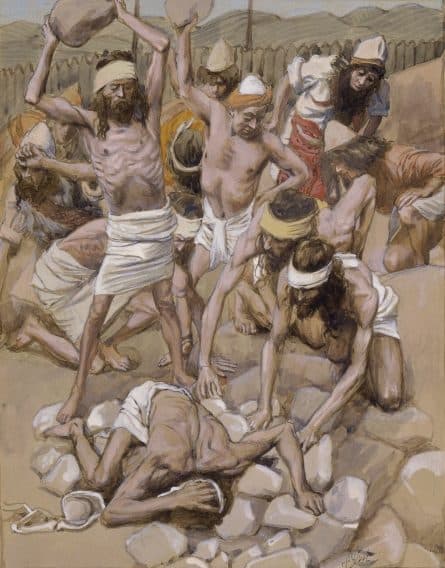
James Tissot, The Sabbath-Breaker Stoned, about 1896 to 1902, gouache on board, The Jewish Museum, New York. Public domain by date (the painter died in 1902), via Wikimedia Commons, File:Tissot_The_Sabbath-Breaker_Stoned.jpg.
THE ARTWORKTissot painted the congregation of Israel stoning the man who was found gathering wood on the Sabbath.
Summary
To be cut off from one's people is a penalty of the law of Moses whose verses seldom say how it is carried out.
- The same words return through Exodus, Leviticus and Numbers for offences against the holy things, the appointed times and the laws of marriage.
- Two of the verses set a death sentence beside it, and in others the LORD says He will act Himself.
- Mishnah Keritot counts thirty-six offences that carry it, and the rabbis read it as an early death.
- Christian commentators have also read it as removal from the people of God or as a sentence of the court.
Where the Torah Names the Penalty
The penalty runs from the covenant with Abraham to any sin done defiantly
But if any male is not circumcised, he will be cut off from his people; he has broken My covenant.”This is the first verse to name the penalty of being cut off from one's people.
Keep the Sabbath, for it is holy to you. Anyone who profanes it must surely be put to death. Whoever does any work on that day must be cut off from among his people.The Sabbath law is the first to join a death sentence to the penalty.
“Tell the Israelites, ‘Any Israelite or foreigner living in Israel who gives any of his children to Molech must be put to death. The people of the land are to stone him. And I will set My face against that man and cut him off from his people, because by giving his offspring to Molech, he has defiled My sanctuary and profaned My holy name.The gift to Molech is the second offence to carry a death sentence beside the penalty.
But the person who sins defiantly, whether a native or foreigner, blasphemes the LORD. That person shall be cut off from among his people.This verse widens the penalty from the named offences to any sin done defiantly.
The Offences That Carry the Penalty
Twenty-one offences in the Torah, each with its verse and what the verse says follows
| The offence | Verse | What the verse says follows |
|---|---|---|
| A male who is not circumcised | Genesis 17:14 | Cut off from his people |
| Eating anything leavened in the seven days of unleavened bread | Exodus 12:15 and 19 | Cut off from Israel |
| Mixing perfume like the anointing oil, or putting it on an outsider | Exodus 30:33 | Cut off from his people |
| Making incense like the holy incense to enjoy its fragrance | Exodus 30:38 | Cut off from his people |
| Profaning the Sabbath, or doing work on it | Exodus 31:14 | Put to death; cut off from among his people |
| Eating the meat of a peace offering while unclean | Leviticus 7:20 to 21 | Cut off from his people |
| Eating the fat of an animal offered by fire | Leviticus 7:25 | Cut off from his people |
| Eating blood | Leviticus 7:27, 17:10 and 17:14 | Cut off; the LORD sets His face against him |
| Slaughtering an ox, a lamb or a goat in the camp or outside it | Leviticus 17:3 to 4 | Bloodguilt; cut off from among his people |
| Offering a burnt offering or a sacrifice away from the Tent of Meeting | Leviticus 17:8 to 9 | Cut off from his people |
| Any of the unions forbidden in Leviticus 18 | Leviticus 18:29 | Cut off from among his people |
| Eating a peace offering on the third day | Leviticus 19:7 to 8 | Cut off from his people |
| Giving a child to Molech | Leviticus 20:2 to 5 | Stoned by the people; the LORD cuts him off |
| Turning to mediums or spiritists | Leviticus 20:6 | The LORD cuts him off from his people |
| Marrying one's sister | Leviticus 20:17 | Cut off in the sight of their people |
| Lying with a menstruating woman | Leviticus 20:18 | Both cut off from among their people |
| Approaching the sacred offerings while unclean | Leviticus 22:3 | Cut off from My presence |
| Not humbling oneself on the Day of Atonement, or working on it | Leviticus 23:29 to 30 | Cut off; the LORD destroys the one who works |
| Failing to keep the Passover while clean and at home | Numbers 9:13 | Cut off from his people |
| Sinning defiantly | Numbers 15:30 to 31 | Cut off; his guilt remains on him |
| Touching a human corpse and not being purified | Numbers 19:13 and 20 | Cut off from Israel, from the assembly |
Three Cases in Numbers
Numbers records one man stoned for the Sabbath, and it gives the unclean and the unwitting a way short of the penalty
The man gathering woodNumbers 15:32 to 36
While the Israelites were in the wilderness, a man was found gathering wood on the Sabbath day. Those who found the man gathering wood brought him to Moses, Aaron, and the whole congregation, and because it had not been declared what should be done to him, they placed him in custody. And the LORD said to Moses, “The man must surely be put to death. The whole congregation is to stone him outside the camp.” So the whole congregation took the man outside the camp and stoned him to death, as the LORD had commanded Moses.This case shows the death sentence of Exodus 31:14 applied by the LORD's answer to Moses.
The second PassoverNumbers 9:6 to 13
“Tell the Israelites: ‘When any one of you or your descendants is unclean because of a dead body, or is away on a journey, he may still observe the Passover to the LORD. Such people are to observe it at twilight on the fourteenth day of the second month. They are to eat the lamb, together with unleavened bread and bitter herbs;The LORD gives the unclean and the traveller a date a month later, so that the penalty of Numbers 9:13 falls only on the one who could keep the feast and did not.
The unwitting and the defiantNumbers 15:27 to 31
Also, if one person sins unintentionally, he is to present a year-old female goat as a sin offering. And the priest shall make atonement before the LORD on behalf of the person who erred by sinning unintentionally; and when atonement has been made for him, he will be forgiven.The one who sins unintentionally brings a sin offering and is forgiven, and verse 30 sets the defiant sinner apart from him.
The Mishnah, in Keritot 1:2, draws the same line for every offence on its list: karet for the deliberate act, and a sin offering when the act was unwitting.
What the Verses Add to the Formula
Four verses that say more about the penalty than the words cut off
I WILL SET MY FACE
Here the LORD Himself cuts off the one who eats blood, and Leviticus 20:3, 5 and 6 use the same words of Molech and the mediums.
WHETHER A FOREIGNER OR NATIVE
The law of leaven binds the foreigner living among Israel as well as the native, and Leviticus 17:10 and 20:2 say the same of blood and of Molech.
CUT OFF FROM MY PRESENCE
Here the verse names the place the offender is removed from as the LORD's own presence, where the other verses name his people.
HE WILL BEAR HIS INIQUITY
Here the offender bears his iniquity as well as being cut off, and Numbers 9:13 says the same of the man who does not keep the Passover.
The Thirty-Six in the Mishnah
How the rabbis counted the offences that carry the penalty, and where their count departs from the verses of the Torah
Six bars count the thirty-six offences of Mishnah Keritot 1:1 by kind, and the forbidden unions make the longest.
The 6 number of offences as a table
| Kind of offence | Number of offences | Verse |
|---|---|---|
| Forbidden unions | 15 | Leviticus 18:29 |
| Holy things | 8 | Leviticus 7:25 |
| Idols and blasphemy | 4 | Leviticus 20:6 |
| Appointed times | 4 | Leviticus 23:29 |
| Oil and incense | 3 | Exodus 30:38 |
| Commands to do | 2 | Numbers 9:13 |
The Mishnah counts each union apart, where the Torah covers them in one verse, Leviticus 18:29.
The two commands to do are bringing the Passover offering, Numbers 9:13, and circumcision, Genesis 17:14, and the other thirty-four entries are things forbidden.
The Words of the Penalty
Four Hebrew words from the lexicon, each in a verse where it stands
KARAT, TO CUT OFF (HEBREW, H3772)
The lexicon gives to cut off, down or asunder, and counts 288 uses; the same verb is used for making a covenant. In this verse it stands twice, which the Berean text renders certainly be cut off.
AM, PEOPLE (HEBREW, H5971)
The lexicon gives a people as a congregated unit, and specifically a tribe. In this verse it names the people from among whom the offender is cut off.
ARIRI, CHILDLESS (HEBREW, H6185)
The lexicon gives bare, that is, destitute of children, and counts 4 uses. Leviticus 20:20 and 21 use it to name the penalty for two unions, that the offenders shall be childless.
ABAD, TO DESTROY (HEBREW, H6)
The lexicon gives properly to wander away or lose oneself, and counts 184 uses. Here the LORD speaks it in the first person, where the verse before says cut off.
What the Torah Leaves Unsaid
Three questions the verses leave open
Who does the cutting offLeviticus 7:20
But if anyone who is unclean eats meat from the peace offering that belongs to the LORD, that person must be cut off from his people.Like most verses of the formula, this one uses the passive, must be cut off, and names no one who does the cutting.
When the penalty fallsGenesis 17:14 to Numbers 19:20
No verse of the formula gives an age or a time for the penalty.
Whether turning back lifts itNumbers 15:31
The Torah gives no offering for the defiant sinner of Numbers 15:30, and it does not say whether his repentance would lift the penalty. Rashi, on Numbers 15:31, reads the words his guilt remains on him to mean that he is cut off only while he has not repented.
The Messiah Cut Off
The prophets speak of the Messiah and the Servant as cut off, and in Acts 8:35 Philip told the good news about Jesus from Isaiah 53
Then after the sixty-two weeks the Messiah will be cut off and will have nothing. Then the people of the prince who is to come will destroy the city and the sanctuary. The end will come like a flood, and until the end there will be war; desolations have been decreed.Daniel uses karat, the verb of the penalty, of the Messiah.
By oppression and judgment He was taken away, and who can recount His descendants? For He was cut off from the land of the living; He was stricken for the transgression of My people.The Hebrew verb here is gazar, a different word from karat, and the verse says why the Servant was cut off.
Two Commentaries on the Penalty
Henry writes of the guilt that stays on an offender no hand has punished, and Jamieson, Fausset and Brown of why a small act on the Sabbath was judged a wilful sin
“Nay it is said, They shall bear their iniquity, that is, though they be not immediately cut off by the hand either of God or man for this sin, yet the guilt of it shall lie upon them, to be reckoned for another day, and not be purged with sacrifice or offering.”
Matthew Henry · Commentary on the Whole Bible · on Leviticus 20:19 to 21Puritan
“The mere gathering of sticks was not a sinful act and might be necessary for fuel to warm him or to make ready his food. But its being done on the Sabbath altered the entire character of the action. The law of the Sabbath being a plain and positive commandment, this transgression of it was a known and wilful sin, and it was marked by several aggravations.”
Jamieson, Fausset & Brown · Commentary Critical and Explanatory on the Whole Bible · on Numbers 15:32 to 34Reformed
Three Readings of Cut Off
The readings differ on who carries out the penalty and on what the offender loses
A death sent by God before its timeTalmud Moed Katan 28a; Rashi on Genesis 17:14, Leviticus 20:20 and 23:30; John Gill on Leviticus 23:29
The Talmud, at Moed Katan 28a, names a death at fifty as death by karet. Rashi, on Genesis 17:14, says the one cut off goes childless and dies before his time, and on Leviticus 20:20 he reads the excision of Leviticus 18:29 as passing from the world childless.
On Leviticus 23:30 Rashi takes the word destroy to show that karet means nothing else than being lost. Gill, on Leviticus 23:29, explains the penalty as an untimely death by the hand of God.
The objection is that Exodus 31:14 and Leviticus 20:2 set a death at human hands beside the penalty.
Removal from the people of GodAdam Clarke on Genesis 17:14 and Numbers 15:30; Albert Barnes on Leviticus 20:17; Jamieson, Fausset and Brown on Numbers 19:13
Clarke, on Genesis 17:14, says the uncircumcised had no right to nor share in the blessings of the covenant, and on Numbers 15:30 that the defiant sinner was excluded from God's people. Barnes, on Leviticus 20:17, thinks of a public excommunication, perhaps with expulsion from the camp.
“Every one knowingly and presumptuously neglecting to have himself sprinkled with this water was guilty of an offense which was punished by excommunication.”
Jamieson, Fausset & Brown · Commentary Critical and Explanatory on the Whole Bible · on Numbers 19:13Reformed
The objection is that Leviticus 23:30 has the LORD destroy the person, which is more than a removal.
A sentence of the courtAdam Clarke on Exodus 31:14; John Wesley on Leviticus 18:29
Clarke, on Exodus 31:14, has the magistrates examine the matter and stone the man found guilty. Wesley, on Leviticus 18:29, holds that the phrase means a punishment of the church or of the state, according to the nature of the offence.
The objection is that in Leviticus 20:4 to 5 the LORD acts Himself when the people fail to carry out the sentence of verse 2.
Books on the Penalty
The Mishnah, Rashi, Wesley and Jamieson, Fausset and Brown, each free to read online
The Mishnah, tractate Keritot
The rabbis of the Mishnah · about 190 to 230
The tractate is named for the penalty, and Sefaria gives the Hebrew beside three English versions.
Read it on SefariaCommentary on the Torah
Rashi · about 1075 to 1105
Rashi wrote at Troyes in France, and his notes on the penalty draw on the Sifra and the Talmud.
Read it on SefariaExplanatory Notes upon the Old Testament
John Wesley · 1765
Wesley's note on Leviticus 7:20 limits the penalty to the one who eats knowingly, since a sacrifice was accepted for the one who ate in ignorance.
Read it on CCELCommentary Critical and Explanatory on the Whole Bible
Robert Jamieson, A. R. Fausset and David Brown · 1871
On Numbers 9:14 the commentary holds that the man who would not be circumcised was barred from the Passover under the sternest penalties.
Read it on CCELBrought Near
The penalty removed a person from the people of the covenant, and the gospel calls every reader to come to Christ and be brought in.
remember that at that time you were separate from Christ, alienated from the commonwealth of Israel, and strangers to the covenants of the promise, without hope and without God in the world. But now in Christ Jesus you who once were far away have been brought near through the blood of Christ.Paul names the blood of Christ as the means by which the Gentiles are brought into the people of God.
Everyone the Father gives Me will come to Me, and the one who comes to Me I will never drive away.Jesus gives the promise on which the call to come rests.
Keep studying
Studies1
Places1