
Numbers 11 · The Elders of Israel
The seventy elders and the Spirit given to them
Numbers 11:10 to 30 records the gathering at the Tent of Meeting where the LORD shared the burden of leading Israel among seventy men.
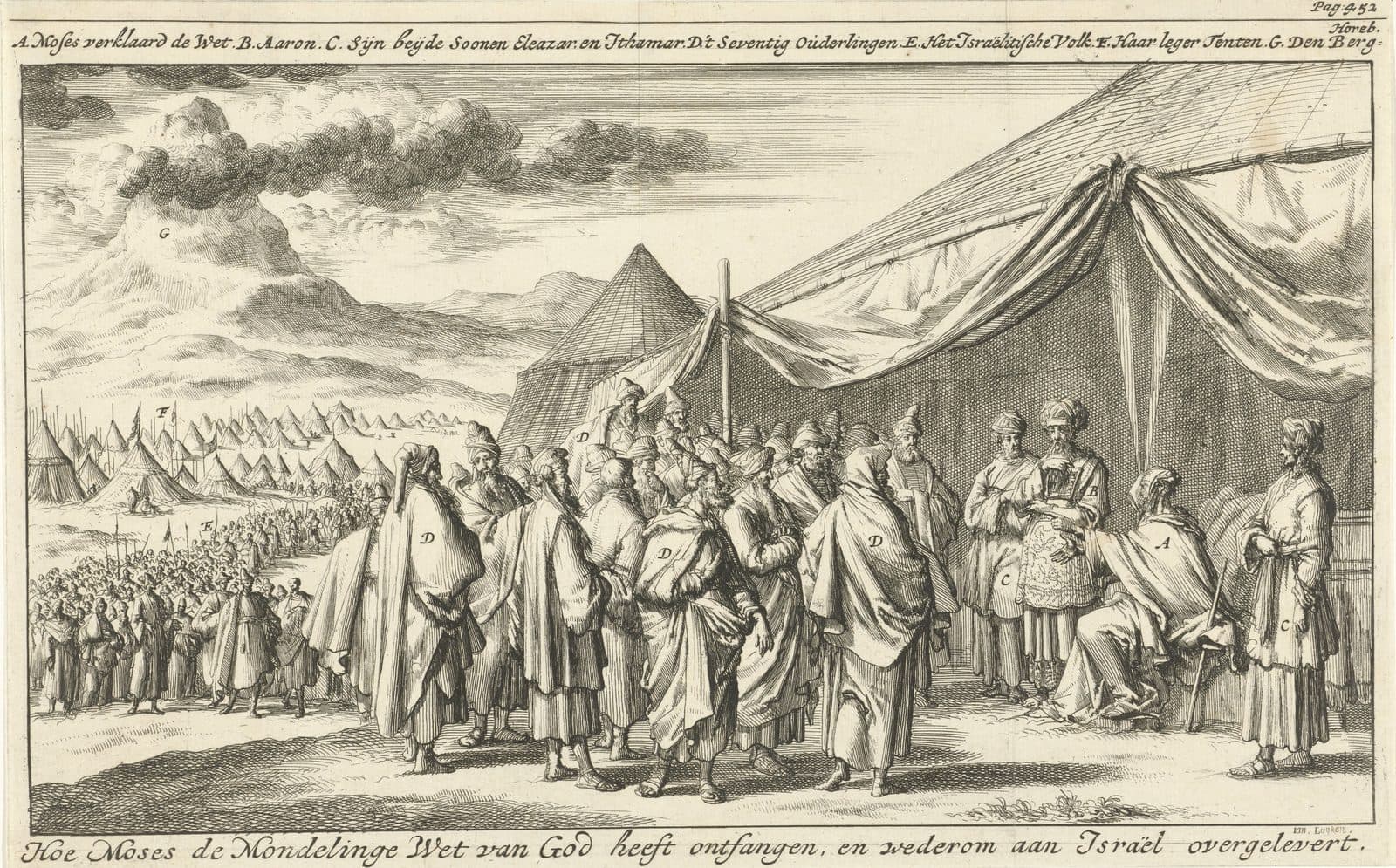
Jan Luyken, Mozes verkiest de zeventig oudsten, 1684, Rijksmuseum, RP-P-1896-A-19368-473. CC0.
THE ARTWORKIn English, the plate's Dutch title reads "How Moses received the oral law from God and handed it on to Israel" and stands below the etching. Its key marks Moses explaining the law, Aaron, Eleazar and Ithamar, the seventy elders, and the people and their tents below Mount Horeb. In Exodus 24:9 seventy elders went up that mountain with Moses.
The Hebrew verb for prophesying is first used in Scripture in Numbers 11, of seventy elders on whom the Spirit rested.
Summary
When Moses told the LORD that he could not carry the people alone, the LORD took some of the Spirit that was on Moses and placed that Spirit on seventy elders of Israel.
- The seventy stood around the Tent of Meeting outside the camp, and they prophesied as the Spirit rested on them.
- Eldad and Medad, two of the men listed, had stayed in the camp, and the Spirit rested on them there.
- When Joshua asked Moses to stop the two men, Moses wished that all the LORD's people were prophets.
- Joel promised the Spirit on all people, and at Pentecost Peter said that Joel's promise had come.
The Burden and the Answer
In Numbers 11:10 to 17 Moses brings his complaint to the LORD, and the LORD answers it with seventy elders, after Exodus 18 and 24 had named judges and elders beside Moses.
The complaint follows the fire at Taberah in Numbers 11:1 to 3 and the people's cry for meat in Numbers 11:4.
So Moses asked the LORD, “Why have You brought this trouble on Your servant? Why have I not found favor in Your sight, that You have laid upon me the burden of all these people? Did I conceive all these people? Did I give them birth, so that You should tell me, ‘Carry them in your bosom, as a nurse carries an infant,’ to the land that You swore to give their fathers?The picture of a nurse carrying an infant shows Moses speaking of the people as a load he never chose.
I cannot carry all these people by myself; it is too burdensome for me. If this is how You are going to treat me, please kill me right now—if I have found favor in Your eyes—and let me not see my own wretchedness.”The request to die in verse 15 shows how heavy the load had become.
Then the LORD said to Moses, “Bring Me seventy of the elders of Israel known to you as leaders and officers of the people. Bring them to the Tent of Meeting and have them stand there with you. And I will come down and speak with you there, and I will take some of the Spirit that is on you and put that Spirit on them. They will help you bear the burden of the people, so that you do not have to bear it by yourself.The LORD answers the words of verse 14 with men to share the load and with a share of the Spirit that was on Moses.
Two Hebrew words describe the men to be chosen in verse 16, zaqen, an elder, and shoter, an officer.
Exodus 18:13 to 26, the judges Jethro proposed1 passage
But Moses’ father-in-law said to him, “What you are doing is not good. Surely you and these people with you will wear yourselves out, because the task is too heavy for you. You cannot handle it alone.Jethro's words match the complaint of Numbers 11:14, that the task is too heavy for Moses alone.
Jethro's counsel gave Moses leaders of thousands, hundreds, fifties and tens to judge the people, and Exodus 18 names no Spirit given to them.
Exodus 24:9 to 11, seventy elders at the mountain1 passage
Then Moses went up with Aaron, Nadab and Abihu, and seventy of the elders of Israel, and they saw the God of Israel. Under His feet was a work like a pavement made of sapphire, as clear as the sky itself. But God did not lay His hand on the nobles of Israel; they saw Him, and they ate and drank.Exodus names a body of seventy elders at Sinai, before Numbers 11 gathers seventy at the tent.
Rashi, Rabbi Shlomo Yitzchaki of Troyes (1040 to 1105), asks in his commentary on Numbers 11:16 why new elders were needed, when elders had served with Moses since Exodus 3:16. He answers that the first elders had died in the fire at Taberah, a punishment he ties to their conduct at Sinai in Exodus 24:11.
From Moses' Burden to Pentecost
Eight texts lead from the gift of Numbers 11 to the day of Pentecost, and a plan shows where each person stood, at the tent and in the camp.
1Moses cannot carry the people alone
- What the text says
- he tells the LORD the burden is too heavy for him
2The LORD promises a share of the Spirit
- What the text says
- He will take some of the Spirit on Moses and put it on the seventy
3The Spirit rests on the seventy
- What the text says
- they prophesy at the tent
4The Spirit rests on two men in the camp
- What the text says
- Eldad and Medad prophesy where they stayed
5Moses wishes for every one of the people
- What the text says
- all the LORD's people would be prophets
- What the text says
- a man with the Spirit in him receives the laying on of Moses' hands
- What the text says
- the Spirit poured out on sons and daughters, old and young, and servants
- What the text says
- Pentecost is what was spoken by the prophet Joel
Eight steps from Moses' complaint in Numbers 11 to Peter's sermon in Acts 2.
The seventy stood around the tent outside the camp, and two men prophesied in the camp.
No scale
- The campthe people weep at the entrances to their tentsNumbers 11:10
- Eldad and Medadthe Spirit rests on them where they areNumbers 11:26
- The young manruns to tell Moses what is happening in the campNumbers 11:27
- The seventy eldersstand around the tent, and the Spirit rests on themNumbers 11:24 to 25
- The Tent of Meetingpitched outside the campExodus 33:7
- Mosesthe LORD comes down in the cloud and speaks to himNumbers 11:25
- Joshuaasks Moses to stop the two menNumbers 11:28
Numbers 11 gives no distances, so the sizes and spacing are the drawing's own; the thirteen filled circles at the tent stand for the seventy, and every filled circle marks a man on whom the Spirit rested.
A plan of Numbers 11:24 to 30 in seven numbered parts.
The Gathering at the Tent
Numbers 11:24 to 30 tells the gathering in four steps, from the tent to the return to the camp.
1. Numbers 11:24 to 25, the Spirit on the seventy2 passages
So Moses went out and relayed to the people the words of the LORD, and he gathered seventy of the elders of the people and had them stand around the tent.Moses does what verse 16 commanded and sets the seventy around the tent.
Then the LORD came down in the cloud and spoke to him, and He took some of the Spirit that was on Moses and placed that Spirit on the seventy elders. As the Spirit rested on them, they prophesied—but they never did so again.The LORD keeps both promises of verse 17, to come down and speak and to place the Spirit on the elders.
John Wesley, in his Explanatory Notes upon the Old Testament, on verse 24, notes that two of the seventy were missing from the tent. He says they are still called seventy by their stated number, as the apostles are called the twelve when one was absent.
2. Numbers 11:26 to 27, two men in the camp1 passage
Two men, however, had remained in the camp—one named Eldad and the other Medad—and the Spirit rested on them. They were among those listed, but they had not gone out to the tent, and they prophesied in the camp. A young man ran and reported to Moses, “Eldad and Medad are prophesying in the camp.”The two men received the gift as fully as the seventy, although they were away from the tent.
3. Numbers 11:28 to 29, Joshua's plea and Moses' wish1 passage
Joshua son of Nun, the attendant to Moses since youth, spoke up and said, “Moses, my lord, stop them!” But Moses replied, “Are you jealous on my account? I wish that all the LORD’s people were prophets and that the LORD would place His Spirit on them!”Moses answers Joshua's concern for his master's honour with a wish that reaches the whole people.
John Wesley, on verse 29, observes that Moses wished for prophets and did not wish for rulers. He draws the lesson that a believer should be glad when God is glorified and good is done, even to the lessening of his own honour.
4. Numbers 11:30, the return to the camp1 passage
Then Moses returned to the camp, along with the elders of Israel.Moses and the elders go back together, and verse 31 turns at once to the wind that brought the quail.
The Hebrew noun ruach names both the Spirit on Moses and the wind of verse 31.
The Spirit Given for a Task
Before Pentecost the Spirit came on chosen people for a task, and the table gives nine of them.
| Who | The task, and what followed | Verse |
|---|---|---|
| Bezalel | the craftsmanship of the tabernacle, and he was filled with skill, ability and knowledge | Exodus 31:3 |
| The seventy elders | carrying the burden of the people with Moses, and they prophesied | Numbers 11:25 |
| Joshua | leading Israel after Moses, and the Israelites obeyed him | Deuteronomy 34:9 |
| Othniel | judging Israel, and he went out to war and prevailed | Judges 3:10 |
| Gideon | rallying his people, and he blew the ram's horn and rallied the Abiezrites behind him | Judges 6:34 |
| Jephthah | the war with the Ammonites, and he advanced against the Ammonites | Judges 11:29 |
| Samson | meeting the young lion that came roaring at him, and he tore the lion apart with his bare hands | Judges 14:5 to 6 |
| Saul | ruling over the LORD's inheritance, and he prophesied with a group of prophets | 1 Samuel 10:10 |
| David | the kingship of Israel after Saul, and the Spirit rushed upon him from that day forward | 1 Samuel 16:13 |
Numbers 27:18 to 20, the Spirit in Joshua1 passage, 1 quotation
And the LORD replied to Moses, “Take Joshua son of Nun, a man with the Spirit in him, and lay your hands on him. Have him stand before Eleazar the priest and the whole congregation, and commission him in their sight. Confer on him some of your authority, so that the whole congregation of Israel will obey him.The LORD chooses Joshua for the Spirit already in him, before any hands are laid on him.
Adam Clarke, in his Commentary on the Bible, on Numbers 27:18, takes the spirit in Joshua to be the Spirit of God, by whom he was able to lead the people.
Matthew Henry, on the same verse, reads the laying on of hands as a sign of two gifts at once.
“This was done in token of Moses' transferring the government to him, as the laying of hands on the sacrifice put the offering in the place and stead of the offerer; also in token of God's conferring the blessing of the Spirit upon him, which Moses obtained by prayer. It is said ( Deut. xxxiv. 9 ), Joshua was full of the spirit of wisdom, for Moses had laid his hands on him.”
Matthew Henry · Commentary on the Whole Bible · on Numbers 27:18Puritan
1 Samuel 16:14, the Spirit departs from Saul1 passage
After the Spirit of the LORD had departed from Saul, a spirit of distress from the LORD began to torment him.The gift given to Saul for his task was later taken from him, after David's anointing.
What the Text Leaves Unsaid
Numbers 11 leaves three things about the gathering unrecorded.
Verse 25 records that the seventy prophesied and does not record what they said.
Verse 26 gives no reason why Eldad and Medad did not go out to the tent.
The young man of verse 27 who ran to tell Moses is given no name.
The Wish and the Promise
Joel turns Moses' wish into a promise, Peter says Pentecost keeps it, and Mark and Luke record a complaint to Jesus like Joshua's.
And afterward, I will pour out My Spirit on all people. Your sons and daughters will prophesy, your old men will dream dreams, your young men will see visions. Even on My menservants and maidservants, I will pour out My Spirit in those days.The promise reaches past every division of age, of men and women, and of rank.
Albert Barnes, in his Notes on Joel 2:29, observes that Joel names the servants among those who receive the Spirit and does not add that they will prophesy.
No, this is what was spoken by the prophet Joel: ‘In the last days, God says, I will pour out My Spirit on all people. Your sons and daughters will prophesy, your young men will see visions, your old men will dream dreams. Even on My menservants and maidservants I will pour out My Spirit in those days, and they will prophesy.Peter quotes Joel to explain the day, and verse 18 adds that the servants too will prophesy.
Adam Clarke, in his Commentary on Acts 2:16, takes the fulfilment of Joel's prophecy that day as another proof that Jesus, whom Peter's hearers had crucified, is the Messiah.
John said to Him, “Teacher, we saw someone else driving out demons in Your name, and we tried to stop him, because he does not accompany us.” “Do not stop him,” Jesus replied. “For no one who performs a miracle in My name can turn around and speak evil of Me. For whoever is not against us is for us.The verses give Jesus' own ruling on a work done outside the company of the Twelve.
Jamieson, Fausset & Brown, in their Commentary Critical and Explanatory on the Whole Bible, on Numbers 11:26 to 29, liken Moses' answer to Joshua to the answer of Jesus in Mark 9:39.
Albert Barnes, in his Notes on Mark 9:39, reads the miracle done in Jesus' name as evidence that the man could not be found among His enemies.
“Master,” said John, “we saw someone driving out demons in Your name, and we tried to stop him, because he does not accompany us.” “Do not stop him,” Jesus replied, “for whoever is not against you is for you.”Luke gives the shorter form of the exchange, and Jesus' answer turns on who is for the disciples.
Ambrose of Milan, in the Catena Aurea of Thomas Aquinas, explains why John is not blamed for what he did.
“Now John is not blamed, because he did this from love, but he is taught to know the difference between the strong and the weak. And therefore our Lord though He rewards the stronger, yet does not exclude the weak; as it follows, And Jesus said unto him, Forbid him not, for he that is not against you is for you. True, O Lord. For both Joseph and Nicodemus, through fear Thy secret disciples, when the time came, did not refuse their offices.”
Ambrose of Milan · Catena Aurea by Aquinas · on Luke 9:50Patristic
Cyril of Alexandria, in the same collection, writes of the grace given to those outside the company of the Apostles.
“But we ought to consider not so much the worker of the miracles, as the grace which was in him, who, by the power of Christ, performed miracles. But what if there should be both those which be numbered together with the Apostles, and those who are crowned with the grace of Christ; there are many diversities in Christ's gifts.”
Cyril of Alexandria · Catena Aurea by Aquinas · on Luke 9:49 to 50Patristic
Voices on Eldad and Medad
Matthew Henry and Cyril of Jerusalem comment on Joshua's request and on Moses' answer to it.
Matthew Henry asks why Joshua wanted the two men stopped.
“It is probable that Joshua himself was one of the seventy, which made him the more jealous for the honour of their order. He takes it for granted that they were not under any necessitating impulse, for the spirit of the prophets is subject to the prophets, and therefore he would have them either not to prophesy at all or to come to the tabernacle and prophesy in concert with the rest.”
Matthew Henry · Commentary on the Whole Bible · on Numbers 11:28Puritan
Cyril of Jerusalem, teaching those preparing for baptism, gives the reason Moses would not forbid the two men.
“Joshua, the son of Nun and successor of Moses, was amazed, and coming to Moses said to him, Have you heard that Eldad and Medad are prophesying? They were called and did not come forward; ‘Moses, my lord, stop them.’ I cannot forbid them, he said, for the grace is from heaven. So far am I from forbidding them that I consider it a favor. But I think you have not spoken thus in envy. Do not be overzealous on my account, because they have prophesied, and you do not yet prophesy. Await the proper time.”
Cyril of Jerusalem · Catechetical Lecture 16.26 · on Numbers 11:28Patristic
The Prophesying of the Seventy
Four readings of verse 25 answer whether the prophesying went on and what it was.
The elders prophesied once
The Berean Standard Bible ends Numbers 11:25 with the words “but they never did so again”, and the American Standard Version reads “but they did so no more”.
The objection is that the King James Version and Young's Literal Translation read the same Hebrew the other way.
The gift stayed with them
The King James Version renders the end of the verse as a prophesying that did not cease. John Wesley, in his Explanatory Notes upon the Old Testament, on Numbers 11:25, holds that the Spirit took up a settled abode with the elders, because the use and end of the gift was lasting.
The objection is that Numbers records no later prophesying by the seventy.
The prophesying was the work of their office
Adam Clarke, on Numbers 11:25, reads the prophesying as the civil and sacred work of the elders' new office. He holds that exhorting the people to trust in the goodness and providence of God made a large part of that work, and he gives naba the root sense of to pray and to entreat.
The objection is that the verse ties the prophesying to the moment the Spirit rested on them, and verse 27 reports it as an event seen in the camp.
The elders spoke as the prophets spoke
John Wesley, on the same verse, takes it to mean that the elders spoke of the word and works of God in a marvelous manner, as the prophets did.
After that you will come to Gibeah of God, where the Philistines have an outpost. As you approach the city, you will meet a group of prophets coming down from the high place, preceded by harps, tambourines, flutes, and lyres, and they will be prophesying. Then the Spirit of the LORD will rush upon you, and you will prophesy with them; and you will be transformed into a different person.Wesley reads the elders' prophesying by the prophesying of this band and of Saul with them.
The objection is that 1 Samuel 10 names music and a band of prophets, and Numbers 11 names neither at the tent.
The Promise for Every One
Peter answers his hearers in Acts 2 with an offer of the Spirit to every one who repents.
Peter's hearers were cut to the heart and asked him and the other apostles what they should do.
Peter replied, “Repent and be baptized, every one of you, in the name of Jesus Christ for the forgiveness of your sins, and you will receive the gift of the Holy Spirit. This promise belongs to you and your children and to all who are far off—to all whom the Lord our God will call to Himself.”The two verses name what a hearer must do to receive the gift that Joel promised and Pentecost brought.
Keep studying
Read it1
People10
Places1
Doctrines11
Peoples and groups1