
Symbol
The Lamb
The lamb Isaac was promised on Moriah is the Lamb of the cross and the throne.
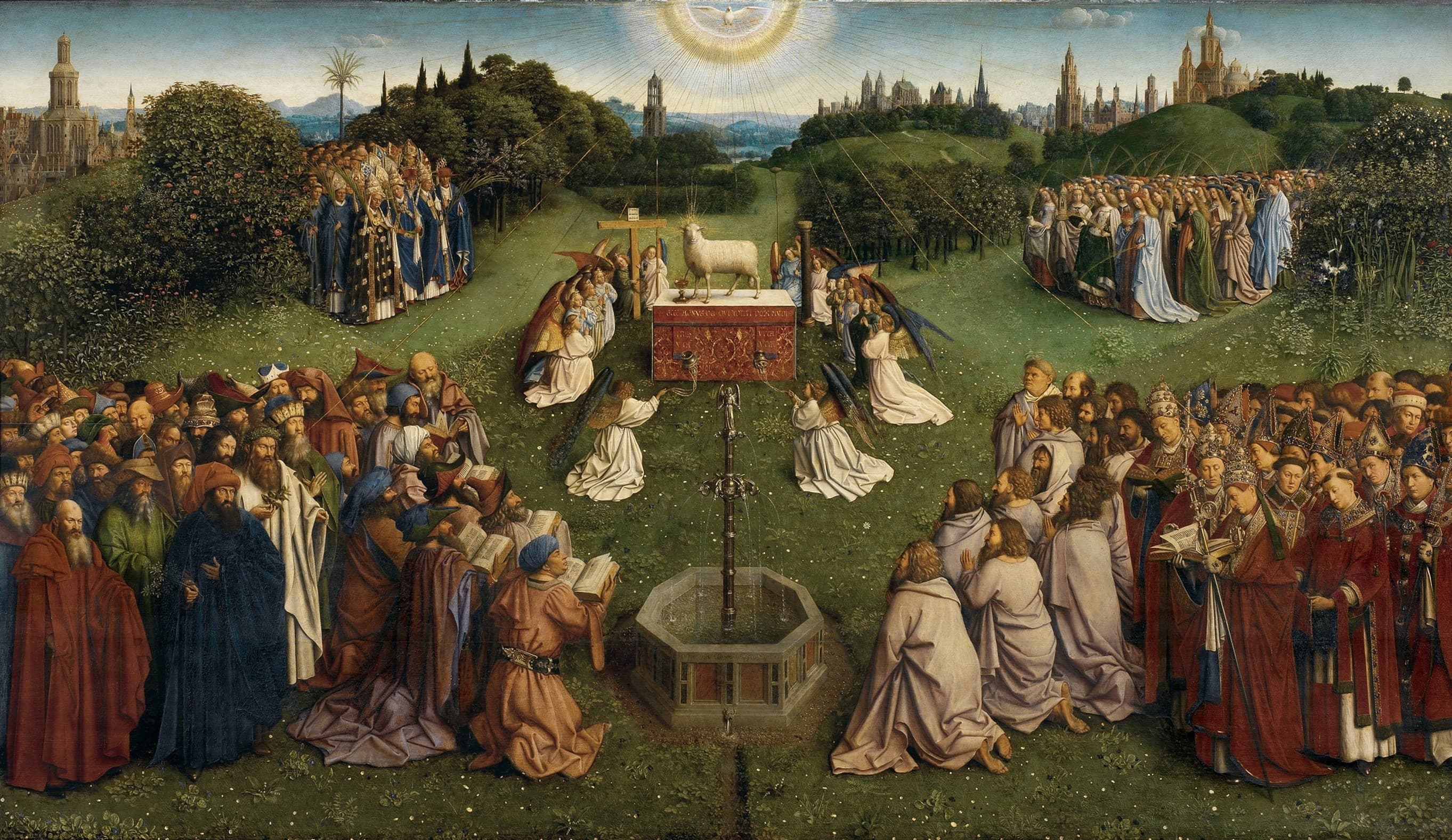
Jan and Hubert van Eyck, The Adoration of the Mystic Lamb, the central panel of the Ghent Altarpiece, 1432, oil on oak, St Bavo's Cathedral, Ghent. Public domain. Look for the fountain below the altar: the water of life flows from the Lamb to the people.
Summary
Abraham told Isaac that God would provide the lamb. This site's tradition reads the promise as paid at the cross and shown on the throne.
- Isaac asks where the lamb is, and the rest of Scripture answers him.
- Israel kept a lamb in every house, and two a day at the altar.
- Isaiah made the lamb a person who says nothing.
- Philip names that person as Jesus, and Paul and Peter give Christ the lamb's name.
- Revelation gives Christ the name most often, and once gives it to a beast.
Genesis 22
Where is the lamb?
Then Isaac said to his father Abraham, “My father!” “Here I am, my son,” he replied. “The fire and the wood are here,” said Isaac, “but where is the lamb for the burnt offering?”The son asks, at the word's first use in Scripture.
Abraham answered, “God Himself will provide the lamb for the burnt offering, my son.” And the two walked on together.The father promises.
Abraham answers his son with a promise, and the chapter closes with a ram on the altar in Isaac’s place.
Two animals, two words
Abraham’s word in verse 8, “will provide the lamb”, is שֶׂה seh (H7716), one head of a flock. The animal Genesis 22:13 provides, “caught by its horns” in a thicket, is אַיִל ayil (H352), a ram, and the two words name two animals.
Read more at The Binding of Isaac, the three days and the wood.
John Wesley reads the answer as a statement about who finds the sacrifice of atonement, the covering of sin.
Christ the great sacrifice of atonement was of God's providing: when none in heaven or earth could have found a lamb for that burnt-offering, God himself found the ransom.
John Wesley· Explanatory Notes upon the Old Testament, 1765Wesleyan
Genesis 22:8
What God provided instead, and the reading that takes it as the answer
the ram in the thicket
Then Abraham looked up and saw behind him a ram in a thicket, caught by its horns. So he went and took the ram and offered it as a burnt offering in place of his son.A ram, caught by its horns in a thicket.
And Abraham called that place The LORD Will Provide. So to this day it is said, “On the mountain of the LORD it will be provided.”Abraham names the mountain for the provision.
That Strong’s number, H352, files more than one Hebrew word, a ram, a doorpost and a chief among them; the ram is the sense in verse 13.
Some readers take the ram and the name Abraham gives the mountain as the chapter’s own answer to Isaac: God did provide, on that day, in that thicket. Augustine reads the ram itself as a sign of Christ, so on his reading Moriah answers the question in the animal it produced. This page reads the promise as still open, because the word Abraham used is seh and the animal in verse 13 is ayil, and because the New Testament gives the lamb a name somewhere else.
God pays that promise away from Moriah. A lamb therefore keeps turning up for the next fifteen hundred years, until John the Baptist points at a man by the Jordan and calls him the Lamb of God.
Wesley hears the question put to the reader as well as to Abraham
Explanatory Notes upon the Old Testament, 1765, on Genesis 22:7
Behold the fire and the wood, but where is the lamb? - This is, 1. A trying question to Abraham; how could he endure to think that Isaac is himself the lamb? 'Tis a teaching question to us all, that when we are going to worship God, we should seriously consider whether we have every thing ready, especially the lamb for a burnt-offering.
Origen, reading the tense of Abraham's answer
Homilies on Genesis 8.6, preached in the 240s, surviving in Rufinus's Latin
Abraham's response, sufficiently accurate and cautious, moves me. I do not know what he saw in his spirit, for he does not speak about the present but about the future: "God himself will provide himself a sheep." He responded to his son's inquiry about present things with future things. For "the Lord himself will provide himself a sheep" in Christ, because also, "Wisdom herself has built herself a house," and "He himself humbled himself unto death."
Augustine, reading the ram as a sign rather than a disappointment
Sermon 19.3, preached between 391 and 430
The sacraments are changed, not the faith. The signs by which something was signified are changed, not the thing signified. For Christ, a ram; for Christ, a lamb; for Christ, a calf; for Christ, a goat, all Christ. A ram, because he leads the flock: he was found in the thickets, when the father Abraham was ordered to spare his son, yet not to depart without offering a sacrifice. And Isaac was Christ, and the ram was Christ. Isaac was carrying wood for himself: Christ was carrying his own cross. For Isaac, a ram; not for Christ, Christ. But in Isaac and in the ram, Christ. The ram was held by the horns in the thicket. … He is a lamb: Behold the Lamb of God, behold him who takes away the sin of the world.
Genesis to Revelation
Across the canon
These eleven stops are where the picture moves on. Four carry a gold chip, where the New Testament names the referent outright.
Old Testament (4)
New Testament (5)
01MoriahGenesis
The word is seh, the flock word, and here it is promised rather than provided.
02The householdExodus
The same word becomes a law: one animal for each house, taken on the tenth day and kept until the fourteenth.
03The table ruleExodus
It must be eaten inside one house. You are not to take any of the meat outside the house, and you may not break any of the bones.
Exodus 12:46A rule about eating the animal without breaking one of its bones.
04The daily lambExodus
Two a day, morning and evening, for as long as the altar stands.
05The feast calendarLeviticus
On the day you wave the sheaf, you shall offer a year-old lamb without blemish as a burnt offering to the LORD,
Leviticus 23:12The festival year carries the animal too, counted in keves, the altar's word.
06The ServantIsaiah
Isaiah 53 is the first place the lamb is a person.
07The JordanJohnScripture says it outright
Twice in eight verses, and the first time the two words stand together in Scripture.
08The chariotActsScripture says it outright
A man reads Isaiah 53 aloud, asks who the prophet means, and Philip answers by preaching Jesus.
09The church's ethic1 CorinthiansScripture says it outright
A letter about church discipline, resting on the identification rather than arguing it.
10The price1 PeterScripture says it outright
The selection rule of Exodus 12:5, applied to a price.
11The throneRevelation
Then I saw a Lamb who appeared to have been slain, standing in the center of the throne, encircled by the four living creatures and the elders. The Lamb had seven horns and seven eyes, which represent the seven Spirits of God sent out into all the earth.
Revelation 5:6The title arrives at the throne, and the book keeps it to the end.
Exodus
A lamb per house
Tell the whole congregation of Israel that on the tenth day of this month each man must select a lamb for his family, one per household.Your lamb must be an unblemished year-old male, and you may take it from the sheep or the goats.And a goat is allowed.
Read more at Passover, the night itself, and the doorposts.
The promise becomes an ordinance, and every family kills its own animal.
This is what you are to offer regularly on the altar, each day: two lambs that are a year old. Offer one lamb in the morning and the other at twilight.Read more at The Sacrificial System, the daily lamb among the offerings.
Once the altar is standing, the lamb is a clock rather than one night a year, and it runs until the temple falls. Hebrews 9 and 10 argue that one sacrifice ended it; Once for All follows.
Whether the Passover victim had to be a lamb at all
Jerome and JFB on Exodus 12
Exodus 12:5 says plainly that the animal may be taken from the sheep or from the goats, and the commentators say so without embarrassment.
"The lamb," the Lord says, "must be without blemish. You may take it from either the sheep or the goats." In another place of Holy Writ, it is prescribed that if anyone is unable to keep the Passover in the first month, he is to do so in the second. According to the regulation above, anyone who is unable to sacrifice a lamb may substitute a kid.
Jerome· Homily 91, preached at Bethlehem, late fourth or early fifth centuryChurch Father
Exodus 12:3
It is observable that, amid all the hurry and bustle of such a departure, their serious attention was to be given to a solemn act of religion. a lamb for an house--a kid might be taken (Ex 12:5). The service was to be a domestic one, for the deliverance was to be from an evil threatened to every house in Egypt.
Jamieson, Fausset & Brown· Commentary Critical and Explanatory on the Whole Bible, issued 1864 to 1870Reformed
Exodus 12:3
Isaiah and Acts
The silent sheep
He was oppressed and afflicted, yet He did not open His mouth. He was led like a lamb to the slaughter, and as a sheep before her shearers is silent, so He did not open His mouth.Read more at The Suffering Servant, where the whole song is read.
Isaiah leaves his sufferer nameless and reaches past the altar’s word for the ordinary flock word, שֶׂה seh, the one Isaac used. Jeremiah says the same of himself at 11:19, “like a gentle lamb led to the slaughter”.
“Tell me,” said the eunuch, “who is the prophet talking about, himself or someone else?” Then Philip began with this very Scripture and told him the good news about Jesus.A eunuch is a court official.
This one keeps the queen’s treasury and is reading Isaiah aloud when Philip catches up with his chariot.
Why the lamb and the sheep change places between Isaiah and Acts
the Greek Old Testament Philip is reading
Philip is reading the Greek Old Testament. There the translator rendered Isaiah’s flock word by the ordinary word for a sheep, and the ewe of the second line by amnos, so in the one place amnos stands in a New Testament quotation of the Old it is rendering the word for a ewe.
What Philip did with the text
Jamieson, Fausset and Brown on Acts 8:35
Jamieson, Fausset and Brown read Philip’s sermon as an exposition of the passage in front of him rather than a change of subject.
Then Philip opened his mouth--(See on Mt 5:2). began at the same scripture--founding on it as his text. preached unto him Jesus--showing Him to be the glorious Burden of this wonderful prediction, and interpreting it in the light of the facts of His history.
Jamieson, Fausset & Brown· Commentary Critical and Explanatory on the Whole Bible, issued 1864 to 1870Reformed
Acts 8:35
John 1
At the Jordan
The next day John saw Jesus coming toward him and said, “Look, the Lamb of God, who takes away the sin of the world!The title lands on a man.
The Baptist gives the title to a man walking toward him, twice in eight verses. His word is amnos, the ordinary word for a sacrificial lamb. Revelation carries a second Greek word for a lamb, arnion, and gives it to Christ on the throne twenty-nine times.
Jamieson, Fausset and Brown hear an offer to anyone who carries too much.
Wherever there shall live a sinner throughout the wide world, sinking under that burden too heavy for him to bear, he shall find in this "Lamb of God," a shoulder equal to the weight.
Jamieson, Fausset & Brown· Commentary Critical and Explanatory on the Whole Bible, issued 1864 to 1870Reformed
John 1:29
Which lamb did John the Baptist mean?
four answers, all ancient
It has been asked since the second century, and the Baptist did not say. The Passover lamb of Exodus 12 is the commonest answer, and 1 Corinthians 5:7 and John 19:36 stand behind it. Origen, in his Commentary on the Gospel of John book 6, argued for the daily burnt-offering instead: of all the animals on the altar, the lamb is the one offered perpetually. Cyril of Alexandria (Commentary on John 2) and Eusebius (Proof of the Gospel 1.10) heard Isaiah’s sheep, whose subject Scripture itself identifies at Acts 8:35, though what the Baptist meant is not recorded. Augustine (Sermon 19.3) heard the lamb of Moriah.
John Wesley, in his Explanatory Notes upon the New Testament (1755), keeps several of them at once on John 1:29.
He seeth Jesus coming and saith, Behold the Lamb - Innocent; to be offered up; prophesied of by Isaiah, Isaiah liii, 7, typified by the paschal lamb, and by the daily sacrifice: The Lamb of God - Whom God gave, approves, accepts of; who taketh away - Atoneth for; the sin - That is, all the sins: of the world - Of all mankind. Sin and the world are of equal extent.
John Wesley· Explanatory Notes upon the New Testament, 1755Wesleyan
John 1:29
The New Testament afterwards uses all of these. This page names the four readings and the men who held them, and leaves the choice to the reader.
'Taketh away the sin of the world', how far, and how long?
four readings of one clause, all in the Catena Aurea on John 1:29
Wesleyreads it at full extent: “all the sins: of the world - Of all mankind. Sin and the world are of equal extent.” The Glossa Ordinaria, the standard medieval gloss on the verse, narrowed it to original sin. Theophylact, in his Commentary on John, pressed the tense: he says not who will take, but who taketh away, as if He were always doing it. And Gregory the Dialogist pressed the other end: But then only will sin be entirely taken away from the human race, when our corruption has been turned to a glorious incorruption. We cannot be free from sin, so long as we are held in the death of the body. All three stand together in the Catena Aurea on this verse, which is where this page reads them.
Four ancient readings of one clause, none of them disparaged. How far the atonement reaches is argued properly on Justification by Faith, not here.
Paul and Peter
Christ our Passover
Get rid of the old leaven, that you may be a new unleavened batch, as you really are. For Christ, our Passover lamb, has been sacrificed.but with the precious blood of Christ, a lamb without blemish or spot.Peter prices redemption by it.
Both apostles write as though their readers already granted the point. Paul lays the Passover under an appeal about discipline, and Peter prices redemption by the rule for choosing the animal. The Blood follows what that price purchased.
What Israel's redemption and this one have in common
Jamieson, Fausset and Brown on 1 Peter 1:19
As Israel's redemption from Egypt required the blood of the paschal lamb, so our redemption from sin and the curse required the blood of Christ; "foreordained" (1Pe 1:20) from eternity, as the passover lamb was taken up on the tenth day of the month.
Jamieson, Fausset & Brown· Commentary Critical and Explanatory on the Whole Bible, issued 1864 to 1870Reformed
1 Peter 1:19
Revelation 5
The Lion and the Lamb
What John was told
“Do not weep! Behold, the Lion of the tribe of Judah, the Root of David, has triumphed to open the scroll.”
Revelation 5:5 (BSB) →What John saw when he turned
“Then I saw a Lamb who appeared to have been slain, standing in the center of the throne.”
Revelation 5:6 (BSB) →The Lion is the Lamb. The elder announces the conqueror, John turns and sees the slain animal standing, and the throne room holds one figure.
What each side of the throne room is carrying
the announcement, the sight, and what follows from them
What John was told. Every messianic expectation in one sentence. Jacob's lion (Genesis 49:9–10) and Jesse's root (Isaiah 11:1, 10), the King who conquers, announced by an elder to a weeping man in a throne room where no one has been found worthy to open the scroll.
What John saw when he turned. John turns and sees a lamb, standing in the middle of the throne and bearing the marks of slaughter. This is what a Lion of Judah looks like when He has finished overcoming.
Jacob’s lion at Genesis 49:9-10 and Jesse’s root at Isaiah 11:1 and 11:10 are the two promises the elder puts into one sentence, and a reader who does not hear them hears only a title.
Everything Revelation goes on to say about power, thrones, horsemen, armies, a rider with a sword out of His mouth, has to be read through a slaughtered animal standing up. The scroll opens because the Lamb was slain, and every scene of power in the book runs back through that.
Revelation, end to end
The Lamb’s ledger
Revelation names Him the Lamb from the sealed scroll to the lamp of the city, and every act runs through the slaughter.
| Where | What He does there | The verse |
|---|---|---|
| The new song | What He does there He buys men for God | The verse: Revelation 5:9, “by Your blood You purchased for God” Read 5:9 wholeAnd they sang a new song: “Worthy are You to take the scroll and open its seals, because You were slain, and by Your blood You purchased for God those from every tribe and tongue and people and nation. Revelation 5:9 (BSB)The new song names the qualification for opening the scroll. The right to open history was bought, not seized. |
| The sixth seal | What He does there He judges the earth | The verse: Revelation 6:16, “the wrath of the Lamb” Read 6:16 wholeAnd they said to the mountains and the rocks, “Fall on us and hide us from the face of the One seated on the throne, and from the wrath of the Lamb. Revelation 6:16 (BSB)Kings and captains and slaves call on the rocks to hide them from two words that ought not to fit together and do. The same gentleness that went to the slaughter is what finally judges the world that loved the slaughtering. |
| The great multitude | What He does there He shepherds the rescued | The verse: Revelation 7:17, “the Lamb ... will be their shepherd” Read 7:17 wholeFor the Lamb in the center of the throne will be their shepherd. ‘He will lead them to springs of living water,’ and ‘God will wipe away every tear from their eyes.’” Revelation 7:17 (BSB)The sheep has become the Shepherd: Psalm 23 relocated to the throne room, and every tear wiped away. |
| The war of the ten kings | What He does there He overcomes ten kings | The verse: Revelation 17:14, “the Lamb will triumph over them” Read 17:14 wholeThey will make war against the Lamb, and the Lamb will triumph over them, because He is Lord of lords and King of kings; and He will be accompanied by His called and chosen and faithful ones.” Revelation 17:14 (BSB)The battle language of chapter 19 is already decided here, and the victor is still called by the name of the sacrifice. |
| The wedding invitation | What He does there He marries His bride | The verse: Revelation 19:9, “the marriage supper of the Lamb” Read 19:9 wholeThen the angel told me to write, “Blessed are those who are invited to the marriage supper of the Lamb.” And he said to me, “These are the true words of God.” Revelation 19:9 (BSB)Revelation 19:7 sounds the announcement, “The marriage of the Lamb is come, and his wife hath made herself ready”, and the blessing at 19:9 falls on the guests. The whole story turns out to have been heading for a wedding. |
| The city with no sun | What He does there He lights the city | The verse: Revelation 21:23, “the Lamb is its lamp” Read 21:23 wholeAnd the city has no need of sun or moon to shine on it, because the glory of God illuminates the city, and the Lamb is its lamp. Revelation 21:23 (BSB)The city keeps no sun and no moon, because the glory of God lights it and the Lamb is the lamp it burns. |
The last light source in Scripture is a slain lamb, and there is no night there.
How the Lamb wins, and how His people do
the same verb, the same instrument
- The Lamb. Conquers by being slain. Worthiness in this book is never raw force; the scroll opens because blood was spent, not because power was applied. Revelation 5:5–9
- The saints. Conquer by the same instrument: “because of the blood of the Lamb, and because of the word of their testimony; and they loved not their life even unto death.” Revelation 12:11
- The seven churches. Each letter ends with a promise “to him that overcometh”, the tree of life, the crown, the hidden manna, the morning star, a place on the throne. The verb is the same one used of the Lamb. Revelation 2:7 – 3:21
The verb is nikao(G3528) in all three places: Revelation 5:5 of the Lamb, 12:11 of the saints, and 2:7 of the churches. This is why Revelation can be given to a church about to lose. The word it uses of Antipas at 2:13 is the ordinary word for a witness; the sense in which English says martyr is later than the book, and the church took it from passages like this one. Antipas is dead and named faithful, the souls under the altar are told to rest a little longer, and the ethic of the whole book is the Lamb’s own method, handed to His people.
The rest of the account
every other place the name stands
- 5:12 “Worthy is the Lamb that hath been slain”, heaven's sevenfold doxology
- 7:14 Robes washed and made white in the blood of the Lamb
- 12:11 They overcame him because of the blood of the Lamb
- 14:1 The Lamb on Mount Zion with the hundred and forty and four thousand
- 21:9 “Come hither, I will show thee the bride, the wife of the Lamb”
- 21:14 Twelve foundations, the twelve apostles of the Lamb
- 21:27 Only they that are written in the Lamb's book of life
- 22:1, 3 The river of life, out of the throne of God and of the Lamb
The colour of this ledger climbs deliberately, blood-crimson to lamp-gold: the book does not move away from the sacrifice as it goes on, it moves further into it. The last thing the Lamb does in Scripture is give light.
Revelation 13
The counterfeit lamb
Then I saw another beast rising out of the earth. This beast had two horns like a lamb, but spoke like a dragon.The costume is Christ's.
The disguise fails the moment it opens its mouth. John dresses the beast in Christ’s own name, ἀρνίον arnion, this once in the whole book. The verse sets the horns against the voice.
Why a counterfeit sharpens the book's thesis
conquest by slaughter, imitated
Revelation carries one more lamb, and it is the beast. Conquest, throne and judgment all run through a sacrifice, so a counterfeit authority has to look like that too, and the book says it will, right down to borrowing the name.
Hippolytus, reading the beast as an imitation of Christ
On Christ and Antichrist 6, third century
For the deceiver seeks to liken himself in all things to the Son of God. Christ is a lion, so Antichrist is also a lion; Christ is a king, so Antichrist is also a king. The Saviour was manifested as a lamb; so he too, in like manner, will appear as a lamb, though within he is a wolf.
A note on 'lambkin', the diminutive reading, and what argues against it
beside the vocabulary note
The Gospels and the epistles call Jesus amnos(the ordinary word for a sacrificial lamb) at John 1:29. Revelation almost never uses it. John’s word here is arnion, a diminutive in form, which is a form that names a small one of a kind. Strong’s own key of 1890 files it as “a lambkin”, and H. B. Swete, in The Apocalypse of St John (1906), reads the little lamb of the throne room as the point of the word. Scholars dispute whether that diminutive force was still live in first-century Greek, and Revelation uses the same word once of the beast (13:11).
That reading is old, and the reversal it describes in Revelation 5:6 is genuinely there. Two things are honestly said against it. First, a great many Koine nouns ending in -ιον had lost their diminutive force by the first century: Revelation itself calls the beast therion, formally a diminutive, and means a wild beast by it rather than a small one. Second, this verse: the two horns of a beast are called arnion, and “lambkin” is plainly not the point there.
Both are worth the reader’s knowing. The reversal at the throne does not depend on the diminutive: a slain animal standing in the middle of the throne is the reversal, whatever the ending of the noun is doing.
Slain from the foundation of the world, or written from it?
two defensible readings of one clause
The KJV and the ASV attach the phrase to the slaying: the Lamb slain from the foundation of the world. Most modern versions attach it to the writing of the names, on the strength of the parallel at Revelation 17:8, where the same construction describes names not written in the book of life from the foundation of the world; Swete reads it that way in The Apocalypse of St John(1906). The word order sits closer to the slaying and the parallel at 17:8 pulls the other way, and the difference is real: one sentence says when the Lamb was slain in God’s purpose, the other says when the names were written. Scripture does not settle it here.
And all who dwell on the earth will worship the beast—all whose names have not been written from the foundation of the world in the Book of Life belonging to the Lamb who was slain.
Exodus and John
Two kinds of claim
What Scripture says outright
- Paul to Corinth, 1 Corinthians 5:7
“For Christ, our Passover lamb, has been sacrificed.”
- John at the cross, John 19:36
“Now these things happened so that the Scripture would be fulfilled: “Not one of His bones will be broken.”” John reports the unbroken bones as a fulfilment and leaves his text unnamed. Exodus 12:46 forbids the eater to “break any of the bones”, and Psalm 34:20 says God “protects all his bones”.
What readers have heard in it
- The promise of Genesis 22:8, paid at the cross
Abraham's “will provide the lamb” stands unquoted in the New Testament. Origen, Augustine and Wesley all read it as paid at the cross, and that reading is theirs rather than a verse's.
- The Passover lamb as an offering for sin
In Exodus 12 the blood is a token on the houses and the rescue is from the destroyer. Scripture joins the lamb to sin later: John 1:29, “who takes away the sin”, and 1 Peter 1:19, “a lamb without blemish”.
- The scapegoat of Leviticus 16, folded in
The Day of Atonement keeps its own animals: Leviticus 16 sets out a bull, two goats and two rams, each named by its own word rather than by seh.
What the text does not say
five silences, named as silences
- God did not provide a lamb on Moriah. He provided a ram. The promise stands unpaid at the end of Genesis 22.
- The Passover victim did not have to be a lamb. Exodus 12:5 allows a goat, and says so plainly.
- Isaiah 53 never uses the word Messiah and never names its subject. Acts 8:34 records a reader asking for exactly that reason, and Acts 8:35 is where the name is supplied.
- Revelation never explains why the word changed from the Gospels’ amnos to its own arnion. The change is real; every account of why is inference.
- The Lamb is seen “as though slain,” and no more is said. Revelation 5:6 does not describe the wounds.
Lactantius, reading the doorpost blood as a figure of the cross
The Divine Institutes IV, written between 303 and 311
And the Jews even now exhibit a figure of this transaction when they mark their thresholds with the blood of a lamb. … not that the blood of a sheep had such efficacy in itself as to be the safety of men, but it was an image of things to come.
Hebrew and Greek
The words underneath
Two Hebrew words carry the chain from Isaac to Isaiah, and it runs on the ordinary one. Hebrew keeps others besides: kar, a fattened lamb; taleh, a sucking lamb; and the Aramaic immar, the lamb of Ezra’s offerings. Each card gives the sense the standard dictionaries agree on, then Strong's own entry of 1890.
Each word, as the dictionaries file it
seh: a single animal taken from the flock, sheep or goat, of any age; the word Exodus 12 uses for the Passover animal and Isaiah uses for his sufferer.
Hebrew · H7716Strong's entry: a member of a flock, i.e. a sheep or goat
47 times in the Old Testament · seh, in full →
keves: a young male lamb in its first year, counted in the daily and festival offerings.
Hebrew · H3532Strong's entry: a ram (just old enough to butt)
107 times in the Old Testament · keves, in full →
amnos: a lamb. In the Greek Old Testament's offering laws it renders keves, and in Isaiah's fourth Servant song the ewe of the second line.
Greek · G286Strong's entry: a lamb
4 times in the New Testament · amnos, in full →
arnion: a lamb, and the name of Christ in Revelation. Its form is a diminutive, the form for a small one, built on the older word.
Greek · G721Strong's entry: a lambkin
30 times in the New Testament · arnion, in full →
The Lamb, and the lambs
the one occurrence outside Revelation
Arnion stands thirty times in the Greek New Testament, twenty-nine of them in Revelation, and those twenty-nine fall in twenty-seven verses because two verses use the word twice. The thirtieth stands outside Revelation, and it is what Jesus calls the people He hands to Peter on a beach.
When they had finished eating, Jesus asked Simon Peter, “Simon son of John, do you love Me more than these?” “Yes, Lord,” he answered, “You know I love You.” Jesus replied, “Feed My lambs.”
The Good Shepherd carries the other half of the flock image.
How the four words are counted
a marked Hebrew and Greek text, not a recollection
The counts come from a Hebrew and Greek text of the whole Bible with every word marked, so each figure can be checked verse by verse. Seh stands forty-seven times, thirteen of them in Exodus, more than in any other book. Kevesstands a hundred and seven times under its own Strong’s number, more than twice as often, and none of them is in Isaiah 53; the same word spelled kesevis filed under a second number besides. Every card links to the word’s own page, where the verses are listed.
Genesis and Revelation
The question, answered
Genesis leaves Isaac’s question open. As this site’s tradition reads it, John the Baptist answered it by the Jordan with Isaac’s own word, and Revelation seats that Lamb in the middle of the throne, still marked by the slaughter.
Read Revelation 5 whole →Where it leads
On this page
The lamb before the cross5
What the blood did4
The lamb among the flock3
The table, and how the pattern is read3
The book of the throne2
Sources
Every work this page stands on
editions, dates and the text behind the counts
Scripture is the Berean Standard Bible, read from this site’s own verse store. The page’s older quotations from Revelation are the American Standard Version, and the two in the throne room say so where they stand. Hebrew and Greek text, tagging and counts come from STEP Bible (Tyndale House, CC BY 4.0), the marked Hebrew and Greek text behind this site. The senses on the word cards follow Brown, Driver and Briggs (1906) for the Hebrew and Abbott-Smith (1922) for the Greek; the numbered keys are Strong’s, from The Exhaustive Concordance of the Bible (1890).
Quotations: John Wesley, Explanatory Notes upon the Old Testament (1765) and upon the New Testament (1755); Jamieson, Fausset and Brown, Commentary Critical and Explanatory on the Whole Bible (issued 1864 to 1870, in volumes by three authors); Jerome, Homily 91, preached at Bethlehem; Origen, Homilies on Genesis 8.6, preached in the 240s and surviving in Rufinus’s Latin translation, and Commentary on the Gospel of John 6; Augustine, Sermon 19.3, preached between 391 and 430; Hippolytus, On Christ and Antichrist 6, third century; Lactantius, The Divine Institutes IV, written between 303 and 311; Gregory the Dialogist, Theophylact and the Glossa Ordinaria, read in the Catena Aurea on John 1:29.
Drafted from MannaFest’s research brief on Revelation §3–§4, with the seven-signs and throne-room briefs behind the John 1:29 link. Public-domain exposition: Seiss, The Apocalypse (1865); Bullinger, The Apocalypse; Swete, The Apocalypse of St John (1906); Spurgeon’s Metropolitan Tabernacle sermons on Revelation 5 and 21. Missler’s The Book of Revelation is cited.