
Place
Egypt
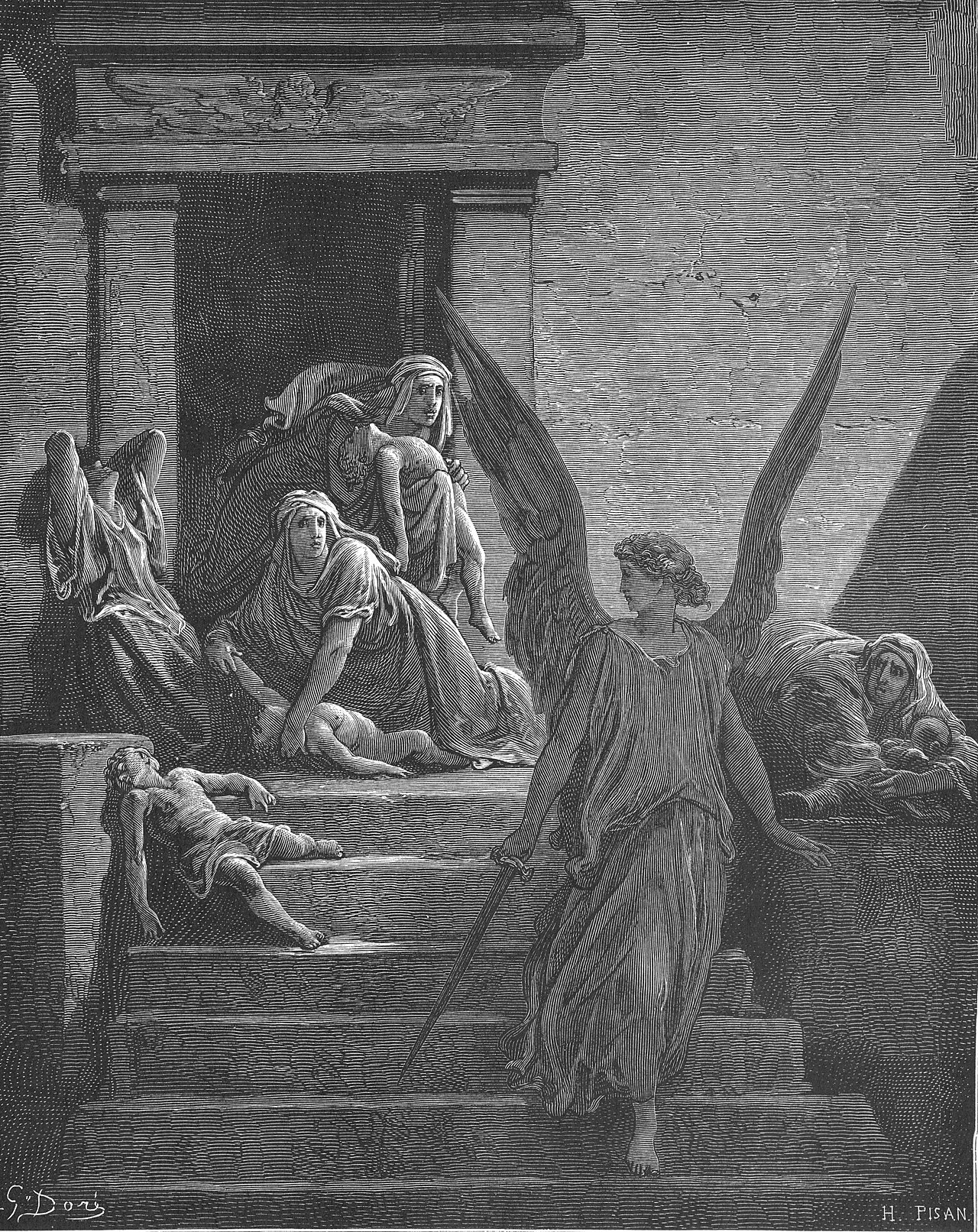
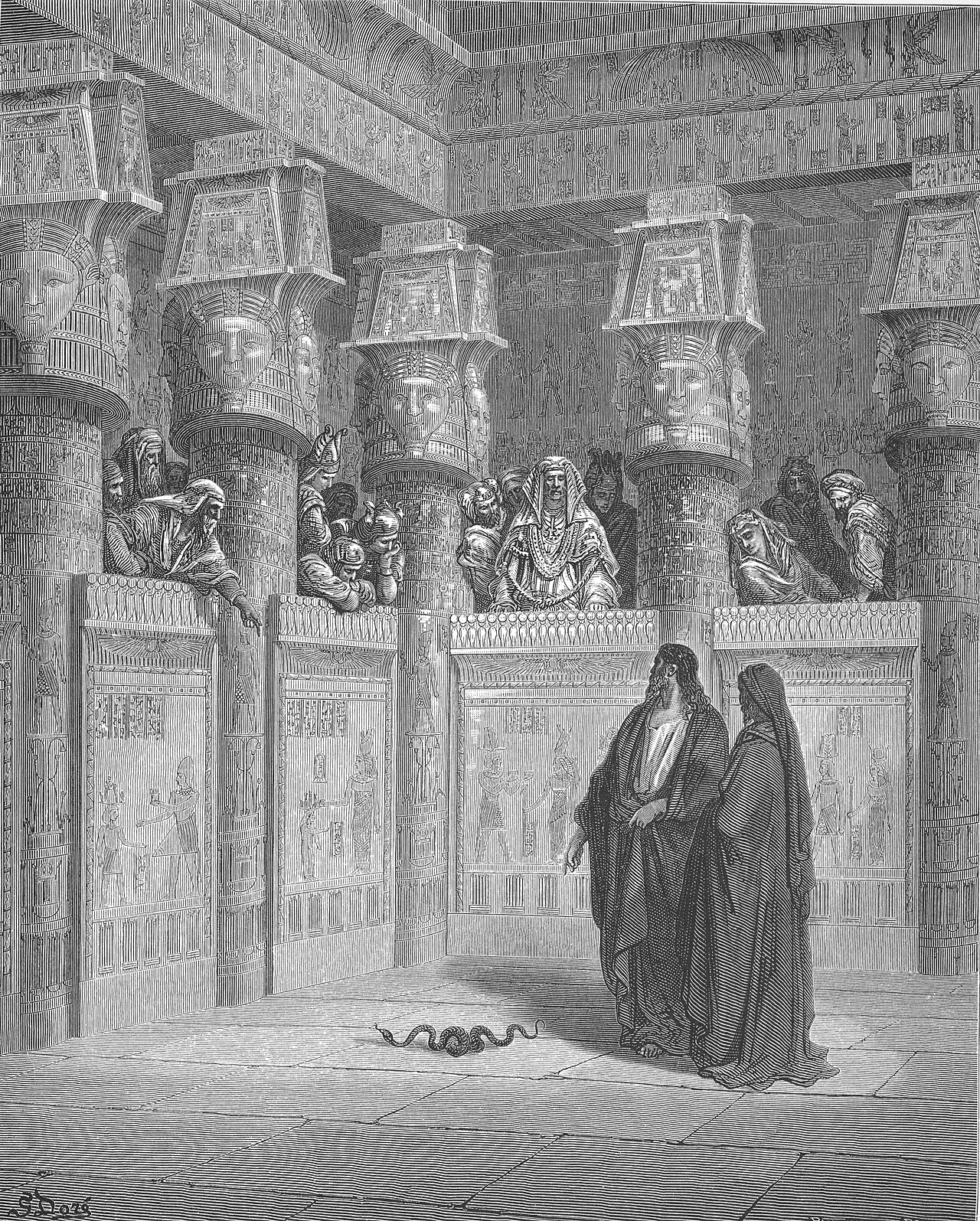
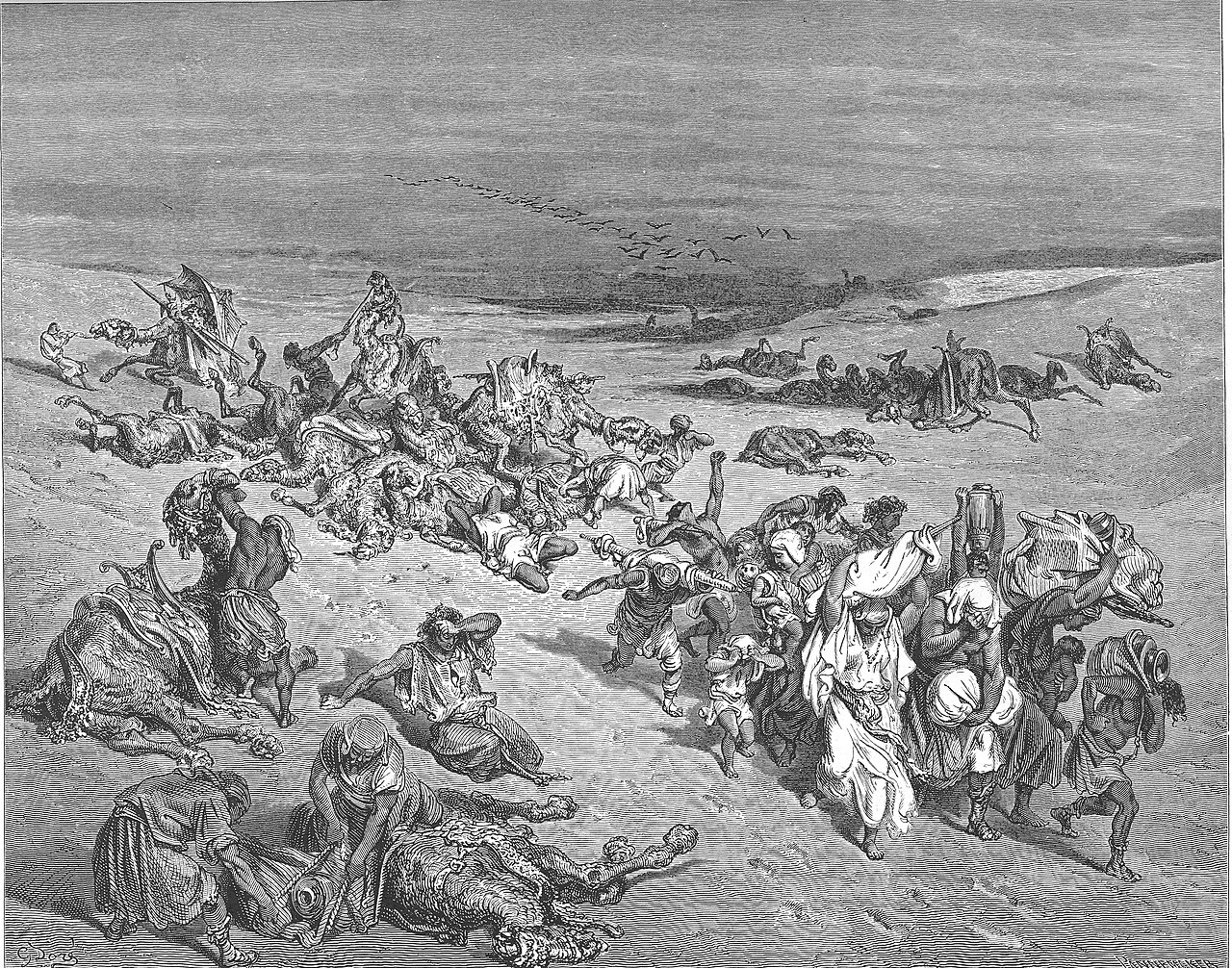
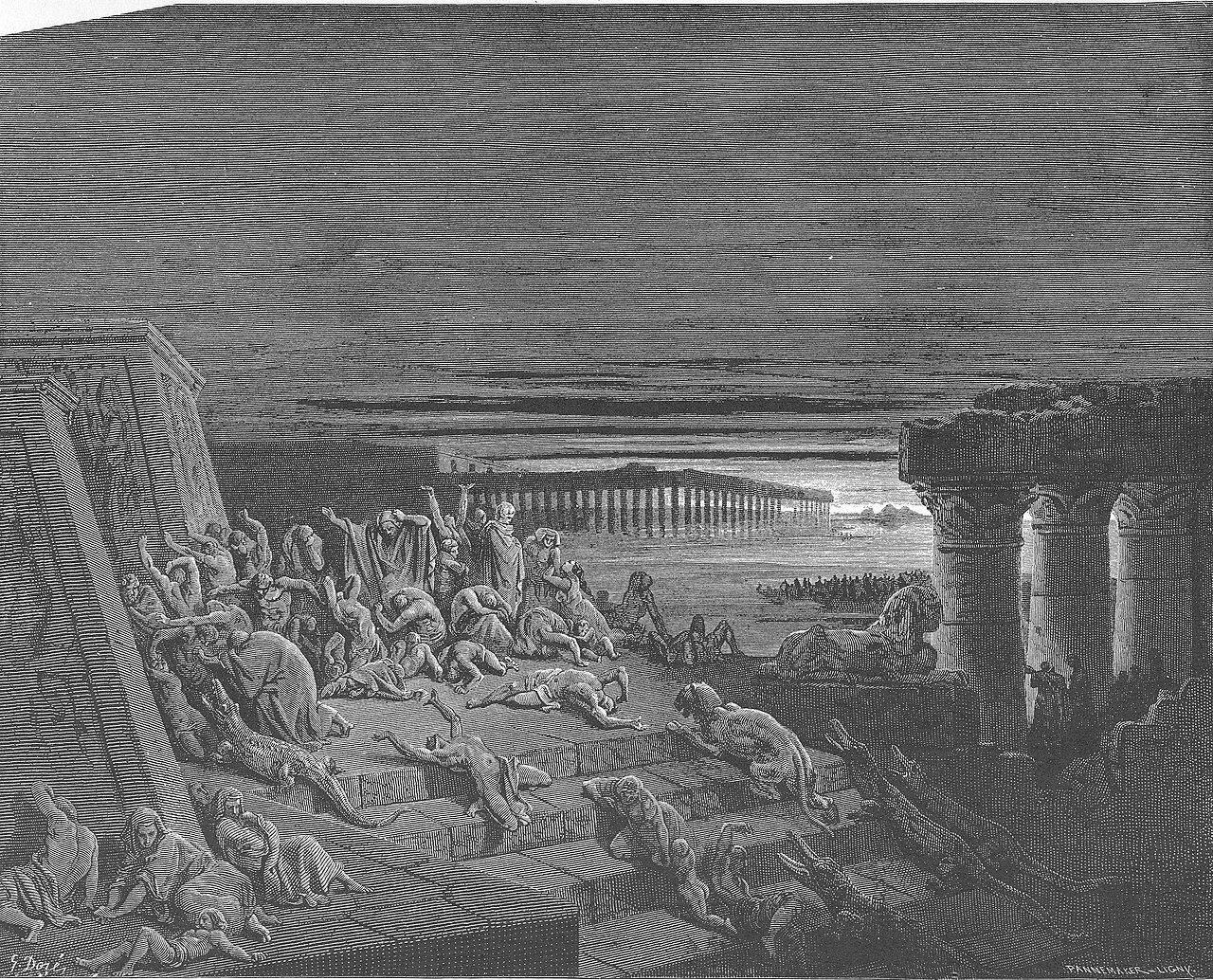
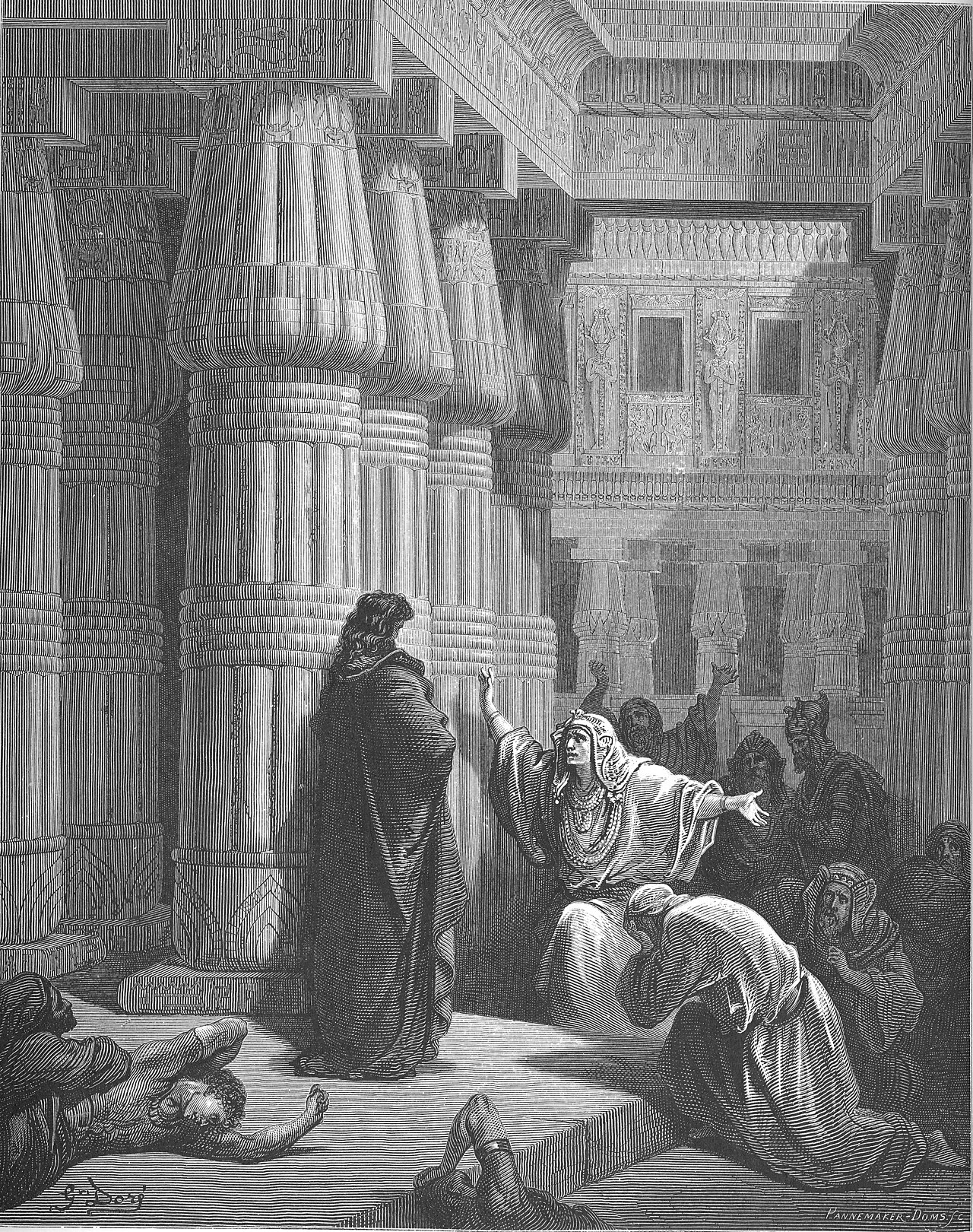
Gustave Doré, La Sainte Bible (Tours: Alfred Mame et fils, 1866). Public domain.
Summary
The land where Joseph rose, where Israel grew into a nation in bondage, where the Passover lamb was slain and the sea opened, and where the child Jesus was hidden until Herod died.
- Egypt is the one foreign country that runs through the whole Bible, from Abram's famine to the child Jesus hidden from Herod.
- Israel went down as a household of seventy and came out a nation. The exodus is the event the rest of Scripture measures redemption by.
- The ten plagues are aimed rather than random. Exodus 12:12 says they are judgment on the gods of Egypt.
- Israel built the mudbrick store cities Pithom and Rameses. The pyramids at Giza were raised about a thousand years earlier.
- Semitic settlement in Egypt is heavily attested. The date of the Exodus is genuinely disputed, and this page names both positions.
On this page
In Scripture
- Verses
- 569
- Books
- 33
Where it is
- Region
- The Nile
Why Egypt matters
What has been found
the evidence, and where it is disputed
The plagues and the Passover, outlined
Exodus 5 to 12, in the order it happens
Read Exodus 5 to 12, in the order it happens
- Pharaoh's answer to the demandExodus 5:2But Pharaoh replied, “Who is the LORD that I should obey His voice and let Israel go? I do not know the LORD, and I will not let Israel go.”
- What the plagues are forExodus 7:5And the Egyptians will know that I am the LORD, when I stretch out My hand against Egypt and bring the Israelites out from among them.”
- The Nile struck firstExodus 7:20Moses and Aaron did just as the LORD had commanded; in the presence of Pharaoh and his officials, Aaron raised the staff and struck the water of the Nile, and all the water was turned to blood.
- Goshen set apart from the fourth blow onwardExodus 8:22-23But on that day I will give special treatment to the land of Goshen, where My people live; no swarms of flies will be found there. In this way you will know that I, the LORD, am in the land. I will make a distinction between My people and your people. This sign will take place tomorrow.’”
- Why Pharaoh is still standingExodus 9:16But I have raised you up for this very purpose, that I might display My power to you, and that My name might be proclaimed in all the earth.
- Three days of darkness over the landExodus 10:22So Moses stretched out his hand toward heaven, and total darkness covered all the land of Egypt for three days.
- Judgment against all the gods of EgyptExodus 12:12On that night I will pass through the land of Egypt and strike down every firstborn male, both man and beast, and I will execute judgment against all the gods of Egypt. I am the LORD.
- The blood, and what God seesExodus 12:13The blood on the houses where you are staying will distinguish them; when I see the blood, I will pass over you. No plague will fall on you to destroy you when I strike the land of Egypt.
- MidnightExodus 12:29Now at midnight the LORD struck down every firstborn male in the land of Egypt, from the firstborn of Pharaoh, who sat on his throne, to the firstborn of the prisoner in the dungeon, as well as all the firstborn among the livestock.
- Pharaoh sends them out by nightExodus 12:31Then Pharaoh summoned Moses and Aaron by night and said, “Get up, leave my people, both you and the Israelites! Go, worship the LORD as you have requested.
Israel walked out with silver, gold and clothing given to them, and a mixed multitude went up with them, which is what Genesis 15:14 had said four centuries earlier. The crossing of the sea that follows at Exodus 13:18 belongs to its own study and is told there.
The Ten Plagues: the full studyWhat happened here, in order
in the order the canon tells it
- Abram goes down to Egypt in a famineGenesis 12:10Now there was a famine in the land. So Abram went down to Egypt to live there for a while because the famine was severe.
- The covenant word about a land not their ownGenesis 15:13Then the LORD said to Abram, “Know for certain that your descendants will be strangers in a land that is not their own, and they will be enslaved and mistreated four hundred years.
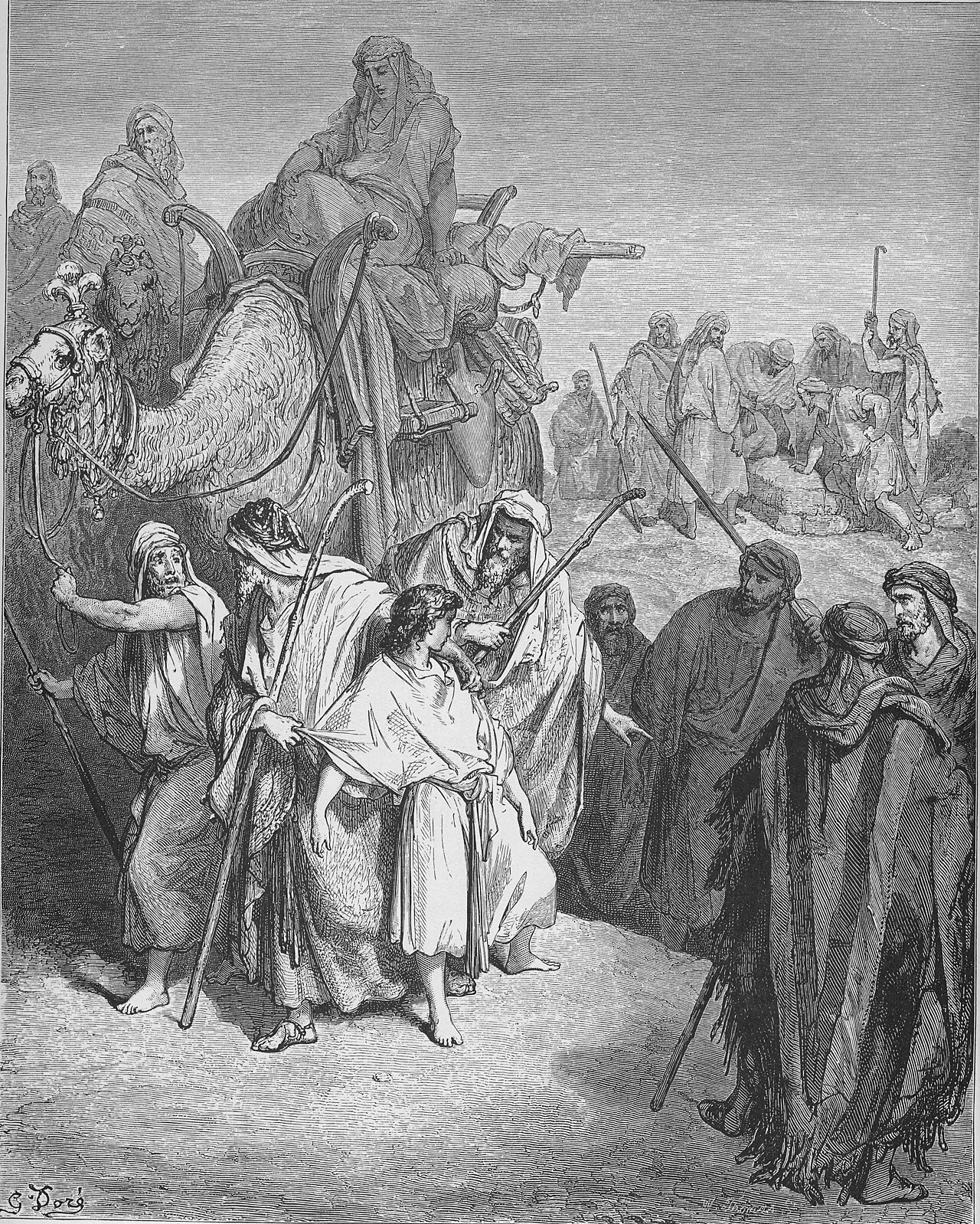
- Joseph sold to traders who take him to EgyptGenesis 37:28So when the Midianite traders passed by, his brothers pulled Joseph out of the pit and sold him for twenty shekels of silver to the Ishmaelites, who took him to Egypt.
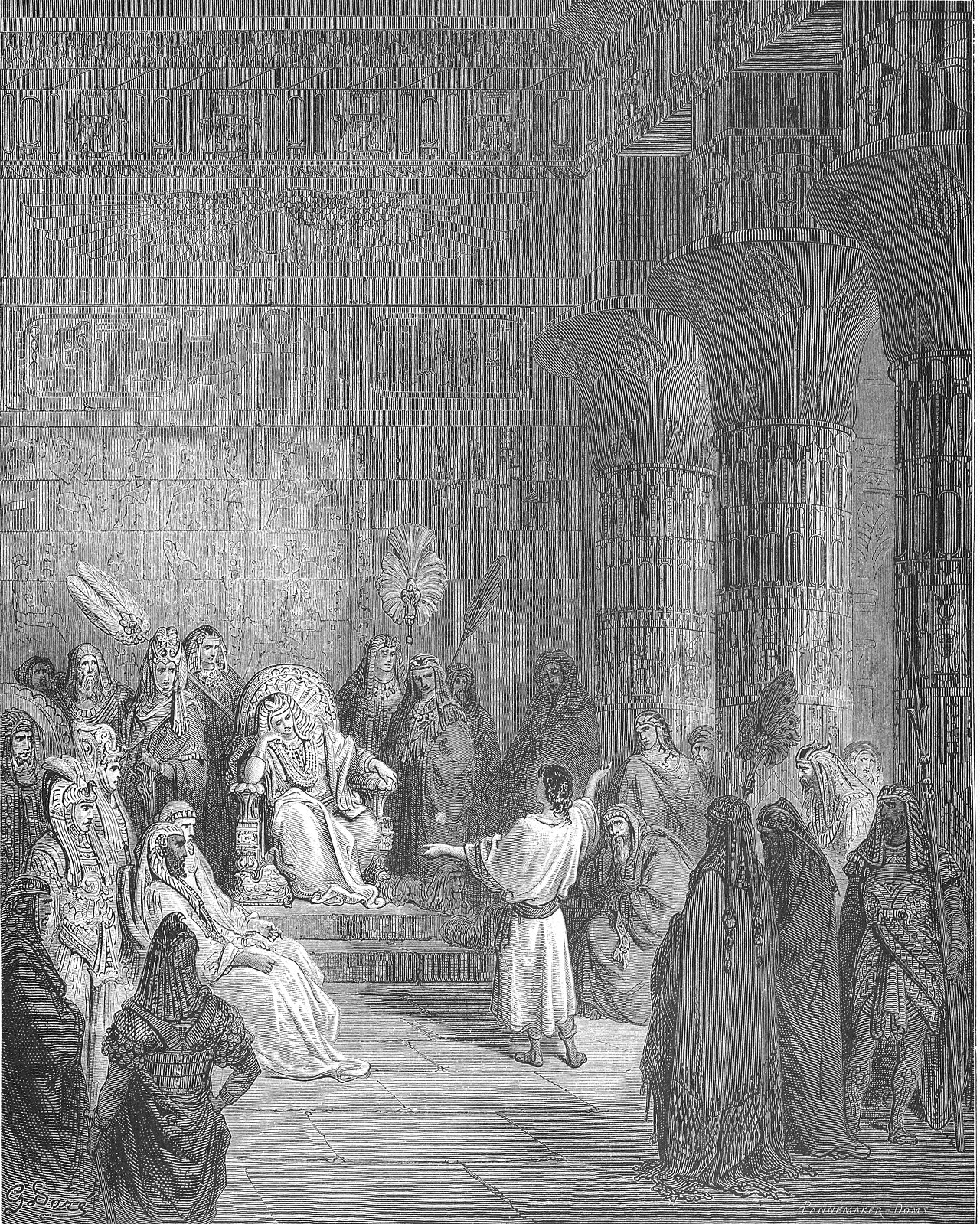
- Pharaoh sets Joseph over all the landGenesis 41:41Pharaoh also told Joseph, “I hereby place you over all the land of Egypt.”
- God tells Jacob not to fear going downGenesis 46:3“I am God,” He said, “the God of your father. Do not be afraid to go down to Egypt, for I will make you into a great nation there.
- Israel settles in Goshen and increasesGenesis 47:27Now the Israelites settled in the land of Egypt, in the region of Goshen. They acquired property there and became fruitful and increased greatly in number.
- Joseph makes them swear about his bonesGenesis 50:25And Joseph made the sons of Israel take an oath and said, “God will surely attend to you, and then you must carry my bones up from this place.”
- A new king who did not know JosephExodus 1:8Then a new king, who did not know Joseph, came to power in Egypt.
- The store cities Pithom and RamesesExodus 1:11So the Egyptians appointed taskmasters over the Israelites to oppress them with forced labor. As a result, they built Pithom and Rameses as store cities for Pharaoh.
- The cry of the slaves reaches GodExodus 2:23After a long time, the king of Egypt died. The Israelites groaned and cried out under their burden of slavery, and their cry for deliverance from bondage ascended to God.
- They go out at the end of the 430 yearsExodus 12:41At the end of the 430 years, to the very day, all the LORD’s divisions went out of the land of Egypt.
- Led toward the sea, which is told on its own pageExodus 13:18So God led the people around by the way of the wilderness toward the Red Sea. And the Israelites left the land of Egypt arrayed for battle.
- The Ten Commandments open by naming EgyptExodus 20:2“I am the LORD your God, who brought you out of the land of Egypt, out of the house of slavery.
- Shishak attacks Jerusalem in Rehoboam's fifth year1 Kings 14:25In the fifth year of Rehoboam’s reign, Shishak king of Egypt came up and attacked Jerusalem.
- Pharaoh Neco kills Josiah at Megiddo2 Kings 23:29At the end of Josiah’s reign, Pharaoh Neco king of Egypt marched up to help the king of Assyria at the Euphrates River. King Josiah went out to confront him, but Neco faced him and killed him at Megiddo.
- The remnant of Judah carried down to TahpanhesJeremiah 43:7So they entered the land of Egypt because they did not obey the voice of the LORD, and they went as far as Tahpanhes.
- The burden against Egypt ends in blessingIsaiah 19:25The LORD of Hosts will bless them, saying, “Blessed be Egypt My people, Assyria My handiwork, and Israel My inheritance.”
- Out of Egypt I called My sonHosea 11:1When Israel was a child, I loved him, and out of Egypt I called My son.
- Matthew reads Hosea over the child brought backMatthew 2:15where he stayed until the death of Herod. This fulfilled what the Lord had spoken through the prophet: “Out of Egypt I called My Son.”
- The name used as a moral descriptionRevelation 11:8Their bodies will lie in the street of the great city—figuratively called Sodom and Egypt—where their Lord was also crucified.
Where it points
The voices
each quoted from the work named
To "the house of bondage?" Well, it once was that. But Egypt was a house of refuge before it was a house of bondage, and now it has but returned to its first use.
EGYPT occupies a very singular position towards Israel. It was often the shelter of the seed of Abraham. Abraham, himself, went there when there was a famine in the land of his sojourn. To Egypt, Joseph was taken that he might escape from the death intended for him by his envious brothers and become the stepfather of the house of Israel. Into Egypt, as we all right well know, went the whole family of Jacob—and there they sojourned in a strange land. There Moses acquired the learning which was so useful to him.
THE DIFFERENCE between the Egyptians and Israel was exceedingly manifest. At first sight it seemed to be very greatly to the advantage of Egypt. They had the whip in their hand, and poor Israel smarted under the lash. Egypt possessed the toil of the Israelites. the sons of Jacob made bricks, and the subjects of Pharaoh inhabited the houses which the sons of Jacob builded. How soon, however, were the tables turned! God wrought plagues in Egypt. but Goshen was spared.
4 more teachers on these versesCharles Spurgeon · Adam Clarke · Eusebius of Caesarea
PHARAOH is the type and image of proud men. God permitted him to be left to the natural hardness of his heart and he stood up against Jehovah in a very remarkable way. Those who are students of the ancient history of Egypt, those especially who have seen the remains of the colossal statues of the kings and those tremendous pyramids which probably were the places of their sepulture, will know that man worship was carried on to the very highest degree in connection with the ancient kingdom of Egypt.
Against all the gods of Egypt, etc. - As different animals were sacred among the Egyptians, the slaying of the first-born of all the beasts might be called executing judgment upon the gods of Egypt. As this however does not appear very clear and satisfactory, some have imagined that the word אלהי elohey should be translated princes, which is the rendering in our margin; for as these princes, who were rulers of the kingdom under Pharaoh, were equally hostile to the Hebrews with Pharaoh himself, therefore these judgments fell equally heavy on them also.
Now one can consider that the prophecy has not been fulfilled if the following are true: if the Egyptians in our own time cannot be seen to have abandoned the gods of their fathers and calling on the God of the prophets; throughout every town and city in the country of Egypt there are not altars built to the God that previously only the Hebrews acknowledged; the idols have not been shaken.… How can we deny that the prophecies of ages past have been fulfilled?
THIS is a very remarkable prophecy. Attempts have been made to explain it, as if it were already fulfilled. I believe all such attempts to be utter failures. This promise stands on record to be, fulfilled at some future day In those bright days for which some of us are looking, when the knowledge of the Lord shall cover the earth, so the waters cover the sea, then shall this word to Egypt be verified; yea, and God shall be glorified both by Egypt and Assyria, as well as in the land of Israel.
Egypt in Scripture
569 verses name it, in 33 books
Open a book to read its mentions here. Text: Berean Standard Bible.
Old TestamentNew Testamentsegment width = share of mentions
Old Testament28 books · 546 mentions
Genesis72 mentions
- Genesis 12:10Now there was a famine in the land. So Abram went down to Egypt to live there for a while because the famine was severe.
- Genesis 12:11As he was about to enter Egypt, he said to his wife Sarai, “Look, I know that you are a beautiful woman,
- Genesis 12:14So when Abram entered Egypt, the Egyptians saw that the woman was very beautiful.
- Genesis 13:1So Abram went up out of Egypt into the Negev—he and his wife and all his possessions—and Lot was with him.
- Genesis 13:10And Lot looked out and saw that the whole plain of the Jordan, all the way to Zoar, was well watered like the garden of the LORD, like the land of Egypt. (This was before the LORD destroyed Sodom and Gomorrah.)
- Genesis 15:18On that day the LORD made a covenant with Abram, saying, “To your descendants I have given this land—from the river of Egypt to the great River Euphrates—
- Genesis 21:21And while he was dwelling in the Wilderness of Paran, his mother got a wife for him from the land of Egypt.
- Genesis 25:18Ishmael’s descendants settled from Havilah to Shur, which is near the border of Egypt as you go toward Asshur. And they lived in hostility toward all their brothers.
64 further mentions in Genesis, read them in the book.
Exodus110 mentions
- Exodus 1:1These are the names of the sons of Israel who went to Egypt with Jacob, each with his family:
- Exodus 1:5The descendants of Jacob numbered seventy in all, including Joseph, who was already in Egypt.
- Exodus 1:8Then a new king, who did not know Joseph, came to power in Egypt.
- Exodus 1:15Then the king of Egypt said to the Hebrew midwives, whose names were Shiphrah and Puah,
- Exodus 1:17The midwives, however, feared God and did not do as the king of Egypt had instructed; they let the boys live.
- Exodus 1:18So the king of Egypt summoned the midwives and asked them, “Why have you done this? Why have you let the boys live?”
- Exodus 2:23After a long time, the king of Egypt died. The Israelites groaned and cried out under their burden of slavery, and their cry for deliverance from bondage ascended to God.
- Exodus 3:7The LORD said, “I have indeed seen the affliction of My people in Egypt. I have heard them crying out because of their oppressors, and I am aware of their sufferings.
102 further mentions in Exodus, read them in the book.
Leviticus11 mentions
- Leviticus 11:45For I am the LORD, who brought you up out of the land of Egypt so that I would be your God; therefore be holy, because I am holy.
- Leviticus 18:3You must not follow the practices of the land of Egypt, where you used to live, and you must not follow the practices of the land of Canaan, into which I am bringing you. You must not walk in their customs.
- Leviticus 19:34You must treat the foreigner living among you as native-born and love him as yourself, for you were foreigners in the land of Egypt. I am the LORD your God.
- Leviticus 19:36You shall maintain honest scales and weights, an honest ephah, and an honest hin. I am the LORD your God, who brought you out of the land of Egypt.
- Leviticus 22:33who brought you out of the land of Egypt to be your God. I am the LORD.”
- Leviticus 23:43so that your descendants may know that I made the Israelites dwell in booths when I brought them out of the land of Egypt. I am the LORD your God.’”
- Leviticus 25:38I am the LORD your God, who brought you out of the land of Egypt to give you the land of Canaan and to be your God.
- Leviticus 25:42Because the Israelites are My servants, whom I brought out of the land of Egypt, they are not to be sold as slaves.
3 further mentions in Leviticus, read them in the book.
Numbers28 mentions
- Numbers 1:1On the first day of the second month of the second year after the Israelites had come out of the land of Egypt, the LORD spoke to Moses in the Tent of Meeting in the Wilderness of Sinai. He said:
- Numbers 3:13for all the firstborn are Mine. On the day I struck down every firstborn in the land of Egypt, I consecrated to Myself all the firstborn in Israel, both man and beast. They are Mine; I am the LORD.”
- Numbers 8:17For every firstborn male in Israel is Mine, both man and beast. I set them apart for Myself on the day I struck down all the firstborn in the land of Egypt.
- Numbers 9:1In the first month of the second year after Israel had come out of the land of Egypt, the LORD spoke to Moses in the Wilderness of Sinai:
- Numbers 11:5We remember the fish we ate freely in Egypt, along with the cucumbers, melons, leeks, onions, and garlic.
- Numbers 11:18And say to the people: Consecrate yourselves for tomorrow, and you will eat meat, because you have cried out in the hearing of the LORD, saying: ‘Who will feed us meat? For we were better off in Egypt!’ Therefore the LORD will give you meat, and you will eat.
- Numbers 11:20but for a whole month—until it comes out of your nostrils and makes you nauseous—because you have rejected the LORD, who is among you, and have cried out before Him, saying, ‘Why did we ever leave Egypt?’”
- Numbers 13:22They went up through the Negev and came to Hebron, where Ahiman, Sheshai, and Talmai, the descendants of Anak, dwelled. It had been built seven years before Zoan in Egypt.
20 further mentions in Numbers, read them in the book.
Deuteronomy46 mentions
- Deuteronomy 1:27You grumbled in your tents and said, “Because the LORD hates us, He has brought us out of the land of Egypt to deliver us into the hand of the Amorites to be annihilated.
- Deuteronomy 1:30The LORD your God, who goes before you, will fight for you, just as you saw Him do for you in Egypt
- Deuteronomy 4:20Yet the LORD has taken you and brought you out of the iron furnace, out of Egypt, to be the people of His inheritance, as you are today.
- Deuteronomy 4:34Or has any god tried to take as his own a nation out of another nation—by trials, signs, wonders, and war, by a strong hand and an outstretched arm, and by great terrors—as the LORD your God did for you in Egypt, before your eyes?
- Deuteronomy 4:37Because He loved your fathers, He chose their descendants after them and brought you out of Egypt by His presence and great power,
- Deuteronomy 4:45These are the testimonies, statutes, and ordinances that Moses proclaimed to them after they had come out of Egypt,
- Deuteronomy 4:46while they were in the valley across the Jordan facing Beth-peor in the land of Sihon king of the Amorites, who lived in Heshbon and was defeated by Moses and the Israelites after they had come out of Egypt.
- Deuteronomy 5:6“I am the LORD your God, who brought you out of the land of Egypt, out of the house of slavery.
38 further mentions in Deuteronomy, read them in the book.
Joshua14 mentions
- Joshua 2:10For we have heard how the LORD dried up the waters of the Red Sea before you when you came out of Egypt, and what you did to Sihon and Og, the two kings of the Amorites across the Jordan, whom you devoted to destruction.
- Joshua 5:4Now this is why Joshua circumcised them: All those who came out of Egypt—all the men of war—had died on the journey in the wilderness after they had left Egypt.
- Joshua 5:5Though all who had come out were circumcised, none of those born in the wilderness on the journey from Egypt had been circumcised.
- Joshua 5:6For the Israelites had wandered in the wilderness forty years, until all the nation’s men of war who had come out of Egypt had died, since they did not obey the LORD. So the LORD vowed never to let them see the land He had sworn to their fathers to give us, a land flowing with milk and honey.
- Joshua 5:9Then the LORD said to Joshua, “Today I have rolled away the reproach of Egypt from you.” So that place has been called Gilgal to this day.
- Joshua 9:9“Your servants have come from a very distant land,” they replied, “because of the fame of the LORD your God. For we have heard the reports about Him: all that He did in Egypt,
- Joshua 13:3All the territory of the Philistines and the Geshurites, from the Shihor east of Egypt to the territory of Ekron on the north (considered to be Canaanite territory)—that of the five Philistine rulers of Gaza, Ashdod, Ashkelon, Gath, and Ekron, as well as that of the Avvites;
- Joshua 15:4It proceeded to Azmon, joined the Brook of Egypt, and ended at the Sea. This was their southern border.
6 further mentions in Joshua, read them in the book.
Judges8 mentions
- Judges 2:1Now the angel of the LORD went up from Gilgal to Bochim and said, “I brought you up out of Egypt and led you into the land that I had promised to your fathers, and I said, ‘I will never break My covenant with you,
- Judges 2:12Thus they forsook the LORD, the God of their fathers, who had brought them out of the land of Egypt, and they followed after various gods of the peoples around them. They bowed down to them and provoked the LORD to anger,
- Judges 6:8He sent them a prophet, who told them, “This is what the LORD, the God of Israel, says: I brought you up out of Egypt, out of the house of slavery.
- Judges 6:9I delivered you out of the hands of Egypt and all your oppressors. I drove them out before you and gave you their land.
- Judges 6:13“Please, my Lord,” Gideon replied, “if the LORD is with us, why has all this happened to us? And where are all His wonders of which our fathers told us, saying, ‘Has not the LORD brought us up out of Egypt?’ But now the LORD has forsaken us and delivered us into the hand of Midian.”
- Judges 11:13The king of the Ammonites answered Jephthah’s messengers, “When Israel came up out of Egypt, they seized my land, from the Arnon to the Jabbok and all the way to the Jordan. Now, therefore, restore it peaceably.”
- Judges 11:16But when Israel came up out of Egypt, they traveled through the wilderness to the Red Sea and came to Kadesh.
- Judges 19:30And everyone who saw it said, “Nothing like this has been seen or done from the day the Israelites came out of the land of Egypt until this day. Think it over, take counsel, and speak up!”
1 Samuel9 mentions
- 1 Samuel 2:27Then a man of God came to Eli and told him, “This is what the LORD says: ‘Did I not clearly reveal Myself to your father’s house when they were in Egypt under Pharaoh’s house?
- 1 Samuel 8:8Just as they have done from the day I brought them up out of Egypt until this day, forsaking Me and serving other gods, so they are doing to you.
- 1 Samuel 10:18and said to the Israelites, “This is what the LORD, the God of Israel, says: ‘I brought Israel up out of Egypt, and I rescued you from the hands of the Egyptians and of all the kingdoms that oppressed you.’
- 1 Samuel 12:6Then Samuel said to the people, “The LORD is the One who appointed Moses and Aaron, and who brought your fathers up out of the land of Egypt.
- 1 Samuel 12:8When Jacob went to Egypt, your fathers cried out to the LORD, and He sent them Moses and Aaron, who brought your fathers out of Egypt and settled them in this place.
- 1 Samuel 15:2This is what the LORD of Hosts says: ‘I witnessed what the Amalekites did to the Israelites when they ambushed them on their way up from Egypt.
- 1 Samuel 15:6And he warned the Kenites, “Since you showed kindness to all the Israelites when they came up out of Egypt, go on and get away from the Amalekites. Otherwise I will sweep you away with them.” So the Kenites moved away from the Amalekites.
- 1 Samuel 15:7Then Saul struck down the Amalekites all the way from Havilah to Shur, which is east of Egypt.
1 further mention in 1 Samuel, read them in the book.
2 Samuel2 mentions
- 2 Samuel 7:6For I have not dwelt in a house from the day I brought the Israelites up out of Egypt until this day, but I have moved about with a tent as My dwelling.
- 2 Samuel 7:23And who is like Your people Israel—the one nation on earth whom God went out to redeem as a people for Himself and to make a name for Himself? You performed great and awesome wonders by driving out nations and their gods from before Your people, whom You redeemed for Yourself from Egypt.
1 Kings21 mentions
- 1 Kings 3:1Later, Solomon formed an alliance with Pharaoh king of Egypt by marrying his daughter. Solomon brought her to the City of David until he had finished building his palace and the house of the LORD, as well as the wall around Jerusalem.
- 1 Kings 4:21And Solomon reigned over all the kingdoms from the Euphrates to the land of the Philistines, as far as the border of Egypt. These kingdoms offered tribute and served Solomon all the days of his life.
- 1 Kings 4:30Solomon’s wisdom was greater than that of all the men of the East, greater than all the wisdom of Egypt.
- 1 Kings 6:1In the four hundred and eightieth year after the Israelites had come out of the land of Egypt, in the month of Ziv, the second month of the fourth year of Solomon’s reign over Israel, he began to build the house of the LORD.
- 1 Kings 8:9There was nothing in the ark except the two stone tablets that Moses had placed in it at Horeb, where the LORD had made a covenant with the Israelites after they had come out of the land of Egypt.
- 1 Kings 8:16‘Since the day I brought My people Israel out of Egypt, I have not chosen a city from any tribe of Israel in which to build a house so that My Name would be there. But I have chosen David to be over My people Israel.’
- 1 Kings 8:21And there I have provided a place for the ark, which contains the covenant of the LORD that He made with our fathers when He brought them out of the land of Egypt.”
- 1 Kings 8:51For they are Your people and Your inheritance; You brought them out of Egypt, out of the furnace for iron.
13 further mentions in 1 Kings, read them in the book.
2 Kings11 mentions
- 2 Kings 17:4But the king of Assyria discovered that Hoshea had conspired to send envoys to King So of Egypt, and that he had not paid tribute to the king of Assyria as in previous years. Therefore the king of Assyria arrested Hoshea and put him in prison.
- 2 Kings 17:7All this happened because the people of Israel had sinned against the LORD their God, who had brought them out of the land of Egypt from under the hand of Pharaoh king of Egypt. They had worshiped other gods
- 2 Kings 17:36Instead, worship the LORD, who brought you out of the land of Egypt with great power and an outstretched arm. You are to bow down to Him and offer sacrifices to Him.
- 2 Kings 18:21Look now, you are trusting in Egypt, that splintered reed of a staff that will pierce the hand of anyone who leans on it. Such is Pharaoh king of Egypt to all who trust in him.
- 2 Kings 18:24For how can you repel a single officer among the least of my master’s servants when you depend on Egypt for chariots and horsemen?
- 2 Kings 19:24I have dug wells and drunk foreign waters. With the soles of my feet I have dried up all the streams of Egypt.”
- 2 Kings 21:15because they have done evil in My sight and have provoked Me to anger from the day their fathers came out of Egypt until this day.’”
- 2 Kings 23:29At the end of Josiah’s reign, Pharaoh Neco king of Egypt marched up to help the king of Assyria at the Euphrates River. King Josiah went out to confront him, but Neco faced him and killed him at Megiddo.
3 further mentions in 2 Kings, read them in the book.
1 Chronicles3 mentions
- 1 Chronicles 13:5So David assembled all Israel, from the River Shihor in Egypt to Lebo-hamath, to bring the ark of God from Kiriath-jearim.
- 1 Chronicles 17:5For I have not dwelt in a house from the day I brought Israel up out of Egypt until this day, but I have moved from tent to tent and dwelling to dwelling.
- 1 Chronicles 17:21And who is like Your people Israel—the one nation on earth whom God went out to redeem as a people for Himself? You made a name for Yourself through great and awesome wonders by driving out nations from before Your people, whom You redeemed from Egypt.
2 Chronicles17 mentions
- 2 Chronicles 1:16Solomon’s horses were imported from Egypt and Kue; the royal merchants purchased them from Kue.
- 2 Chronicles 1:17A chariot could be imported from Egypt for six hundred shekels of silver, and a horse for a hundred and fifty. Likewise, they exported them to all the kings of the Hittites and to the kings of Aram.
- 2 Chronicles 5:10There was nothing in the ark except the two tablets that Moses had placed in it at Horeb, where the LORD had made a covenant with the Israelites after they had come out of Egypt.
- 2 Chronicles 6:5‘Since the day I brought My people out of the land of Egypt, I have not chosen a city from any tribe of Israel in which to build a house so that My Name would be there, nor have I chosen anyone to be ruler over My people Israel.
- 2 Chronicles 7:8So at that time Solomon and all Israel with him—a very great assembly of people from Lebo-hamath to the Brook of Egypt—kept the feast for seven days.
- 2 Chronicles 7:22And others will answer, ‘Because they have forsaken the LORD, the God of their fathers, who brought them out of the land of Egypt, and have embraced other gods, worshiping and serving them—because of this, He has brought all this disaster upon them.’”
- 2 Chronicles 9:26He reigned over all the kings from the Euphrates to the land of the Philistines, as far as the border of Egypt.
- 2 Chronicles 9:28Solomon’s horses were imported from Egypt and from all the lands.
9 further mentions in 2 Chronicles, read them in the book.
Nehemiah3 mentions
- Nehemiah 9:9You saw the affliction of our fathers in Egypt; You heard their cry at the Red Sea.
- Nehemiah 9:17They refused to listen and failed to remember the wonders You performed among them. They stiffened their necks and appointed a leader to return them to their bondage in Egypt. But You are a forgiving God, gracious and compassionate, slow to anger and rich in loving devotion, and You did not forsake them.
- Nehemiah 9:18Even when they cast for themselves an image of a calf and said, ‘This is your God who brought you up out of Egypt,’ and when they committed terrible blasphemies,
Psalms15 mentions
- Psalms 68:31Envoys will arrive from Egypt; Cush will stretch out her hands to God.
- Psalms 78:12He worked wonders before their fathers in the land of Egypt, in the region of Zoan.
- Psalms 78:43when He performed His signs in Egypt and His wonders in the fields of Zoan.
- Psalms 78:51He struck all the firstborn of Egypt, the virility in the tents of Ham.
- Psalms 80:8You uprooted a vine from Egypt; You drove out the nations and transplanted it.
- Psalms 81:5He ordained it as a testimony for Joseph when he went out over the land of Egypt, where I heard an unfamiliar language:
- Psalms 81:10I am the LORD your God, who brought you up out of Egypt. Open wide your mouth, and I will fill it.
- Psalms 105:23Then Israel entered Egypt; Jacob dwelt in the land of Ham.
7 further mentions in Psalms, read them in the book.
Proverbs1 mention
Isaiah35 mentions
- Isaiah 10:26And the LORD of Hosts will brandish a whip against them, as when He struck Midian at the rock of Oreb. He will raise His staff over the sea, as He did in Egypt.
- Isaiah 11:11On that day the Lord will extend His hand a second time to recover the remnant of His people from Assyria, from Egypt, from Pathros, from Cush, from Elam, from Shinar, from Hamath, and from the islands of the sea.
- Isaiah 11:15The LORD will devote to destruction the gulf of the Sea of Egypt; with a scorching wind He will sweep His hand over the Euphrates. He will split it into seven streams for men to cross with dry sandals.
- Isaiah 11:16There will be a highway for the remnant of His people who remain from Assyria, as there was for Israel when they came up from the land of Egypt.
- Isaiah 19:1This is the burden against Egypt: Behold, the LORD rides on a swift cloud; He is coming to Egypt. The idols of Egypt will tremble before Him, and the hearts of the Egyptians will melt within them.
- Isaiah 19:6The canals will stink; the streams of Egypt will trickle and dry up; the reeds and rushes will wither.
- Isaiah 19:12Where are your wise men now? Let them tell you and reveal what the LORD of Hosts has planned against Egypt.
- Isaiah 19:13The princes of Zoan have become fools; the princes of Memphis are deceived. The cornerstones of her tribes have led Egypt astray.
27 further mentions in Isaiah, read them in the book.
Jeremiah56 mentions
- Jeremiah 2:6They did not ask, ‘Where is the LORD who brought us up from the land of Egypt, who led us through the wilderness, through a land of deserts and pits, a land of drought and darkness, a land where no one travels and no one lives?’
- Jeremiah 2:18Now what will you gain on your way to Egypt to drink the waters of the Nile? What will you gain on your way to Assyria to drink the waters of the Euphrates?
- Jeremiah 2:36How unstable you are, constantly changing your ways! You will be disappointed by Egypt just as you were by Assyria.
- Jeremiah 7:22For when I brought your fathers out of the land of Egypt, I did not merely command them about burnt offerings and sacrifices,
- Jeremiah 7:25From the day your fathers came out of the land of Egypt until this day, I have sent you all My servants the prophets again and again.
- Jeremiah 9:26Egypt, Judah, Edom, Ammon, Moab, and all the inhabitants of the desert who clip the hair of their temples. For all these nations are uncircumcised, and the whole house of Israel is uncircumcised in heart.”
- Jeremiah 11:4which I commanded your forefathers when I brought them out of the land of Egypt, out of the iron furnace, saying, ‘Obey Me, and do everything I command you, and you will be My people, and I will be your God.’
- Jeremiah 11:7For from the time I brought your fathers out of the land of Egypt until today, I strongly warned them again and again, saying, ‘Obey My voice.’
48 further mentions in Jeremiah, read them in the book.
Lamentations1 mention
Ezekiel49 mentions
- Ezekiel 17:15But this king rebelled against Babylon by sending his envoys to Egypt to ask for horses and a large army. Will he flourish? Will the one who does such things escape? Can he break a covenant and yet escape?’
- Ezekiel 19:4When the nations heard of him, he was trapped in their pit. With hooks they led him away to the land of Egypt.
- Ezekiel 20:5and tell them that this is what the Lord GOD says: On the day I chose Israel, I swore an oath to the descendants of the house of Jacob and made Myself known to them in the land of Egypt. With an uplifted hand I said to them, ‘I am the LORD your God.’
- Ezekiel 20:6On that day I swore to bring them out of the land of Egypt into a land that I had searched out for them, a land flowing with milk and honey, the glory of all lands.
- Ezekiel 20:7And I said to them: ‘Each of you must throw away the abominations before his eyes, and you must not defile yourselves with the idols of Egypt. I am the LORD your God.’
- Ezekiel 20:8But they rebelled against Me and refused to listen. None of them cast away the abominations before their eyes, and they did not forsake the idols of Egypt. So I resolved to pour out My wrath upon them and vent My anger against them in the land of Egypt.
- Ezekiel 20:9But I acted for the sake of My name, that it should not be profaned in the eyes of the nations among whom they were living, in whose sight I had revealed Myself to Israel by bringing them out of the land of Egypt.
- Ezekiel 20:10So I brought them out of the land of Egypt and led them into the wilderness.
41 further mentions in Ezekiel, read them in the book.
Daniel4 mentions
- Daniel 9:15Now, O Lord our God, who brought Your people out of the land of Egypt with a mighty hand, and who made for Yourself a name renowned to this day, we have sinned; we have acted wickedly.
- Daniel 11:8He will take even their gods captive to Egypt, with their metal images and their precious vessels of silver and gold. For some years he will stay away from the king of the North,
- Daniel 11:42He will extend his power over many countries, and not even the land of Egypt will escape.
- Daniel 11:43He will gain control of the treasures of gold and silver and over all the riches of Egypt, and the Libyans and Cushites will also submit to him.
Hosea13 mentions
- Hosea 2:15There I will give back her vineyards and make the Valley of Achor into a gateway of hope. There she will respond as she did in the days of her youth, as in the day she came up out of Egypt.
- Hosea 7:11So Ephraim has become like a silly, senseless dove—calling out to Egypt, then turning to Assyria.
- Hosea 7:16They turn, but not to the Most High; they are like a faulty bow. Their leaders will fall by the sword for the cursing of their tongue; for this they will be ridiculed in the land of Egypt.
- Hosea 8:13Though they offer sacrifices as gifts to Me, and though they eat the meat, the LORD does not accept them. Now He will remember their iniquity and punish their sins: They will return to Egypt.
- Hosea 9:3They will not remain in the land of the LORD; Ephraim will return to Egypt and eat unclean food in Assyria.
- Hosea 9:6For even if they flee destruction, Egypt will gather them and Memphis will bury them. Their precious silver will be taken over by thistles, and thorns will overrun their tents.
- Hosea 11:1When Israel was a child, I loved him, and out of Egypt I called My son.
- Hosea 11:5Will they not return to the land of Egypt and be ruled by Assyria because they refused to repent?
5 further mentions in Hosea, read them in the book.
Joel1 mention
Amos7 mentions
- Amos 2:10And I brought you up from the land of Egypt and led you forty years in the wilderness, that you might take possession of the land of the Amorite.
- Amos 3:1Hear this word that the LORD has spoken against you, O children of Israel, against the whole family that I brought up out of the land of Egypt:
- Amos 3:9Proclaim to the citadels of Ashdod and to the citadels of Egypt: “Assemble on the mountains of Samaria; see the great unrest in the city and the acts of oppression in her midst.”
- Amos 4:10“I sent plagues among you like those of Egypt; I killed your young men with the sword, along with your captured horses. I filled your nostrils with the stench of your camp, yet you did not return to Me,” declares the LORD.
- Amos 8:8Will not the land quake for this, and all its dwellers mourn? All of it will swell like the Nile; it will surge and then subside like the Nile in Egypt.
- Amos 9:5The Lord GOD of Hosts, He who touches the earth and it melts, and all its dwellers mourn—all the land rises like the Nile, then sinks like the river of Egypt—
- Amos 9:7“Are you not like the Cushites to Me, O children of Israel?” declares the LORD. “Did I not bring Israel up from the land of Egypt, the Philistines from Caphtor, and the Arameans from Kir?
Micah3 mentions
- Micah 6:4For I brought you up from the land of Egypt and redeemed you from the house of slavery. I sent Moses before you, as well as Aaron and Miriam.
- Micah 7:12On that day they will come to you from Assyria and the cities of Egypt, even from Egypt to the Euphrates, from sea to sea and mountain to mountain.
- Micah 7:15As in the days when you came out of Egypt, I will show My wonders.
Nahum1 mention
Haggai1 mention
Zechariah4 mentions
- Zechariah 10:10I will bring them back from Egypt and gather them from Assyria. I will bring them to Gilead and Lebanon until no more room is found for them.
- Zechariah 10:11They will pass through the sea of distress and strike the waves of the sea; all the depths of the Nile will dry up. The pride of Assyria will be brought down, and the scepter of Egypt will depart.
- Zechariah 14:18And if the people of Egypt will not go up and enter in, then the rain will not fall on them; this will be the plague with which the LORD strikes the nations who do not go up to celebrate the Feast of Tabernacles.
- Zechariah 14:19This will be the punishment of Egypt and of all the nations that do not go up to celebrate the Feast of Tabernacles.
New Testament5 books · 23 mentions
Matthew4 mentions
- Matthew 2:13When the Magi had gone, an angel of the Lord appeared to Joseph in a dream. “Get up!” he said. “Take the Child and His mother and flee to Egypt. Stay there until I tell you, for Herod is going to search for the Child to kill Him.”
- Matthew 2:14So he got up, took the Child and His mother by night, and withdrew to Egypt,
- Matthew 2:15where he stayed until the death of Herod. This fulfilled what the Lord had spoken through the prophet: “Out of Egypt I called My Son.”
- Matthew 2:19After Herod died, an angel of the Lord appeared in a dream to Joseph in Egypt.
Acts13 mentions
- Acts 2:10Phrygia and Pamphylia, Egypt and the parts of Libya near Cyrene; visitors from Rome,
- Acts 7:9Because the patriarchs were jealous of Joseph, they sold him as a slave into Egypt. But God was with him
- Acts 7:10and rescued him from all his troubles. He granted Joseph favor and wisdom in the sight of Pharaoh king of Egypt, who appointed him ruler over Egypt and all his household.
- Acts 7:11Then famine and great suffering swept across Egypt and Canaan, and our fathers could not find food.
- Acts 7:12When Jacob heard that there was grain in Egypt, he sent our fathers on their first visit.
- Acts 7:15So Jacob went down to Egypt, where he and our fathers died.
- Acts 7:17As the time drew near for God to fulfill His promise to Abraham, our people in Egypt increased greatly in number.
- Acts 7:18Then another king, who knew nothing of Joseph, arose over Egypt.
5 further mentions in Acts, read them in the book.
Hebrews4 mentions
- Hebrews 3:16For who were the ones who heard and rebelled? Were they not all those Moses led out of Egypt?
- Hebrews 8:9It will not be like the covenant I made with their fathers when I took them by the hand to lead them out of the land of Egypt, because they did not abide by My covenant, and I disregarded them, declares the Lord.
- Hebrews 11:26He valued disgrace for Christ above the treasures of Egypt, for he was looking ahead to his reward.
- Hebrews 11:27By faith Moses left Egypt, not fearing the king’s anger; he persevered because he saw Him who is invisible.
Jude1 mention
The account
Read the account as one telling
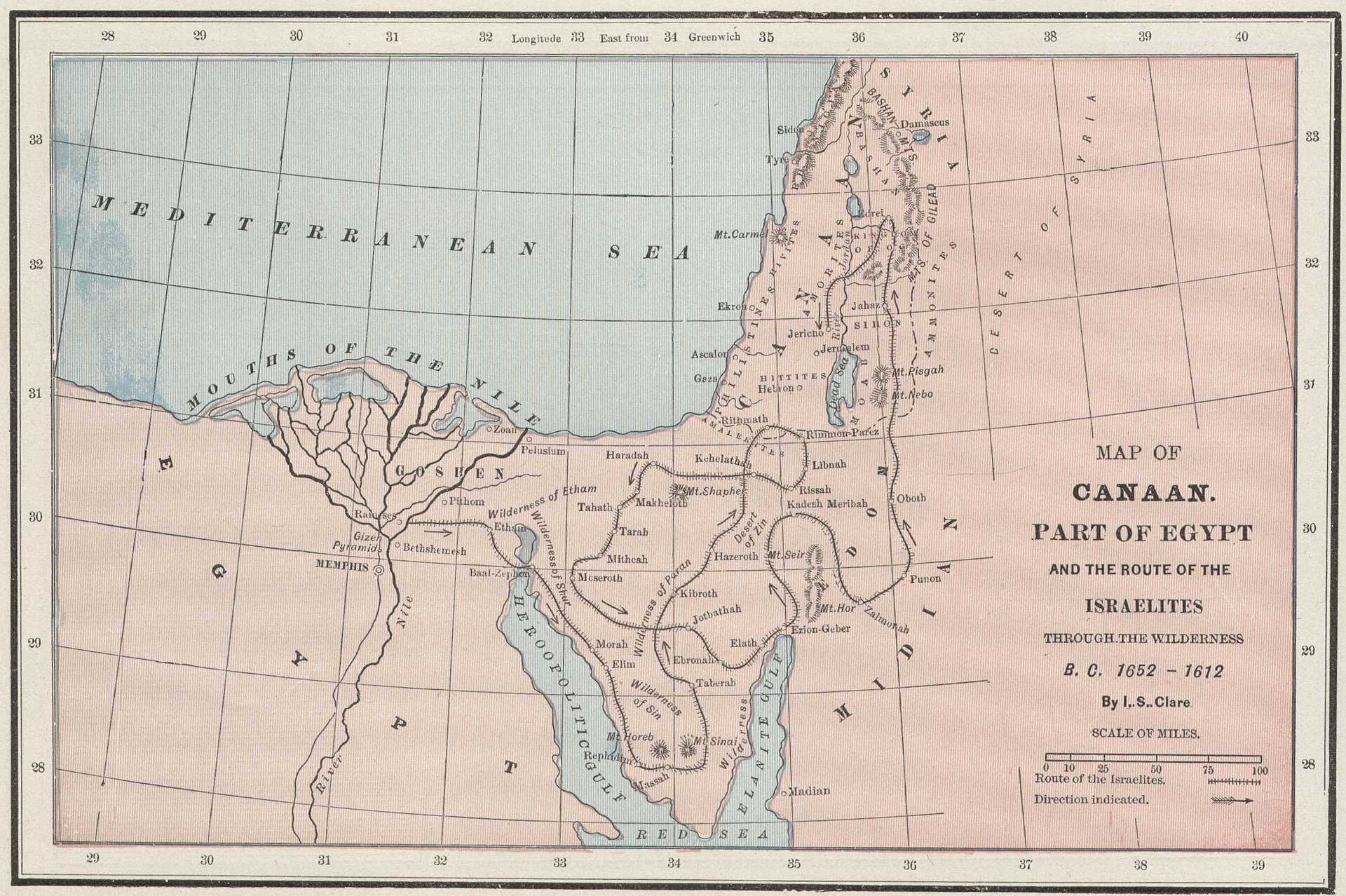
Egypt is two lands joined by one river. The Hebrew name, Mitsrayim, is a dual form, which is why Scripture can speak of Egypt as a pair: the narrow valley of Upper Egypt in the south and the wide Delta of Lower Egypt in the north. The eastern edge of that Delta, in and around the Wadi Tumilat, is the country Scripture calls Goshen, and it is where almost everything in the biblical account of Egypt happens.
Abram is the first to go down. A famine drives him out of Canaan and into Egypt to live there for a while, and he comes back out with his household and his possessions. Not long after, the covenant word to Abram puts Egypt in the plan before Joseph is born: his descendants will be strangers in a land that is not their own, they will be enslaved and mistreated, God will judge the nation they serve, and they will depart with many possessions.
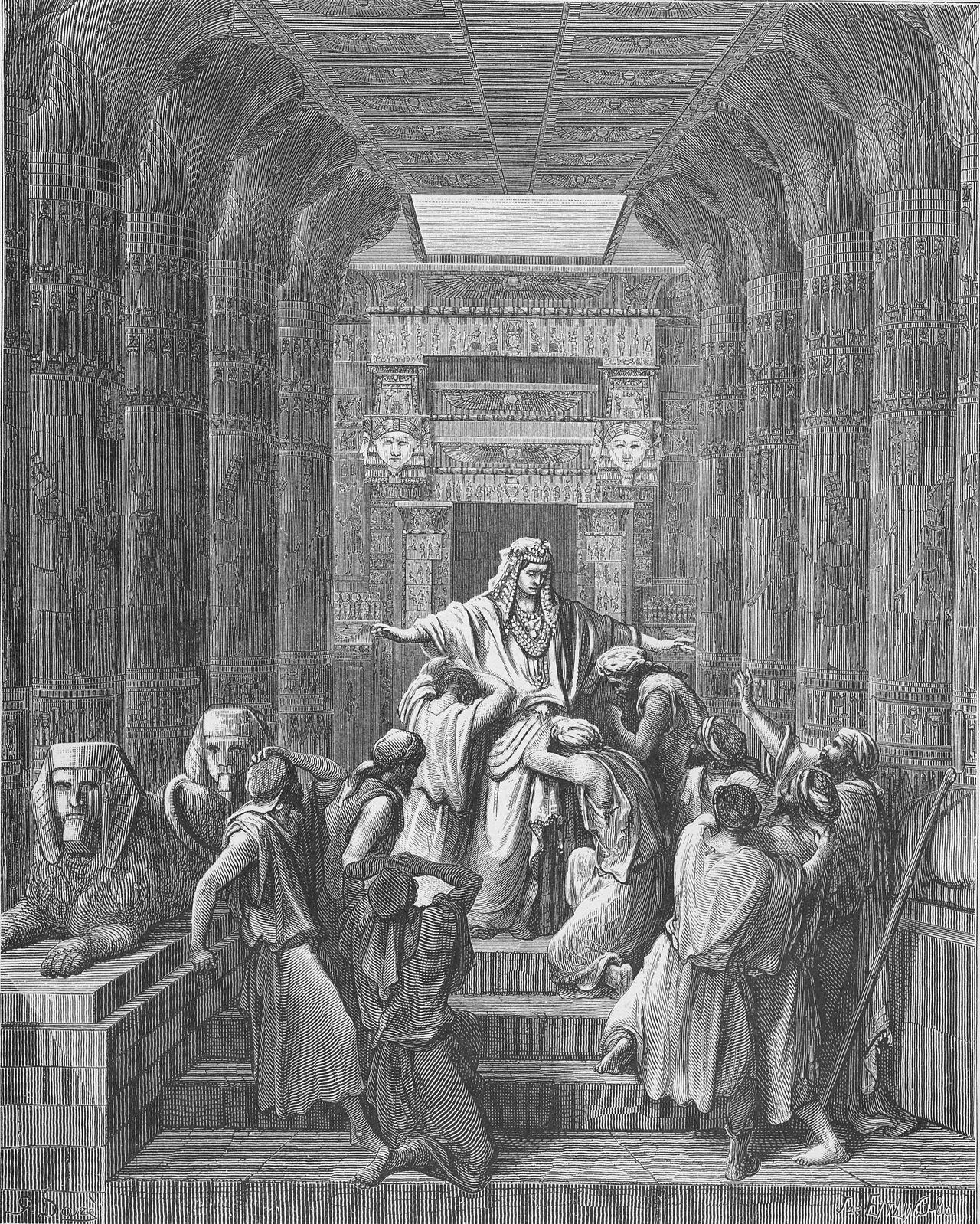
Joseph goes down next, and not by choice. His brothers sell him for twenty shekels of silver to traders who take him to Egypt, where Potiphar, an officer of Pharaoh, buys him. Years later Pharaoh places him over the whole land, gives him the Egyptian name Zaphenath-paneah and a wife, Asenath, the daughter of a priest of On. When the famine comes, the man who was sold into Egypt is the man every nation comes to for grain.
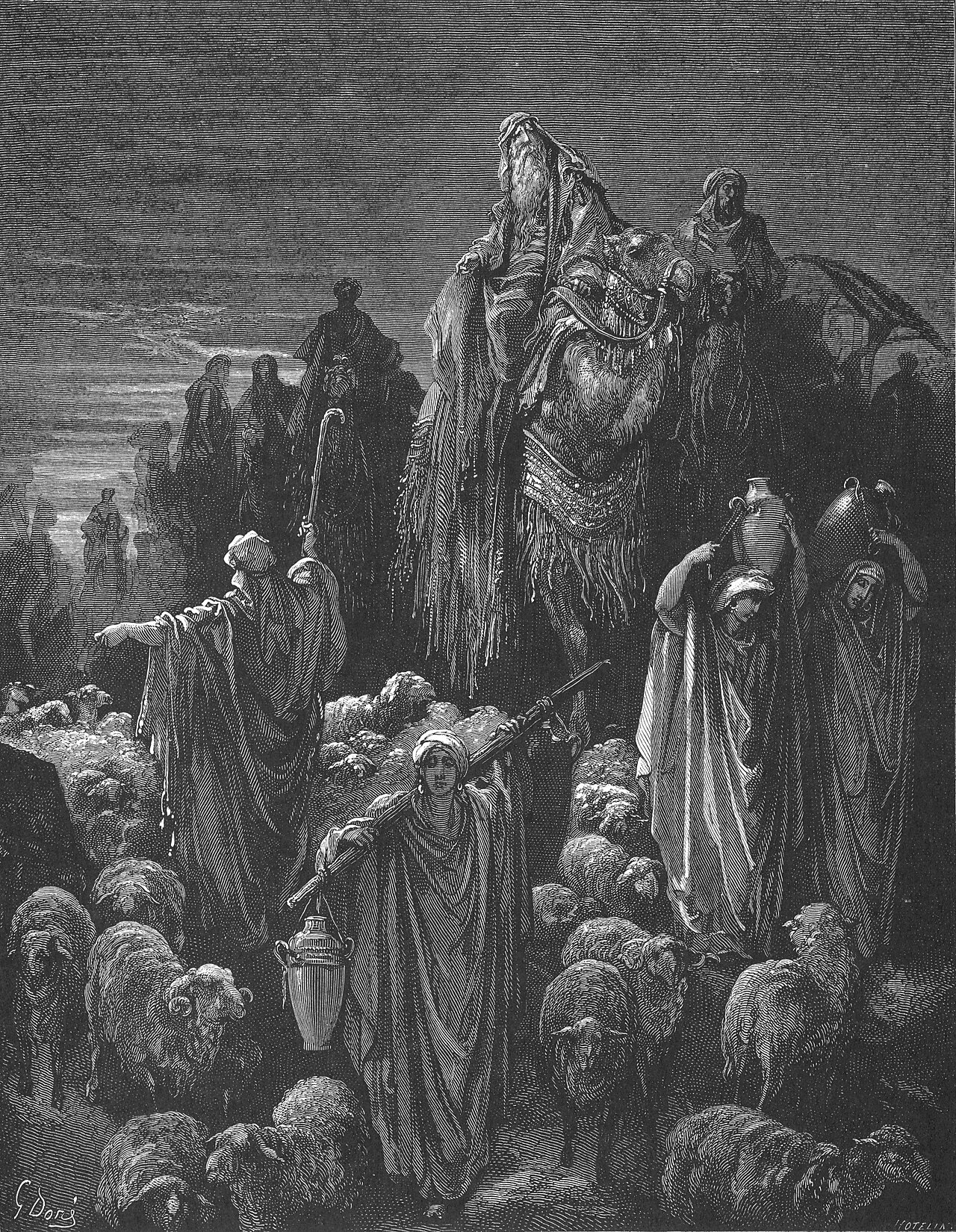
Then the household follows. God tells Jacob plainly not to be afraid to go down, because He will make a nation of him there. Joseph settles his father and brothers in the best part of the land, the district of Rameses, and the Israelites acquire property in Goshen and increase greatly. Joseph dies in Egypt, and makes the sons of Israel swear to carry his bones up when God brings them out.
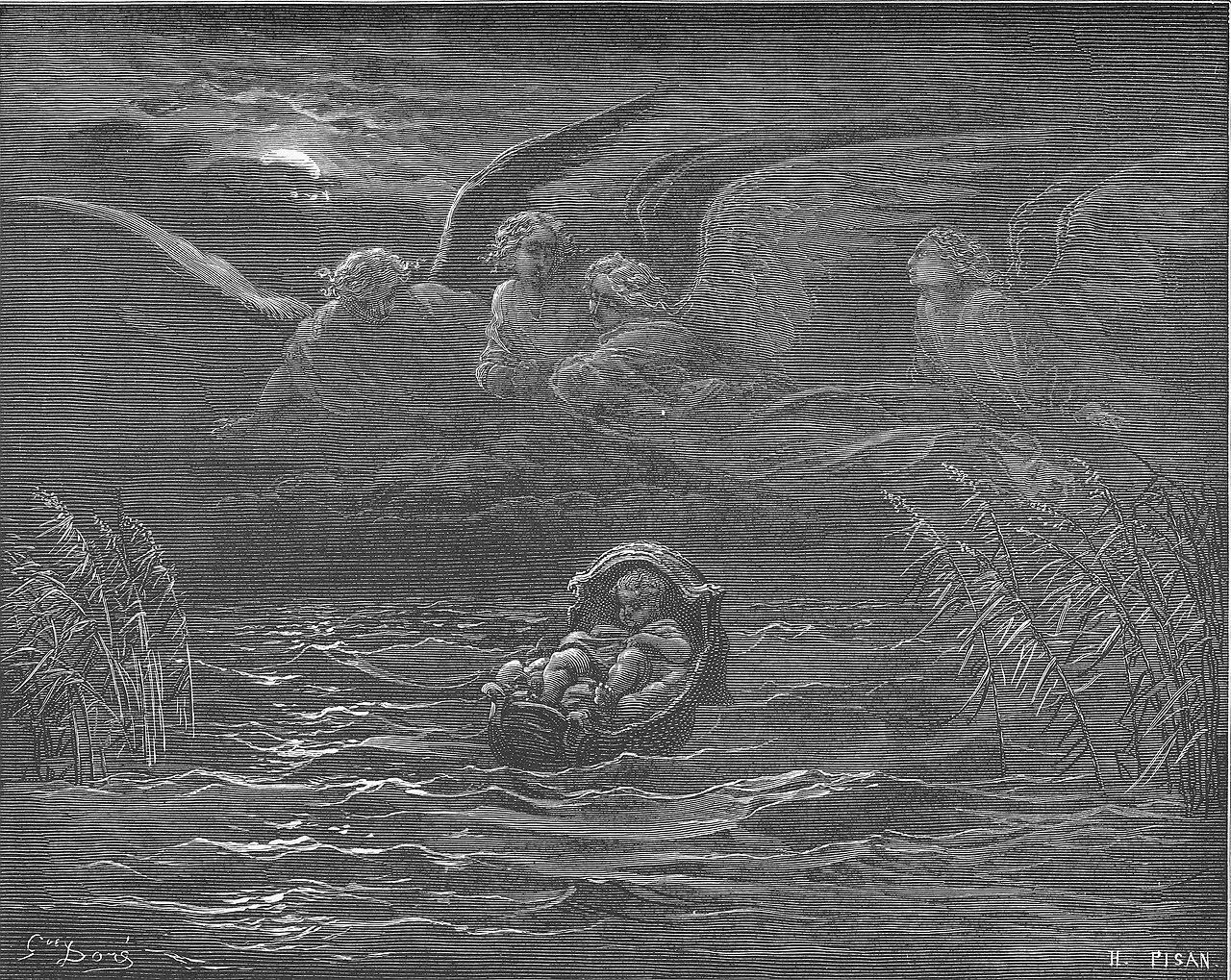
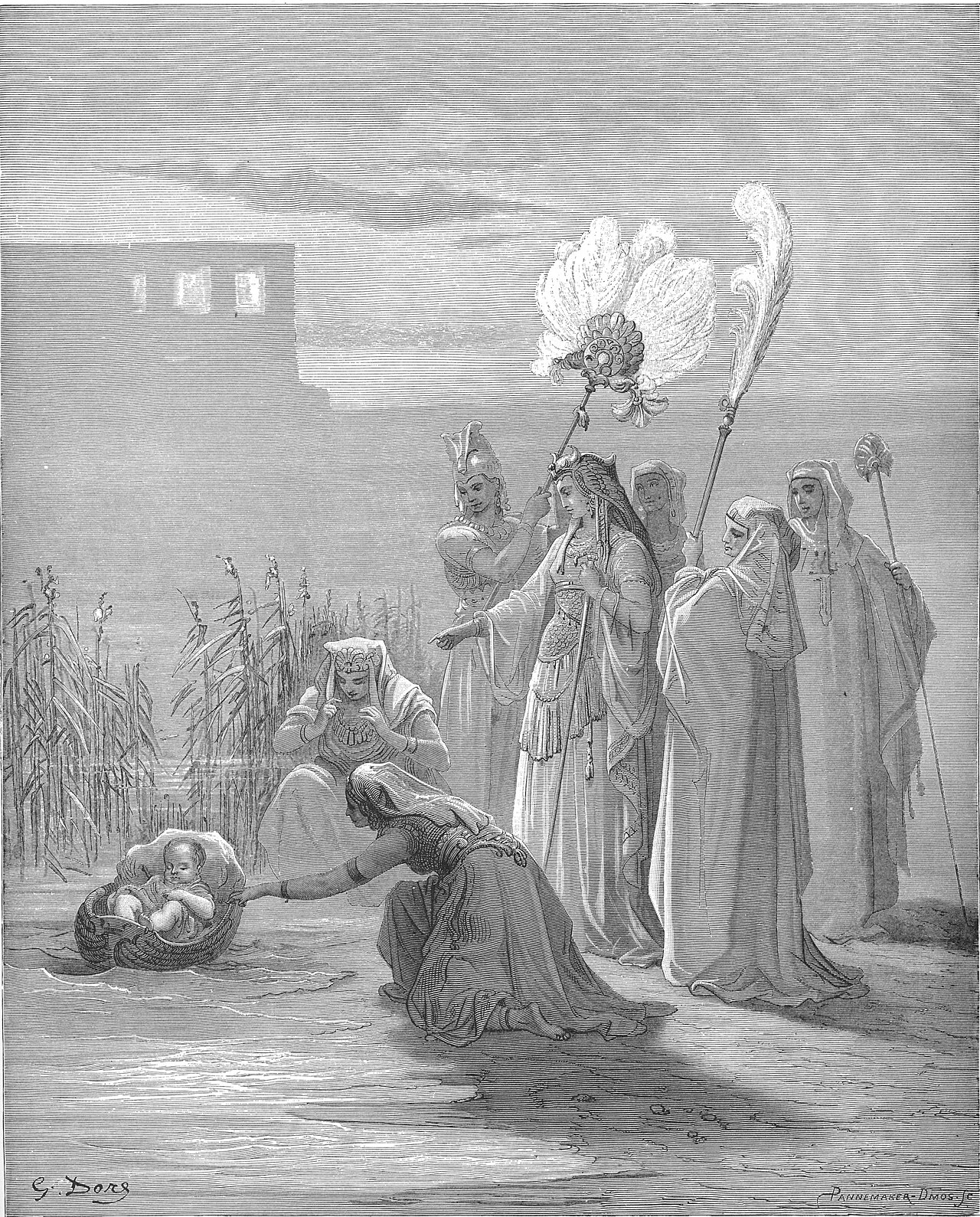
A new king comes to power who does not know Joseph, and the arithmetic that had been Israel's blessing becomes Egypt's fear. Taskmasters are set over them, they build the store cities Pithom and Rameses in brick and mortar, and Pharaoh orders every Hebrew son thrown into the Nile. One mother hides her son in a papyrus basket among the reeds, Pharaoh's own daughter draws him out and names him Moses, and Acts says he was educated in all the wisdom of the Egyptians. He kills an Egyptian, flees to Midian, and stays there until the king dies and the cry of the slaves reaches God.
What follows is the confrontation told above: the demand, the ten blows on the gods of Egypt, and the night of the Passover. Exodus 12:41 says that at the end of 430 years, to the very day, all the LORD's divisions went out of the land of Egypt. They left with silver, gold and clothing given to them by their neighbours, and a mixed multitude went up with them.
Afterward the law keeps pointing back. Egypt is named in the first line of the Ten Commandments as the house of slavery. Israel is told not to oppress a foreign resident, because they were foreigners in Egypt themselves. And they are told not to despise an Egyptian, because they lived as foreigners in his land. The king of Israel is forbidden to send the people back to Egypt to buy horses.
The monarchy dealt with Egypt anyway. Solomon married a daughter of Pharaoh. Jeroboam fled to Shishak king of Egypt and waited there for Solomon to die. In the fifth year of Rehoboam, Shishak came up and attacked Jerusalem and carried off the treasures of the house of the LORD, including the gold shields Solomon had made. Later, Hoshea of Israel sent envoys to King So of Egypt and lost his throne for it, and Pharaoh Neco killed Josiah at Megiddo on his way to the Euphrates.
Common questions
Did the Israelites build the pyramids?
No. The pyramids at Giza belong to the Old Kingdom, roughly a thousand years before the earliest date anyone proposes for Israel in Egypt. Exodus names both the work and the material: the store cities Pithom and Rameses, built in brick and mortar.
Albert Barnes points out that a small temple at Thebes carries a painted record of the whole brickmaking process, which is exactly the work the text describes.
When did the Exodus happen?
Readers differ; the positions are named
Two dates are held by serious people. The early date, about 1446 BC, follows 1 Kings 6:1, which puts the fourth year of Solomon 480 years after the Exodus, and is supported independently by Jephthah's 300 years at Judges 11:26; it is held by Bryant Wood, Eugene Merrill and Douglas Petrovich, and makes Amenhotep II the pharaoh of the Exodus.
The late date, around 1260 to 1250 BC, follows the name Rameses at Exodus 1:11 and the building of Pi-Ramesse by Ramesses II; it is held by Kenneth Kitchen and James Hoffmeier, and reads the 480 years as twelve generations of forty. The Merneptah Stele of about 1208 BC sets the outer limit either way, because Israel is a people in Canaan by then. The evidence for each is set out further up this page.
Is there any archaeological evidence for Israel in Egypt?
There is a great deal of evidence for Semites in Egypt, and it lines up with what the text describes. Tell el-Dab'a in the eastern Delta, excavated by Manfred Bietak since 1966, is a Canaanite settlement that became the Hyksos capital. The Brooklyn Papyrus of about 1740 BC lists an Egyptian estate's servants, of whom more than 40 carry Northwest Semitic names, one of them Shiphrah, the name of a Hebrew midwife at Exodus 1:15.
What no excavation has produced is an object or an inscription naming Israel inside Egypt. This page says that plainly rather than claiming more than the finds carry.
Was Egypt Israel's enemy or Israel's refuge?
Both, at different times, and Scripture never flattens it. Abram goes down there in a famine, Joseph is raised to run the country, and Jacob's household is settled in the best of the land. Then a king who did not know Joseph turns the household into forced labour.
At the end of the story Egypt shelters the child Jesus from Herod. Jamieson, Fausset and Brown put the whole reversal in one line: Egypt was a house of refuge before it was a house of bondage.
Why ten plagues instead of one?
Exodus says what the plagues are aimed at: "I will execute judgment against all the gods of Egypt." Numbers 33:4 repeats it. Each blow lands on something Egypt worshipped or trusted, from the Nile itself to the sun to the person of Pharaoh's own son.
God also tells Pharaoh why the confrontation is drawn out rather than settled at once: that He might display His power and that His name might be proclaimed in all the earth. From the fourth plague onward Goshen is spared, and the text says the separation is itself the sign.
How long was Israel actually in Egypt?
Readers differ; the positions are named
Exodus 12:40 says the stay was 430 years, and Genesis 15:13 says 400. Paul counts 430 years from the promise made to Abraham to the giving of the law, which fits the Greek Septuagint and the Samaritan Pentateuch, both of which read Exodus 12:40 as the sojourn in Canaan and in Egypt together. John Gill records that reading and notes that both Talmuds took it the same way, as did Abraham ibn Ezra, the twelfth-century Spanish Jewish commentator. The two Talmuds are the Bavli, compiled in Babylonia, and the Yerushalmi, compiled in the land of Israel. On that count the years actually spent in Egypt are about 215, which is the position David Down and John Ashton hold.
Others read the Hebrew of Exodus 12:40 as it stands and put all 430 years inside Egypt, which is the plain sense of the Masoretic text and fits the four generations named at Exodus 6:16 to 6:20 only with difficulty. This page names both readings and settles neither.
Does anything in Egyptian records mention the plagues?
Readers differ; the positions are named
One text is regularly offered: the Ipuwer Papyrus, a Nineteenth Dynasty copy of an Egyptian lament that speaks of a river turned to blood, a land without light, and wailing everywhere. David Rohl and others read it as an Egyptian memory of the plagues.
Most Egyptologists read it as a literary lament in a known genre and date its composition to the Middle Kingdom or the Second Intermediate Period, centuries before the thirteenth-century date for the Exodus. It never mentions Israel. Egypt also recorded its victories rather than its defeats, so the absence of a royal record of the Exodus is what the sources would look like either way.
Why does Isaiah say God will bless Egypt?
Readers differ; the positions are named
Isaiah 19 opens as a burden against Egypt and closes with an altar to the LORD in the middle of the land, a savior sent to Egypt, and the LORD calling Egypt "My people," Assyria "My handiwork" and Israel "My inheritance."
Christians have read the promise two ways. Eusebius, writing around AD 339, held that it had already been fulfilled in the churches and altars standing in Egypt in his own day. Charles Spurgeon held that every such attempt fails and that the promise waits for a future day when the knowledge of the LORD covers the earth. The verse itself keeps Israel named as God's inheritance inside the blessing.
Why did Jeremiah end up in Egypt when he had preached against going?
He was taken. Jeremiah told the remnant of Judah plainly that the LORD had said not to go to Egypt, and Johanan and the commanders carried the whole remnant down anyway, Jeremiah and Baruch with them, as far as Tahpanhes.
His last recorded oracles are addressed to Jews living at Migdol, Tahpanhes, Memphis and in Pathros. The Elephantine papyri of the fifth century BC show a Jewish community still living in Pathros a century and a half later.
Notable art
10 verified pieces depicting Egypt
Sources cited
- Gustave Doré, La Sainte Bible (Tours: Alfred Mame et fils, 1866)The eleven engravings on this page. Public domain.
- Manfred Bietak, Avaris: The Capital of the Hyksos. Recent Excavations at Tell el-Dab'a (London: British Museum Press, 1996)The Austrian excavation of Tell el-Dab'a, cited for the Canaanite settlement in the eastern Delta.
- William C. Hayes, A Papyrus of the Late Middle Kingdom in the Brooklyn Museum, Papyrus Brooklyn 35.1446 (Brooklyn Museum, 1955)The publication of the servant list with more than forty Northwest Semitic names.
- W. M. Flinders Petrie, Six Temples at Thebes, 1896 (London: Bernard Quaritch, 1897)The discovery and first publication of the Merneptah Stele. Egyptian Museum, Cairo, JE 31408.
- Kenneth A. Kitchen, The Third Intermediate Period in Egypt, 1100 to 650 BC (Warminster: Aris and Phillips, 1973; 2nd ed. 1986)The standard treatment of Shoshenq I and the Karnak campaign list.
- Kenneth A. Kitchen, On the Reliability of the Old Testament (Grand Rapids: Eerdmans, 2003)The late-date position on the Exodus, cited for the position it argues.
- James K. Hoffmeier, Israel in Egypt: The Evidence for the Authenticity of the Exodus Tradition (Oxford University Press, 1996)The Egyptian material in Exodus read against the Late Bronze Age record.
- James K. Hoffmeier, Ancient Israel in Sinai (Oxford University Press, 2005)The companion volume on the wilderness geography.
- Bryant G. Wood and Associates for Biblical ResearchThe early-date position. Associates for Biblical Research is a confessional body, and this page names it as one.
- Eugene H. Merrill, Kingdom of Priests: A History of Old Testament Israel (Grand Rapids: Baker, 1987)The early-date position, cited for the position it argues.
- Israel Finkelstein and Neil Asher Silberman, The Bible Unearthed (New York: Free Press, 2001)The minimalist position, named and answered on the evidence rather than dismissed.
- Edwin R. Thiele, The Mysterious Numbers of the Hebrew Kings, 3rd ed. (1983)The regnal chronology behind the 967 BC and 925 BC figures on this page.
- Alan H. Gardiner, The Admonitions of an Egyptian Sage from a Hieratic Papyrus in Leiden, Pap. Leiden 344 recto (Leipzig: J. C. Hinrichs, 1909)The edition of the Ipuwer text.
- John Van Seters, "A Date for the 'Admonitions' in the Second Intermediate Period", Journal of Egyptian Archaeology 50 (1964)The literary and Second Intermediate Period dating of Ipuwer.
- David Rohl, A Test of Time: The Bible from Myth to History (London: Century, 1995)The Ipuwer parallel and the Tell el-Dab'a proposal about Joseph, cited for the positions they argue.
- A. E. Cowley, Aramaic Papyri of the Fifth Century B.C. (Oxford: Clarendon Press, 1923)The Elephantine documents. Public domain.
- Emil G. Kraeling, The Brooklyn Museum Aramaic Papyri (New Haven: Yale University Press, 1953)The second Elephantine archive, from the Brooklyn Museum collection.
- Ricardo A. Caminos, Late-Egyptian Miscellanies (London: Oxford University Press, 1954)The translation of Papyrus Anastasi VI and the Shasu admitted at Tjeku.
- Charles H. Spurgeon, The Metropolitan Tabernacle Pulpit, sermons 1675, 2503 and 3515, and The New Park Street Pulpit, sermon 305Public domain, CCEL edition, lightly modernized text.
- Jamieson, Fausset & Brown, Commentary Critical and Explanatory on the Whole Bible (1871)Public domain.
- Matthew Henry, Commentary on the Whole Bible (1710)Public domain.
- Adam Clarke, Commentary on the Bible (1832)Public domain.
- Albert Barnes, Notes, Explanatory and Practical, on the Old and New Testaments (1832 to 1869)Public domain. Cited on the taskmasters and the brickmaking record at Thebes.
- John Gill, Exposition of the Old Testament (1748 to 1763)Public domain. Cited for the ancient textual evidence behind the 430 years.
- John Wesley, Explanatory Notes upon the Old Testament (1765)Public domain. Cited on Hosea 11:1, presented as a reading of the text.
- Eusebius of Caesarea, Proof of the Gospel (Demonstratio Evangelica) 8:5, c. AD 339Public domain, W. J. Ferrar translation. The earliest dated Christian reading of Isaiah 19 on this page.
- Victorinus of Pettau, Commentary on the Apocalypse of the Blessed John, c. AD 304Public domain. The earliest surviving commentary on Revelation, cited on the name Egypt at Revelation 11:8.
- John F. Ashton, ed., with David Down, Unwrapping the Pharaohs (Green Forest: Master Books, 2006)In copyright. Cited only as a named holder of the shorter reading of the 430 years.
Keep studying
On this page
Studies18
- The plagues and the Passover, outlined
- Exodus: the Study Guide
- Hosea, the Study Guide
- Joel, the Study Guide
- Jude: the Study Guide
- Moses in the Bulrushes: Exodus 2
- The Burning Bush: the Name Revealed
- The Flight to Egypt: Matthew 2
- The Red Sea Crossing: Exodus 14-15
- Egypt
- Joseph, Genesis 37-50
- The Tabernacle
- The Fulfillment Formula (Matthew's Ten Quotations)
- Type-Scenes: the Stories Scripture Tells Twice
- Fire
- The Sevens of Scripture
- Archaeology and the Bible (the Evidence Ledger)
- The Altar
Doorway2
Keep this page