
Exodus 18:13 to 26 · Passage · Stress and Weariness
You Cannot Handle It Alone
Exodus 18:13 to 26 stands between the battle with Amalek in Exodus 17 and Israel's arrival at Sinai in Exodus 19.
The Hebrew verb for the people standing around Moses all day is the verb Jethro uses when he promises that Moses himself will be able to stand.
If you follow this advice and God so directs you, then you will be able to endure, and all these people can go home in peace.”
- The passage
- Exodus 18:13 to 26, Deuteronomy 1:9 to 18, Acts 6:1 to 4
- Books
- Exodus, Deuteronomy, Acts
- Hold in memory
- Exodus 18:18
Summary
Moses was settling every dispute in Israel by himself. His father-in-law Jethro saw what it cost Moses and the people, and he gave counsel that spread the work among trustworthy men. Moses listened and set the plan in place. The passage shows a faithful servant of God carrying a load too heavy for one person, and God's provision for it coming through the help of others.
- Jethro judged the arrangement not good, because the work was too heavy for Moses and would wear out both him and the people (Exodus 18:17 to 18).
- Moses kept the work only he could do, standing before God for the people and teaching them God's ways, while appointed men settled the minor cases (Exodus 18:19 to 22).
- Jethro made his counsel depend on God's direction and promised that Moses would then be able to endure (Exodus 18:23).
- Deuteronomy 1:9 to 18 tells the same appointment in Moses' own words, with the people choosing the men.
The Day Moses Judged Alone
Jethro came to the camp with Moses' wife and sons.
You Cannot Handle It Alone studies Exodus 18:13 to 26, the day Jethro watched Moses hear the cases of all Israel. It is one of the texts of the trial of stress and weariness, the weight of work and care that wears a person down.
The question it answers is what Jethro saw, what he counselled and how Moses' load could be shared without Moses leaving his post. It gives the Hebrew of Jethro's warning, the counsel laid beside its verses, the second telling of the appointment in Deuteronomy, and two questions readers have argued over. The first is whether the chapter keeps the sequence of what happened, and the second is whether Moses' load was a fault.
Jethro, the priest of Midian, had heard all that God had done for Israel (Exodus 18:1). He met Moses in the desert at the mountain of God, offered sacrifices to God, and ate bread with Aaron and the elders of Israel (Exodus 18:5 to 12).
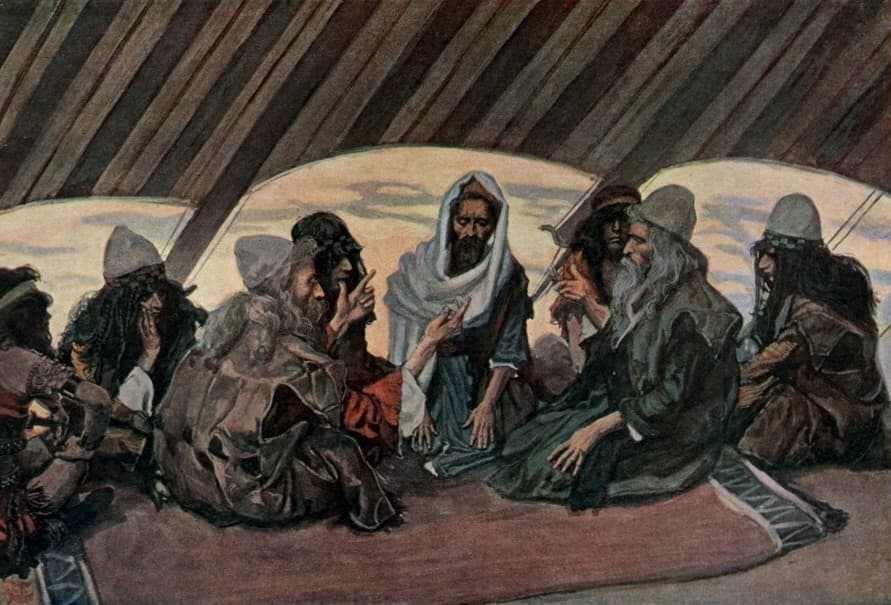
When his father-in-law saw all that Moses was doing for the people, he asked, “What is this that you are doing for the people? Why do you sit alone as judge, with all the people standing around you from morning till evening?” “Because the people come to me to inquire of God,” Moses replied. “Whenever they have a dispute, it is brought to me to judge between one man and another, and I make known to them the statutes and laws of God.”Jethro's question and Moses' answer show why every case came to one man, since the people came to him to learn the mind of God.
Jethro's Counsel
The plan set judges over the people in four ranks and left the hard cases with Moses.
Jethro answered a whole people waiting on one man by giving the minor cases to tested men.
| Step | Verse | The Berean words | What it does |
|---|---|---|---|
| The problem | Exodus 18:13 | Moses took his seat to judge the people, and they stood around him from morning until evening. | One man heard every case while the whole people waited. |
| The verdict | Exodus 18:18 | the task is too heavy for you. You cannot handle it alone. | Jethro names the cost to Moses and to the people with him. |
| Moses' own part | Exodus 18:19 to 20 | You must be the people's representative before God and bring their causes to Him. Teach them the statutes and laws | Moses goes on as the people's go-between with God and as their teacher. |
| The judges | Exodus 18:21 | God-fearing, trustworthy men who are averse to dishonest gain | The men are chosen for their character before they are given rank. |
| The division of cases | Exodus 18:22 | they can bring you any major issue, but all minor cases they can judge on their own | The load is shared, and Moses hears only the hard cases. |
Jethro's warning opens with one Hebrew verb said twice, nabol tibbol, glossed "certainly to wear out" and "you will wear yourself out". Strong's dictionary counts 25 uses of the verb nabel.
In Exodus 18:22 Jethro names what the sharing does with two verbs, qalal, to lighten, and nasa, to bear. The judges lighten Moses' load by carrying it with him.
Every judge Moses appointed decided cases under God, since, as Moses later charged them, "judgment belongs to God" (Deuteronomy 1:17).
Moses Listened
Deuteronomy and Acts tell of the same choice of helpers.
Moses chose capable men from all Israel and set them over the people, and from then on the difficult cases came to him while the judges settled the minor ones (Exodus 18:25 to 26). Jethro then went back to his own land (Exodus 18:27).
But how can I bear your troubles, burdens, and disputes all by myself?Moses' own question in Deuteronomy shows that he felt the weight Jethro had named and gave it as his reason for sharing the work.
In Deuteronomy Moses tells the people to choose "wise, understanding, and respected men from each of your tribes", and they answer, "What you propose to do is good" (Deuteronomy 1:13 to 14). He tells it as part of the account of how Israel left Horeb, where the LORD said, "You have stayed at this mountain long enough" (Deuteronomy 1:6).
The apostles met the same need in Jerusalem when the widows of the Grecian Jews were overlooked in the daily distribution of food (Acts 6:1). They had the disciples select seven men so that they themselves could give their time "to prayer and to the ministry of the word" (Acts 6:3 to 4).
The same weight returned in Numbers 11, where the LORD answered Moses with seventy elders of Israel.
How the Church Has Read Exodus 18
Two preachers fourteen centuries apart read the chapter for its lesson on taking advice.
died 407 · John Chrysostom
HOMILIES ON 1 CORINTHIANS 1.4
The quotation1 quotation
“For nothing was ever more humble than he; who, being leader of so great a people, and having overwhelmed in the sea the king and the host of all the Egyptians, as if they had been flies; and having wrought so many wonders both in Egypt and by the Red Sea and in the wilderness, and received such high testimony, yet felt exactly as if he had been an ordinary person, and as a son-in-law was humbler than his father-in-law, and took advice from him, and was not indignant, nor did he say, ‘What is this? After such and so great achievements, art thou come to us with thy counsel?’ This is what most people feel; though a man bring the best advice, despising it, because of the lowliness of the person. But not so did he: rather through lowliness of mind he wrought all things well.”
John Chrysostom · Homilies on 1 Corinthians 1.4 · on Exodus 18:24Patristic
1703 to 1791 · John Wesley
Explanatory Notes upon the Old Testament
The quotation1 quotation
“Those are not so wise as they would be thought to be, who think themselves too wise to be counselled; for a wise man will hear, and will increase learning, and not slight good counsel, though given by an inferior.”
John Wesley · Explanatory Notes upon the Old Testament · on Exodus 18:24Evangelical
Numbers 12:3 calls Moses a very humble man, more so than any man on the face of the earth.
Where Readers Differ
Readers have argued over where the chapter belongs in time and over the cause of Moses' burden, and each reading stands with its holder and the strongest objection to it.
Exodus 18 is told before Sinai but belongs after the law was givenAdam Clarke
Adam Clarke, in his Commentary on the Bible (1832), wrote that Moses' words about the statutes "leave little room for doubt that the law had been given". He held that "the transaction mentioned here stands out of its due chronological order". Jethro finds Moses already "encamped at the mountain of God" (Exodus 18:5), while Israel reaches the Wilderness of Sinai only in Exodus 19:1. Deuteronomy 1:6 to 15 places the appointment at Horeb.
The objection: Exodus 17:6 already places the rock "at Horeb" while Israel camped at Rephidim, so a camp at the mountain of God can come before Exodus 19.
Exodus 18 stands in the order of eventsAlbert Barnes
Albert Barnes, in his Notes, Explanatory and Practical (1832 to 1869), read the chapter where it stands. He judged it "at least probable that numerous cases of difficulty arose out of the division of the spoil of the Amalekites" after the battle of Exodus 17:13.
The objection: Moses already says he makes known "the statutes and laws of God" (Exodus 18:16), which Clarke took as proof that the law had been given.
Moses' labour was misdirectedGregory the Great
Gregory the Great, in The Book of Pastoral Rule (Part 2, Chapter 7), wrote that Moses "is judged by the reproof of Jethro" because "with ill-advised labour he devotes himself to the people's earthly affairs". Gregory drew from the counsel that Moses should be "more free to learn spiritual secrets for the instruction of the people".
The objection: the people came to Moses "to inquire of God" (Exodus 18:15), so the cases he heard were questions put to God.
The load wanted order, and the counsel supplied itMatthew Henry
Matthew Henry drew a lesson from Jethro's counsel in his Commentary on the Whole Bible (1710). He wrote that wisdom directs us "that we may neither content ourselves with less than our duty nor over-task ourselves with that which is beyond our strength".
The objection: Jethro's verdict begins "What you are doing is not good" (Exodus 18:17), a judgment on Moses' own practice.
A Load Carried Together
Jethro's counsel holds for anyone whose work has grown past one person's strength.
Work given by God can still exceed what one person can bear, and Exodus 18 counts asking for help as wisdom.
For a reader worn down by work and care, the passage commends sharing the load with trustworthy people and seeking God's direction in prayer. A doctor's care for body and mind belongs beside that prayer.
Sources
Scripture is the Berean Standard Bible.
- STEP Bible, the tagged Hebrew Bible (Tyndale House, Cambridge), CC BY 4.0.
- STEP Bible brief lexicon of Extended Strongs for Hebrew (Tyndale House, Cambridge), CC BY 4.0, with the Strong's glosses.
- John Chrysostom, Homilies on the First Epistle to the Corinthians, Homily 1 (Nicene and Post-Nicene Fathers, first series, volume 12, ed. Philip Schaff)
- John Wesley, Explanatory Notes upon the Old Testament (1765), on Exodus 18:24.
- Gregory the Great, The Book of Pastoral Rule, Part 2, Chapter 7 (Nicene and Post-Nicene Fathers, second series, volume 12)
- Adam Clarke, Commentary on the Bible (1832), on Exodus 18:16.
- Albert Barnes, Notes, Explanatory and Practical, on the Old and New Testaments (1832 to 1869), on Exodus 18:13.
- Matthew Henry, Commentary on the Whole Bible (1710), on Exodus 18:14 to 17.
Keep Studying
People and groups7
Places1
Doctrines1