
Genesis · Group · Featured Study
The Cherubim
Readers from the fathers to the nineteenth century divide over the cherubim's faces and over the cherub of Tyre.
The LORD told Moses He would meet with him above the mercy seat, between two cherubim of gold.
- Began
- First named at the east of Eden (Genesis 3:24)
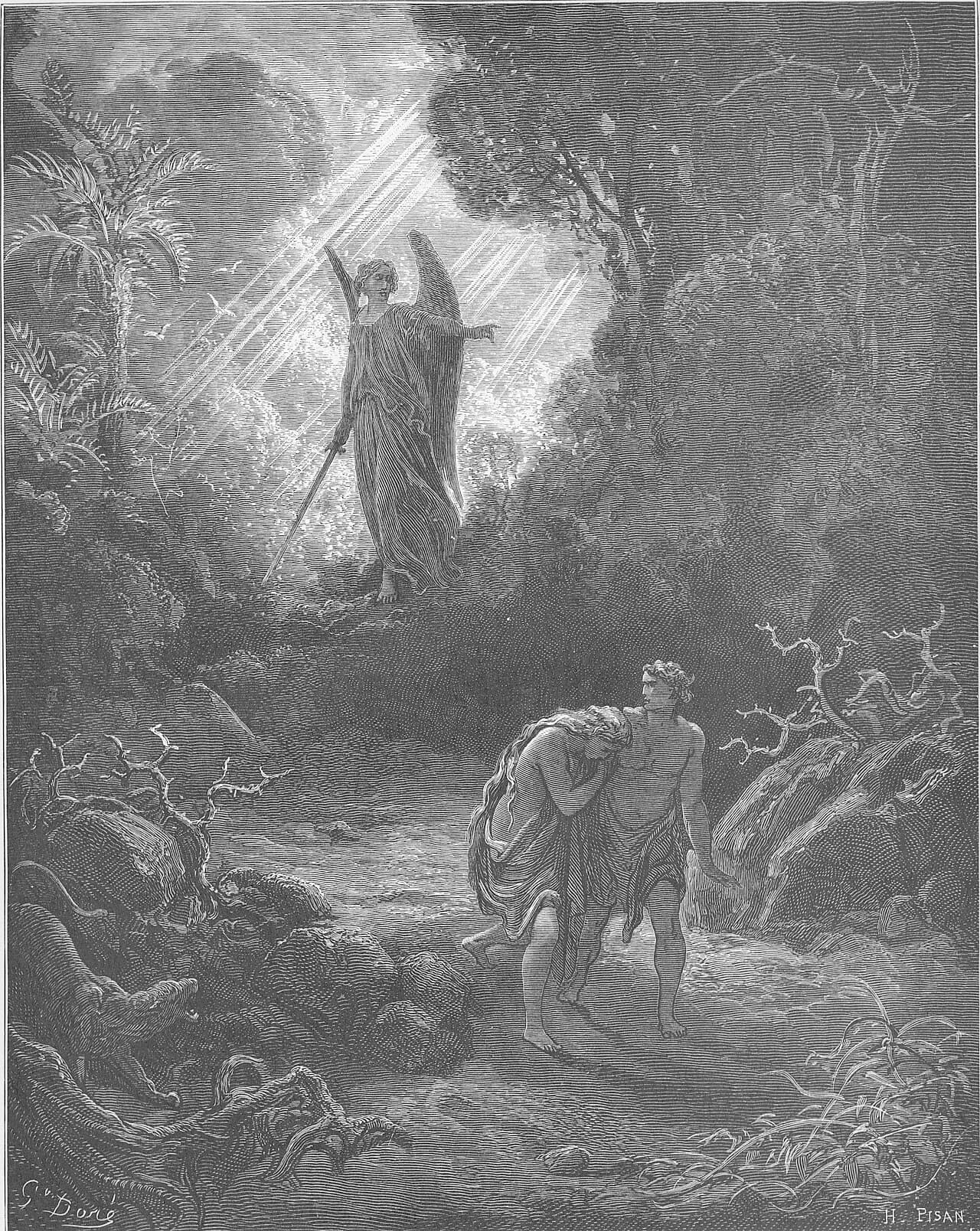
Gustave Doré, Adam and Eve Driven out of Eden, 1866, from Doré's English Bible. Public domain.
THE ARTWORKDoré drew the guard of Genesis 3:24 as one winged figure holding a sword and pointing Adam and Eve out of the garden. The verse itself names cherubim, more than one, and a whirling sword of flame.
Summary
The cherubim are heavenly beings that Scripture sets beside the presence of God, at the ark, in the temple and at His throne.
- Their first work in Scripture is to guard the way to the tree of life.
- Solomon set two cherubim of olive wood overlaid with gold in the inner room of the temple.
- The four living creatures of Revelation 4 have the faces of Ezekiel's creatures and the six wings of Isaiah's seraphim.
- Ezekiel saw four living creatures with four faces and four wings, and in his second vision he knew they were cherubim.
The Cherubim East of Eden
The cherubim appear at the close of the account of the fall
Then the LORD God said, “Behold, the man has become like one of Us, knowing good and evil. And now, lest he reach out his hand and take also from the tree of life, and eat, and live forever...”The LORD God's own words give the reason for the guard that follows.
So He drove out the man and stationed cherubim on the east side of the Garden of Eden, along with a whirling sword of flame to guard the way to the tree of life.The guard follows the banishment of verse 23 and answers the danger the LORD names in verse 22.
The Hebrew word kerub
The Hebrew word is kerub, and kerubim is its plural, so the English cherubim keeps the Hebrew plural ending. Adam Clarke notes in his Commentary on the Bible that kerub never occurs as a verb.
Where Scripture Sets the Cherubim
Six places where the cherubim are made, carried, seen or named, from Sinai to Patmos
- Proposed: one candidate among several
- Located: the gazetteer fixes one site
- Placed: the point stands for an area, or is rounded
about 500 km (311 miles)
- 1Mount Sinai, Moses receives the pattern of the ark Exodus 25:18 to 22
- 2Shiloh, The ark is brought out to battle 1 Samuel 4:4
- 3Jerusalem, Solomon builds the inner sanctuary 1 Kings 6:23 to 28
- 4Babylonia, Ezekiel's first vision, by the River Kebar Ezekiel 1:1 to 14
- 5Tyre, The lament for the city's king Ezekiel 28:14 to 16
- 6Patmos, John's vision of the throne in heaven Revelation 4:6 to 8
The coastline is simplified; each place stands at its place page's coordinates.
The key names what happens at each place, with the verse, from Patmos in the west to Babylonia in the east.
The Cherubim from Exodus to Revelation
Eight texts after Genesis that name the cherubim or the living creatures, in the order of the canon
OF ONE PIECE WITH THE ARK'S COVER
They were hammered from the same piece of gold as the mercy seat, with wings spread upward and faces turned toward it. Bezalel made them as Moses was told.
CHERUBIM WORKED INTO THE CURTAINS AND THE VEIL
The ten linen curtains of the tabernacle and its veil of blue, purple and scarlet yarn had cherubim worked into them.
TWO GREAT CHERUBIM IN SOLOMON'S SANCTUARY
Each was ten cubits high. Their wings reached from wall to wall and touched in the middle of the room.
THE LORD RIDING ON A CHERUB
David's psalm pictures the LORD coming down to him mounted on a cherub and soaring on the wings of the wind.
THE LIVING CREATURES EZEKIEL KNEW AS CHERUBIM
In his second vision the creatures bear the glory of the LORD away from the temple, as far as its east gate.
THE GUARDIAN CHERUB OF TYRE
Ezekiel's lament for the king of Tyre calls him an anointed guardian cherub on the holy mountain of God.
THE CHERUBIM OF GLORY
Hebrews names them among the furnishings of the Most Holy Place, overshadowing the mercy seat above the ark.
FOUR LIVING CREATURES AROUND THE THRONE
John sees four living creatures like a lion, a calf, a man and an eagle in flight, each with six wings and covered with eyes. John Wesley, in his Explanatory Notes upon the New Testament, reads them as the same order as Ezekiel's cherubim.
What the Texts Give of Their Form
Four details of the cherubim's form in Ezekiel, each with the verse that gives it
FOUR FACES
Each of Ezekiel's creatures had the face of a man, of a lion on the right, of an ox on the left and of an eagle.
A CHERUB'S FACE, AND NO OX
In the second vision the faces are those of a cherub, a man, a lion and an eagle.
FOUR WINGS, WITH HANDS BENEATH
Each cherub had four wings and what looked like human hands under them.
FEET LIKE A CALF'S HOOVES
Their legs were straight, and the soles of their feet gleamed like polished bronze.
Winged Figures in Assyria
Commentators of the nineteenth century compared the cherubim with Assyrian carvings
Jamieson, Fausset and Brown set Ezekiel's vision beside the carvings of the land where he saw it.
“The cherubim and their wings and wheels stood in contrast to the symbolical figures, somewhat similar, then existing in Chaldea, and found in the remains of Assyria. The latter, though derived from the original revelation by tradition, came by corruption to symbolize the astronomical zodiac, or the sun and celestial sphere, by a circle with wings or irradiations.”
Jamieson, Fausset & Brown · Commentary Critical and Explanatory on the Whole Bible · on Ezekiel 1:15Reformed
Barnes on Solomon's temple, and the pattern in Exodus
Albert Barnes, in his Notes on 1 Kings 6:29, made the comparison for Solomon's temple. He judged that its carved palms, cherubs and flowers resemble Assyrian ornament too closely to be an accident.
Exodus names one source for the design of the tabernacle and its furnishings.
See to it that you make everything according to the pattern shown you on the mountain.The ark's cherubim come under this charge, which ties every furnishing to what Moses saw on the mountain.
What Scripture Leaves Unsaid
What the texts leave open about the cherubim
Genesis gives no number for the cherubim east of Eden and does not describe them.
No verse of the Berean text that names a cherub calls it an angel, and Scripture gives no cherub a name.
Neither Ezekiel nor John says what the four faces mean. Hebrews says the cherubim of glory cannot be discussed in detail now.
The Throne Between the Cherubim
The cherubim mark the place of the LORD's throne in Israel's worship
Scripture names the LORD as the One enthroned between the cherubim when Israel brings the ark from Shiloh to battle and when Hezekiah prays, and two psalms call on Him by that seat.
Hear us, O Shepherd of Israel, who leads Joseph like a flock; You who sit enthroned between the cherubim, shine forthA prayer for rescue rests on the title, so the throne it names is one the people may call on for help.
The LORD reigns; let the nations tremble! He is enthroned above the cherubim; let the earth quake!Here the title stands for a rule that reaches every people beyond Israel's sanctuary.
Henry and Wesley on the throne and the ark
Matthew Henry finds comfort for prayer in that throne.
“He dwells between the cherubim, where he is ready to receive petitions and to give directions. The mercy-seat was between the cherubim; and it is very comfortable in prayer to look up to God as sitting on a throne of grace, and that it is so to us is owning to the great propitiation, for the mercy-seat was the propitiatory.”
Matthew Henry · Commentary on the Whole Bible · on Psalm 80:1 to 2Puritan
John Wesley, in his Explanatory Notes upon the Old Testament, judged that the cherubim of the temple stood for the holy angels who serve the God of Israel. They were set there to show His greatness and were never to be worshipped. Matthew Henry reads Israel's use of the ark in the battle of 1 Samuel 4 as worship gone astray.
“And yet indeed they did but make an idol of the ark, and looked upon it to be as much an image of the God of Israel as those idols which the heathen worshipped were of their gods. To worship the true God, and not to worship him as God, is in effect not to worship him at all.”
Matthew Henry · Commentary on the Whole Bible · on 1 Samuel 4:4Puritan
Three Voices on the Cherubim
Eusebius of Caesarea, Athanasius and Bede
Eusebius of Caesarea reads the cherub of Psalm 18 as the one Christ rode when He returned to heaven.
“Secretly and with mysterious reckoning he represents his incarnation through [images of] darkness and thick clouds. At last he returns to the same place from whence he had set forth: and he ascends into the heavens with the cherubim and flies, although he had not descended with those cherubim, without the cherubim he himself bowed the heavens and descended. On his return it is said, ‘And he mounted on cherubs, and he flew,’ with the body he had assumed.”
Eusebius of Caesarea · Commentary on Psalms 18:11-13 · on Psalm 18:10Patristic
Athanasius uses the cherubim to show that even the creatures nearest to God do not see Him.
“For what is nearer [God] than the Cherubim or the Seraphim? And yet they, not even seeing Him, nor standing on their feet, nor even with bare, but as it were with veiled faces, offer their praises, with untiring lips doing nought else but glorify the divine and ineffable nature with the Trisagion.”
Athanasius of Alexandria · On Luke 10:22 · on Revelation 4:8Patristic
Bede finds a reason in the number of Solomon's cherubim.
“Two cherubim were made in order to signify a sharing in the same love of which we speak, because love cannot exist between fewer than two. Moreover, the reason why the Savior took care to send the disciples in twos to preach was that he …”
Bede · Of the Temple of Solomon 1.13.3 · on 1 Kings 6:25Patristic
The Cherub's Face and the Cherub of Tyre
Three readings of the cherubim's faces, and two of the guardian cherub of Ezekiel 28
The cherub's face was an ox's faceAdam Clarke
Adam Clarke, in his Commentary on the Bible, reads the two lists of Ezekiel 1:10 and 10:14 as one face named in two ways, so that a cherub had the head of an ox. He holds the common view that a cherub had one body and four heads.
The objection: Exodus names no animal in the faces of the ark's cherubim, and Rashi, in his commentary on Exodus 25:18, gives them the form of a child's face.
The ox's face was changedRashi; Matthew Henry
Rashi, in his commentary on Ezekiel 10:14, says the face of the ox was changed into the face of a cherub. Matthew Henry gives a reason for the change.
“And this first appearing in the proper figure of a cherub, and yet it being proper to retain the number of four, that of the ox is left out and dropped, because the face of the cherub had been most abused by the worship of an ox.”
Matthew Henry · Commentary on the Whole Bible · on Ezekiel 10:20Puritan
The objection: Ezekiel compares the two visions himself.
Their faces looked like the faces I had seen by the River Kebar. Each creature went straight ahead.The prophet's own comparison treats the two visions as one sight seen twice.
The faces as figuresJohn Wesley; Jamieson, Fausset and Brown
John Wesley, in his Explanatory Notes upon the Old Testament, reads each face as the best of its kind, so that the four together join wisdom, strength, patient labour and speed. Jamieson, Fausset and Brown report the fathers' reading of the faces and add one of their own.
“The Fathers identified them with the four Gospels: Matthew the lion, Mark the ox, Luke the man, John the eagle. Two cherubim only stood over the ark in the temple; two more are now added, to imply that, while the law is retained as the basis, a new form is needed to be added to impart new life to it.”
Jamieson, Fausset & Brown · Commentary Critical and Explanatory on the Whole Bible · on Ezekiel 1:10Reformed
The objection: the readings disagree, since the fathers find the four Gospels where Wesley finds four virtues.
The words as spoken of the kingAdam Clarke; Rashi; Aphrahat
“Son of man, take up a lament for the king of Tyre and tell him that this is what the Lord GOD says: ‘You were the seal of perfection, full of wisdom and perfect in beauty.The opening of the lament fixes its addressee before any word of Eden or a cherub.
Adam Clarke, in his Commentary on the Bible, reads the passage as irony, likening the proud king to the cherub that guarded Paradise or to the cherubim over the mercy seat. Rashi's note on Ezekiel 28:14 reads the cherub as a great bird whose wings cover a wide area, a figure of the king's wide rule.
Aphrahat takes the anointing as the anointing of a king.
“For the king who was anointed with the holy oil was called a cherub. And he was overshadowing all his people.… They were sitting in the shadow of the king, while he was standing at their head. And when the crown of their head fell, they were without shade. And if anyone should say that this word is spoken concerning Christ, let him accept what I write for him without dispute, and he will be persuaded that it was said with reference to the king.”
Aphrahat the Persian Sage · DEMONSTRATIONS 5:9 · on Ezekiel 28:14Patristic
The objection: the lament gives its subject more than a king could bear, a place in Eden and a blameless beginning.
The devil behind the throne of TyreAmbrose of Milan; Origen of Alexandria
Ambrose of Milan, in On Paradise, reads the prince of Tyre as the devil, whom he also sees in the serpent.
You were in Eden, the garden of God. Every kind of precious stone adorned you: ruby, topaz, and diamond, beryl, onyx, and jasper, sapphire, turquoise, and emerald. Your mountings and settings were crafted in gold, prepared on the day of your creation.The verse sets the one addressed in the garden, which is what this reading turns on.
Origen draws from the passage a lesson on the will of a created being.
“He had in himself the power of admitting either good or evil. Falling away from good, he turned with his whole mind to evil. There are other created beings who, while possessing the power to choose either, by the exercise of free will flee from evil and cleave to the good.”
Origen of Alexandria · On First Principles 1:8.3 · on Ezekiel 28:13Patristic
The objection: the LORD addresses the king of Tyre throughout.
By the vastness of your trade, you were filled with violence, and you sinned. So I drove you in disgrace from the mountain of God, and I banished you, O guardian cherub, from among the fiery stones.The sin charged here belongs to commerce, which fits the king of a trading city.
Books to Read Next
Three works on the cherubim, from the eighth century to the nineteenth
Of the Temple of Solomon
Bede · eighth century
Bede reads Solomon's temple part by part, its two cherubim, its floor and its doors among them.
Commentary on the Whole Bible
Matthew Henry · 1710
Henry comments on the cherubim of the ark, of Solomon's sanctuary, of Ezekiel's visions and of Hebrews 9.
Commentary on the Bible
Adam Clarke · 1810 to 1826
Clarke's notes on Exodus 25 and Ezekiel 10 gather the readings of the cherubim's form known in his day, and he says none of them satisfied him.
The Way to the Tree of Life
The last chapter of the Bible returns to the tree the cherubim guarded.
Blessed are those who wash their robes, so that they may have the right to the tree of life and may enter the city by its gates.Genesis 3:24 closed the way to that tree, and here it stands open to the cleansed.
Hebrews 10 opens the room the cherubim of glory stood in.
Therefore, brothers, since we have confidence to enter the Most Holy Place by the blood of Jesus, by the new and living way opened for us through the curtain of His body,The text asks the reader to come in where only the high priest went, once a year.
Keep studying
Read it4
Places9
Doctrines8