
Exodus 6:6 · The LORD Who Redeems
Redemption
Exodus calls the LORD the redeemer of Israel, and the New Testament names the blood of Christ as the price of His people's redemption.
Before the plagues began, the LORD told Moses that He would redeem Israel with an outstretched arm.
- First taught
- Exodus 6:6
- Fullest statement
- Exodus 13:13 to 15
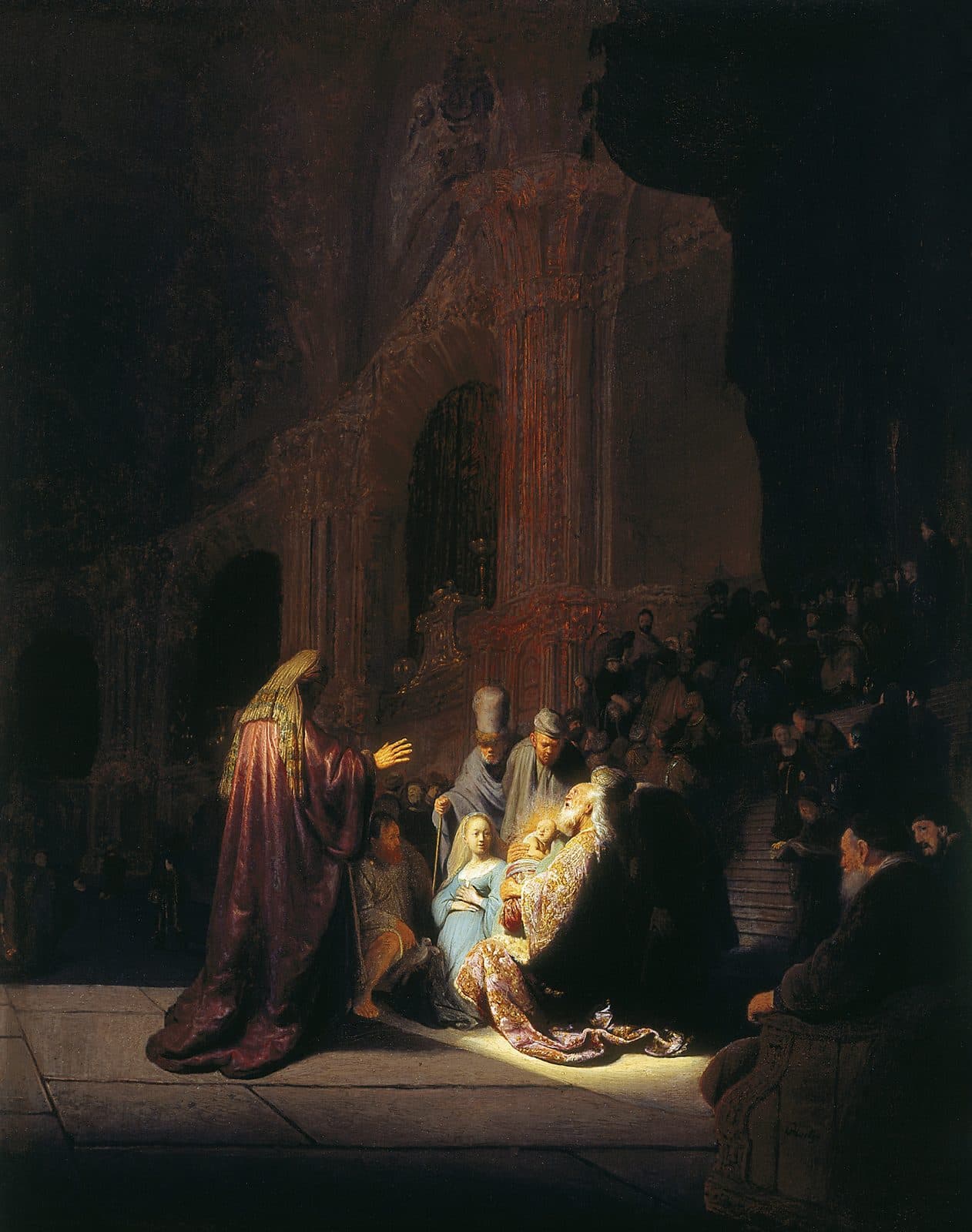
Rembrandt van Rijn, Simeon's Song of Praise, 1631, oil on panel, Mauritshuis, The Hague, inventory 145. Public domain, via Wikimedia Commons.
THE ARTWORKRembrandt painted the day Mary and Joseph brought Jesus to the temple to present Him to the Lord, as the law of the firstborn required. He set the small group in a beam of light at the foot of a temple so tall that its roof is lost in shadow.
Summary
To redeem in Scripture is to set a person or a thing free by paying a price, and Exodus gives Israel the word for its release from Egypt.
- Three Hebrew words carry the teaching, ga'al for the kinsman's redemption, padah for a ransom and kopher for the ransom price.
- Numbers 18:16 sets the price of a firstborn son at five shekels of silver.
- A kinsman could buy back the land a poor brother had sold, and the brother himself, with the price counted to the Year of Jubilee.
- Jesus said He came to give His life as a ransom for many, and the apostles write of redemption through His blood.
I Will Redeem You
Exodus 6, 13 and 15 give the first promise of redemption, its law and its song.
Therefore tell the Israelites: ‘I am the LORD, and I will bring you out from under the yoke of the Egyptians and deliver you from their bondage. I will redeem you with an outstretched arm and with mighty acts of judgment. I will take you as My own people, and I will be your God. Then you will know that I am the LORD your God, who brought you out from under the yoke of the Egyptians.The LORD sets redeem beside bring out and deliver, so the release from Egypt is called a redemption, and its end is a people taken as His own.
The verb of verse 6 is ga'al, the kinsman's verb of Leviticus 25 and Ruth 4.
You must redeem every firstborn donkey with a lamb, and if you do not redeem it, you are to break its neck. And every firstborn of your sons you must redeem.The law applies the redemption from Egypt to the firstborn of every household, of its animals and of its sons.
In the future, when your son asks you, ‘What does this mean?’ you are to tell him, ‘With a mighty hand the LORD brought us out of Egypt, out of the house of slavery. And when Pharaoh stubbornly refused to let us go, the LORD killed every firstborn in the land of Egypt, both of man and beast. This is why I sacrifice to the LORD the firstborn male of every womb, but I redeem all the firstborn of my sons.’The father is told to answer his son's question by naming the night the firstborn of Egypt died.
With loving devotion You will lead the people You have redeemed; with Your strength You will guide them to Your holy dwelling.The Song of the Sea uses the word of Exodus 6:6, so the deliverance at the sea is counted as the promised redemption.
Redemption in Hebrew and Greek
The Hebrew words name the kinsman's act, the ransom and its price, and the Greek words carry them into the New Testament.
| Word | Its sense | A verse where it stands |
|---|---|---|
| ga'al (H1350) | to redeem as the nearest kinsman | Exodus 6:6 |
| padah (H6299) | to ransom, to set free by a price | Exodus 13:13 |
| kopher (H3724) | a ransom paid for a life | Exodus 30:12 |
| lutron (G3083) | a ransom | Mark 10:45 |
| apolutrosis (G629) | redemption, release on payment of a price | Romans 3:24 |
| exagorazo (G1805) | to buy out, to redeem | Galatians 3:13 |
| lutroo (G3084) | to ransom | 1 Peter 1:18 |
- Word
- ga'al (H1350)
- Its sense
- to redeem as the nearest kinsman
- A verse where it stands
- Exodus 6:6
- Word
- padah (H6299)
- Its sense
- to ransom, to set free by a price
- A verse where it stands
- Exodus 13:13
- Word
- kopher (H3724)
- Its sense
- a ransom paid for a life
- A verse where it stands
- Exodus 30:12
- Word
- lutron (G3083)
- Its sense
- a ransom
- A verse where it stands
- Mark 10:45
- Its sense
- redemption, release on payment of a price
- A verse where it stands
- Romans 3:24
- Its sense
- to buy out, to redeem
- A verse where it stands
- Galatians 3:13
- Word
- lutroo (G3084)
- Its sense
- to ransom
- A verse where it stands
- 1 Peter 1:18
From Egypt to the Cross
Scripture follows the redemption of Exodus through the law of the kinsman, Ruth, the Psalms, the words of Jesus and the apostles' letters.
1. Exodus 6:4 to 5, the covenant behind the promise1 passage
I also established My covenant with them to give them the land of Canaan, the land where they lived as foreigners. Furthermore, I have heard the groaning of the Israelites, whom the Egyptians are enslaving, and I have remembered My covenant.The promise of verse 6 rests on the covenant with the patriarchs, which these verses say the LORD has remembered.
Rashi, Rabbi Shlomo Yitzchaki of Troyes (1040 to 1105), in his commentary on Exodus, reads the word therefore at the head of verse 6 as following from the oath of that covenant.
Albert Barnes, in his Notes on Exodus, suggests that the outstretched arm struck Moses and the people the more because they knew the Egyptian hieroglyph that shows might by two outstretched arms.
2. Exodus 13:2 and Luke 2:22 to 24, the firstborn2 passages
“Consecrate to Me every firstborn male. The firstborn from every womb among the Israelites belongs to Me, both of man and beast.”The law of redemption rests on this claim, that every firstborn of Israel belongs to the LORD.
Albert Barnes notes that the donkey of Exodus 13:13 could not be offered in sacrifice because it was an unclean animal, and that Numbers 18:15 extends the law to every unclean beast.
Rashi gives two reasons why the donkey alone is named. The firstborn of the Egyptians are likened to donkeys in Ezekiel 23:20, and the donkeys carried the silver and gold of Egypt out with Israel.
And when the time of purification according to the Law of Moses was complete, His parents brought Him to Jerusalem to present Him to the Lord (as it is written in the Law of the Lord: “Every firstborn male shall be consecrated to the Lord”), and to offer the sacrifice specified in the Law of the Lord: “A pair of turtledoves or two young pigeons.”Mary and Joseph kept this law for Jesus, and Luke quotes the law of Exodus 13 as they do it.
3. Exodus 15:16 to 17, the land ahead1 passage
and terror and dread will fall on them. By the power of Your arm they will be as still as a stone until Your people pass by, O LORD, until the people You have bought pass by. You will bring them in and plant them on the mountain of Your inheritance—the place, O LORD, You have prepared for Your dwelling, the sanctuary, O Lord, Your hands have established.The song names the land and the sanctuary before Israel had reached either.
Adam Clarke, in his Commentary on the Bible, reads verses 13 to 18 as a prediction of what God would do for the people He had redeemed. He would render several of their verbs in the future tense.
4. Leviticus 25, Ruth 4 and Psalm 49, the kinsman redeemer3 passages
If your brother becomes impoverished and sells some of his property, his nearest of kin may come and redeem what his brother has sold.This verse gives the right of redemption to the nearest of kin, the office Boaz takes up in Ruth 4.
I thought I should inform you that you may buy it back in the presence of those seated here and in the presence of the elders of my people. If you want to redeem it, do so. But if you will not redeem it, tell me so I may know, because there is no one but you to redeem it, and I am next after you.” “I will redeem it,” he replied. Then Boaz said, “On the day you buy the land from Naomi and also from Ruth the Moabitess, you must also acquire the widow of the deceased in order to raise up the name of the deceased on his inheritance.” The kinsman-redeemer replied, “I cannot redeem it myself, or I would jeopardize my own inheritance. Take my right of redemption, because I cannot redeem it.”The nearer kinsman agrees to redeem Elimelech's field and then gives up his right when the field brings a widow with it, which leaves the right to Boaz.
No man can possibly redeem his brother or pay his ransom to God. For the redemption of his soul is costly, and never can payment suffice,The psalm sets the limit of every kinsman's power, which the redemption of a soul exceeds.
5. Mark 10:45 and Romans 3:24 to 25, the ransom and the redemption2 passages
For even the Son of Man did not come to be served, but to serve, and to give His life as a ransom for many.”Jesus names His own death as the ransom, and He gives it as the reason He came.
and are justified freely by His grace through the redemption that is in Christ Jesus. God presented Him as the atoning sacrifice through faith in His blood, in order to demonstrate His righteousness, because in His forbearance He had passed over the sins committed beforehand.Paul grounds justification in the redemption that is in Christ Jesus and names His blood as the atoning sacrifice.
Adam Clarke explains apolutrosis in verse 24 as a word made from apo, from, and lutroo, I redeem, which properly means the price laid down for the redemption of a captive.
6. Galatians 3:13, Ephesians 1:7 and 1 Peter 1:18 to 19, the price named3 passages
Christ redeemed us from the curse of the law by becoming a curse for us. For it is written: “Cursed is everyone who is hung on a tree.” He redeemed us in order that the blessing promised to Abraham would come to the Gentiles in Christ Jesus, so that by faith we might receive the promise of the Spirit.Paul states what Christ redeemed His people from and the blessing that follows for the Gentiles.
Albert Barnes notes that Paul's verb here, exagorazo, more often means a purchase of any kind, and that Paul uses it in the proper sense of redeem.
In Him we have redemption through His blood, the forgiveness of our trespasses, according to the riches of His gracePaul makes redemption and the forgiveness of trespasses one gift, given through Christ's blood.
For you know that it was not with perishable things such as silver or gold that you were redeemed from the empty way of life you inherited from your forefathers, but with the precious blood of Christ, a lamb without blemish or spot.Peter sets the blood of Christ against silver and gold, and silver was the metal of the law's redemption money.
Adam Clarke says the verb of verse 18 means to procure life for a captive or liberty for a slave by paying a price.
The Laws of Redemption
The law of Moses names what may be redeemed in Israel and sets the price or the term of each redemption.
The land must not be sold permanently, because it is Mine, and you are but foreigners and residents with Me. Thus for every piece of property you possess, you must provide for the redemption of the land.The LORD owns the land, so no sale of it is final and every sale carries a right of redemption.
| Law | What is redeemed | The price or the term |
|---|---|---|
| Exodus 13:13 | a firstborn donkey | a lamb, or the donkey's neck is broken |
| Exodus 21:29 to 30 | the life of an owner whose ox, known to gore, has killed | the full amount demanded of him |
| Exodus 30:12 to 15 | the life of each man counted in a census | half a shekel, the same for the rich and the poor |
| Leviticus 25:25 to 27 | land a poor man has sold | the balance for the years since the sale |
| Leviticus 25:29 to 30 | a house in a walled city | redeemable for one full year after the sale |
| Leviticus 25:47 to 52 | an Israelite who has sold himself to a foreigner | the years left until the Jubilee, at a hired hand's wages |
| Numbers 3:46 to 51 | the 273 firstborn of Israel beyond the number of the Levites | five shekels each, 1,365 shekels in all |
| Numbers 18:15 to 16 | every firstborn son, at a month old | five shekels of silver by the sanctuary shekel |
- Law
- Exodus 13:13
- What is redeemed
- a firstborn donkey
- The price or the term
- a lamb, or the donkey's neck is broken
- What is redeemed
- the life of an owner whose ox, known to gore, has killed
- The price or the term
- the full amount demanded of him
- What is redeemed
- the life of each man counted in a census
- The price or the term
- half a shekel, the same for the rich and the poor
- What is redeemed
- land a poor man has sold
- The price or the term
- the balance for the years since the sale
- What is redeemed
- a house in a walled city
- The price or the term
- redeemable for one full year after the sale
- What is redeemed
- an Israelite who has sold himself to a foreigner
- The price or the term
- the years left until the Jubilee, at a hired hand's wages
- What is redeemed
- the 273 firstborn of Israel beyond the number of the Levites
- The price or the term
- five shekels each, 1,365 shekels in all
- What is redeemed
- every firstborn son, at a month old
- The price or the term
- five shekels of silver by the sanctuary shekel
What the Text Leaves Unsaid
Scripture leaves three questions about redemption open.
The New Testament says what the price of redemption was, and it never says to whom the price is paid.
Luke 2:22 to 24 records the offering of two birds at the temple, and it does not record a price paid for Jesus as a firstborn son.
Ruth 4:9 records that Boaz bought all that belonged to Elimelech, and it names no price.
The Redeemer Who Pays
Titus, Hebrews and Revelation set the redemption Christ won beside the words of Exodus and Leviticus.
He gave Himself for us to redeem us from all lawlessness and to purify for Himself a people for His own possession, zealous for good deeds.Paul gives the church the purpose of Exodus 6:7, a people taken as the Redeemer's own.
He did not enter by the blood of goats and calves, but He entered the Most Holy Place once for all by His own blood, thus securing eternal redemption.Hebrews places the redemption in the work of the high priest, whose yearly entry Leviticus 16 sets out.
And they sang a new song: “Worthy are You to take the scroll and open its seals, because You were slain, and by Your blood You purchased for God those from every tribe and tongue and people and nation.Revelation sings of redemption to the Lamb, as Exodus 15 sang of the people the LORD redeemed.
Voices on Redemption
Matthew Henry, Ambrose of Milan and Origen comment on the firstborn, the kinsman and the redemption in Christ Jesus.
Matthew Henry applies the father's answer of Exodus 13:14 to the Christian reader.
“Mercies to our fathers are mercies to us; we reap the benefit of them, and therefore must keep up a grateful remembrance of them. We stand upon the bottom of former deliverances, and were in the loins of our ancestors when they were delivered. Much more reason have we to say that in the death and resurrection of Jesus Christ we were redeemed.”
Matthew Henry · Commentary on the Whole Bible · on Exodus 13:14 to 16Puritan
Ambrose of Milan explains the law by which Ruth, a widow from Moab, passed to her husband's next of kin.
“For, by the law, when a man died, the marriage bond with his wife was passed on to his brother or other male next of kin, in order that the seed of the brother or next of kin might renew the life of the house. And so it was that Ruth, though she was foreign-born, had possessed a husband of the Jewish people who had left a kinsman of near relation.”
Ambrose of Milan · Exposition of the Christian Faith 3.69-70 · on Ruth 4:5Patristic
Origen of Alexandria sets out whom the redemption in Christ Jesus justifies, and then asks what it means.
“Therefore the righteousness of God, coming through faith in Jesus Christ to all who believe, whether they be Jews or Greeks, justifies them once cleansed of their former crimes, and makes them capable of the glory of God: and this he does not from their merits, nor for their works, but freely bestows glory upon those who believe. ‘Through the redemption,’ he says, ‘which is in Christ Jesus.’ Let us consider more attentively what is meant by the redemption which is in Christ Jesus.”
Origen of Alexandria · Commentary on the Epistle to the Romans · on Romans 3:24Patristic
What the Price Secures
Readers divide over to whom the price of redemption is paid, and over whether the exodus is a pattern of the Christian's redemption.
A ransom from the captor
Gregory of Nyssa, in The Great Catechism (about 385), chapters 22 and 23, holds that man bartered away his own freedom. God in His justice therefore paid the master of the slave a ransom rather than take him back by force.
Now since the children have flesh and blood, He too shared in their humanity, so that by His death He might destroy him who holds the power of death, that is, the devil, and free those who all their lives were held in slavery by their fear of death.The verses give the ransom reading a captor from whom the redeemed are set free.
Jerome describes the state of the one who needs redeeming.
“The one who is yet to be redeemed is a captive. He has ceased to be free by coming under the power of the enemy. So we are captives in this world and bound by the yoke of slavery to the principalities and powers, unable to release our hands from our chains. So we raise our eyes upward until the Redeemer arrives.”
Jerome · Commentary on Ephesians 1:7 · on Ephesians 1:7Patristic
Anselm objects, in Why God Became Man (1098), book 1, chapter 7, that the devil and man both belong to God, so the devil holds no right over man that God must buy out.
A satisfaction paid to God
Anselm, in the same work, book 1, chapter 15, holds that God does not suffer His honour to be violated even in the least degree.
Jamieson, Fausset & Brown name the one who received the ransom of 1 Peter 1:18.
“Man is ‘sold under sin’ as a slave; shut up under condemnation and the curse. The ransom was, therefore, paid to the righteously incensed Judge, and was accepted as a vicarious satisfaction for our sin by God, inasmuch as it was His own love as well as righteousness which appointed it.”
Jamieson, Fausset & Brown · Commentary Critical and Explanatory on the Whole Bible · on 1 Peter 1:18Reformed
Matthew Henry answers how a redemption bought at a price can still be free.
“All our spiritual blessings flow down to us in that stream. This great benefit, which comes freely to us, was dearly bought and paid for by our blessed Lord; and yet it is according to the riches of God's grace. Christ's satisfaction and God's rich grace are very consistent in the great affair of man's redemption.”
Matthew Henry · Commentary on the Whole Bible · on Ephesians 1:7Puritan
The ransom reading's holders object that Hebrews 2:14 to 15 has Christ's death destroy the one who holds the power of death, a captor that a payment to God leaves out.
A penalty borne in our place
John Wesley, in his Explanatory Notes upon the New Testament, on Romans 3:25, holds that the propitiation shows God's justice, whose office is to punish sin.
J. I. Packer defines the curse of Galatians 3:13 and says what Christ did with it.
“The curse is the divine condemnation of sin which leads to death. To this curse we lay exposed; but Christ on his cross identified himself with the doom impending on sinners that, through his act, the curse passes away and we go free.”
J.I. Packer · What Did the Cross Achieve? The Logic of Penal Substitution · on Galatians 3:13Reformed Anglican
Anselm's own answer stands against it, since in that chapter he sets satisfaction freely given and punishment as two different ways in which sin is met.
The exodus as a pattern of redemption in Christ
Now these things happened to them as examples and were written down as warnings for us, on whom the fulfillment of the ages has come.Paul's word examples gives the typological reading its ground in the New Testament itself.
Matthew Henry reads the Passover sacrifice of Exodus 12:27 as Christ's own.
“We were obnoxious to the sword of the destroying angel, but Christ our passover was sacrificed for us, his death was our life, and thus he was the Lamb slain from the foundation of the world, from the foundation of the Jewish church: Moses kept the passover by faith in Christ, for Christ was the end of the law for righteousness.”
Matthew Henry · Commentary on the Whole Bible · on Exodus 12:27Puritan
The sages of the Mishnah object, in tractate Pesachim 10:5, that Exodus 13:8 has each father tell his son what the LORD did for him when he came out of Egypt.
The exodus as Israel's own deliverance
The Mishnah, in tractate Pesachim 10:5 (compiled in the land of Israel about 190 to 230), teaches that in every generation a person must see himself as though he had come out of Egypt.
The typological reading answers from 1 Corinthians 10:4, where Paul names Christ as the spiritual rock that accompanied Israel.
Redeemed at a Price
Redemption asks the reader to live as one who has been bought.
The law of the firstborn taught each household of Israel that a redeemed life belongs to the One who redeemed it.
Since you call on a Father who judges each one’s work impartially, conduct yourselves in reverent fear during your stay as foreigners.Peter grounds his call to live in reverent fear on the price that follows in verses 18 and 19.
Keep studying
Read it1
Studies8
Doctrines14
Peoples and groups1