
From the apostles to today · The churches · Featured Study
The Eastern Orthodox Church
A family of self-governing churches of the East, apart from the Church of Rome since the eleventh century.
On 16 July 1054, Philip Schaff writes, the legates of Rome placed a writ of excommunication on the altar of Hagia Sophia with the words “Videat Deus et judicet.”
- Began
- The apostles' churches of the East, as the church holds (proposed)
- Bodies
- Fifteen jurisdictions that govern themselves, as Pew counted them in 2017
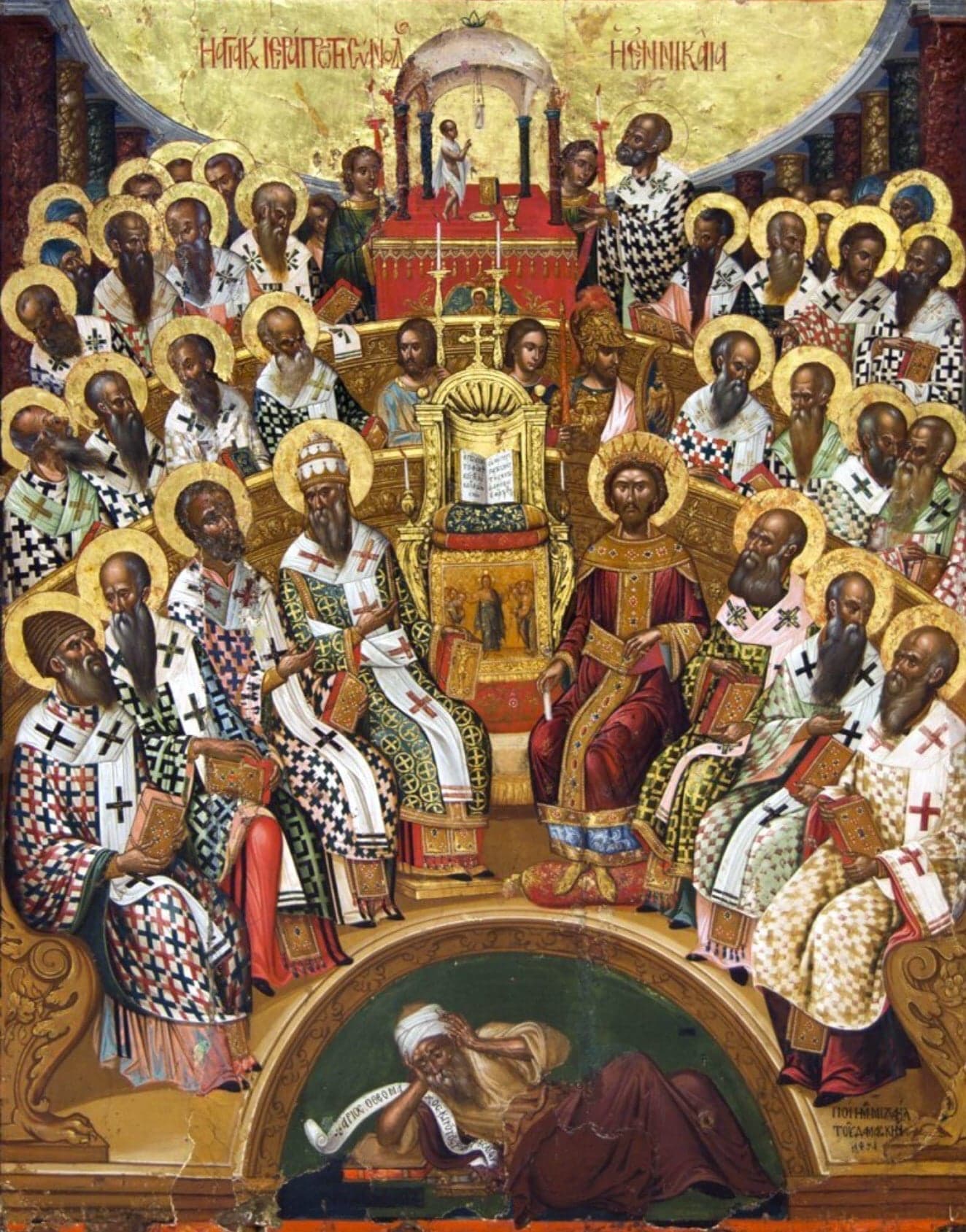
Michael Damaskinos, The First Council of Nicaea, 1591. Public domain.
Through these He has given us His precious and magnificent promises, so that through them you may become partakers of the divine nature, now that you have escaped the corruption in the world caused by evil desires.
Summary
The Eastern Orthodox churches trace their faith to the apostles. They keep the Creed of Constantinople without the words the West later added. They see salvation as union with God.
- Their seventh council set out the honour due to icons.
- They hold that the Spirit comes from the Father, and they add no words to the Creed.
- Rome and Constantinople have lifted their mutual excommunications.
The Texts the Orthodox Read
The texts come from 2 Peter 1, John 15, Ephesians 2 and Exodus 25.
The Longer Catechism of the Orthodox, Catholic, Eastern Church was “Examined and Approved by the Most Holy Governing Synod” and printed at Moscow in 1830. Philip Schaff prints it in R. W. Blackmore's English of 1845.
A share in the divine nature
Through these He has given us His precious and magnificent promises, so that through them you may become partakers of the divine nature, now that you have escaped the corruption in the world caused by evil desires.
Peter's promise stands behind the Orthodox hope of union with God, which Athanasius put in one line.
2 Peter 1:4BSB
The Spirit who proceeds from the Father
When the Advocate comes, whom I will send to you from the Father—the Spirit of truth who proceeds from the Father—He will testify about Me.
The Catechism answers its question 241, on the Spirit's procession, from these words of Christ.
John 15:26BSB
The foundation of the apostles
Therefore you are no longer strangers and foreigners, but fellow citizens with the saints and members of God’s household, built on the foundation of the apostles and prophets, with Christ Jesus Himself as the cornerstone.
The Catechism cites verses 19 and 20 in its answer to question 274.
The cherubim of the tabernacle
And I will meet with you there above the mercy seat, between the two cherubim that are over the ark of the Testimony; I will speak with you about all that I command you regarding the Israelites.
The Catechism's answer 518 recalls the order Moses received to place golden cherubim in the tabernacle.
Exodus 25:22BSB
John 15:26, Ephesians 2:19 to 20, Exodus 25:22
The Orthodox Branch of the Family of Churches
From the church of Jerusalem to the jurisdictions of 2017.
The Eastern churches run from the apostles through the councils, part from Rome in 1054, and stand as fifteen jurisdictions in 2017.
Pentecost
325 to 381
- The Council of Nicaea
- The Council of Constantinople and its Creed
431 to 451
- The Council of Ephesus
- The Council of Chalcedon and its Definition
787
- The Second Council of Nicaea
- The honour given to icons, defined by the council
1054
- The break with Rome
- The Roman Catholic Church, the other side of the break
1965 to 2017
- The sentences lifted
- Fifteen jurisdictions in Pew's count of 2017
The Christian Traditions dates Nicaea and Ephesus, the Catechism of the Catholic Church dates Constantinople, and Schaff dates Chalcedon and 1054. Percival's volume dates the council of 787, the joint declaration dates 1965, and Pew dates its count.
The Christian Traditions sets this branch beside the other families of the churches, each with the date on which it began.
How the Orthodox Churches Trace Their Beginning
The church's own claim, the councils and an outside historian.
At question 274 the Catechism calls the Church Apostolic because she has, it says, “without break or change, both her doctrine and the succession of the gifts of the Holy Ghost.”
This is the church's account of itself, and the succession of bishops is the part of it a historian can trace.
At question 273 the Catechism holds that the faith, “confirmed by the seven oecumenical Councils,” is preserved in the ancient churches of the East. The Catechism of the Catholic Church dates the Creed of the second council to 381 at Constantinople.
Schaff dates the Definition of the Council of Chalcedon to 22 October 451. The churches of Egypt, Ethiopia, Armenia and Syria did not receive it, and they stand apart from the Eastern Orthodox to this day.
Who tells this story, and with what interest1 paragraph
The Catechism speaks for the church that approved it. Philip Schaff, who lived from 1819 to 1893, narrates the councils and the break with Rome as an outsider. Pew Research Center, a survey body, counts the churches.
The Truth They Keep: Union With God
Athanasius on the Word made man, the Spirit's procession and the council on icons.
Athanasius of Alexandria wrote On the Incarnation in or shortly before 318, by the date his translator Robertson calls the one usually adopted. In Robertson's English of 1885 he says of the Word, “For He was made man that we might be made God.”
The Greek word behind “partakers” in 2 Peter 1:4, koinōnós, is glossed “a sharer.”
On the Spirit, the Catechism holds at question 242 that the doctrine of the procession from the Father admits no change or supplement. Its second reason is that the second council set the doctrine out in the Creed, and it adds that “the third oecumenical Council in its seventh canon forbade the composition of any new Creed.”
The Catechism of the Catholic Church answers at paragraph 247 that Pope Leo I “had already confessed it dogmatically in 447.”
The same paragraph grants that “The affirmation of the filioque does not appear in the Creed confessed in 381 at Constantinople.”
The Second Council of Nicaea defined in 787 that holy images receive “due salutation and honourable reverence,” and “not indeed that true worship of faith (latreian) which pertains alone to the divine nature.”
In Percival's English in the Nicene and Post-Nicene Fathers, the council gives its reason: “For the honour which is paid to the image passes on to that which the image represents.”
The Catechism calls icons “books, written with the forms of persons and things instead of letters,” and cites Gregory the Great's letter to Serenus.
The Reformed answer on images1 verse, 1 paragraph
The Heidelberg Catechism of 1563 asks at question 98 whether pictures may be tolerated in churches as books for the laity. Its answer, in Schaff's English, is “No; for we should not be wiser than God, who will not have his people taught by dumb idols, but by the lively preaching of his Word.”
You shall not make for yourself an idol in the form of anything in the heavens above, on the earth below, or in the waters beneath. You shall not bow down to them or worship them; for I, the LORD your God, am a jealous God, visiting the iniquity of the fathers on their children to the third and fourth generations of those who hate Me,Both catechisms read the second commandment here and reach opposite answers on pictures in churches.
The Catechism's Own Words
The Church, its Head, the apostles' tradition and the saints, in Blackmore's English.
At question 252 the Catechism defines the Church as “a divinely instituted community of men, united by the orthodox faith, the law of God, the hierarchy, and the Sacraments.”
At question 253 it names “her one only everlasting Head, the Lord Jesus Christ.”
At question 275 the Creed's word Apostolic teaches the faithful “to hold fast the Apostolical doctrine and tradition, and eschew such doctrine and such teachers as are not warranted by the doctrine of the Apostles.”
Therefore, brothers, stand firm and cling to the traditions we taught you, whether by speech or by letter.Paul's charge to the Thessalonians is the text behind question 275.
The Catechism teaches at question 263 that the faithful “call at the same time to their aid the saints who belong to the Church in heaven.”
At question 264 it grounds the invocation of the saints “On a holy tradition, the principle of which is to be seen also in holy Scripture.”
For there is one God, and there is one mediator between God and men, the man Christ Jesus,It is the teaching of the one mediator, set here beside the practice of question 263.
The Orthodox Churches Today
Pew's estimates of 2017, with the method behind them.
Pew Research Center published its estimates on 8 November 2017, built from censuses and surveys gathered for its 2011 report Global Christianity and from its population projections of 2015.
Pew estimated that in Russia alone the Orthodox population “has surpassed 100 million, a sharp resurgence after the fall of the Soviet Union.”
Pew also reports that “Orthodox Christians in the former Soviet Union generally report the lowest levels of observance among those of their faith, perhaps reflecting the legacy of Soviet repression of religion.”
Pew estimated in 2017, from censuses and surveys, that the Eastern family holds about four in five of the world's Orthodox.
| What Pew counts | Pew's figure |
|---|---|
| Both families together | nearly 260 million |
| The Oriental family's share | roughly 20 percent |
| The Eastern family's share | the remaining 80 percent |
Where the Orthodox Churches Stand
The apostles' fields, the ancient patriarchates and Russia, and Europe today.
Eusebius finished his Church History about 324, and in McGiffert's English of 1890 he reports, “Parthia, according to tradition, was allotted to Thomas as his field of labor, Scythia to Andrew, and Asia to John.”
The Catechism of 1830 names at question 261 the “many separate and independent churches, as those of Jerusalem, Antioch, Alexandria, Constantinople, Russia.”
At question 273 it says the church spread from Judaea “over the whole universe,” and it counts among the churches that keep the faith “the Church of Russia.”
Pew wrote in 2017 that Eastern Orthodoxy is “heavily centered in Central and Eastern Europe.”
The Sentences of 1054 and Their Lifting
The mutual excommunications of 1054 and the declaration that lifted them.
Schaff titles his section 71 “Progress and Completion of the Schism,” since he reads 1054 as one stage of a longer parting. Schaff, a historian of the nineteenth century and the one source cited for the day, says that Patriarch Michael Cerularius “immediately answered by a synodical counter-anathema on the papal legates.”
On 7 December 1965 Pope Paul VI and Patriarch Athenagoras I with his synod declared that they “regret and remove both from memory and from the midst of the Church the sentences of excommunication.”
They “commit these excommunications to oblivion,” and they granted that the gesture “is not sufficient to end both old and more recent differences.”
that all of them may be one, as You, Father, are in Me, and I am in You. May they also be in Us, so that the world may believe that You sent Me.Christ prayed that all His people be one, the prayer both sentences broke and the later declaration answered.
Books to Read Next
The Creeds of Christendom, volume 2
Philip Schaff · 1877
It prints the Longer Catechism whole in Blackmore's English, with the Definition of Chalcedon.
Free at the Christian Classics Ethereal LibraryOn the Incarnation
Athanasius, in Archibald Robertson's English · 1892
Athanasius sets out why the Word became man.
Free at the Christian Classics Ethereal LibraryChurch History
Eusebius, translated by Arthur Cushman McGiffert · 1890
Eusebius preserves the earliest reports of where the apostles preached.
Free at the Christian Classics Ethereal LibraryWhat the Orthodox Churches Hand On
The Orthodox churches hold that the apostles' teaching can be kept whole through bishops in succession and the councils, and their catechism is their witness to that claim. Their story also shows that the sentences of a schism can be withdrawn while the questions behind them stay open.
The line through this page
The verse whose work this page shows continuing, then 1 link to other pages, in order of date.
The verse whose work this page shows continuing.
In or shortly before 318, approximate
The Fathers & the Creeds to The Eastern Orthodox Church
In Robertson's English of 1885 he says of the Word, “For He was made man that we might be made God.”
This page
The Eastern Orthodox Church
Sources
Scripture is the Berean Standard Bible.
- The Holy Bible, Berean Standard Bible (read 2026)
- The Longer Catechism of the Orthodox, Catholic, Eastern Church (Moscow, 1830), translated by R. W. Blackmore (Aberdeen, 1845), questions 241, 242, 252, 253, 261, 263, 264, 273, 274, 275 and 518 to 521, in Philip Schaff, The Creeds of Christendom, volume 2, sixth edition.
- Athanasius, On the Incarnation 54.3 (in or shortly before 318), translated by Archibald Robertson (1885), in the Nicene and Post-Nicene Fathers, second series, volume 4 (New York, 1892)
- The Second Council of Nicaea (AD 787), the Definition, in Henry R. Percival's edition, the Nicene and Post-Nicene Fathers, second series, volume 14.
- The Heidelberg Catechism (1563), questions 97 and 98, in Philip Schaff, The Creeds of Christendom, volume 3.
- The Definition of the Council of Chalcedon (22 October AD 451), in Philip Schaff, The Creeds of Christendom, volume 2.
- Catechism of the Catholic Church, paragraphs 247 and 248 (Libreria Editrice Vaticana; read 2026)
- Eusebius, Church History 3.1.1 (completed about 324), translated by Arthur Cushman McGiffert, in the Nicene and Post-Nicene Fathers, second series, volume 1 (New York, 1890)
- Philip Schaff, History of the Christian Church, volume 4, section 71, Progress and Completion of the Schism (read 2026)
- Joint Catholic-Orthodox Declaration of Pope Paul VI and Patriarch Athenagoras I, 7 December 1965.
- Pew Research Center, Orthodox Christianity in the 21st Century, 8 November 2017.
Keep Studying
People and groups7
Doctrines3
Subjects1