
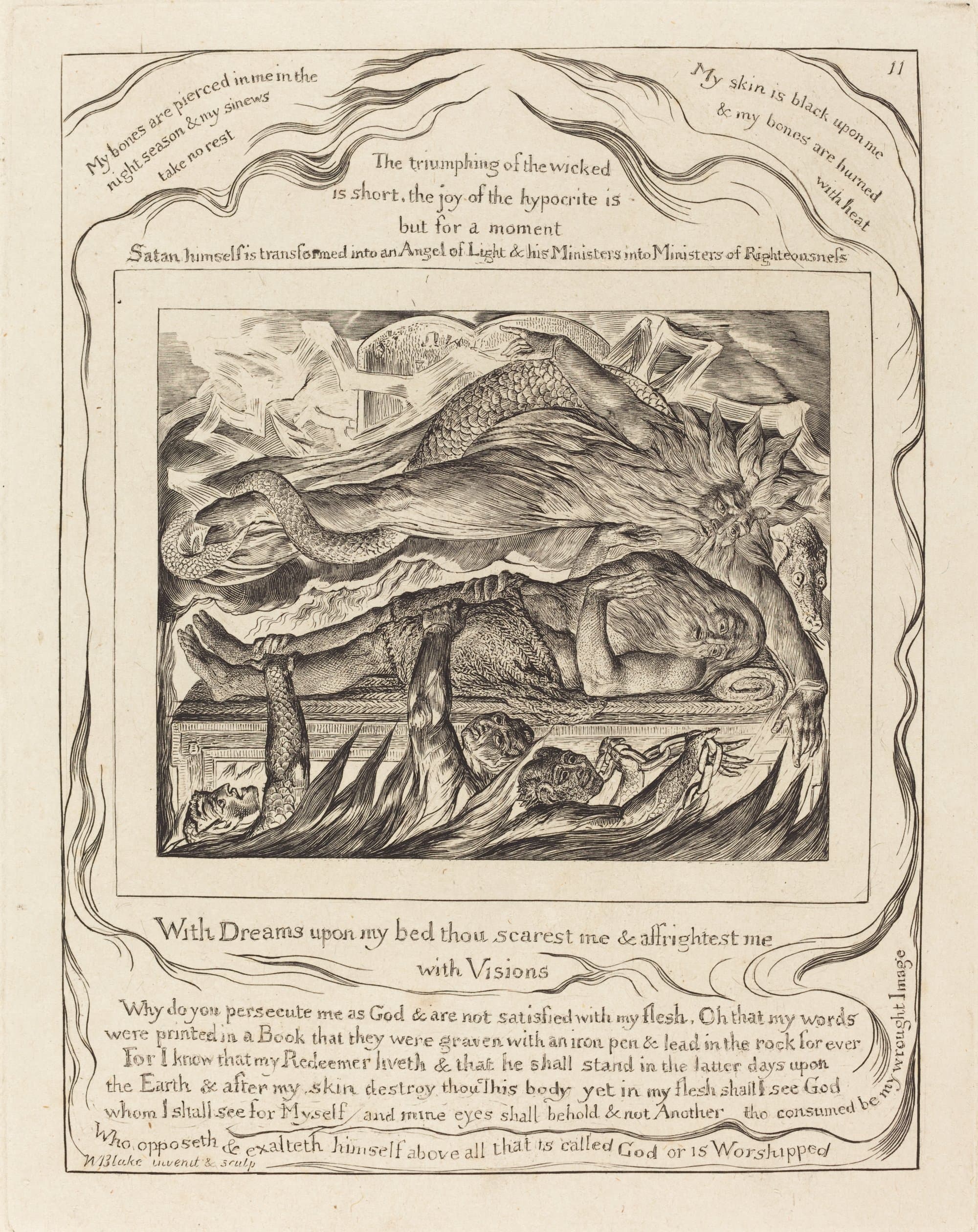
Job 3:25 · Symbol · Fear
The Words Pachad and Deilia
Hebrew pachad and Greek deilia are two of the words English Bibles render fear, dread and timidity.
Job said that the very thing he feared had overtaken him, and the Hebrew uses one word twice to say it.
For the thing I feared has overtaken me, and what I dreaded has befallen me.
- The word
- פַּחַד (pachad), H6343
- First appears
- Genesis 31:42 “If the God of my father, the God…”
Summary
The Hebrew pachad has a verb and a noun. The verb means to be startled and then to fear, and the noun names the thing feared as well as the feeling. The Greek noun deilia has a verb, deiliao, and an adjective, deilos, and the New Testament sets these words against faith.
- The noun pachad first stands in a name of God, the Fear of Isaac.
- Many uses of pachad name the dread God lays on Israel's enemies (Exodus 15:16; Deuteronomy 2:25).
- Jesus used the verb deiliao when He gave His disciples His peace on the night before He died (John 14:27).
- Pachad can also name trembling before God's goodness and the fear of God, so the sense of each use is read from its sentence.
The Fear of Isaac
Jacob spoke the name in his defence before Laban and swore by it in their covenant (Genesis 31:42 and Genesis 31:53).
This study asks what the Hebrew pachad and the Greek deilia mean and where each stands in Scripture. It belongs to the trial of fear, because these words name the fear that seizes a person in danger.
It counts the uses of pachad, pachdah and three Greek words in one table, follows pachad from Jacob's oath to the Psalms, and reads deilia beside its verb and adjective. It ends with two questions on which commentators part, the meaning of the name the Fear of Isaac and the time when Job's dread began.
If the God of my father, the God of Abraham and the Fear of Isaac, had not been with me, surely by now you would have sent me away empty-handed. But God has seen my affliction and the toil of my hands, and last night He rendered judgment.”The verse stands here because Jacob sets the Fear of Isaac beside the God of Abraham in his defence to Laban.
Where the Words Stand
Three Hebrew words and three Greek words share the sense of dread or timidity.
The noun pachad carries most of the uses, and deilia and deiliao each stand once in the New Testament.
| Word | Sense in Strong's dictionary | Uses | One use in the Berean words |
|---|---|---|---|
| Hebrew | |||
| pachad, פָּחַד, H6342, verb | to be startled (by a sudden alarm) | 25 | Isaiah 51:13, "You live in terror all day long" |
| pachad, פַּחַד, H6343, noun | a (sudden) alarm (properly, the object feared, by implication, the feeling) | 49 | Job 4:14, "fear and trembling came over me" |
| pachdah, פַּחְדָּה, H6345, noun | alarm (i.e. awe) | 1 | Jeremiah 2:19, "to have no fear of Me" |
| Greek | |||
| deilia, δειλία, G1167, noun | timidity | 1 | 2 Timothy 1:7, "a spirit of fear" |
| deiliao, δειλιάω, G1168, verb | to be timid | 1 | John 14:27, "do not be afraid" |
| deilos, δειλός, G1169, adjective | timid, i.e. (by implication) faithless | 3 | Matthew 8:26, "why are you so afraid?" |
deiliao, δειλιάω, G1168, verb, deilos, δειλός, G1169, adjective
The noun pachad book by book1 figure
Job holds more uses of the noun pachad than any other book, and the Psalms hold the next most.
The fourteen counts as a table
| Book | Uses |
|---|---|
| Job | 10 |
| Psalms | 9 |
| Isaiah | 5 |
| 2 Chronicles | 4 |
| Proverbs | 4 |
| Jeremiah | 4 |
| Deuteronomy | 3 |
| Esther | 3 |
| Genesis | 2 |
| Exodus | 1 |
| 1 Samuel | 1 |
| 1 Chronicles | 1 |
| Song of Songs | 1 |
| Lamentations | 1 |
14 bars from zero, one for each book where the noun pachad (H6343) stands, in the order of their counts.
Dread That Falls Without Warning
The Law and the Psalms use pachad for terror that comes on a person from outside.
and terror and dread will fall on them. By the power of Your arm they will be as still as a stone until Your people pass by, O LORD, until the people You have bought pass by.The song of Exodus 15 uses the noun for the dread that falls on the nations until the LORD's people pass by.
So your life will hang in doubt before you, and you will be afraid night and day, never certain of survival. In the morning you will say, ‘If only it were evening!’ and in the evening you will say, ‘If only it were morning!’—because of the dread in your hearts of the terrifying sights you will see.The curses of the covenant use the verb and the noun for a life lived in dread from morning to evening.
You will not fear the terror of the night, nor the arrow that flies by day,The psalm names pachad as the terror of the night and promises that it need not be feared.
Psalm 14:5 uses the verb and the noun together of the wicked: “There they are, overwhelmed with dread, for God is in the company of the righteous.”
One Word, Several Senses
Isaiah, Hosea, Jeremiah and the Psalms use the word for joy, for awe and for reverence.
Then you will look and be radiant, and your heart will tremble and swell with joy, because the riches of the sea will be brought to you, and the wealth of the nations will come to you.The verb here describes a heart that trembles with joy at what God gives, the opposite of dread.
Israel will "come trembling to the LORD and to His goodness" (Hosea 3:5), and the nations "will tremble in awe because of all the goodness" God gives Jerusalem (Jeremiah 33:9).
The noun also names the fear of God, as in Psalm 36:1, "There is no fear of God before his eyes", and in 2 Chronicles 19:7, "may the fear of the LORD be upon you". That fear is the reverence taught on the word study of yirah and phobos, a different thing from the terror of Job 3:25.
A third word spelled pachad (H6344) stands once, in Job 40:17, where the Berean text renders it "thighs". It shares the letters of the word for dread and carries none of its sense, so a reader cannot carry the meaning of one into the other because the spelling matches.
Deilia, Deiliao and Deilos
The Greek words of timidity stand in the Gospels, in 2 Timothy and in Revelation.
In the storm on the sea Jesus answered the disciples' fear with a rebuke of their little faith (Matthew 8:26).
But to the cowardly and unbelieving and abominable and murderers and sexually immoral and sorcerers and idolaters and all liars, their place will be in the lake that burns with fire and sulfur. This is the second death.”The verse stands here because it sets deilos, the cowardly, beside the unbelieving.
John Gill, in his Exposition of the New Testament (1746 to 1748), set apart "the timorous sheep and lambs of Christ, the dear children of God, who are sometimes of a fearful heart". He applied the word to "such who are of cowardly spirits, and are not valiant for the truth".
Two Texts Read Two Ways
Each of the two texts has two readings, and each reading has its holder and its objection.
The name honoured a father still livingMatthew Henry
Against this reading, the LORD called Himself "the God of Isaac" when He spoke to Jacob while Isaac was still alive (Genesis 28:13).
The two names mean one GodAdam Clarke
Adam Clarke, in his Commentary on the Bible (1832), found Jacob's two titles strange, "when both words are meant of the same Being".
Against this reading, the same sentence gives the word of fear to Isaac alone and the plain title "the God of" to Abraham (Genesis 31:42).
Job had dreaded calamity in his prosperityJohn Wesley
John Wesley, in his Explanatory Notes upon the Old Testament (1765), read Job as saying, "Even in the time of my prosperity, I was full of fears".
Against this reading, the next verse speaks of the present, "I have no rest, for trouble has come" (Job 3:26), which fits fears that grew within the trial.
Job's fears came within the trial, one loss after anotherJamieson, Fausset and Brown
Jamieson, Fausset and Brown, in their Commentary Critical and Explanatory (1871), wrote, "In the beginning of his trials, when he heard of the loss of one blessing, he feared the loss of another".
Against this reading, the prologue shows Job anxious for his sons before any loss, offering burnt offerings because he thought, "Perhaps my children have sinned" (Job 1:5).
Trust in Place of Dread
Isaiah 12 is a song of praise for the day God's anger turns away and He comforts His people.
Surely God is my salvation; I will trust and not be afraid. For the LORD GOD is my strength and my song, and He also has become my salvation.”The verse stands here because it answers the verb pachad with trust in the same line.
Sources
Scripture is the Berean Standard Bible.
- James Strong, The Exhaustive Concordance of the Bible, with its dictionaries of the Hebrew and Greek words of the original (1890)
- STEP Bible, Translators Amalgamated Hebrew Old Testament and Greek New Testament, the tagged texts (Tyndale House, Cambridge), CC BY 4.0.
- Matthew Henry, Commentary on the Whole Bible (1710), on Genesis 31:42.
- John Gill, Exposition of the New Testament (1746 to 1748), on Revelation 21:8.
- John Wesley, Explanatory Notes upon the Old Testament (1765), on Job 3:25.
- Adam Clarke, Commentary on the Bible (1832), on Genesis 31:42.
- Robert Jamieson, A. R. Fausset and David Brown, Commentary Critical and Explanatory on the Whole Bible (1871), on Job 3:25.
Keep Studying
People and groups11