
Genesis 17:9 to 14 · Subject · Featured Study
The sign of circumcision
Genesis 17 makes circumcision the mark of the covenant for every male of the household, and the Law, the prophets and Paul each return to it.
Abraham was ninety-nine years old when he received the sign in his own flesh.
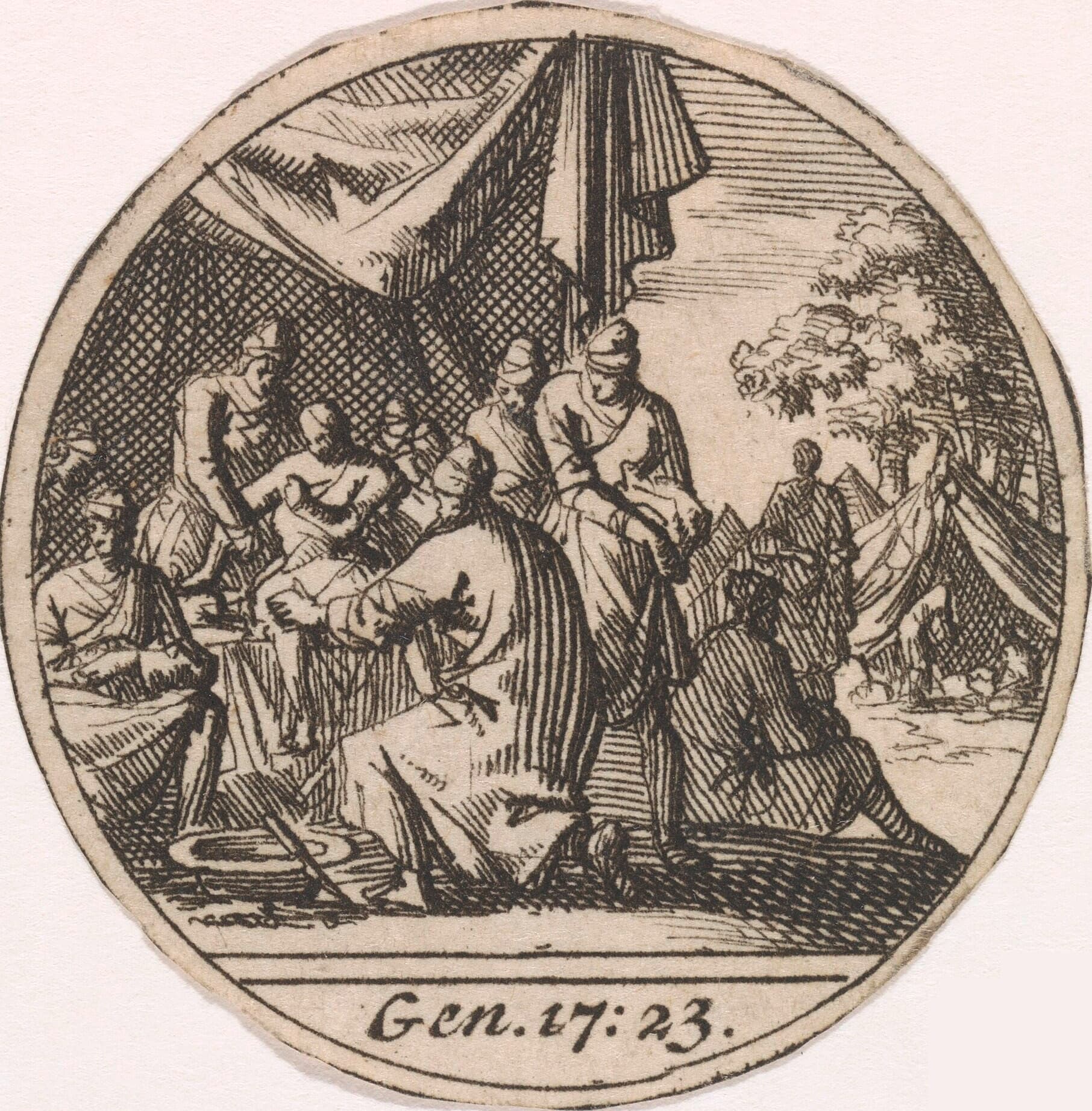
Jan Luyken, Abraham Circumcises His Son Ishmael, etching for Willem Goeree, Mosaize historie der Hebreeuwse kerke, 1700, Rijksmuseum, Amsterdam. Public domain, via Wikimedia Commons.
THE ARTWORKThe roundel sets the day of Genesis 17:23 inside the tent, with the son held up among the men of the camp. Others wait outside among the tents, since every male of the household received the sign that same day.
Summary
In Genesis 17 God told Abraham that every male of his descendants and his household was to be circumcised, as the sign of the covenant between God and them.
- On the same day Abraham circumcised Ishmael, who was thirteen, and every male of his household.
- No foreigner could eat the Passover unless the males of his household were circumcised.
- Joshua circumcised the sons born in the wilderness at Gilgal before Israel kept the Passover in Canaan.
- Moses and Jeremiah call for circumcised hearts, and Paul calls Abraham's circumcision a seal of the righteousness he had by faith.
- Christians divide over how circumcision and baptism are related.
The Sign Given to Abraham
Genesis 17 gives the command in verses 9 to 14 and records its keeping in verses 23 to 27.
God had just renamed Abram as Abraham and promised to be the God of his descendants after him.
God also said to Abraham, “You must keep My covenant—you and your descendants in the generations after you. This is My covenant with you and your descendants after you, which you are to keep: Every male among you must be circumcised. You are to circumcise the flesh of your foreskin, and this will be a sign of the covenant between Me and you. Generation after generation, every male must be circumcised when he is eight days old, including those born in your household and those purchased from a foreigner—even those who are not your offspring. Whether they are born in your household or purchased, they must be circumcised. My covenant in your flesh will be an everlasting covenant. But if any male is not circumcised, he will be cut off from his people; he has broken My covenant.”The command binds Abraham's line in every generation, and verse 11 calls the rite the sign of the covenant.
Verse 12 sets the rite at eight days old, and the page Brit milah: circumcision on the eighth day teaches why that day was kept.
On that very day Abraham took his son Ishmael and all those born in his household or purchased with his money—every male among the members of Abraham’s household—and he circumcised them, just as God had told him. So Abraham was ninety-nine years old when he was circumcised, and his son Ishmael was thirteen; Abraham and his son Ishmael were circumcised on the same day. And all the men of Abraham’s household—both servants born in his household and those purchased from foreigners—were circumcised with him.The rite was kept on the very day the LORD spoke, a year before the son of the promise was born.
Cyril of Alexandria reads the covenant in the flesh of verse 13 through Paul's words on carrying the death of Jesus.
“God's covenant is ‘in the flesh’ of the person who ‘does not fight on the terms of the flesh’ and who ‘always carries about in his body the death of Jesus.’”
Cyril of Alexandria · Catena on Genesis 3.1027 · on Genesis 17:13Patristic
Circumcisions in Scripture
Scripture records nine circumcisions, from Abraham's household in Genesis to Paul's own in Philippians.
| Occasion | Who was circumcised | Verse |
|---|---|---|
| Abraham's household | Abraham, his son Ishmael and every male born or bought in the house | Genesis 17:23 to 27 |
| The birth of Isaac | Isaac, by Abraham, as God had commanded him | Genesis 21:4 |
| The city of Shechem | Every male of the city, on the terms Jacob's sons set | Genesis 34:24 |
| The road to Egypt | The son of Moses, by Zipporah with a flint knife | Exodus 4:25 |
| Gilgal | The sons of Israel born in the wilderness | Joshua 5:7 |
| The naming of John | The son of Zechariah, on the eighth day | Luke 1:59 |
| The naming of Jesus | Jesus, when He was named | Luke 2:21 |
| Lystra | Timothy, by Paul, on account of the Jews in that area | Acts 16:3 |
| Paul's infancy | Paul, on the eighth day, of the tribe of Benjamin | Philippians 3:5 |
- Occasion
- Abraham's household
- Who was circumcised
- Abraham, his son Ishmael and every male born or bought in the house
- Verse
- Genesis 17:23 to 27
- Occasion
- The birth of Isaac
- Who was circumcised
- Isaac, by Abraham, as God had commanded him
- Verse
- Genesis 21:4
- Occasion
- The city of Shechem
- Who was circumcised
- Every male of the city, on the terms Jacob's sons set
- Verse
- Genesis 34:24
- Occasion
- The road to Egypt
- Who was circumcised
- The son of Moses, by Zipporah with a flint knife
- Verse
- Exodus 4:25
- Occasion
- Gilgal
- Who was circumcised
- The sons of Israel born in the wilderness
- Verse
- Joshua 5:7
- Occasion
- The naming of John
- Who was circumcised
- The son of Zechariah, on the eighth day
- Verse
- Luke 1:59
- Occasion
- The naming of Jesus
- Who was circumcised
- Jesus, when He was named
- Verse
- Luke 2:21
- Occasion
- Lystra
- Who was circumcised
- Timothy, by Paul, on account of the Jews in that area
- Verse
- Acts 16:3
- Occasion
- Paul's infancy
- Who was circumcised
- Paul, on the eighth day, of the tribe of Benjamin
- Verse
- Philippians 3:5
The Sign in the Law and in Joshua
Exodus 4, Exodus 12 and Joshua 5 tell how Israel kept the sign after Abraham.
Exodus 4:24 to 26, Zipporah and the son of Moses1 passage, 1 quotation
Now at a lodging place along the way, the LORD met Moses and was about to kill him. But Zipporah took a flint knife, cut off her son’s foreskin, and touched it to Moses’ feet. “Surely you are a bridegroom of blood to me,” she said. So the LORD let him alone. (When she said, “bridegroom of blood,” she was referring to the circumcision.)Zipporah's act ends the danger on the road, and verse 26 ties her words to the circumcision.
Albert Barnes, in his Notes on the Old and New Testaments, reads bridegroom of blood as Zipporah's word that the marriage bond was now sealed by blood.
Jamieson, Fausset & Brown weigh what the omission meant for the man chosen to lead Israel.
“To dishonor that sign and seal of the covenant was criminal in any Hebrew, peculiarly so in one destined to be the leader and deliverer of the Hebrews; and he seems to have felt his sickness as a merited chastisement for his sinful omission.”
Jamieson, Fausset & Brown · Commentary Critical and Explanatory on the Whole Bible · on Exodus 4:24Reformed
Exodus 12:43 to 49, the foreigner at the Passover1 passage
If a foreigner resides with you and wants to celebrate the LORD’s Passover, all the males in the household must be circumcised; then he may come near to celebrate it, and he shall be like a native of the land. But no uncircumcised man may eat of it. The same law shall apply to both the native and the foreigner who resides among you.”Circumcision was the condition an outsider had to meet before sharing Israel's feast, and verse 49 gives one law to both.
Albert Barnes takes the foreigner of verse 43 to mean anyone outside Israel until circumcision brought him into the nation.
Joshua 5:2 to 9, the second circumcision at Gilgal2 passages, 1 quotation
Now this is why Joshua circumcised them: All those who came out of Egypt—all the men of war—had died on the journey in the wilderness after they had left Egypt. Though all who had come out were circumcised, none of those born in the wilderness on the journey from Egypt had been circumcised. For the Israelites had wandered in the wilderness forty years, until all the nation’s men of war who had come out of Egypt had died, since they did not obey the LORD. So the LORD vowed never to let them see the land He had sworn to their fathers to give us, a land flowing with milk and honey. And Joshua raised up their sons in their place, and these were the ones he circumcised. Until this time they were still uncircumcised, since they had not been circumcised along the way.These verses give the reason for the rite at Gilgal, the generation that died in the wilderness and the sons who grew up uncircumcised.
Then the LORD said to Joshua, “Today I have rolled away the reproach of Egypt from you.” So that place has been called Gilgal to this day.The LORD names what the rite removed, and the place takes its name from His word.
Rashi, in his commentary on Joshua, holds that Joshua reminded the people of Genesis 17:8 to 9, so that their inheritance of the land depended on keeping the covenant of circumcision.
John Damascene reads the wilderness years as proof of what the sign was for.
“The circumcision was given to Abraham before the law, after the blessings and after the promise, as a sign to set him and those born of him and those of his household apart from the Gentiles in whose midst he was living. And this is obvious, because, when Israel spent forty years alone by themselves in the desert without mixing with any other nation, all those who were born in the desert were not circumcised. However, when Joshua brought them across the Jordan, they were circumcised and a second law of circumcision was made.”
John Damascene · Orthodox Faith 4.25 · on Joshua 5:4 to 7Patristic
The Hebrew of the Sign
Four Hebrew words carry the command of Genesis 17.
Each count in the table is of the tagged words of the STEP Bible Hebrew text, by Strong's number.
| Word | Hebrew | Meaning | In Genesis | Verse |
|---|---|---|---|---|
| ot | אוֹת | a sign | 6 times | Genesis 17:11 |
| mul | מוּל | to circumcise | 17 times | Genesis 17:10 |
| orlah | עׇרְלָה | foreskin | 6 times | Genesis 17:14 |
| berit | בְּרִית | covenant | 27 times, 13 of them in chapter 17 | Genesis 17:13 |
- Word
- ot
- Hebrew
- אוֹת
- Meaning
- a sign
- In Genesis
- 6 times
- Verse
- Genesis 17:11
- Word
- mul
- Hebrew
- מוּל
- Meaning
- to circumcise
- In Genesis
- 17 times
- Verse
- Genesis 17:10
- Word
- orlah
- Hebrew
- עׇרְלָה
- Meaning
- foreskin
- In Genesis
- 6 times
- Verse
- Genesis 17:14
- Word
- berit
- Hebrew
- בְּרִית
- Meaning
- covenant
- In Genesis
- 27 times, 13 of them in chapter 17
- Verse
- Genesis 17:13
The word for a sign in Genesis 17:11 is the word Genesis 9 uses for the rainbow after the flood. The rainbow and circumcision are the only two things Genesis calls the sign of a covenant.
| Sign | Given to | What the text says of it |
|---|---|---|
| The rainbow | Noah and every living creature | God will see it and remember the everlasting covenant |
| Circumcision | Abraham and every male of his household | The covenant in their flesh will be an everlasting covenant |
- Sign
- The rainbow
- Given to
- Noah and every living creature
- What the text says of it
- God will see it and remember the everlasting covenant
- Sign
- Circumcision
- Given to
- Abraham and every male of his household
- What the text says of it
- The covenant in their flesh will be an everlasting covenant
What the Text Leaves Unsaid
Genesis, Exodus and Joshua leave three questions about the sign open.
Genesis 17 gives the sign to males and names no sign for women, though Sarah stands in the same chapter's promise.
Exodus 4:24 does not say why the LORD was about to kill Moses. John Wesley, in his Explanatory Notes upon the Old Testament, takes the reason from the son Zipporah circumcised in the next verse, and names the sin of Moses as his neglect to circumcise the boy. Adam Clarke, in his Commentary on the Bible, calls the account very obscure.
Joshua 5 does not say why the sons born in the wilderness were left uncircumcised. Rashi, in his commentary on Joshua 5:2, holds that the north wind did not blow for them in the wilderness. Wesley, in the same Notes upon the Old Testament, reads the omission as a token of God's displeasure at the people's unbelief.
The Sign and the Heart
Deuteronomy, Jeremiah and Romans speak of the heart in the terms of the sign.
| Text | What it says of the heart |
|---|---|
| Deuteronomy 10:16 | Israel is told to circumcise their hearts and stiffen their necks no more |
| Deuteronomy 30:6 | The LORD will circumcise their hearts and the hearts of their descendants, so that they love Him |
| Jeremiah 4:4 | The men of Judah are told to remove the foreskins of their hearts |
| Jeremiah 9:25 to 26 | The LORD will punish all who are circumcised yet uncircumcised in heart |
| Romans 2:28 to 29 | Circumcision is a matter of the heart, by the Spirit |
- What it says of the heart
- Israel is told to circumcise their hearts and stiffen their necks no more
- Text
- Deuteronomy 30:6
- What it says of the heart
- The LORD will circumcise their hearts and the hearts of their descendants, so that they love Him
- Text
- Jeremiah 4:4
- What it says of the heart
- The men of Judah are told to remove the foreskins of their hearts
- What it says of the heart
- The LORD will punish all who are circumcised yet uncircumcised in heart
- What it says of the heart
- Circumcision is a matter of the heart, by the Spirit
Rashi, in his commentary on Deuteronomy 10:16, reads the call as a command to remove the closure and cover over the heart that keep God's words from entering it.
Paul's argument in Romans 4 turns on what came first in Genesis, chapter 15 or chapter 17. John Wesley, in his Explanatory Notes upon the New Testament, sets out that order, with Abraham's faith credited as righteousness before Ishmael was born and his circumcision in Ishmael's thirteenth year.
Is this blessing only on the circumcised, or also on the uncircumcised? We have been saying that Abraham’s faith was credited to him as righteousness. In what context was it credited? Was it after his circumcision, or before? It was not after, but before. And he received the sign of circumcision as a seal of the righteousness that he had by faith while he was still uncircumcised. So then, he is the father of all who believe but are not circumcised, in order that righteousness might be credited to them. And he is also the father of the circumcised who not only are circumcised, but who also walk in the footsteps of the faith that our father Abraham had before he was circumcised.Paul draws on that order to give Jews and Gentiles one father.
Galatians 5:2 to 6, the sign and the Gentile believers1 passage
Take notice: I, Paul, tell you that if you let yourselves be circumcised, Christ will be of no value to you at all. Again I testify to every man who gets himself circumcised that he is obligated to obey the whole law. You who are trying to be justified by the law have been severed from Christ; you have fallen away from grace. But by faith we eagerly await through the Spirit the hope of righteousness. For in Christ Jesus neither circumcision nor uncircumcision has any value. All that matters is faith, expressed through love.Paul writes to Gentile believers who were being pressed to be circumcised, and he puts faith expressed through love above both states.
Acts 15:1 to 2 and 16:3 to 4, the council and Timothy2 passages
Then some men came down from Judea and were teaching the brothers, “Unless you are circumcised according to the custom of Moses, you cannot be saved.” And after engaging these men in sharp debate, Paul and Barnabas were appointed, along with some other believers, to go up to Jerusalem to see the apostles and elders about this question.This dispute over whether Gentile believers had to be circumcised to be saved is the question the council met to settle.
The council's letter in Acts 15:28 to 29 lays four requirements on the Gentiles who are turning to God, and none of the four is circumcision.
Paul wanted Timothy to accompany him, so he took him and circumcised him on account of the Jews in that area, for they all knew that his father was a Greek. As they went from town to town, they delivered the decisions handed down by the apostles and elders in Jerusalem for the people to obey.Paul circumcised Timothy, the son of a Jewish mother, on the same journey on which he delivered the council's decisions from town to town.
John Wesley, in his Explanatory Notes upon the New Testament, says the unbelieving Jews of that region would not have spoken with Timothy at all while he was uncircumcised.
Three Voices on the Sign
Tertullian, Ambrosiaster and Ambrose of Milan on what the sign points to, earliest first.
Tertullian reads Romans 2:29 as the purpose of the God who gave the law.
“Now it is quite within the purpose of the God of the law that circumcision should be that of the heart, not in the flesh; in the spirit, and not in the letter.”
Tertullian · Against Marcion Book V · on Romans 2:29Patristic
Ambrosiaster reads the promise Abraham believed as a promise for the nations.
“What did Abraham believe? He believed that he would have a descendant, a son, in whom all the nations would be justified by faith while they were still uncircumcised, as Abraham then was.”
Ambrosiaster · Commentary on Paul's Epistles · on Romans 4:10Patristic
Ambrose of Milan takes up a question his readers asked of the sign of Genesis 17.
“I know that this part of the text is disturbing to many. Indeed, if circumcision is a good thing, it should be maintained today as well. If it is useless, it never should have been mandated in the first place, particularly not by divine precept. But, inasmuch as the apostle said, ‘Abraham received the sign of circumcision,’ certainly the sign is not the reality itself but points to another reality. That is, it is not the truth but points to the truth.”
Ambrose of Milan · On Abraham · on Genesis 17:11Patristic
Circumcision and Baptism
Christians who read Colossians 2:11 to 12 differ over who should receive baptism.
In Him you were also circumcised, in the putting off of your sinful nature, with the circumcision performed by Christ and not by human hands. And having been buried with Him in baptism, you were raised with Him through your faith in the power of God, who raised Him from the dead.Paul joins the circumcision performed by Christ to burial with Him in baptism.
Baptism follows circumcision and is given to the children of believersMatthew Henry
Matthew Henry, in his Commentary on the Whole Bible, holds that circumcision gives way to baptism once the blood of Christ has been shed.
He reads the circumcision of Abraham's household as a pattern for believing families.
“This is a good example to masters of families; they and their houses must serve the Lord. Though God's covenant was not established with Ishmael, yet he was circumcised; for children of believing parents, as such, have a right to the privileges of the visible church, and the seals of the covenant, whatever they may prove afterwards.”
Matthew Henry · Commentary on the Whole Bible · on Genesis 17:23 to 26Puritan
Those who give baptism only to believers answer from Colossians 2:12, which ties the rite to the faith of the one who receives it.
Baptism is given to those who profess faithThe Second London Baptist Confession
The Baptist churches of the Second London Confession of 1689 give baptism only to those who profess repentance toward God and faith in Christ, and they hold immersion necessary to it.
Adam Clarke, in his Commentary on the Bible, reads buried with Him in Colossians 2:12 as an allusion to the immersion of adults.
Those who give baptism to the children of believers answer from the household of Genesis 17, where the sign was given with Abraham to sons and servants alike.
Books on the Sign
Three commentaries that treat the sign at length, earliest first.
Commentary on the Whole Bible
Matthew Henry · 1710
Henry's note on Colossians 2:11 reads the circumcision of Christ as the putting off of the whole body of sin.
Explanatory Notes upon the New Testament
John Wesley · 1755
Wesley's note on Galatians 5:6 reads the faith that works through love as all inward and outward holiness.
Commentary on the Bible
Adam Clarke · 1832
Clarke's note on Genesis 17:11 reads the sign as a figure of the heart made pure and links it to the seal of Romans 4:11.
The Faith the Sign Sealed
Galatians 6:15 is the last place in the letter where Paul names circumcision.
But as for me, may I never boast, except in the cross of our Lord Jesus Christ, through which the world has been crucified to me, and I to the world. For neither circumcision nor uncircumcision means anything. What counts is a new creation.Paul measures both states of the sign by his boast in the cross and by the new creation.
Keep studying
Read it1