
Joshua 24 · Shechem · Featured Study
The covenant at Shechem
Joshua 24:1 to 28 records the covenant made between the LORD and Israel in Joshua's last years, sealed by a written record and a standing stone.
Before he died, Joshua asked the tribes of Israel at Shechem to choose whom they would serve.
- Where
- Shechem
- Who
- Joshua
- When
- late in Joshua's life, after the land was divided (Joshua 23:1 and 24:29)
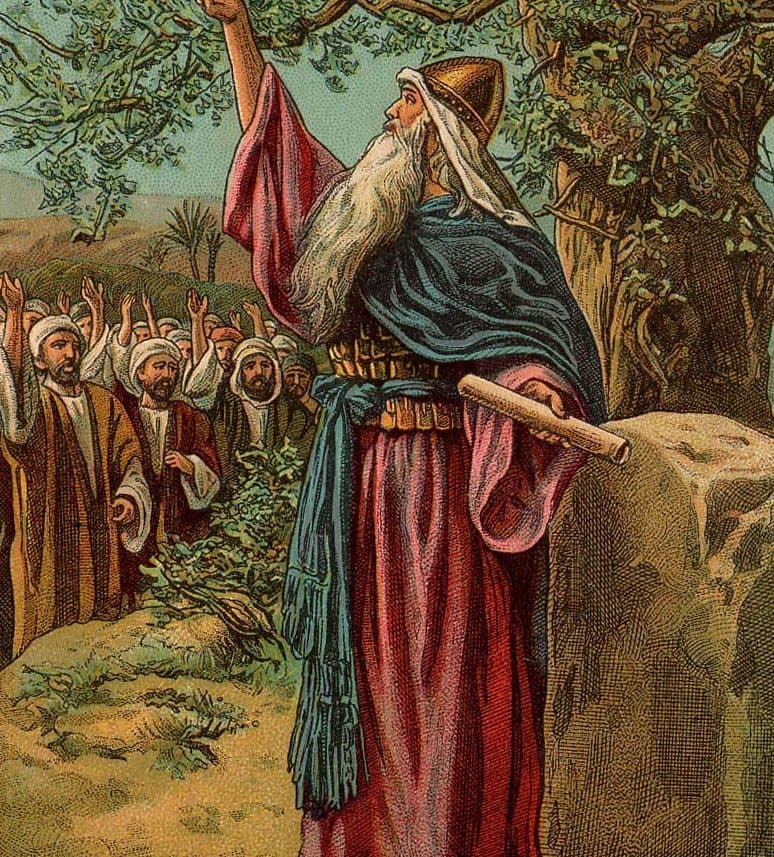
The Providence Lithograph Company, Joshua Renewing the Covenant with Israel, Bible card, 1907. Public domain (published before 1930), via Wikimedia Commons, File:Joshua_Renewing_the_Covenant_with_Israel_(Bible_Card).jpg.
THE ARTWORKThe card draws Joshua 24:26 to 27, with the book in Joshua's hand and the large stone beside him under the oak.
Summary
Joshua 24 is the last assembly Joshua called, held at Shechem in the hill country between Mount Ebal and Mount Gerizim.
- Joshua speaks for the LORD and recounts what He did for Israel, from Terah to the land (Joshua 24:2 to 13).
- He calls the people to cast aside their fathers' gods, and he answers for his own house (Joshua 24:14 to 15).
- The people answer three times that they will serve the LORD, and Joshua makes them witnesses against themselves (Joshua 24:16 to 24).
- Joshua makes the covenant and sets up a large stone under the oak as its witness (Joshua 24:25 to 27).
The Assembly at Shechem
Twenty-eight verses hold an assembly, an exchange of promises and a covenant made the same day.
Joshua speaks the LORD's words first, so the tribes hear what God has done for them before they are asked to promise anything. The charge comes only in verse 14.
But if it is unpleasing in your sight to serve the LORD, then choose for yourselves this day whom you will serve, whether the gods your fathers served beyond the Euphrates, or the gods of the Amorites in whose land you are living. As for me and my house, we will serve the LORD!”Joshua names the gods of the fathers and of the Amorites as the other choices, and he answers first for his own house.
The Day at Shechem, Act by Act
The covenant was made in nine acts, from the gathering of the tribes to their going home.
- 1. The gatheringJoshua summons the tribes and their officers to Shechem, and they stand before God.Joshua 24:1
- 2. The LORD's accountThe LORD names what He did, from Terah's household to the land Israel now holds.Joshua 24:2 to 13
- 3. The chargeJoshua tells them to fear the LORD, cast aside the gods of their fathers and choose whom they will serve.Joshua 24:14 to 15
- 4. The first answerThe people say they will never forsake the LORD, and they recount what He did for them.Joshua 24:16 to 18
- 5. The warningJoshua tells them they are not able to serve a holy and jealous God and warns of disaster if they turn.Joshua 24:19 to 20
- 6. The second answerThe people answer that they will serve the LORD and agree to be witnesses against themselves.Joshua 24:21 to 22
- 7. The third answerJoshua tells them to get rid of their foreign gods, and they promise to serve and obey the LORD.Joshua 24:23 to 24
- 8. The covenant, the book and the stoneJoshua makes the covenant, writes the words in the Book of the Law of God and sets up a stone under the oak.Joshua 24:25 to 27
- 9. The sending homeJoshua sends each man away to his own inheritance.Joshua 24:28
Each card names who spoke or acted, with the verses that record it.
What the LORD Had Done
Joshua 24:2 to 13 recounts six stages of Israel's past, and the LORD is the one who acts in each.
BEYOND THE EUPHRATES
Terah's household worshiped other gods until the LORD took Abraham from there.
THE FATHERS
The LORD gave Isaac to Abraham, and Jacob and Esau to Isaac.
EGYPT AND THE SEA
He sent Moses and Aaron and brought the sea over the army of Egypt.
EAST OF THE JORDAN
He gave the Amorites into Israel's hand and made Balaam bless them.
JERICHO AND THE SEVEN NATIONS
He gave the men of Jericho and seven nations into their hand.
A LAND GIVEN
He gave them cities they did not build and vineyards they did not plant.
You Are Not Able to Serve the LORD
Joshua answers the people's first promise by telling them they are not able to keep it.
A warning to the people as they stoodKeil and Delitzsch
C. F. Keil and F. Delitzsch, in their commentary on Joshua, read the words as spoken of the people in their present state, so that they would not vow what they would not keep. They quote J. H. Michaelis: the people could not serve the LORD by their own resolution alone, without divine grace, conversion from idols, repentance and faith.
If you forsake the LORD and serve foreign gods, He will turn and bring disaster on you and consume you, even after He has been good to you.”The next verse gives the reason for the warning: the LORD who has been good to them will turn against them if they serve foreign gods.
A word that foresaw the people's failureRashi
Rashi, on Joshua 24:22, wrote that Joshua foresaw that the people would one day wish to be like the other nations, as Ezekiel 20 records, and so he was hard on them at Shechem. On verse 25 he wrote that Joshua set the statutes of the Torah before them there and that they accepted them.
After that whole generation had also been gathered to their fathers, another generation rose up who did not know the LORD or the works that He had done for Israel.Judges records that the generation after Joshua's did not know the LORD, which is the failure this reading says Joshua saw coming.
Why Shechem
Shechem had stood in Israel's story since the call of Abram.
Shechem was the first place in Canaan where the LORD appeared to Abram and promised the land to his offspring, and Abram built an altar there. Jacob later bought the plot where he camped for a hundred pieces of silver, and before he went up to Bethel he told his household to get rid of the foreign gods among them.
So they gave Jacob all their foreign gods and all their earrings, and Jacob buried them under the oak near Shechem.Jacob buried his household's foreign gods under an oak at Shechem, and Joshua 24:23 and 24:26 tell Israel to get rid of foreign gods beside an oak at the same town.
Keil and Delitzsch held that Joshua chose Shechem because the covenant was a renunciation of idolatry, made where the patriarch had purified his house. They also note that some manuscripts of the Septuagint read Shiloh in Joshua 24:1, where the Hebrew reads Shechem.
“Shechem, situated between those mountains, Ebal and Gerizim, which had already been the scene of a solemn rehearsal of the covenant soon after the first entry of the people into the promised land Jos 8:30-35, was a fitting scene for the solemn renewal on the part of the people of that covenant with God which had been on His part so signally and so fully kept. The spot itself suggested the allusions to Abraham, Isaac, and Jacob, etc., in Joshua’s address; and its associations could not but give special force and moving effect to his appeals.”
Albert Barnes · Notes, Explanatory and Practical, on the Old and New Testaments (1832-1869) · on Joshua 24:1Evangelical
Shechem stands north of Shiloh and Bethel in the hill country.
- 1Shechem, Joshua gathered the tribes and made the covenant. Joshua 24:1
- 2Shiloh, The congregation set up the Tent of Meeting there. Joshua 18:1
- 3Bethel, Jacob went up from Shechem to build an altar. Genesis 35:3
- 4Gilgal, Israel camped there after crossing the Jordan. Joshua 4:19
The coasts and rivers are simplified; each place stands at its place page's coordinates.
Four places of the covenant and the conquest, each with the event the key names.
Shechem after JoshuaJoshua 24:32 to John 4:6
Shechem appears again in Judges, Kings and John, at the crowning of kings and at Jacob's well.
- Joshua's last yearsJoseph's bones are buried in the plot Jacob bought from the sons of Hamor.Joshua 24:32
- The judgesAbimelech is paid from the temple of Baal-berith.Judges 9:4
- The judgesThe leaders of Shechem make Abimelech king beside the oak at the pillar.Judges 9:6
- The kingsAll Israel goes to Shechem to make Rehoboam king.1 Kings 12:1
- The kingsJeroboam builds Shechem in the hill country of Ephraim and lives there.1 Kings 12:25
- JesusJesus sits by Jacob's well at Sychar, near the plot Jacob gave to Joseph.John 4:5 to 6
A timeline of six events at Shechem after the covenant, in the order Scripture records them.
The ceremony on Mount EbalJoshua 8:30 to 35
Earlier in the book, Joshua read the whole law of Moses to the assembly between Ebal and Gerizim, as Deuteronomy 27 commanded.
There was not a word of all that Moses had commanded that Joshua failed to read before the whole assembly of Israel, including the women, the little ones, and the foreigners who lived among them.The reading on Ebal reached women, children and foreigners, and the covenant of chapter 24 was made with the same whole assembly.
The Shape of a Treaty
George Mendenhall found in Joshua 24 the parts of the treaties Hittite kings made with lesser kings.
In 1954 George Mendenhall argued, in the journal The Biblical Archaeologist, that two traditions in the Old Testament follow the form of the Hittite vassal treaties: the Ten Commandments and the covenant of Joshua 24.
| Part | What a Hittite treaty held | Where Joshua 24 holds it |
|---|---|---|
| The author named | The great king gives his name and titles | Verse 2 |
| The historical prologue | What the king has done for the vassal | Verses 2 to 13 |
| The stipulation | The vassal's duties, loyalty first | Verses 14 and 23 |
| The writing and deposit | A copy kept in the sanctuary | Verse 26 |
| The witnesses | The gods called to witness the oath | Verses 22 and 27 |
| The blessings and curses | What follows loyalty and what follows breach | Verse 20 holds a warning; Mendenhall found no formula |
| The oath | The vassal's sworn acceptance | Verses 16, 21 and 24 |
Mendenhall also noted that the chapter lists none of the further duties a treaty would carry, beyond the one command to cast aside other gods. He judged that the narrative rests on traditions from the time when the treaty form was still in use.
What Joshua 24 Leaves Unsaid
The chapter is silent on four things readers often supply.
The book of Joshua records no battle for Shechem, and the town stands in Israel's hands at Joshua 8:30 and 24:1. Chapter 24 names no sacrifice at the covenant, while the ceremony on Ebal records burnt offerings and peace offerings (Joshua 8:31). No act of destroying or burying the gods follows the command of verse 23. It does not say what became of the stone.
A Covenant Each Generation Keeps
Joshua 24 repeats the answer given at Sinai.
Then he took the Book of the Covenant and read it to the people, who replied, “All that the LORD has spoken we will do, and we will be obedient.”At Sinai the people answered the Book of the Covenant with the same promise to obey that they make again at Shechem in Joshua 24:24.
Israel had served the LORD throughout the days of Joshua and of the elders who outlived him and who had experienced all the works that the LORD had done for Israel.The covenant was kept while its witnesses lived, which is why Joshua made the people witnesses against themselves in verse 22.
Voices on the Covenant
Basil of Caesarea wrote in the fourth century on the stone Joshua set up as a witness.
Basil set Joshua's stone beside the heap Jacob called a witness, and he gave two ways the stone could testify.
“Moreover, Joshua, the son of Nun, even set up a stone as witness of his words (already a heap somewhere had been called a witness by Jacob), for he says, ‘Behold this stone shall be a witness unto you this day to the end of days, when ye lie to the Lord our God,’ perhaps believing that by God's power even the stones would speak to the conviction of the transgressors; or, if not, that at least each man's conscience would be wounded by the force of the reminder.”
Basil of Caesarea · On the Spirit 13.30 · on Joshua 24:27Patristic
Books on the Covenant at Shechem
Two works a reader can open in full, one a commentary and one a study of covenant forms.
Biblical Commentary on the Old Testament: Joshua, Judges, Ruth
C. F. Keil and F. Delitzsch, translated by James Martin · 1875
The commentary reads Joshua 24 verse by verse, with the place, the oath and the stone.
Read on archive.orgCovenant Forms in Israelite Tradition, The Biblical Archaeologist 17.3
George E. Mendenhall · 1954
The article prints the outline of a Hittite treaty, part by part, and reads the covenants of Israel by it.
Read on archive.orgA Better Covenant
The New Testament names a better covenant than the one made at Shechem.
Joshua gave Israel the land, but Hebrews 4:8 says that if Joshua had given them rest, God would not have spoken later about another day. At the supper Jesus called the cup the new covenant in His blood (Luke 22:20). Joshua's question in Joshua 24:15 still asks each reader whom he will serve.
Now, however, Jesus has received a much more excellent ministry, just as the covenant He mediates is better and is founded on better promises.This verse answers the failure Joshua foresaw at Shechem with a covenant founded on better promises.
Keep studying
People7
Show the next 1 title
Places7