
Place
The Red Sea
Also known as Yam Suph · Sea of Reeds
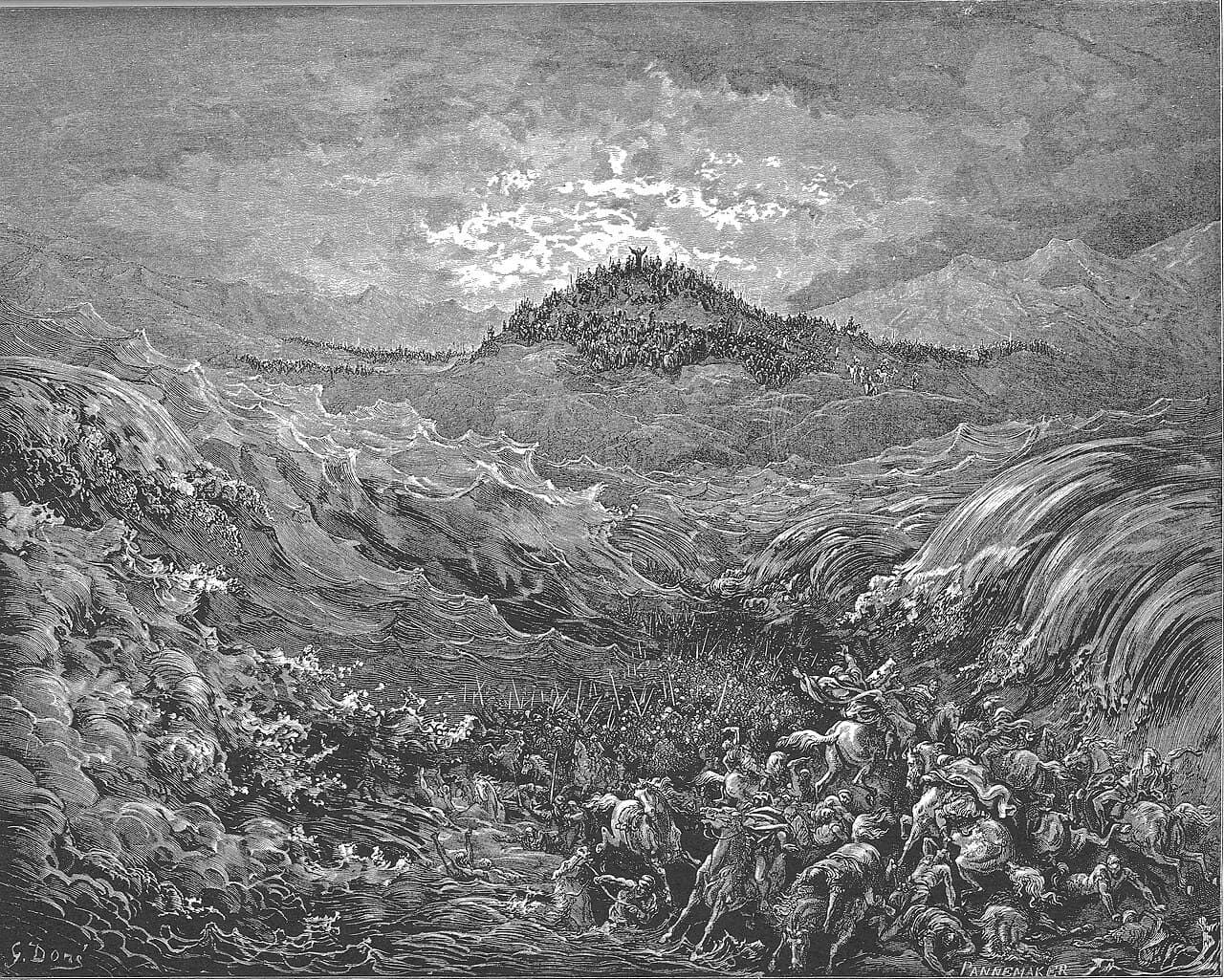
Gustave Doré, La Sainte Bible (Tours: Alfred Mame et fils, 1866). Public domain.
Summary
The sea God parted for Israel and closed over Pharaoh's army, the deliverance every later generation of Israel sang about.
- Israel walked out of Egypt and was penned against water with Pharaoh's chariots closing behind, and God opened the sea.
- The same seabed carried Israel across on dry ground and drowned the army that rode in after them.
- Exodus 15 is the first song in Scripture, and Revelation 15 gives the redeemed the song of Moses to sing again.
- The Hebrew name is yam suph, sea of reeds, and the same phrase names the deep water at Ezion-geber where Solomon launched a fleet.
- Nobody knows where the crossing happened. Four proposals hold the field, which is why this place carries no pin on the map.
On this page
In Scripture
- Verses
- 26
- Books
- 11
Where it is
- Region
- Between Egypt and Sinai
- Kind of place
- Body of water
Why The Red Sea matters
What has been found
the evidence, and where it is disputed
The crossing, outlined
Exodus 14, in the order it happens
Read Exodus 14, in the order it happens
- God sends them into the trap on purposeExodus 14:2“Tell the Israelites to turn back and encamp before Pi-hahiroth, between Migdol and the sea. You are to encamp by the sea, directly opposite Baal-zephon.
- Egypt overtakes them by the waterExodus 14:9The Egyptians—all Pharaoh’s horses and chariots, horsemen and troops—pursued the Israelites and overtook them as they camped by the sea near Pi-hahiroth, opposite Baal-zephon.
- Stand firm, and the LORD will fightExodus 14:13-14But Moses told the people, “Do not be afraid. Stand firm and you will see the LORD’s salvation, which He will accomplish for you today; for the Egyptians you see today, you will never see again. The LORD will fight for you; you need only to be still.”
- Go forwardExodus 14:15Then the LORD said to Moses, “Why are you crying out to Me? Tell the Israelites to go forward.
- The pillar moves between the two campsExodus 14:19-20And the angel of God, who had gone before the camp of Israel, withdrew and went behind them. The pillar of cloud also moved from before them and stood behind them, so that it came between the camps of Egypt and Israel. The cloud was there in the darkness, but it lit up the night. So all night long neither camp went near the other.
- An east wind, all that nightExodus 14:21Then Moses stretched out his hand over the sea, and all that night the LORD drove back the sea with a strong east wind that turned it into dry land. So the waters were divided,
- Dry ground, with the water standing on both sidesExodus 14:22and the Israelites went through the sea on dry ground, with walls of water on their right and on their left.
- The chariot wheels failExodus 14:25He caused their chariot wheels to wobble, so that they had difficulty driving. “Let us flee from the Israelites,” said the Egyptians, “for the LORD is fighting for them against Egypt!”
- At daybreak the sea comes backExodus 14:27-28So Moses stretched out his hand over the sea, and at daybreak the sea returned to its normal state. As the Egyptians were retreating, the LORD swept them into the sea. The waters flowed back and covered the chariots and horsemen—the entire army of Pharaoh that had chased the Israelites into the sea. Not one of them survived.
- Israel sees them dead on the shore, and believesExodus 14:30-31That day the LORD saved Israel from the hand of the Egyptians, and Israel saw the Egyptians dead on the shore. When Israel saw the great power that the LORD had exercised over the Egyptians, the people feared the LORD and believed in Him and in His servant Moses.
The chapter does not end at the shore. Exodus 15 gives the song Moses and the people sang there, and Miriam the prophetess sang it back with the women; both are in the timeline below.
The Red Sea Crossing: the full studyWhat happened here, in order
in the order the canon tells it
- The first song in Scripture, sung on the far shoreExodus 15:1Then Moses and the Israelites sang this song to the LORD: “I will sing to the LORD, for He is highly exalted. The horse and rider He has thrown into the sea.
- Who among the gods is like YouExodus 15:11Who among the gods is like You, O LORD? Who is like You—majestic in holiness, revered with praises, performing wonders?
- Miriam the prophetess sings it backExodus 15:20-21Then Miriam the prophetess, Aaron’s sister, took a tambourine in her hand, and all the women followed her with tambourines and dancing. And Miriam sang back to them: “Sing to the LORD, for He is highly exalted; the horse and rider He has thrown into the sea.”
- The Red Sea named as a border of the promised landExodus 23:31And I will establish your borders from the Red Sea to the Sea of the Philistines, and from the desert to the Euphrates. For I will deliver the inhabitants into your hand, and you will drive them out before you.
- From Mount Hor along the route to the Red SeaNumbers 21:4Then they set out from Mount Hor along the route to the Red Sea, in order to bypass the land of Edom. But the people grew impatient on the journey
- Israel camps by the Red Sea again, after ElimNumbers 33:10They set out from Elim and camped by the Red Sea.
- Moses reminds the next generation what the water didDeuteronomy 11:4what He did to the Egyptian army and horses and chariots when He made the waters of the Red Sea engulf them as they pursued you, and how He destroyed them completely, even to this day;
- Rahab has heard about it inside JerichoJoshua 2:10For we have heard how the LORD dried up the waters of the Red Sea before you when you came out of Egypt, and what you did to Sihon and Og, the two kings of the Amorites across the Jordan, whom you devoted to destruction.
- The Jordan dried up, just as the Red Sea wasJoshua 4:23For the LORD your God dried up the waters of the Jordan before you until you had crossed over, just as He did to the Red Sea, which He dried up before us until we had crossed over.
- Jephthah recites the route to the AmmonitesJudges 11:16But when Israel came up out of Egypt, they traveled through the wilderness to the Red Sea and came to Kadesh.
- Solomon's fleet on the shore of the Red Sea at Ezion-geber1 Kings 9:26King Solomon also assembled a fleet of ships at Ezion-geber, which is near Eloth in Edom, on the shore of the Red Sea.
- The returned exiles pray the crossing back to GodNehemiah 9:11You divided the sea before them, and they crossed through it on dry ground. You hurled their pursuers into the depths like a stone into raging waters.
- He rebuked the Red Sea, and it dried upPsalms 106:9He rebuked the Red Sea, and it dried up; He led them through the depths as through a desert.
- The sea observed and fledPsalms 114:3The sea observed and fled; the Jordan turned back;
- He divided the Red Sea in twoPsalms 136:13He divided the Red Sea in two His loving devotion endures forever.
- Isaiah makes the crossing a promise of rescue still to comeIsaiah 51:10Was it not You who dried up the sea, the waters of the great deep, who made a road in the depths of the sea for the redeemed to cross over?
- Stephen puts the Red Sea in his last sermonActs 7:36He led them out and performed wonders and signs in the land of Egypt, at the Red Sea, and for forty years in the wilderness.
- Paul calls the crossing a baptism1 Corinthians 10:2They were all baptized into Moses in the cloud and in the sea.
- Hebrews credits the crossing to faithHebrews 11:29By faith the people passed through the Red Sea as on dry land; but when the Egyptians tried to follow, they were drowned.
- The redeemed sing the song of Moses beside a sea of glassRevelation 15:3and they sang the song of God’s servant Moses and of the Lamb: “Great and wonderful are Your works, O Lord God Almighty! Just and true are Your ways, O King of the nations!
Where it points
The voices
each quoted from the work named
God ever puts the highest honor on his instrument, Nature; and where it can act, he ever employs it. No natural agent could divide these waters, and cause them to stand as a wall upon the right hand and upon the left; therefore God did it by his own sovereign power. When the waters were thus divided, there was no need of a miracle to dry the bed of the sea and make it passable; therefore the strong desiccating east wind was brought, which soon accomplished this object. In this light I suppose the text should be understood.
A strong east wind - The agency by which the object effected was natural (compare Exo 15:8 note): and the conditions of the narrative are satisfied by the hypothesis, that the passage took place near Suez. The waters were divided - i. e. there was a complete separation between the water of the gulf and the water to the north of Kolsum.
The idea of divine interposition, therefore, is imperative; and, assuming the passage to have been made at Mount Attakah, or at the mouth of Wady Tawarik, an east wind would cut the sea in that line.
4 more teachers on these versesJohn Wesley · Gregory of Nyssa · John Chrysostom · Charles Spurgeon
And Israel saw the Egyptians dead upon the shore - The Egyptians were very curious in preserving the bodies of their great men, but here the utmost contempt is poured upon all the grandees of Egypt; see how they lie heaps upon heaps, as dung upon the face of the earth.
Again, according to the view of the inspired Paul, the people itself, by passing through the Red Sea, proclaimed the good tidings of salvation by water. The people passed over, and the Egyptian king with his host was engulfed, and by these actions this Sacrament was foretold. For even now, whensoever the people is in the water of regeneration, fleeing from Egypt, from the burden of sin, it is set free and saved; but the devil with his own servants (I mean, of course, the spirits of evil), is choked with grief, and perishes, deeming the salvation of men to be his own misfortune.
And he made it clear that it was really water, through those that fell into it, and were choked; that it was not a mere appearance: but as in the case of the lions those who were devoured proved the reality of the facts, and in the case of the fiery furnace, those who were burnt; so here also thou seest that the same things become to the one a cause of salvation and glory, and to the other of destruction.
AT THE OUTSET, let us remark the carefulness of the Holy Spirit in guarding the honor of our blessed Lord. This verse is often quoted as if it runs thus—“They sang the song of Moses and the Lamb.” This mistake has led many weak minds to wonder at the expression, for they have imagined that it divided the honor of the song of heaven between Moses and the Redeemer. The clause—“the servant of God”—is doubtless inserted by the Holy Spirit to prevent any error upon this point, and therefore it should be carefully included in the quotation.
The Red Sea in Scripture
26 verses name it, or one of its other names (Yam Suph, Sea of Reeds), in 11 books
Open a book to read its mentions here. Text: Berean Standard Bible.
Old TestamentNew Testamentsegment width = share of mentions
Old Testament9 books · 24 mentions
Exodus5 mentions
- Exodus 10:19And the LORD changed the wind to a very strong west wind that carried off the locusts and blew them into the Red Sea. Not a single locust remained anywhere in Egypt.
- Exodus 13:18So God led the people around by the way of the wilderness toward the Red Sea. And the Israelites left the land of Egypt arrayed for battle.
- Exodus 15:4Pharaoh’s chariots and army He has cast into the sea; the finest of his officers are drowned in the Red Sea.
- Exodus 15:22Then Moses led Israel from the Red Sea, and they went out into the Desert of Shur. For three days they walked in the desert without finding water.
- Exodus 23:31And I will establish your borders from the Red Sea to the Sea of the Philistines, and from the desert to the Euphrates. For I will deliver the inhabitants into your hand, and you will drive them out before you.
Numbers4 mentions
- Numbers 14:25Now since the Amalekites and Canaanites are living in the valleys, turn back tomorrow and head for the wilderness along the route to the Red Sea.”
- Numbers 21:4Then they set out from Mount Hor along the route to the Red Sea, in order to bypass the land of Edom. But the people grew impatient on the journey
- Numbers 33:10They set out from Elim and camped by the Red Sea.
- Numbers 33:11They set out from the Red Sea and camped in the Desert of Sin.
Deuteronomy3 mentions
- Deuteronomy 1:40But you are to turn back and head for the wilderness along the route to the Red Sea.”
- Deuteronomy 2:1Then we turned back and headed for the wilderness by way of the Red Sea, as the LORD had instructed me, and for many days we wandered around Mount Seir.
- Deuteronomy 11:4what He did to the Egyptian army and horses and chariots when He made the waters of the Red Sea engulf them as they pursued you, and how He destroyed them completely, even to this day;
Joshua3 mentions
- Joshua 2:10For we have heard how the LORD dried up the waters of the Red Sea before you when you came out of Egypt, and what you did to Sihon and Og, the two kings of the Amorites across the Jordan, whom you devoted to destruction.
- Joshua 4:23For the LORD your God dried up the waters of the Jordan before you until you had crossed over, just as He did to the Red Sea, which He dried up before us until we had crossed over.
- Joshua 24:6When I brought your fathers out of Egypt and you reached the Red Sea, the Egyptians pursued them with chariots and horsemen as far as the Red Sea.
Judges1 mention
1 Kings1 mention
Nehemiah1 mention
Psalms5 mentions
- Psalms 106:7Our fathers in Egypt did not grasp Your wonders or remember Your abundant kindness; but they rebelled by the sea, there at the Red Sea.
- Psalms 106:9He rebuked the Red Sea, and it dried up; He led them through the depths as through a desert.
- Psalms 106:22wondrous works in the land of Ham, and awesome deeds by the Red Sea.
- Psalms 136:13He divided the Red Sea in two His loving devotion endures forever.
- Psalms 136:15but swept Pharaoh and his army into the Red Sea. His loving devotion endures forever.
New Testament2 books · 2 mentions
Acts1 mention
The account
Read the account as one telling
The name has to come first, because it decides what a reader pictures. The Hebrew is yam suph, two words. Suph is the ordinary word for reed or rush, the same word used of the reeds on the Nile where the infant Moses was hidden. So the plain sense of the phrase is sea of reeds. Jewish translators working in Egypt in the third and second centuries BC rendered it erythra thalassa, the Red Sea, and the New Testament follows them at Acts 7:36 and Hebrews 11:29. English Bibles have carried Red Sea for centuries, and the Berean Standard Bible carries it still.
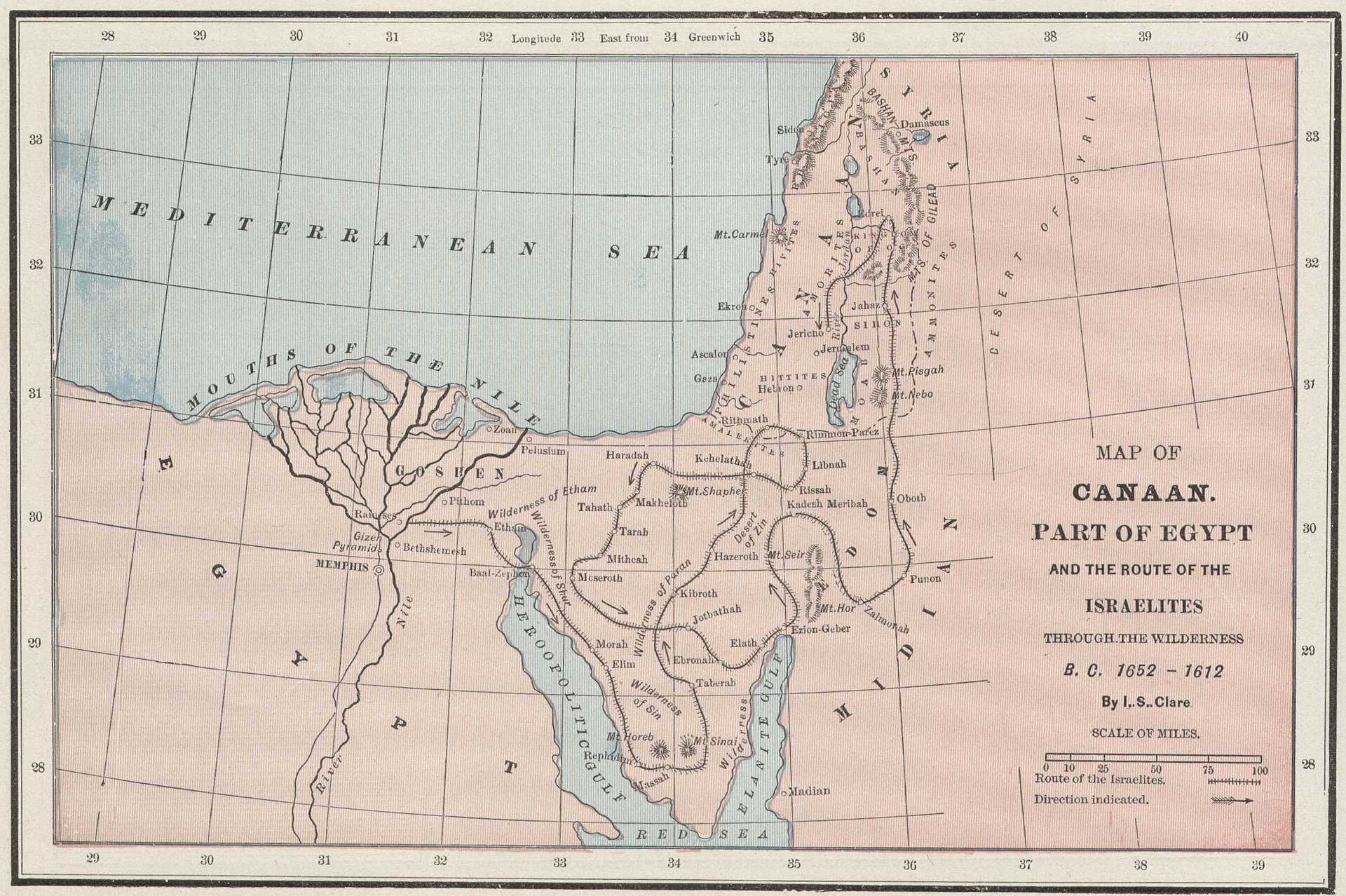
The water the name covers is a long narrow rift between Africa and Arabia. At its northern end it splits around the Sinai Peninsula into two arms. The Gulf of Suez is the western arm, long and shallow. The Gulf of Aqaba is the eastern arm, much shorter and far deeper. Between the head of the Gulf of Suez and the Mediterranean runs a low corridor of lakes and marsh: Lake Manzala, Lake Ballah, Lake Timsah and the Bitter Lakes. Every serious proposal for the crossing sits somewhere on that map.
Israel reached the water within days of leaving Egypt, and what happened there is the story told above. The account picks up on the far shore, because the sea does not leave the story once the army is dead in it.
Three days into the wilderness the people ran out of good water at Marah and complained. They came next to Elim, with its twelve springs and seventy palm trees, and then camped by the Red Sea again, which Numbers 33:10 records in one line. The deliverance got Israel out of Egypt. It did not by itself get Egypt out of Israel.
After that the name works as a road as much as a place. Numbers 21:4 has Israel setting out from Mount Hor along the route to the Red Sea in order to bypass Edom, and Numbers 14:25 uses the same phrase a generation earlier. Jephthah recites the same route to the Ammonites in Judges 11:16, centuries later, as a piece of national memory that needs no explaining.
Exodus 23:31 had promised borders running from the Red Sea to the Sea of the Philistines, and under Solomon the eastern end of that promise carries shipping. 1 Kings 9:26 puts Solomon's fleet at Ezion-geber, near Eloth in Edom, on the shore of the Red Sea, and the ships sail from there to Ophir and come back with gold. Ezion-geber sits at the head of the Gulf of Aqaba. That single verse is the strongest control there is on what the Hebrew name can mean, because no marsh launches an ocean-going fleet.
The memory kept working. Rahab tells two spies inside Jericho that she has heard how the LORD dried up the waters of the Red Sea, before Israel has even crossed the Jordan. Joshua sets the two crossings side by side. Nehemiah's returned exiles pray it back to God. Six psalms retell it, Isaiah turns it into the promise of a rescue still to come, and Stephen puts it in the sermon that cost him his life. Josephus retells the whole account for a Roman readership in the Antiquities of the Jews, Book 2, and compares the parting to the Pamphylian Sea opening before Alexander.
Second Temple Jewish writers heard the chapter their own way. The Animal Apocalypse in 1 Enoch, a labelled study resource on this site and never Scripture, retells Israel's history with the people as sheep and their oppressors as wolves, and gives the crossing in one sentence: “And that sea was divided, and the water stood on this side and on that before their face, and their Lord led them and placed Himself between them and the wolves.” That is Exodus 14:19 to 14:20 read as a person standing in the gap, written somewhere in the second century BC. It is evidence of how the chapter was received, not evidence of what happened.
Common questions
Was it the Red Sea or the Sea of Reeds?
Readers differ; the positions are named
The Hebrew is yam suph, and suph on its own means reed, so the plain sense of the two words is sea of reeds. The Septuagint, made by Jewish translators in Egypt in the third and second centuries BC, rendered it erythra thalassa, the Red Sea, and the New Testament follows it at Acts 7:36 and Hebrews 11:29.
The strongest argument against reading the phrase as marsh comes from the Bible itself. 1 Kings 9:26 uses the same two words of the water at Ezion-geber, where Solomon launched a fleet that sailed to Ophir. Both readings sit in the evidence, and neither of them settles where Israel crossed.
Where did Israel cross?
Readers differ; the positions are named
Nobody knows, and this page does not pretend otherwise. Four proposals hold the field: the northern Gulf of Suez, kept by the ancient tradition and by commentators such as Albert Barnes and Jamieson, Fausset and Brown; the Bitter Lakes or Lake Timsah at the end of the Wadi Tumilat, going back to Edouard Naville's work in 1883; the former Lake Ballah in the northern delta, argued by James K. Hoffmeier; and the Gulf of Aqaba at Nuweiba, promoted by Ron Wyatt, Bob Cornuke and Lennart Moller.
The three place names the text gives, Pi-hahiroth, Migdol and Baal-zephon, have never been fixed on the ground, which is why the argument is still open. That is also why this place carries no pin on the map. A point dropped on any one of the four would state a verdict the evidence does not support.
Did somebody find Pharaoh's chariot wheels in the sea?
Readers differ; the positions are named
Ron Wyatt reported from the late 1970s that he had found coral-encrusted chariot wheels, axles and bones on the seabed off Nuweiba, and photographs of the supposed finds circulate widely. No artefact from that site has ever been recovered, catalogued or published, and no independent examination has authenticated the photographs.
The claims are rejected by secular archaeologists and by confessional ones alike, including Associates for Biblical Research. Wyatt also said he had found Noah's ark, the ark of the covenant and the blood of Christ. The honest statement is that the crossing has produced no recovered physical evidence of any kind, at Nuweiba or anywhere else.
Was it a miracle, or a strong wind?
The text names a wind and calls the result the work of God, and it does both in one verse: all that night the LORD drove back the sea with a strong east wind that turned it into dry land. Two teams of oceanographers have modelled that mechanism, Doron Nof and Nathan Paldor in 1992 and Carl Drews and Weiqing Han in 2010, and both found that a sustained strong wind over shallow water can push it back and then let it return suddenly.
Adam Clarke drew the distinction this site keeps, arguing in 1832 that no natural agent could make water stand as a wall on both sides, and that the east wind served to dry the seabed once God had divided it. This site's tradition teaches Exodus 14 as a miracle of God, and reports the modelling as modelling.
How many people went through?
Readers differ; the positions are named
Exodus 12:37 says about 600,000 men on foot besides women and children, which on a plain reading means a company somewhere near two million. Some scholars take the Hebrew word eleph in its other sense of a clan or a military unit rather than the number one thousand, and read the figure as much smaller; Colin J. Humphreys argued that in Vetus Testamentum in 1998.
Kenneth Kitchen and others hold that the text means what it says. This page names both readings and settles neither.
What does Paul mean by baptized into Moses?
1 Corinthians 10:1 to 10:2 says Israel were all baptized into Moses in the cloud and in the sea, and Paul says it as a warning: the people who went through that water still fell in the wilderness. Christian readers from Tertullian onward took the crossing as a picture of baptism, with the cloud standing for the Spirit and the sea for the water.
Theodoret of Cyrus put it in one line in 458: the cloud is the grace of the Holy Spirit, while the sea represents baptism. On this site that is presented as the church's reading of Paul, and it is never used to say that the church has taken Israel's place.
Why does the rest of the Bible keep coming back to this?
Because it is the event Israel used to say what God is like. Rahab has heard about it inside Jericho before Israel crosses the Jordan, and Jephthah recites it to the Ammonites generations later.
Six psalms retell it, Nehemiah prays it back to God, Isaiah turns it into the promise of a deliverance still to come, Stephen puts it in his last sermon, and Revelation gives the redeemed the song of Moses to sing. The crossing is the fixed point every later writer measures God's power against.
When did it happen?
Readers differ; the positions are named
Two dates are held by serious people. The early date, about 1446 BC, follows the 480 years of 1 Kings 6:1 and the 300 years of Judges 11:26, and is held by Bryant G. Wood and Associates for Biblical Research, by Eugene Merrill in Kingdom of Priests (1987), and by Douglas Petrovich.
The late date, about 1260 to 1250 BC, follows the name Rameses at Exodus 1:11 and the building of Pi-Ramesse by Ramesses II, and is held by Kenneth Kitchen in On the Reliability of the Old Testament (2003) and by James Hoffmeier. This page prints both and lands nowhere, and the Egypt page states them the same way.
Notable art
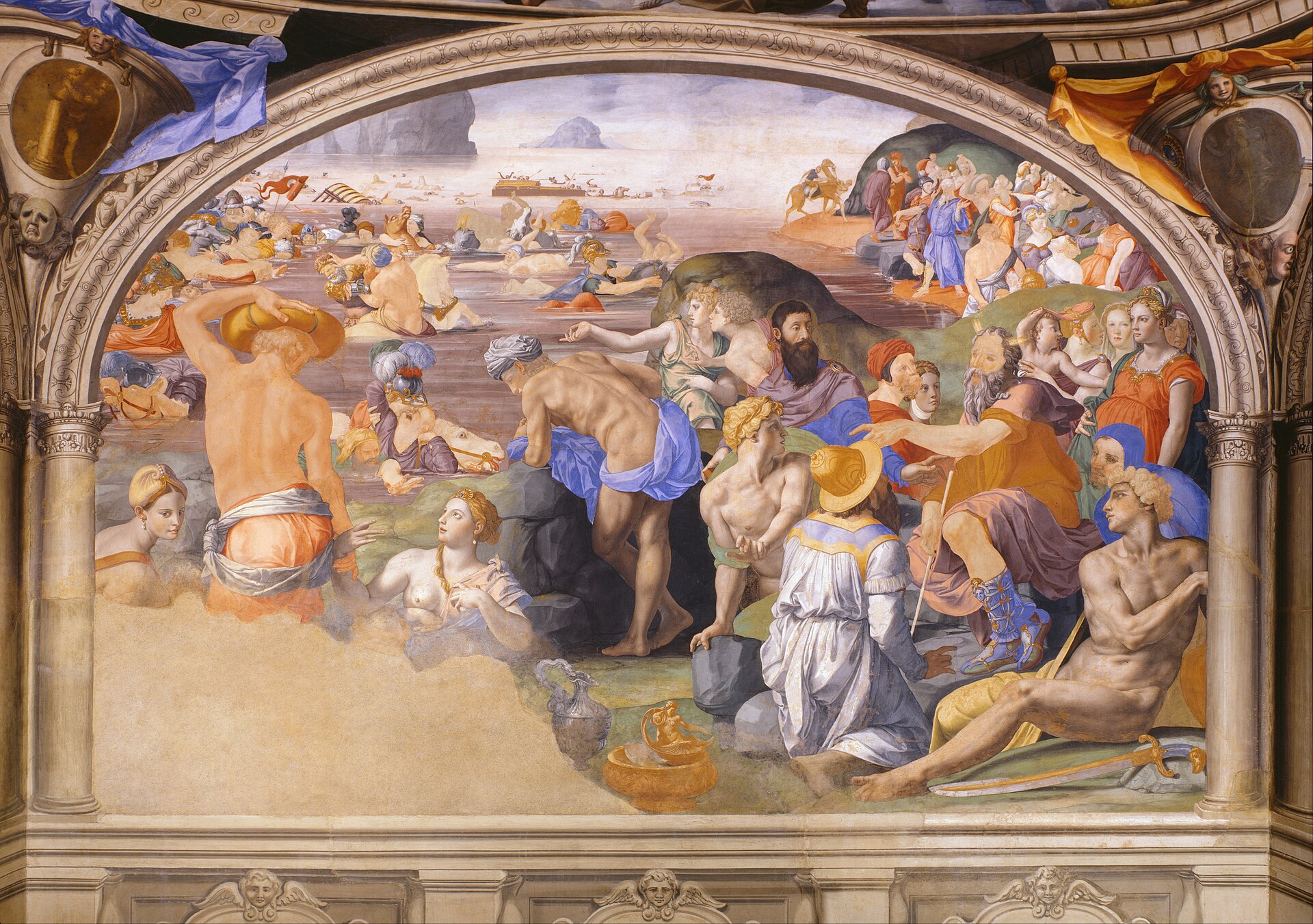
3 verified pieces depicting The Red Sea
Sources cited
- Berean Standard BiblePublic domain since 2023. Every verse quoted on this page, from the site's own verse store.
- Strong's Hebrew and Greek lexiconsThe site's lexicon floor. Entries h3220 yam, h5488 suph, h5489 Suph, g2063 erythros, g2281 thalassa.
- R. H. Charles, The Book of Enoch (London: SPCK, 1917)Public domain. The Animal Apocalypse passage quoted in the account, carried in the site's apocrypha store. A labelled study resource, never Scripture.
- Flavius Josephus, Antiquities of the Jews, Book 2Cited at book level for the retelling of the crossing and the comparison to the Pamphylian Sea before Alexander.
- Otto Eissfeldt, Baal Zaphon, Zeus Kasios und der Durchzug der Israeliten durchs Meer (Halle: Max Niemeyer, 1932)The identification of Baal-zephon with the sanctuary at Mount Casius, cited for the position it argues.
- Édouard Naville, The Store-City of Pithom and the Route of the Exodus (London: Egypt Exploration Fund, 1885)The 1883 excavation at Tell el-Maskhuta and the Wadi Tumilat route.
- James K. Hoffmeier, Israel in Egypt (Oxford University Press, 1996)The northern delta crossing and the late-date position, cited for the positions they argue.
- James K. Hoffmeier, Ancient Israel in Sinai (Oxford University Press, 2005)The wilderness geography, the Tell el-Borg excavation, and the answer to the Arabian location of Sinai.
- Kenneth A. Kitchen, On the Reliability of the Old Testament (Grand Rapids: Eerdmans, 2003)The late-date position on the Exodus, and the reading that takes the numbers as they stand.
- Eugene H. Merrill, Kingdom of Priests: A History of Old Testament Israel (Grand Rapids: Baker, 1987)The early-date position, cited for the position it argues.
- Bryant G. Wood and Associates for Biblical ResearchThe early-date position. Associates for Biblical Research is a confessional body, and this page names it as one.
- Larry Williams, The Mountain of Moses (New York: Wynwood Press, 1990)The Nuweiba and Jebel al-Lawz proposal, cited for the position it argues.
- Lennart Möller, The Exodus Case (Copenhagen: Scandinavia Publishing House, 2000)The same proposal, cited for the position it argues.
- Doron Nof and Nathan Paldor, "Are There Oceanographic Explanations for the Israelites' Crossing of the Red Sea?", Bulletin of the American Meteorological Society 73 (1992)Wind setdown modelled at the northern Gulf of Suez. Cited at journal level.
- Carl Drews and Weiqing Han, "Dynamics of Wind Setdown at Suez and the Eastern Nile Delta", PLoS ONE 5(8): e12481 (2010)Open access. The source of the wind speed, the twelve hours and the four-hour land bridge given on this page.
- Colin J. Humphreys, "The Number of People in the Exodus from Egypt", Vetus Testamentum 48 (1998)The reading of eleph as a clan or unit. Cited at journal level.
- Charles H. Spurgeon, The New Park Street Pulpit, sermon 136Public domain, CCEL edition, lightly modernized text.
- Adam Clarke, Commentary on the Bible (1832)Public domain.
- Albert Barnes, Notes, Explanatory and Practical, on the Old and New Testaments (1832 to 1869)Public domain. Cited for the crossing near Suez, as a position.
- Jamieson, Fausset & Brown, Commentary Critical and Explanatory on the Whole Bible (1871)Public domain. Cited for the crossing at Mount Attakah, as a position.
- John Wesley, Explanatory Notes upon the Old Testament (1765)Public domain.
- The patristic readings named on this page: Tertullian (about 220), Cyprian (258), Victorinus of Pettau (304), Cyril of Jerusalem (386), Gregory of Nyssa (395), John Chrysostom (407), Theodore of Mopsuestia (428), Augustine (430), Theodoret of Cyrus (458) and Bede (735)All public domain, all carried in the site's own curated quote pool.
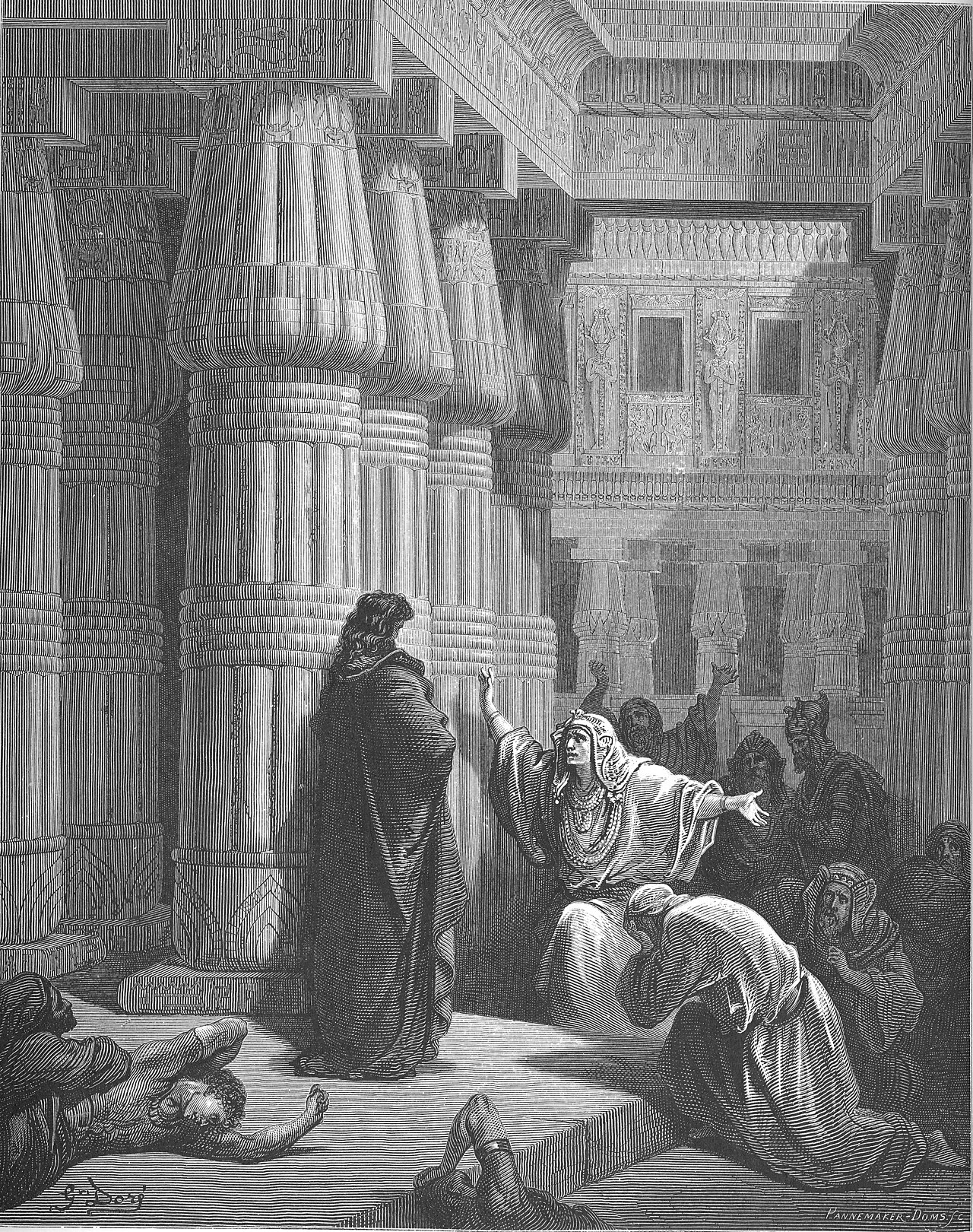
- Gustave Doré, La Sainte Bible (Tours: Alfred Mame et fils, 1866)Plates 36 and 37 on this page. Public domain.
- Agnolo Bronzino, The Crossing of the Red SeaPublic domain, via Wikimedia Commons and the Google Art Project. The one painting of the crossing this site holds.
- George F. Cram, Map of Canaan, part of Egypt and the route of the Israelites through the wildernessPublic domain. The atlas plate on this page.
- Drews and Han, Dynamics of Wind Setdown at Suez and the Eastern Nile Delta, PLoS ONE 5(8): e12481 (2010)Confirms the page's 28 m/s (about 63 mph) easterly wind for twelve hours, exposing a land bridge for about four hours, and cites Nof and Paldor 1992 directly. Confirmed 2026-09-02 (session 7 re-verification).
Keep studying
On this page
Studies15
Every page that names it1
Lives that run through it1
Doorway2
Keep this page