
Joshua 1 and 2 · Subject · Featured Study
The Haftarah
How the closing lesson of the Sabbath and feast-day readings is chosen, who reads it, and which lessons come from the Former Prophets.
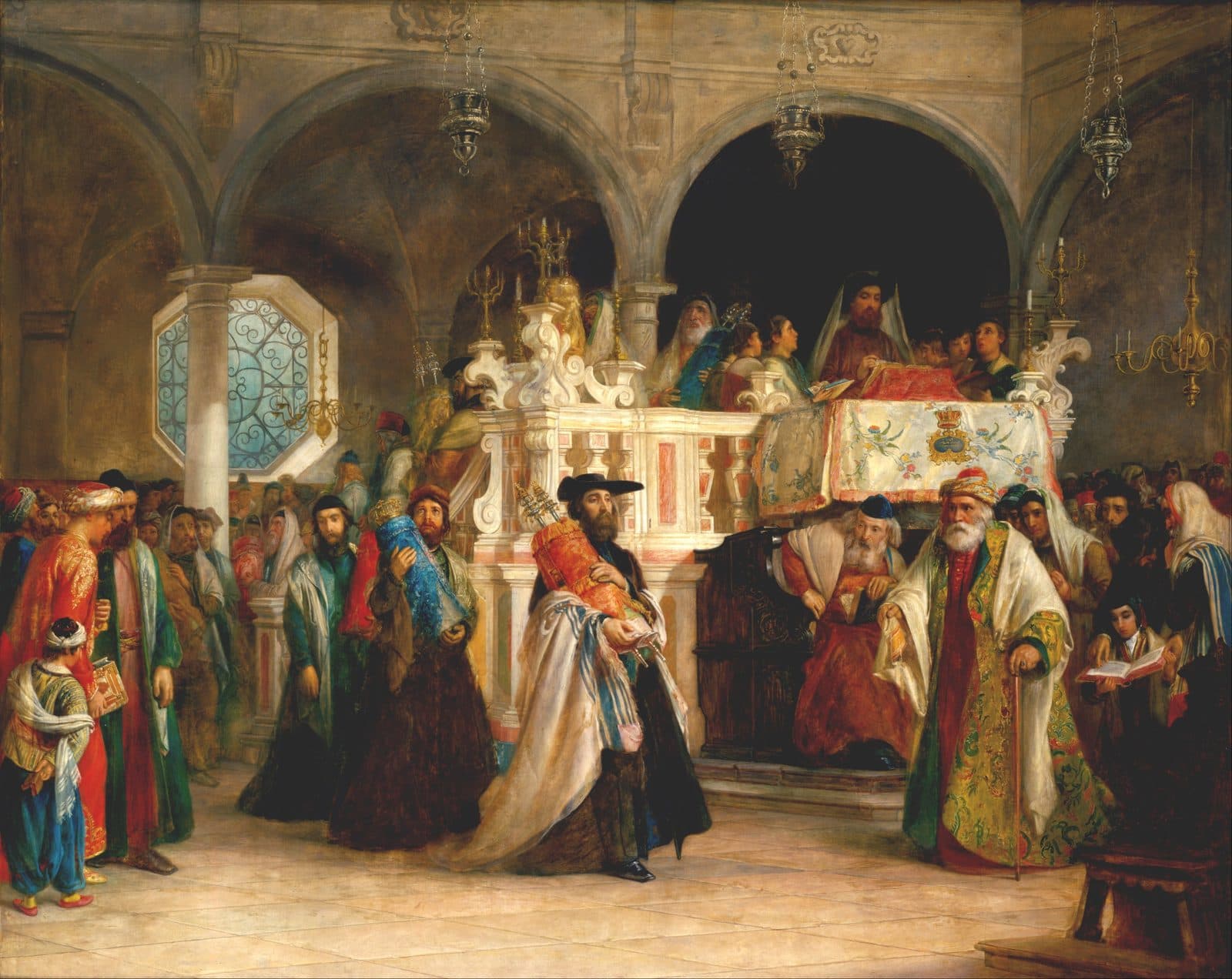
Solomon Alexander Hart, The Feast of the Rejoicing of the Law at the Synagogue in Leghorn, Italy, 1850, oil on canvas, The Jewish Museum, New York. Public domain (published before 1930), via Wikimedia Commons.
THE ARTWORKHart painted the synagogue of Livorno on Simchat Torah, with the scrolls carried in their mantles past the raised marble desk where the Law is read aloud. On that feast the yearly reading of the Torah ends and begins again at Genesis 1.
On the day the synagogue finishes reading Deuteronomy, the passage read after it is the first chapter of Joshua.
Summary
The Haftarah is the passage from the Prophets read in the synagogue after the portion of the Torah on Sabbaths and feast days.
- The Hebrew word means conclusion, because the reading from the Prophets closes the public reading of Scripture.
- Each Haftarah is chosen for a story, a law or a word it shares with the portion of the Law read before it.
- Joshua and Judges have no weekly portion of their own. A congregation hears them in four Sabbath readings, on Simchat Torah and on the first day of Passover.
- Luke 4 and Acts 13 show the Prophets read after the Law in the synagogues of the first century.
- No ancient source names who began the custom, and its origin is still argued.
The Law and the Prophets on the Sabbath
The Gospel of Luke and Acts set the reading in Nazareth, Pisidian Antioch and Jerusalem.
The main work of a synagogue service in the first century was the teaching of the people from Scripture. A portion of the Law was read first, and a passage from the Prophets and an address followed it.
Then Jesus came to Nazareth, where He had been brought up. As was His custom, He entered the synagogue on the Sabbath. And when He stood up to read, the scroll of the prophet Isaiah was handed to Him. Unrolling it, He found the place where it was written:The passage handed to Jesus comes from the Prophets, the second reading of the service, and He stands for it as readers did.
After the reading from the Law and the Prophets, the synagogue leaders sent word to them: “Brothers, if you have a word of encouragement for the people, please speak.”The leaders at Pisidian Antioch invite a word only after both readings are finished, and Paul's sermon follows.
For Moses has been proclaimed in every city from ancient times and is read in the synagogues on every Sabbath.”James gives the weekly reading of Moses as his reason for asking the Gentile believers to keep four rules, since every city already heard the Law.
The people of Jerusalem and their rulers did not recognize Jesus, yet in condemning Him they fulfilled the words of the prophets that are read every Sabbath.Paul makes the weekly reading part of his charge, since the hearers of those passages condemned the One they foretold.
Ezra reads the Law and the Levites give its senseNehemiah 8:8
So they read from the Book of the Law of God, explaining it and giving insight, so that the people could understand what was being read.The public reading after the exile joins the reading of the text to its explanation, the pattern the synagogue later kept with its translator and its address.
John Wesley, in his Explanatory Notes upon the Old Testament (1765) on Nehemiah 8:7, held that the Hebrew words had to be put into the Aramaic the people now spoke.
The Order of the Sabbath Morning Reading
The Mishnah and the later lists give the parts of the Sabbath morning reading.
- The Torah portionSeven men are called up in turn to read the week's portion of the Law, each reading three verses or more.
- The last reader (maftir)The man who will read from the Prophets is the last one called to the scroll of the Law.
- The blessings beforeHe says blessings for the Prophets and the Torah before he reads.
- The HaftarahHe reads the passage of the Prophets set for that portion, from ten to fifty-two verses long.
- The blessings afterHe gives thanks for God's faithfulness to His promises, for Zion and the throne of David, and for the Torah, the Prophets and the day.
A sequence of five steps, each naming who acts and what is read or said.
The Portions That Read Joshua and Judges
Five portions of the yearly cycle take their Haftarah from Joshua and Judges.
| Torah portion | Haftarah | What the two share |
|---|---|---|
| Beshalach, Exodus 13:17 to 17:16 | Judges 4:4 to 5:31; Sephardi rite Judges 5:1 to 31 | A song sung after a victory, by Moses at the sea and by Deborah and Barak |
| Nasso, Numbers 4:21 to 7:89 | Judges 13:2 to 25 | The law of the Nazirite, and Samson set apart as a Nazirite from the womb |
| Sh'lach, Numbers 13:1 to 15:41 | Joshua 2:1 to 24 | Spies sent into the land, twelve by Moses and two by Joshua |
| Chukat, Numbers 19:1 to 22:1 | Judges 11:1 to 33 | The march around Edom and Moab and the defeat of Sihon, which Jephthah retells |
| V'Zot HaBerachah, Deuteronomy 33:1 to 34:12 | Joshua 1:1 to 18; Sephardi rite Joshua 1:1 to 9 | The death of Moses, and the LORD's charge to Joshua after it |
The song of Moses and the song of DeborahExodus 15:1 and Judges 5:1
Then Moses and the Israelites sang this song to the LORD: “I will sing to the LORD, for He is highly exalted. The horse and rider He has thrown into the sea.Beshalach carries this song of the crossing, and the Haftarah answers it with another song of deliverance.
Barak's answer to Deborah follows the pattern of Miriam's answer to Moses.
“Deborah, as ‘a prophetess,’ both composed and sang this noble ode, which, for poetic spirit and lyric fire, is not surpassed by any of the sacred songs in the Bible. And, as Miriam took up the first verse of the song of Moses Exo 15:21, and sang it as an antiphony, so Barak, with the chorus of men, answered the song of Deborah by singing Jdg 5:2, which is also exactly suited for an antiphon, summing up as it does the subject matter of the whole ode. Compare David’s example 2Sa 6:15.”
Albert Barnes · Notes, Explanatory and Practical, on the Old and New Testaments (1832-1869) · on Judges 5:1Evangelical
The Nazirite in Numbers 6 and in Judges 13Numbers 6:5 and Judges 13:5
For the entire period of his vow of separation, no razor shall pass over his head. He must be holy until the time of his separation to the LORD is complete; he must let the hair of his head grow long.Nasso holds the law of the Nazirite, and the razor that may not touch his head is the sign the Haftarah takes up.
For behold, you will conceive and give birth to a son. And no razor shall come over his head, because the boy will be a Nazirite to God from the womb, and he will begin the deliverance of Israel from the hand of the Philistines.”The angel gives Samson's mother the same rule of the razor for a son who will be a Nazirite from birth.
The Jewish Encyclopedia gives the law of the Nazirite in Numbers 6 as the reason Judges 13 goes with this portion.
Twelve spies and twoNumbers 13:2 and Joshua 2:1
“Send out for yourself men to spy out the land of Canaan, which I am giving to the Israelites. From each of their fathers’ tribes send one man who is a leader among them.”Moses sends a leader from each tribe, and all but Joshua and Caleb bring back the report that turns the people away from the land.
Then Joshua son of Nun secretly sent two spies from Shittim, saying, “Go, inspect the land, especially Jericho.” So they went and entered the house of a prostitute named Rahab and stayed there.Joshua, one of the first twelve, sends two men in secret a generation later, and their report sends Israel across the Jordan.
Sihon in Numbers and in Jephthah's messageNumbers 21:23 to 24 and Judges 11:19 to 21
But Sihon would not let Israel pass through his territory. Instead, he gathered his whole army and went out to confront Israel in the wilderness. When he came to Jahaz, he fought against Israel. And Israel put him to the sword and took possession of his land, from the Arnon to the Jabbok—but only up to the border of the Ammonites, because it was fortified.Chukat tells of Sihon refusing Israel passage and losing his land from the Arnon to the Jabbok.
And Israel sent messengers to Sihon king of the Amorites, who ruled in Heshbon, and said to him, ‘Please let us pass through your land into our own place.’ But Sihon would not trust Israel to pass through his territory. So he gathered all his people, encamped in Jahaz, and fought with Israel. Then the LORD, the God of Israel, delivered Sihon and all his people into the hand of Israel, who defeated them. So Israel took possession of all the land of the Amorites who inhabited that country,Jephthah answers the king of the Ammonites with that same history, so the Haftarah repeats the portion's own events.
The last portion and the first chapterJoshua 1:8
The last portion of the Torah ends with the death of Moses in the land of Moab, and Joshua 1 opens with that death. The Haftarah takes up the story where the Torah leaves it.
This Book of the Law must not depart from your mouth; meditate on it day and night, so that you may be careful to do everything written in it. For then you will prosper and succeed in all you do.The LORD ties Joshua's success to the book Moses left, so the charge to the new leader answers the close of that book.
The Talmud names another Haftarah for that day. Megillah 31a sets Solomon's prayer, 1 Kings 8:22 to 53, after the reading of Deuteronomy 33 and 34, and the Jewish Encyclopedia of 1901 to 1906 lists Joshua 1 in its place.
Why Joshua and Judges Are Heard a Passage at a Time
The yearly cycle reads the Law through and takes from the Prophets the passages that answer it.
Each of the fifty-four portions of the yearly cycle is drawn from the five books of Moses. Joshua and Judges open the Former Prophets, and no portion is taken from them.
A congregation hears these books when a portion of the Law or a feast calls for one of their passages, and Megillah 31a sets Joshua 5:2 to 14 for the first day of Passover. The Mishnah let the reader of the Prophets skip from one place to another, and it forbade the reader of the Law to do the same.
The older cycle and its short readingsThe Jewish Encyclopedia, Haftarah
In the land of Israel the Law was once read over three years, and the Prophets were read in step with it, with a passage for every week. The Jewish Encyclopedia notes that these passages were often two or three verses long and that a list of them survives in a manuscript from a synagogue in Cairo.
The Reading in the Mishnah and the Later Sources
The Mishnah sets the rules of the reading, and Alfred Edersheim reads Luke 4 by them.
The rules and the lists of the reading were written down long after the New Testament.
- About AD 190 to 230Mishnah Megillah 4, Rules for the readers of the Law and of the Prophets on Sabbaths and weekdays.
- About AD 450 to 550Talmud Megillah 29b to 31a, A Haftarah for each feast and special Sabbath, each chosen to match the reading of the Law.
- About AD 900The prayer book of Amram Gaon, The blessings said before and after the Haftarah, first set down in the treatise Soferim.
- 1330 to 1340Sefer Abudarham, Seville, The order of the weekly portions and their Haftarot, with an account of how the custom began.
- 1901 to 1906The Jewish Encyclopedia, Haftarah, The list of every portion with its Haftarah, the Sephardi readings beside the Ashkenazi.
A timeline of five written witnesses after the New Testament, each row with its work.
The Mishnah gave no Haftarah to the readings of Monday, Thursday and the Sabbath afternoon, when three men read from the Law. A translator stood beside the reader and gave the text in Aramaic, one verse at a time from the Law and three at a time from the Prophets.
The Shema and the prayersMishnah Megillah 4:5
The man who read from the Prophets also said the blessing before the Shema and led the congregation in prayer. Alfred Edersheim, in Sketches of Jewish Social Life (1876), drew from this rule that Jesus in all likelihood led the prayers on the Sabbath He read from Isaiah.
He found the placeAlfred Edersheim, 1876
Edersheim held that no fixed list of passages from the Prophets stood in the time of Jesus, and that the choice was left to the reader. He read the words of Luke 4:17, that Jesus unrolled the scroll and found the place, as an exact account of that freedom.
The Words of the Reading
Four words name the parts of the reading.
HAFTARAH
The reading from the Prophets that concludes the reading of the Law, from the verb patar, to conclude.
MAFTIR
The one who concludes, the Mishnah's name for the man who reads the Haftarah.
METURGEMAN
The interpreter who stood by the reader and put the Hebrew into Aramaic as it was read.
DERASHAH
The homily that often followed the reading of the Prophets, given by the preacher called the darshan.
What the Sources Leave Unsaid
The New Testament and the Mishnah leave three matters open.
Luke 4:17 does not say whether the passage of Isaiah was set for that Sabbath or chosen by Jesus.
The account of Pisidian Antioch in Acts 13 does not name the passages read before Paul spoke.
Mishnah Megillah 4 gives the rules for reading the Prophets and names no passage for an ordinary Sabbath.
What Jesus Said of Moses and the Prophets
Three sayings in the Gospels set the Prophets beside the books of Moses.
Do not think that I have come to abolish the Law or the Prophets. I have not come to abolish them, but to fulfill them.Jesus answers the charge that He set Scripture aside by claiming to fulfill both of its parts.
But Abraham replied, ‘They have Moses and the prophets; let your brothers listen to them.’Abraham's answer in the parable assumes that the rich man's brothers could hear Moses and the prophets read.
And beginning with Moses and all the Prophets, He explained to them what was written in all the Scriptures about Himself.The risen Jesus treats Moses and the Prophets together as one witness to Himself, which is how the Haftarah has the reader hear them.
Voices on the Reading
Origen, Cyril of Alexandria and Matthew Henry on the reading of Scripture to the people.
Origen reads the finding of the place in Isaiah as God's own doing.
“It was no accident that he opens the scroll and finds the chapter of the reading that prophesies about him. This too was an act of God's providence.… Precisely the book of Isaiah was found, and the reading was no other but this one, which spoke about the mystery of Christ.”
Origen of Alexandria · Homilies on the Gospel of Luke 32.4 · on Luke 4:17Patristic
Cyril of Alexandria explains why Jesus said the passage was fulfilled that day.
“These words having been read to the assembled people, all eyes focused on Jesus, wondering perhaps how he could read without having been taught. The Israelites used to say that the prophecies concerning Christ were fulfilled, either in the persons of some of their more glorious kings or at least in the holy prophets. They did not correctly understand what was written about him, so they missed the true direction and traveled down another path. He carefully guards against error by saying, ‘This day is this prophecy fulfilled in your ears,’ that they might not again misinterpret the present prophecy.”
Cyril of Alexandria · Commentary on Luke, Homily 12 · on Luke 4:20 to 21Patristic
Matthew Henry draws from Ezra's reading a rule for everyone who reads Scripture aloud.
“Let those that read and preach the word learn also to deliver themselves distinctly, as those who understand what they say and are affected with it themselves, and who desire that those they speak to may understand it, retain it, and be affected with it likewise. It is a snare for a man to devour that which is holy.”
Matthew Henry · Commentary on the Whole Bible · on Nehemiah 8:8Puritan
How the Haftarah Began
Two accounts of the origin, each with its holders and the objection to it.
It began under the ban of AntiochusDavid Abudarham, Sefer Abudarham, 1330 to 1340
David Abudarham, in the Sefer Abudarham he wrote at Seville, gave a decree of persecution as the reason the Prophets are read. The Torah could not be read in public, so the Prophets were read in its place, twenty-one verses to answer the seven readers of three verses each, and the custom stayed when the ban ended. The Jewish Encyclopedia sets the decree under Antiochus IV Epiphanes, in 168 to 165 BC.
The same article answers that all authority for this account is lacking. Alfred Edersheim objected that a persecution strict enough to destroy the rolls of the Law would not have spared the rolls of the Prophets.
It grew from the feast days to every SabbathEmil G. Hirsch and Adolf Büchler, 1901 to 1906
Emil G. Hirsch and Adolf Büchler signed the main part of the Jewish Encyclopedia's article on the Haftarah. They held that the custom was older than the Christian era, kept at first on feast days and the four special Sabbaths and later on every Sabbath. They also held that the Pharisees, against the Sadducees, chose passages from the Former Prophets that supported their reading of the laws of the feasts.
The objection is that no text shows this earlier stage. The same article says that the Talmudic sources name no one who began the reading and that the passages for the feasts were first fixed in the second century.
Books on the Reading
Three works to read next, from the Mishnah to the Jewish Encyclopedia.
Mishnah Megillah, chapter 4
The sages of the Mishnah · about AD 190 to 230
The chapter sets the number of readers, the translator's work and who reads the Haftarah.
Read it on SefariaSketches of Jewish Social Life in the Days of Christ
Alfred Edersheim · 1876
Chapter 17 walks through the synagogue service and sets Luke 4 beside the Mishnah's rules.
Read it on ccel.orgThe Jewish Encyclopedia, Haftarah
Emil G. Hirsch, Adolf Büchler, Joseph Jacobs and I. George Dobsevage · 1901 to 1906
The article traces the accounts of the origin and the growth of the custom in Palestine and Babylonia.
Read it on jewishencyclopedia.comToday This Scripture Is Fulfilled
Luke 4 on the reading at Nazareth and Hebrews 1 on the God who spoke through the prophets.
At Nazareth the reading that closed the Law became the place where Jesus announced His own work.
So the Haftarah asks the reader to hear the Prophets beside the Law and to hear both as words about Christ.
Then He rolled up the scroll, returned it to the attendant, and sat down. The eyes of everyone in the synagogue were fixed on Him, and He began by saying, “Today this Scripture is fulfilled in your hearing.”Jesus sits down to teach after the reading, and His first words claim the passage for that very day.
On many past occasions and in many different ways, God spoke to our fathers through the prophets. But in these last days He has spoken to us by His Son, whom He appointed heir of all things, and through whom He made the universe.The letter sets the prophets the synagogue read beside the Son in whom God has now spoken.
Keep studying
Read it4
Studies9
People9
Doctrines9
Peoples and groups1