
Exodus 15:1 to 21 · Passage · Featured Study
The Song of the Sea
The song celebrates the LORD's victory over Pharaoh's chariots and army at the sea and names Him the strength and salvation of Israel.
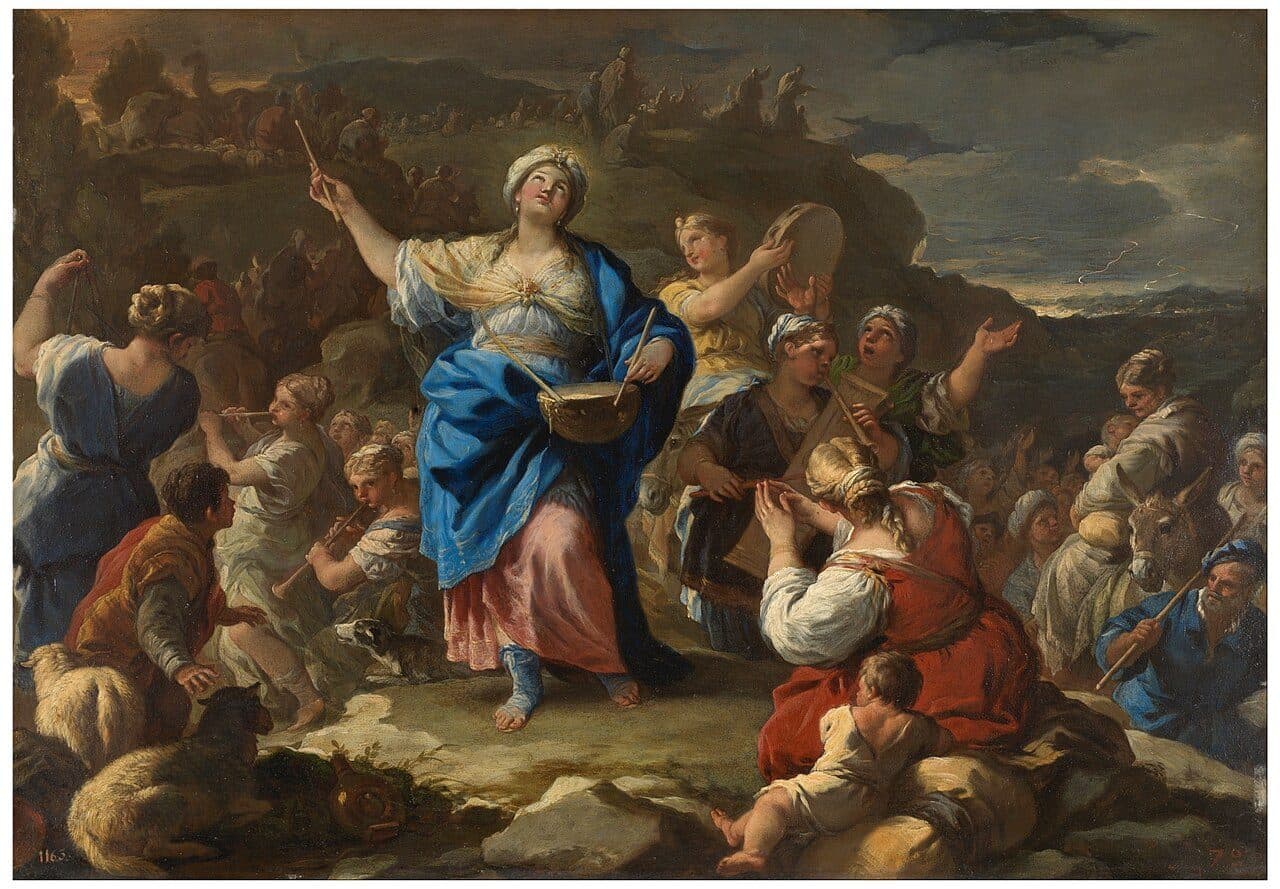
Luca Giordano, The Song of Miriam the Prophetess, about 1687, Museo del Prado, Madrid. Public domain, via Wikimedia Commons.
THE ARTWORKGiordano paints Miriam leading the women with music on the far shore, while the people move off over the hill behind her toward the desert.
The first song to the LORD in the Berean text is sung on the shore of the Red Sea.
Summary
The passage stands between the crossing of the sea in Exodus 14 and the march into the Desert of Shur in Exodus 15:22.
- C. F. Keil divides the song into a theme and three strophes.
- Miriam is the first woman the Berean text calls a prophetess.
- Readers divide over whether Moses composed the whole song at the sea or later hands extended its closing verses.
The Song and Its Setting, Verse by Verse
That day the LORD saved Israel from the hand of the Egyptians, and Israel saw the Egyptians dead on the shore. When Israel saw the great power that the LORD had exercised over the Egyptians, the people feared the LORD and believed in Him and in His servant Moses.The next verse opens with the word then, which joins the song to this sight on the shore.
Then Moses and the Israelites sang this song to the LORD: “I will sing to the LORD, for He is highly exalted. The horse and rider He has thrown into the sea.The line about the horse and rider is the one line of the song that Miriam repeats in verse 21.
The LORD is my strength and my song, and He has become my salvation. He is my God, and I will praise Him, my father’s God, and I will exalt Him. The LORD is a warrior, the LORD is His name. Pharaoh’s chariots and army He has cast into the sea; the finest of his officers are drowned in the Red Sea. The depths have covered them; they sank there like a stone.The singer calls the LORD a warrior, though Moses had told the people in Exodus 14:14 that the LORD would fight for them while they stood still.
Your right hand, O LORD, is majestic in power; Your right hand, O LORD, has shattered the enemy. You overthrew Your adversaries by Your great majesty. You unleashed Your burning wrath; it consumed them like stubble. At the blast of Your nostrils the waters piled up; like a wall the currents stood firm; the depths congealed in the heart of the sea. The enemy declared, ‘I will pursue, I will overtake. I will divide the spoils; I will gorge myself on them. I will draw my sword; my hand will destroy them.’ But You blew with Your breath, and the sea covered them. They sank like lead in the mighty waters.The strong east wind of Exodus 14:21 is sung here as the blast of the LORD's nostrils that piled up the waters.
Who among the gods is like You, O LORD? Who is like You—majestic in holiness, revered with praises, performing wonders? You stretched out Your right hand, and the earth swallowed them up. With loving devotion You will lead the people You have redeemed; with Your strength You will guide them to Your holy dwelling.The question of verse 11 answers the plagues, since the LORD had said in Exodus 12:12 that He would execute judgment against all the gods of Egypt.
The nations will hear and tremble; anguish will grip the dwellers of Philistia. Then the chiefs of Edom will be dismayed; trembling will seize the leaders of Moab; those who dwell in Canaan will melt away, and terror and dread will fall on them. By the power of Your arm they will be as still as a stone until Your people pass by, O LORD, until the people You have bought pass by.Rahab tells the spies in Joshua 2:9 to 11 that Canaan's people were melting in fear after they heard how the LORD dried up the sea.
You will bring them in and plant them on the mountain of Your inheritance—the place, O LORD, You have prepared for Your dwelling, the sanctuary, O Lord, Your hands have established. The LORD will reign forever and ever!”The song ends by looking past the wilderness to the mountain where the LORD would dwell among His people and reign.
For when Pharaoh’s horses, chariots, and horsemen went into the sea, the LORD brought the waters of the sea back over them. But the Israelites walked through the sea on dry ground.This one verse of prose retells the crossing and ties the song back to the night it celebrates.
Then Miriam the prophetess, Aaron’s sister, took a tambourine in her hand, and all the women followed her with tambourines and dancing. And Miriam sang back to them: “Sing to the LORD, for He is highly exalted; the horse and rider He has thrown into the sea.”Moses led the song and Miriam led the women's reply, so the chapter records two leaders of Israel's worship that day.
The Theme and the Three Strophes
Each strophe opens with praise of the LORD and runs longer than the one before.
| Part | Verses | The praise it opens with | The picture it closes on |
|---|---|---|---|
| The theme | Verse 1 | He is highly exalted | The horse and rider He has thrown into the sea |
| The first strophe | Verses 2 to 5 | The LORD is my strength and my song | They sank there like a stone |
| The second strophe | Verses 6 to 10 | Your right hand, O LORD, is majestic in power | They sank like lead in the mighty waters |
| The third strophe | Verses 11 to 18 | Who among the gods is like You, O LORD? | They will be as still as a stone (verse 16), and the LORD will reign forever and ever (verse 18) |
- Part
- The theme
- Verses
- Verse 1
- The praise it opens with
- He is highly exalted
- The picture it closes on
- The horse and rider He has thrown into the sea
- Verses
- Verses 2 to 5
- The praise it opens with
- The LORD is my strength and my song
- The picture it closes on
- They sank there like a stone
- Verses
- Verses 6 to 10
- The praise it opens with
- Your right hand, O LORD, is majestic in power
- The picture it closes on
- They sank like lead in the mighty waters
- Verses
- Verses 11 to 18
- The praise it opens with
- Who among the gods is like You, O LORD?
- The picture it closes on
- They will be as still as a stone (verse 16), and the LORD will reign forever and ever (verse 18)
How the Song Was Sung
Rashi, C. F. Keil and Jamieson, Fausset & Brown read verses 1 and 21 for how the song was sung and by whom.
Moses with the men, Miriam with the womenRashi; Jamieson, Fausset & Brown
Jamieson, Fausset & Brown, in their Commentary Critical and Explanatory (1871), note that the word them in verse 21 is masculine in the Hebrew. They take it that Moses led the men and Miriam the women, the two bands answering each other.
The women's refrainC. F. Keil
C. F. Keil, in his commentary on the Pentateuch (English 1864), holds that the women's chorus under Miriam repeated the theme of verse 1 as a refrain. He leaves open whether the refrain came after every verse or only after the longer strophes.
The tense of the verb sangRashi
The Hebrew verb for sang in verse 1 has the form that usually speaks of what is still to come. Rashi reads it as the intent that rose in Moses when he saw the miracle, which he then carried out.
Rashi also reports that the Rabbis read the form as a hint in the Torah of the resurrection of the dead, citing the Talmud at Sanhedrin 91b.
Miriam the Prophetess
Exodus 15:20 is the first verse of the Berean text to name Miriam.
and Amram’s wife was named Jochebed. She was also a daughter of Levi, born to Levi in Egypt. To Amram she bore Aaron, Moses, and their sister Miriam.This register names Miriam as the sister of both Aaron and Moses, so she is the sister who watched over the infant Moses at the Nile in Exodus 2:4.
The word prophetess appears in seven later verses of the Berean text, for Deborah, Huldah twice, Noadiah, the prophetess of Isaiah 8:3, Anna and the woman of Thyatira called Jezebel.
Then Miriam and Aaron criticized Moses because of the Cushite woman he had married, for he had taken a Cushite wife. “Does the LORD speak only through Moses?” they said. “Does He not also speak through us?” And the LORD heard this.Miriam's claim that the LORD also spoke through her is the next word Scripture gives about her gift.
Rashi gives two reasons for the title Aaron's sister. In the first, from the Talmud at Sotah 12b, Miriam prophesied while Aaron was her only brother that her mother would bear a son who would deliver Israel. In the second, Aaron pleaded for her when she was struck with leprosy, as Numbers 12:10 to 12 records.
Keil takes the title to rank Miriam with Aaron, both of them under Moses.
Matthew Henry weighs what Miriam is remembered for.
“When God brought Israel out of Egypt, it is said ( Micah vi. 4 ), He sent before them Moses, Aaron, and Miriam, though we read not of any thing memorable that Miriam did but this. But those are to be reckoned great blessings to a people who assist them, and go before them, in praising God.”
Matthew Henry · Commentary on the Whole Bible · on Exodus 15:20 to 21Puritan
And when Jephthah returned home to Mizpah, there was his daughter coming out to meet him with tambourines and dancing! She was his only child; he had no son or daughter besides her.Keil cites this welcome as the same custom of women meeting a victory with tambourines and dancing.
As the troops were returning home after David had killed the Philistine, the women came out of all the cities of Israel to meet King Saul with singing and dancing, with joyful songs, and with tambourines and other instruments. And as the women danced, they sang out: “Saul has slain his thousands, and David his tens of thousands.”The women's song for Saul and David is a couplet, as Miriam's reply in Exodus 15:21 is.
The Song Sung Again
A psalm of Israel's history recalls the song, and Isaiah and a psalm of thanksgiving repeat the first line of its second verse.
Then they believed His promises and sang His praise.The psalm tells the crossing in verses 9 to 11 and then records the belief of Exodus 14:31 and the song that followed it.
Surely God is my salvation; I will trust and not be afraid. For the LORD GOD is my strength and my song, and He also has become my salvation.”Isaiah sets the line in the song of the remnant who come home from Assyria on a highway (Isaiah 11:16).
The LORD is my strength and my song, and He has become my salvation. Shouts of joy and salvation resound in the tents of the righteous: “The right hand of the LORD performs with valor! The right hand of the LORD is exalted! The right hand of the LORD performs with valor!”Verses 15 and 16 go on to praise the right hand of the LORD as Exodus 15:6 does.
Voices on the Song
Matthew Henry and Ambrose of Milan read verses 1, 2 and 10 of the song.
Singing as worship before the lawMatthew Henry, on verse 1
“They expressed their joy in God, and thankfulness to him, by singing; it is almost natural to us thus to give vent to our joy and the exultations of our spirit. By this instance it appears that the singing of psalms, as an act of religious worship, was used in the church of Christ before the giving of the ceremonial law, and therefore was no part of it, nor abolished with it.”
Matthew Henry · Commentary on the Whole Bible · on Exodus 15:1Puritan
The LORD as the believer's strength and songMatthew Henry, on verse 2
“They have work to do, temptations to grapple with, and afflictions to bear, and are weak in themselves; but he strengthens them: his grace is their strength. They are often in sorrow, upon many accounts, but in him they have comfort, he is their song; sin, and death, and hell, threaten them, but he is, and will be, their salvation: See Isa. xii.”
Matthew Henry · Commentary on the Whole Bible · on Exodus 15:2Puritan
The sea as a figure of baptismAmbrose of Milan, on verse 10
“Moses himself says in his song, ‘You sent your Spirit, and the sea covered them.’ You observe that even then holy baptism was prefigured in that passage of the Hebrews, wherein the Egyptian perished, the Hebrew escaped. For what else are we daily taught in this sacrament but that guilt is swallowed up and error done away, but that virtue and innocence remain unharmed?”
Ambrose of Milan · On the Mysteries 3.12 · on Exodus 15:10Patristic
I do not want you to be unaware, brothers, that our forefathers were all under the cloud, and that they all passed through the sea. They were all baptized into Moses in the cloud and in the sea.Paul reads the crossing of the sea as a baptism into Moses, the reading Ambrose builds on.
When the Song Was Composed
The dispute turns on whether verses 13 and 17 speak of the past or of what was still to come.
Composed and sung at the seaC. F. Keil; Adam Clarke; Albert Barnes
C. F. Keil wrote the Pentateuch volumes of the commentary that bears his name and that of F. Delitzsch, and the preface of those volumes is signed by Keil alone. Keil holds that Moses composed the song for the congregation. He reads verses 13 to 18 as prophecy of the entry into Canaan and of a sanctuary there, and the Berean text renders those verses in the future tense. Adam Clarke, in his Commentary on the Bible (1810 to 1826), also reads verses 13 to 18 as a prediction of what God would do for the people He had redeemed.
“With the deliverance of Israel is associated the development of the national poetry, which finds its first and perfect expression in this magnificent hymn. It was sung by Moses and the people, an expression which evidently points to him as the author. That it was written at the time is an assertion expressly made in the text, and it is supported by the strongest internal evidence.”
Albert Barnes · Notes, Explanatory and Practical, on the Old and New Testaments (1832-1869) · on Exodus 15:1Evangelical
The objection: Driver reads verse 13 as a past event and verse 17 as the sanctuary at Shiloh or at Jerusalem.
A song of Moses extended laterS. R. Driver
S. R. Driver, in An Introduction to the Literature of the Old Testament (1891), holds that the greater part of the song is from Moses and that its closing verses were expanded at a later age. He takes verse 19 for a later editor's link back to the narrative.
Driver reports that Ewald, Dillmann and Delitzsch, the last in his commentary on Genesis, read the whole song as a later expansion of a theme from Moses in verses 1 to 3.
The objection: Driver grants that the verbs of verse 17 may be read as pasts or as futures. Keil answers that the critics reject verses 16 and 17 only because those verses look past the time of Moses.
The Song of Moses and of the Lamb
And I saw something like a sea of glass mixed with fire, beside which stood those who had conquered the beast and its image and the number of its name. They were holding harps from God,John saw the same sea of glass before the throne in Revelation 4:6.
and they sang the song of God’s servant Moses and of the Lamb: “Great and wonderful are Your works, O Lord God Almighty! Just and true are Your ways, O King of the nations! Who will not fear You, O Lord, and glorify Your name? For You alone are holy. All nations will come and worship before You, for Your righteous acts have been revealed.”Exodus 15:14 has the nations hear and tremble, and here all nations will come and worship before the Lord.
These verses ask the reader to fear the Lord and glorify His name, and to sing of the salvation the Lamb, Jesus Christ, has won as Israel sang of its rescue at the sea.
Keep studying
Read it1
Places7
Show the next 1 title
Symbols1
Doctrines7