
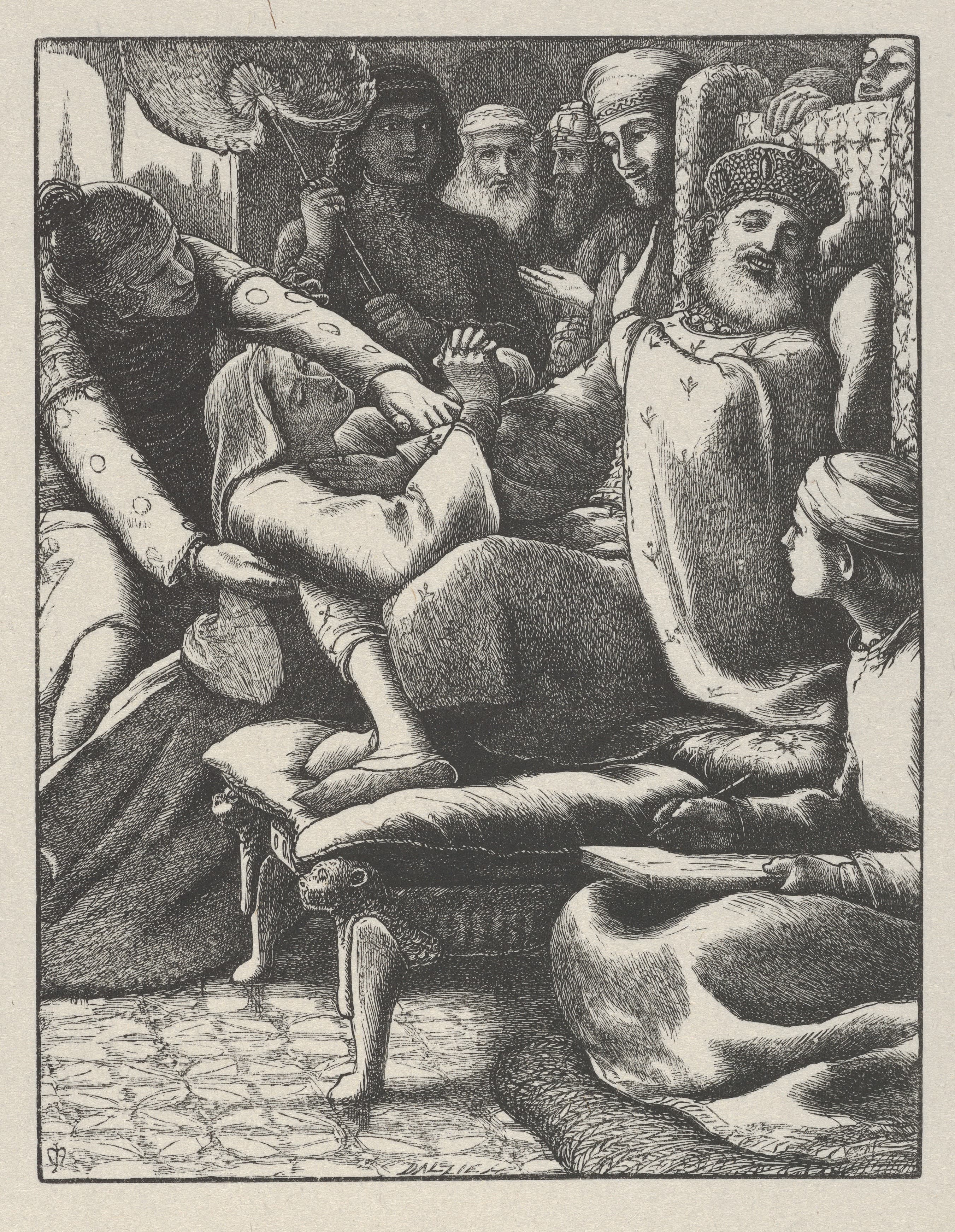
Luke 18:1 to 8 · Story · Prayer
The Persistent Widow
Luke 18:1 to 8 is a parable of Jesus set in a town court, told to His disciples about prayer.
A widow with no one to speak for her wore down a judge who answered to no one.
Then Jesus told them a parable about their need to pray at all times and not lose heart:
- Who
- Jesus of Nazareth
- When
- On the way to Jerusalem, between Samaria and Galilee (Luke 17:11)
Summary
A widow kept coming to a judge who had no fear of God and no regard for people, asking for justice against her adversary. He gave her justice in the end so that she would stop wearing him out. Luke sets the parable on Jesus' way to Jerusalem, after His words to the disciples about the days of the Son of Man, and the Pharisee and the tax collector follows it.
- Luke states the parable's purpose before the story, that the disciples should keep praying and never give up (Luke 18:1).
- The judge is a contrast with God, never a likeness of Him, and the argument runs from an unjust judge to a just God.
- The widow asks for justice against an opponent at law, the kind of case the Law of Moses told judges to defend.
- The parable ends with a question, whether the Son of Man will find faith on earth when He comes (Luke 18:8).
A Parable With Its Purpose First
The parable answers a question every praying disciple meets, how long to keep asking.
The Persistent Widow is a parable of Jesus about a widow who kept asking an unjust judge for justice until he gave it. It belongs to the value of prayer, since Luke says Jesus told it to teach His disciples to pray without losing heart.
The question this study answers is what the parable teaches about prayer that goes on while the answer is slow. It gives the parable in order, the law for widows, its Greek words, the argument from the lesser to the greater and the teachers' readings.
“In a certain town there was a judge who neither feared God nor respected men. And there was a widow in that town who kept appealing to him, ‘Give me justice against my adversary.’Jesus sets the weakest party in the town against the one man with power over her case.
The next parable opens the same way, told "To some who trusted in their own righteousness and viewed others with contempt" (Luke 18:9).
From the Pharisees' Question to the Question of Faith
Luke frames the parable with Jesus' teaching on the coming of the Son of Man.
The parable stands between a question about the coming of the kingdom of God and a question about faith at the Son of Man's coming.
- The Pharisees ask when the kingdom will comethe PhariseesLuke 17:20
- Jesus tells the disciples of days they will long to seeJesusLuke 17:22
- He sets His day beside the days of Noah and of LotJesusLuke 17:26 to 32
- He tells the parable and gives its purposeJesusLuke 18:1
- A judge fears no onethe judgeLuke 18:2
- A widow keeps appealing to himthe widowLuke 18:3
- The judge yields to be rid of herthe judgeLuke 18:4 to 5
- Jesus draws the lesson for God's electJesusLuke 18:6 to 7
- He asks about faith at His comingJesusLuke 18:8
A timeline of nine steps in Luke 17:20 to 18:8, each with the one who speaks or acts and its verse.
The judge yields to be rid of her, Jesus draws the lesson for God's elect, He asks about faith at His coming
The Judge and the Widow
The Law of Moses named the widow among those God defends, and the judge in the parable defended no one.
You must not mistreat any widow or orphan. If you do mistreat them, and they cry out to Me in distress, I will surely hear their cry.The Law set God Himself against anyone who mistreated a widow, the duty the judge of the parable ignored.
He executes justice for the fatherless and widow, and He loves the foreigner, giving him food and clothing.Moses names justice for the widow as the work of God, so a judge who refused it acted against God's own character.
The prophets held Israel's courts to the same duty: "Defend the fatherless and plead the case of the widow" (Isaiah 1:17).
The Greek word for the widow's opponent, antidikos, means an opponent in a lawsuit. It stands five times in four verses of the New Testament, and in 1 Peter 5:8 it names the devil.
The judge's words "wearing me out" render hypopiazo, a word for a blow under the eye, which stands only twice, here in Luke 18:5 and in 1 Corinthians 9:27.
How Much More
Two of Luke's parables of asking reach their lesson from an unwilling figure.
And the Lord said, “Listen to the words of the unjust judge. Will not God bring about justice for His elect who cry out to Him day and night? Will He continue to defer their help?The command to listen marks the turn from the story to its lesson for God's chosen.
Augustine stands here as an early reader who set out the parable's logic in full.
“These examples now are proposed so that important things may be suggested from things of less importance. They are like the example of the judge who feared neither God nor people and who nevertheless yielded to the widow bothering him to judge her case. He yielded not through piety or kindness but through fear of suffering annoyance. By no means does that unjust judge furnish an allegorical representation of God. The example is of an unjust man who, although he yields for the mere sake of avoiding annoyance, nevertheless cannot disregard those who bother him with continual pleadings. By this the Lord wishes us to infer how much care God bestows on those who beseech him, for God is both just and good.”
Augustine of Hippo · Sermon on the Mount 15 · on Luke 18:6 to 7Patristic
I tell you, even though he will not get up to provide for him because of his friendship, yet because of the man’s persistence, he will get up and give him as much as he needs.The friend at midnight gives way for the asker's persistence, as the judge gives way in Luke 18.
That parable ends with the Father in heaven, who will give "the Holy Spirit to those who ask Him" (Luke 11:13).
The widow's coming day after day has its picture in Anna, who "was a widow to the age of eighty-four" and "worshiped night and day, fasting and praying" (Luke 2:37).
The widow who is truly in need and left all alone puts her hope in God and continues night and day in her petitions and prayers.Paul gives the widow left alone the same prayer by night and day that Jesus gives the elect in Luke 18:7.
Luke 11:8, 1 Timothy 5:5
The Frame in Luke 17
Jesus had just told the disciples to expect a long wait and a sudden day.
For just as the lightning flashes and lights up the sky from one end to the other, so will be the Son of Man in His day.The day of the Son of Man will come as plainly as lightning, so the disciples need not chase rumours while they wait.
In the days of Noah, "People were eating and drinking" up to the day Noah entered the ark (Luke 17:27), and Jesus said His own day would come the same way.
Theophylact of Ohrid stands here for the tie between the dangers of Luke 17 and the prayer of Luke 18.
“Since the Lord mentioned sorrows and dangers, He also offers the remedy for them. This remedy is prayer, and not simply prayer, but constant and fervent prayer.”
Theophylact of Ohrid · Commentary on Luke · on Luke 18:1Patristic
So keep watch at all times, and pray that you may have the strength to escape all that is about to happen and to stand before the Son of Man.”Later in Luke, Jesus joins watching and prayer again before the coming of the Son of Man.
Will He Find Faith on Earth?
The Greek words for speed and for patience stand side by side in Luke 18:7 to 8.
I tell you, He will promptly carry out justice on their behalf. Nevertheless, when the Son of Man comes, will He find faith on earth?”The parable's last line turns from the faithfulness of God to the faithfulness of the hearer.
The Greek of the verse has the article before faith, the faith. The word for "promptly" is tachos, speed, which stands eight times, Revelation 1:1 and Revelation 22:6 among them.
The verb rendered "defer" in Luke 18:7 is makrothymeo, to be patient, which stands ten times in the New Testament.
The Lord is not slow in keeping His promise as some understand slowness, but is patient with you, not wanting anyone to perish but everyone to come to repentance.Peter uses the same verb of the Lord's patience, which explains how the day of justice can be long in coming.
And they cried out in a loud voice, “How long, O Lord, holy and true, until You avenge our blood and judge those who dwell upon the earth?”The martyrs' cry uses the widow's verb ekdikeo, to give justice, and asks how long the waiting will last.
Cyril of Alexandria stands here for the widow as a pattern for the prayer of God's elect.
“The present parable assures us God will bend his ear to those who offer him their prayers, not carelessly nor negligently but with earnestness and constancy. The constant coming of the oppressed widow conquered the unjust judge that did not fear God or have any shame. Even against his will, he granted her request. How will not he who loves mercy and hates iniquity, and who always gives his helping hand to those that love him, accept those who draw near to him day and night and avenge them as his elect?”
Cyril of Alexandria · Commentary on Luke, Homily 119 · on Luke 18:2 to 5Patristic
Revelation 6:10, Cyril of Alexandria
Where Readers Differ on the Parable
Readers differ on what the widow and the judge stand for and on when the promised justice comes.
Augustine, as the Catena Aurea gives him, read the widow as a figure of the Church, desolate until the Lord comes. Irenaeus, in Against Heresies Book 5, read the unjust judge as the Antichrist and the widow as the earthly Jerusalem.
John Wesley, in his Explanatory Notes upon the New Testament (1755), read the promised justice as near, God saving the Christians out of the general destruction. Jamieson, Fausset and Brown (1871) read it at the end, with the answer delayed until faith in Christ's coming is scarcely found.
The Next Parable
Luke follows the widow with two men who went up to the temple to pray.
But the tax collector stood at a distance, unwilling even to lift up his eyes to heaven. Instead, he beat his breast and said, ‘God, have mercy on me, a sinner!’ I tell you, this man, rather than the Pharisee, went home justified. For everyone who exalts himself will be humbled, but the one who humbles himself will be exalted.”The next parable turns from how long to pray to how to stand before God while praying.
Prayer in Luke sets the widow among the moments of prayer across the whole Gospel, and Jesus on Prayer gathers His teaching on prayer in one study.
Sources
Scripture is the Berean Standard Bible.
- STEP Bible, Translators Amalgamated Greek New Testament, the tagged Greek text (Tyndale House, Cambridge), CC BY 4.0.
- STEP Bible TBESG lexicon of Extended Strongs for Greek (Tyndale House, Cambridge), CC BY 4.0, based on Abbott-Smith (1922)
- Augustine of Hippo, Sermon on the Mount 15 (fifth century), and his words on Luke 18 in Thomas Aquinas, Catena Aurea.
- Irenaeus, Against Heresies, Book 5 (second century)
- John Wesley, Explanatory Notes upon the New Testament (1755), on Luke 18:7.
- Robert Jamieson, A. R. Fausset and David Brown, Commentary Critical and Explanatory on the Whole Bible (1871), on Luke 18:8.
- Theophylact of Ohrid, Commentary on Luke (eleventh century)
- Tertullian, Against Marcion, Book 4 (third century)
- Cyril of Alexandria, Commentary on Luke, Homily 119 (fifth century)
Keep Studying
In this value4
People and groups7