
Genesis 39 to 50 · Subject · Featured Study
The Religion of Egypt: Its Gods and Practices
Egypt's magicians, priests, customs of the table, divination and embalming as Genesis records them in the story of Joseph, with the verdict of Exodus and the prophets.
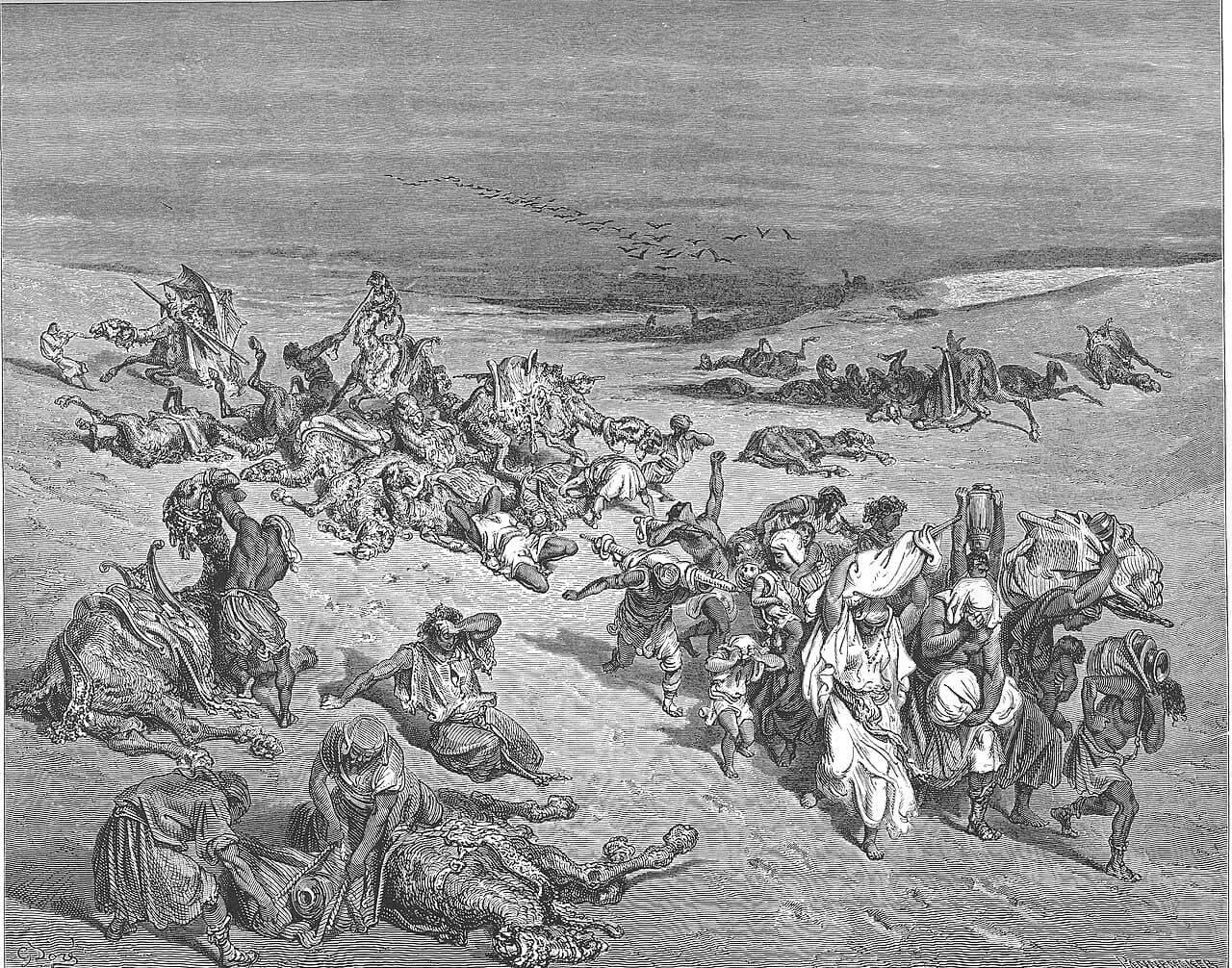
Gustave Doré, The Fifth Plague: Livestock Disease, The Holy Bible, Tours, 1866. Public domain.
THE ARTWORKDoré drew the fifth plague as a plain of fallen camels and cattle, with men kneeling by the dead and families carrying their goods away. The plagues the plate belongs to ended on the night of Exodus 12:12, when the firstborn of Egypt died.
Joseph rose to rule beside Egypt's magicians and priests, and he named God before Pharaoh.
Summary
Genesis 39 to 50 shows the religion of Egypt only where it touches Joseph and his family, and Exodus 12:12 records the LORD's judgment against all the gods of Egypt.
- Pharaoh's magicians could not interpret his dreams, and Pharaoh said the Spirit of God abides in Joseph.
- Joseph married Asenath, the daughter of Potiphera, priest of On.
- Egyptians would not eat with Hebrews and held shepherds detestable, so Jacob's household settled in Goshen.
- Egyptian physicians embalmed Jacob, and Joseph was embalmed and placed in a coffin in Egypt.
The God of Joseph in Egypt
Three passages name God in an Egyptian house, at Pharaoh's court and at Joseph's death.
Joseph came to Egypt as a slave, bought by Potiphar, an officer of Pharaoh and captain of the guard.
No one in this house is greater than I am. He has withheld nothing from me except you, because you are his wife. So how could I do such a great evil and sin against God?”In his Egyptian master's house, Joseph weighs the act against God before he weighs it against his master.
So Pharaoh asked them, “Can we find anyone like this man, in whom the Spirit of God abides?” Then Pharaoh said to Joseph, “Since God has made all this known to you, there is no one as discerning and wise as you.Pharaoh credits Joseph's wisdom to God, and Adam Clarke notes that his words for the Spirit of God are the words of Genesis 1:2.
Then Joseph said to his brothers, “I am about to die, but God will surely visit you and bring you up from this land to the land He promised on oath to Abraham, Isaac, and Jacob.” And Joseph made the sons of Israel take an oath and said, “God will surely attend to you, and then you must carry my bones up from this place.”At his death Joseph looks beyond Egypt, and his charge about his bones tells his family it will one day leave.
Egypt's Practices in Genesis 39 to 50
Seven practices of Egypt stand in these chapters, each at its verses.
| Practice | Verses | What Genesis says |
|---|---|---|
| Magicians and wise men | Genesis 41:8 and 41:24 | None of them could interpret Pharaoh's dreams. |
| The priest of On | Genesis 41:45, 41:50 and 46:20 | His daughter Asenath bore Joseph two sons, Manasseh and Ephraim. |
| Separate tables | Genesis 43:32 | The Egyptians would not eat with the Hebrews, since that was detestable to them. |
| The cup of divination | Genesis 44:5 and 44:15 | The steward calls the silver cup the one his master uses for divination. |
| Shepherds kept apart | Genesis 46:34 | All shepherds were detestable to the Egyptians. |
| The priests' land | Genesis 47:22 and 47:26 | The priests ate rations Pharaoh supplied and did not sell their land. |
| Embalming and the coffin | Genesis 50:2 to 3 and 50:26 | Physicians took forty days to embalm Jacob, and Joseph's body was laid in a coffin. |
- Practice
- Magicians and wise men
- Verses
- Genesis 41:8 and 41:24
- What Genesis says
- None of them could interpret Pharaoh's dreams.
- Practice
- The priest of On
- Verses
- Genesis 41:45, 41:50 and 46:20
- What Genesis says
- His daughter Asenath bore Joseph two sons, Manasseh and Ephraim.
- Practice
- Separate tables
- Verses
- Genesis 43:32
- What Genesis says
- The Egyptians would not eat with the Hebrews, since that was detestable to them.
- Practice
- The cup of divination
- Verses
- Genesis 44:5 and 44:15
- What Genesis says
- The steward calls the silver cup the one his master uses for divination.
- Practice
- Shepherds kept apart
- Verses
- Genesis 46:34
- What Genesis says
- All shepherds were detestable to the Egyptians.
- Practice
- The priests' land
- Verses
- Genesis 47:22 and 47:26
- What Genesis says
- The priests ate rations Pharaoh supplied and did not sell their land.
- Practice
- Embalming and the coffin
- Verses
- Genesis 50:2 to 3 and 50:26
- What Genesis says
- Physicians took forty days to embalm Jacob, and Joseph's body was laid in a coffin.
On, the Priests and the Table
The commentators write on the city of On, the priests' land, the days of embalming and the Egyptian table.
Potiphera's city stands in Scripture under two spellings. Genesis calls it On, and Ezekiel spells the same Hebrew name Aven.
The young men of On and Pi-beseth will fall by the sword, and those cities will go into captivity.This oracle against Egypt is the one place outside Genesis where the city's name stands.
Theodoret of Cyrus, writing on Jeremiah 43:13, says the city had two names, On and Heliopolis. Adam Clarke reads the Beth-shemesh of that verse as the house or temple of the sun, the same city as Heliopolis.
Albert Barnes adds that Aven also means transgression, and he reports readers who think Ezekiel chose that spelling to mark the city's idolatry.
Adam Clarke reads Genesis 47:22 as the earliest account of an established religion supported by the state.
He also counts the seventy days of mourning in Genesis 50:3 as the forty days of embalming and thirty more in natron.
Readers give three reasons for the rule of Genesis 43:32 and 46:34. Jamieson, Fausset and Brown trace it to the hatred the shepherd kings left behind them. Adam Clarke, on Exodus 8:26, says Israel's sacrifices were animals Egypt held sacred.
Ambrose of Milan finds the reason in the flocks and in Egypt's work on the land.
“You tell me that you have felt a difficulty in the text We shall sacrifice the abomination of the Egyptians to the Lord our God. But you had the means of solving it, for it is written in the book of Genesis, that a shepherd is an abomination to the Egyptians, and this not on account of the shepherd himself, but of his flocks. For the Egyptians were tillers of the ground, but Abraham and Jacob, and afterwards Moses and David, were shepherds, and in this function exercised a certain kingly discipline.”
Ambrose of Milan · Letter 27.1-3 · on Exodus 8:26Patristic
The Hebrew of Egypt's Practices
Six Hebrew words name Egypt's practices in Genesis 39 to 50.
CHARTUMMIM (HEBREW, H2748)
Chartummim names Pharaoh's magicians here and again in Exodus 7 to 9 and in Daniel 1 and 2. Adam Clarke held it an Egyptian word for interpreters of hard matters, above all of hieroglyphics.
KOHEN (HEBREW, H3548)
Kohen names Potiphera's office in Genesis 41:45. Rashi notes that the word usually names one who ministers to a deity. In a few places it names a man of high rank, and Rashi counts the chief of On among them.
TO'EVAH (HEBREW, H8441)
To'evah stands behind the word detestable in Genesis 43:32 and 46:34. Its sense in the lexicon is an abhorrence, and especially idolatry or an idol.
NACHASH (HEBREW, H5172)
Nachash is the verb of the cup in Genesis 44:5 and 44:15. Its sense in the lexicon is to whisper a spell, and more generally to foretell.
CHANAT (HEBREW, H2590)
Chanat is the verb for embalming, from a root that means to spice. Rashi explains embalming as the use of a mixture of aromatic spices.
ARON (HEBREW, H727)
The coffin of Genesis 50:26 is an aron, a box, the word Exodus 25 uses for the ark of the covenant.
What the Text Leaves Unsaid
Genesis 39 to 50 leaves four things about the religion of Egypt unrecorded.
The Berean text of Genesis 39 to 50 never uses the word gods, and it names no god of Egypt.
Genesis does not say what Potiphera served at On, or whether Asenath kept her father's worship after her marriage.
Genesis states the Egyptians' rule against eating with Hebrews and against shepherds, and it gives no reason for it.
Genesis never shows Joseph using the silver cup.
The Judgment on the Gods of Egypt
Four books after Genesis follow the magicians to their end and record the sentence passed on Egypt's temples and idols.
Exodus names magicians again at the court of a later Pharaoh, and there their part runs from a matched sign to a confession.
But Pharaoh called the wise men and sorcerers and magicians of Egypt, and they also did the same things by their magic arts. Each one threw down his staff, and it became a serpent. But Aaron’s staff swallowed up the other staffs.The first contest shows that the magicians' arts could copy the sign and could not stand against it.
The magicians tried to produce gnats using their magic arts, but they could not. And the gnats remained on man and beast. “This is the finger of God,” the magicians said to Pharaoh. But Pharaoh’s heart was hardened, and he would not listen to them, just as the LORD had said.This is where the magicians fail for the first time and give the credit to God.
Albert Barnes calls the finger of God a thoroughly Egyptian expression, which need not mean the magicians recognized the LORD.
The magicians could not stand before Moses, because the boils had broken out on them and on all the Egyptians.Here the plague strikes the magicians themselves and they leave the contest, and Exodus names them no more.
On that night I will pass through the land of Egypt and strike down every firstborn male, both man and beast, and I will execute judgment against all the gods of Egypt. I am the LORD.Here the judgment reaches past Pharaoh and his magicians to the gods of Egypt, and the LORD gives His own name as their judge.
who were burying all their firstborn, whom the LORD had struck down among them; for the LORD had executed judgment against their gods.Moses' record of the journey looks back on that night as a judgment on Egypt's gods.
The prophets on the temples and gods of EgyptJeremiah 43 and 46; Ezekiel 30
I will kindle a fire in the temples of the gods of Egypt, and Nebuchadnezzar will burn those temples and take their gods as captives. So he will wrap himself with the land of Egypt as a shepherd wraps himself in his garment, and he will depart from there unscathed. He will demolish the sacred pillars of the temple of the sun in the land of Egypt, and he will burn down the temples of the gods of Egypt.’”Here the prophet carries the judgment of Exodus 12:12 into Egypt's own sanctuaries.
The LORD of Hosts, the God of Israel, says: “Behold, I am about to punish Amon god of Thebes, along with Pharaoh, Egypt with her gods and kings, and those who trust in Pharaoh.Here the LORD's judgment falls on an Egyptian god called by name.
Albert Barnes calls Amon the first of the supreme triad of Thebes, a god whose name signifies the concealed.
This is what the Lord GOD says: I will destroy the idols and put an end to the images in Memphis. There will no longer be a prince in Egypt, and I will instill fear in that land.Adam Clarke reads the city of this oracle as the place where Apis was particularly worshipped.
Two Voices on Egypt's Magicians and Priests
Albert Barnes in the nineteenth century and Origen in the third read Egypt's magicians and its priests.
Albert Barnes tells apart the three kinds of men Pharaoh summoned against Moses.
“Three names for the magicians of Egypt are given in this verse. The ‘wise men’ are men who know occult arts. The ‘sorcerers’ are they who ‘mutter magic formulae,’ especially when driving away crocodiles, snakes, asps, etc. It was natural that Pharaoh should have sent for such persons. The ‘magicians’ are the ‘bearers of sacred words,’ scribes and interpreters of hieroglyphic writings.”
Albert Barnes · Notes, Explanatory and Practical, on the Old and New Testaments (1832-1869) · on Exodus 7:11Evangelical
Origen sets the priests of Pharaoh beside the priests of the LORD.
“Indeed, do you wish to know what the difference is between the priests of God and the priests of Pharaoh? Pharaoh grants lands to his priests. The Lord, on the other hand, does not grant his priests a portion in the land but says to them: ‘I am your portion.’”
Origen of Alexandria · Homilies on Genesis 16.5 · on Genesis 47:26Patristic
Where Readers Differ
Readers differ on the gods of Exodus 12:12, on Joseph's cup and on the age of the Egyptian detail in Genesis.
The idols themselves were destroyedMatthew Henry
“Moses does not mention the fulfillment, in this chapter, yet he speaks of it Num. xxxiii. It is very probable that the idols which the Egyptians worshipped were destroyed, those of metal melted, those of wood consumed, and those of stone broken to pieces, whence Jethro infers ( ch. xviii. 11 ), The Lord is greater than all gods.”
Matthew Henry · Commentary on the Whole Bible · on Exodus 12:12 to 13Puritan
Against this reading stands the chapter itself, which tells of the firstborn struck down and of no image broken.
The sacred animals died with the firstborn of the livestockJohn Wesley; Adam Clarke
John Wesley, on Numbers 33:4, takes their gods as the beasts Egypt worshipped, killed when the firstborn of man and beast died. Adam Clarke gives the same reading first on Exodus 12:12.
Clarke himself doubts it, and he says the reading does not appear very clear and satisfactory.
The gods are Egypt's princesthe King James Version's margin, reported by Adam Clarke
The margin of the King James Version renders elohey in Exodus 12:12 as princes. Adam Clarke reports the reading and names the princes as the rulers under Pharaoh, as hostile to the Hebrews as he was.
Jeremiah 46:25 tells against it, since that verse names Egypt's gods and its kings as two objects of one judgment.
The first plague struck the Nile Egypt worshippedAlbert Barnes
Albert Barnes, on Exodus 7:15, says the Nile was worshipped under various names and symbols, so the first plague struck what Egypt revered.
In the Berean text of Exodus 7 to 12 the word gods stands only at Exodus 12:12, and no plague is tied to a named god.
The cup was used for divining, as Egyptians used cupsJamieson, Fausset and Brown
Jamieson, Fausset and Brown take the cup as one the governor drank from and divined by, and they call divination by cups a common practice of ancient Egypt.
Joseph himself gave the steward the words of Genesis 44:5 as part of the test he set his brothers.
The verb means to look closely and find outAdam Clarke; Rashi
Adam Clarke reads nachash in its general sense of viewing attentively and inquiring. Rashi reads Joseph's words in Genesis 44:15 as a claim that he could find the thief by his own sense and reasoning.
The law uses the same verb for the divination it forbids in Leviticus 19:26 and Deuteronomy 18:10.
The Egyptian detail fits the age of JosephKenneth Kitchen; James Hoffmeier
Genesis 41:45 gives Joseph the name Zaphenath-paneah and names his wife Asenath and her father Potiphera, and all three names are Egyptian.
When the Egyptian detail entered the story is disputed. Kitchen and Hoffmeier hold the traditional reading. Kenneth Kitchen, in On the Reliability of the Old Testament (2003), reads the Egyptian detail of Genesis 39 to 50 as fitting Egypt of the second millennium BC. James Hoffmeier reads it the same way in Israel in Egypt (1997).
They count among that detail the court titles and the dream readers, and both treat Jacob's embalming as an Egyptian practice.
The story's colour comes from a later EgyptDonald Redford
Donald B. Redford, in A Study of the Biblical Story of Joseph (1970), dated the Egyptian colour of the story to the first millennium BC.
State of the question as of 2003: Kitchen answered Redford's book in chapter 10 of On the Reliability of the Old Testament, arguing that its word lists cannot establish a late date. He grants Redford that Genesis 37 and 39 to 50 form one story within Genesis and that some Egyptian parallels proposed for it do not hold.
Books on Egypt in Genesis and Exodus
Commentaries by Adam Clarke and Albert Barnes and a homily by Origen read these chapters.
Commentary on the Bible, Genesis 39 to 50
Adam Clarke · 1810 to 1826
Clarke comments on the magicians, the cup, the priests' land and the embalming at each verse.
Notes, Explanatory and Practical, on the Old and New Testaments, Exodus 7 to 12
Albert Barnes · 1832 to 1869
Barnes reads the plagues and the magicians against what was then known of Egyptian worship.
Homilies on Genesis, Homily 16
Origen · third century
Origen sets Joseph's law of the fifth beside the tithes Israel gave its priests.
One Lord Over Every House
For even if there are so-called gods, whether in heaven or on earth (as there are many so-called gods and lords), yet for us there is but one God, the Father, from whom all things came and for whom we exist. And there is but one Lord, Jesus Christ, through whom all things came and through whom we exist.Keep studying
Studies1
Places3