
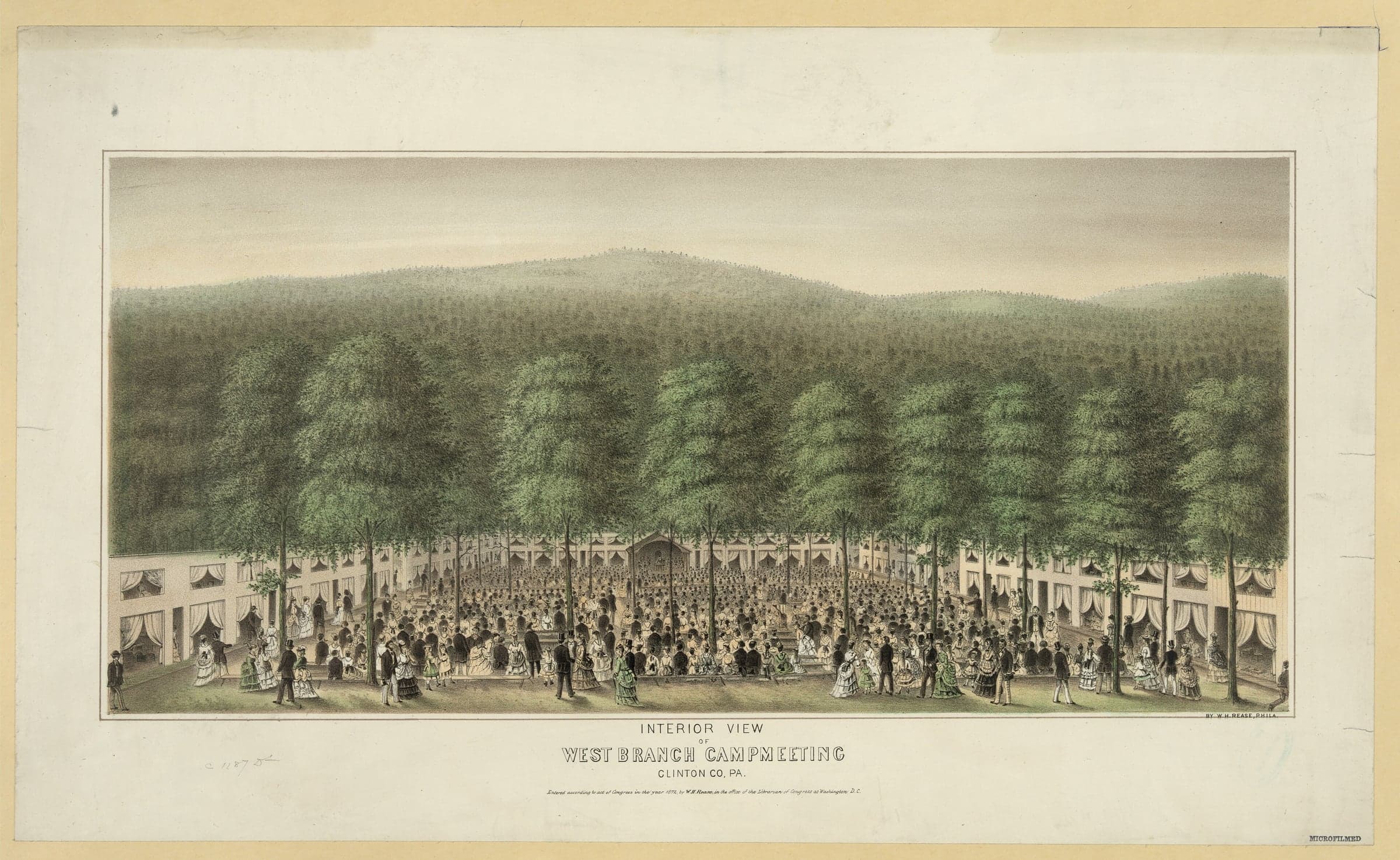
W. H. Rease, Interior View of West Branch Campmeeting, 1872. Public domain.
1843 to 1908 · The churches · Featured Study
The Holiness Churches
A movement that carried Wesley's teaching of entire sanctification into camp meetings and new churches in America and Britain.
Now may the God of peace Himself sanctify you completely, and may your entire spirit, soul, and body be kept blameless at the coming of our Lord Jesus Christ. The One who calls you is faithful, and He will do it.
- Began
- 1843, the year of Palmer's The Way of Holiness
- Bodies
- The Church of the Nazarene, The Free Methodist Church, The Christian and Missionary Alliance, The Salvation Army
The first National Camp-Meeting “in the annals of Methodism,” as its own book calls it, met at Vineland, New Jersey, from 17 to 26 July 1867.
Summary
The Holiness movement taught that God can make a believer holy through and through in this life. It grew inside Methodism and then formed new churches.
- Phoebe Palmer taught a shorter way to holiness, through the altar.
- Preachers put out of their Methodist conference formed the Free Methodist Church.
- William Booth's mission in East London became the Salvation Army.
- Three bodies joined to make the Church of the Nazarene.
- A. B. Simpson's Alliance taught entire sanctification as the Spirit's filling.
The Texts of Entire Sanctification
Paul's prayer for complete sanctification and Palmer's texts of the altar are the movement's Scripture.
The Salvation Army's doctrines and the Nazarene Manual of 1908 both echo Paul's prayer in 1 Thessalonians 5:23. Phoebe Palmer read the way into entire sanctification from the texts of the altar.
You blind men! Which is greater: the gift, or the altar that makes it sacred?Palmer grounds her shorter way in this saying of Jesus, which she quotes as “The altar sanctifieth the gift.”
For seven days you shall make atonement for the altar and consecrate it. Then the altar will become most holy; whatever touches the altar will be holy.Palmer drew from Exodus 29:36 to 37 that the gift laid on the altar is made holy by the altar.
Therefore I urge you, brothers, on account of God’s mercy, to offer your bodies as living sacrifices, holy and pleasing to God, which is your spiritual service of worship.Palmer's call to lay all upon the altar takes its offering from this verse.
The Holiness Branch of the Family of Churches
The branch runs from Wesley's Plain Account to the union at Pilot Point.
The Holiness churches grew out of Methodism in the nineteenth century.
1777 to 1784
- Wesley's Plain Account
- The Methodist Episcopal Church
1843 to 1860
- The Way of Holiness
- The Free Methodist Church
1867 to 1878
- The first National Camp-Meeting
- The Salvation Army
1890 to 1895
1906 to 1908
- Azusa Street
- The union at Chicago
- The union at Pilot Point
Each date is read from the body's own record or from a book of its time.
The site's tradition is Wesleyan-Pentecostal, a line that runs from Wesley through the Holiness churches to Azusa Street.
The Christian Traditions sets these churches among the other families, from Ephesus in 431 to the Pentecostals in 1906.
How the Movement Began: Palmer's Book and the Camp at Vineland
A book and a camp meeting tell the start in the movement's own words.
Phoebe Palmer published The Way of Holiness with Piercy and Reed in 1843. Her narrative answers that “there is a shorter way” to the blessing of entire sanctification.
Penuel; or, Face to Face with God, edited by Alexander McLean and Joel W. Eaton in 1869, is the movement's own record of Vineland. Its publisher was W. C. Palmer, Jr.
The book says the meetings in the Bower of Prayer “were frequently led by those successful servants of Jesus, Dr. and Mrs. Palmer.” Its thirteenth chapter tells of “Bishop Simpson and family” at the close of the camp.
The Truth They Pressed: Perfect Love Received by Faith
Wesley's tract of 1777 set out the doctrine the Holiness churches preached.
Wesley's Plain Account, last revised in 1777, says he and his brother maintained “That Christian perfection is that love of God and our neighbour, which implies deliverance from all sin.”
They held that this love is “received merely by faith” and “given instantaneously, in one moment.”
The same tract allows both words for the work: “one may affirm the work is gradual, another, it is instantaneous, without any manner of contradiction.”
Jesus declared, “‘Love the Lord your God with all your heart and with all your soul and with all your mind.’ This is the first and greatest commandment. And the second is like it: ‘Love your neighbor as yourself.’ All the Law and the Prophets hang on these two commandments.”Wesley's definition, the love of God and of our neighbour, takes its words from these two commands.
Their Own Statements on Holiness
Four bodies set the teaching down in their own documents.
Each body teaches that a believer may be wholly sanctified.
| Body | Document | Its words |
|---|---|---|
| The Free Methodist Church | Its article of 1860 | “Entire sanctification takes place subsequently to justification, and is the work of God, wrought instantaneously upon the consecrated, believing soul.” |
| The Church of the Nazarene | The Manual of 1908, article 6 | “That believers are to be sanctified wholly, subsequent to justification, through faith in the Lord Jesus Christ.” |
| The Christian and Missionary Alliance | Pardington's history of 1914 | “the life of entire sanctification is entered by a definite experience” |
| The Salvation Army | Its doctrines, on its headquarters page, which gives no year | “it is the privilege of all believers to be wholly sanctified” |
The Holiness Bodies and Their Counts
Three of the four bodies give a total; the Alliance's history of 1914 says its membership was not tabulated.
Each body counts its own people, and each counts a different thing.
| Body | The count | Who counted, and for when |
|---|---|---|
| The Church of the Nazarene | 2,764,205 members | The General Secretary, for 2025, from the church's global reports, released 16 January 2026 |
| The Salvation Army | 1,250,459 soldiers | The Army's International Headquarters, on a page read in October 2026 that gives no year |
| The Free Methodist Church | 10,682 members | The church's own count for 1878, printed by B. T. Roberts in 1879 |
Where the Movement Went
Each place stands with the year its record gives.
The movement's bodies took shape in New York, London, Los Angeles, Chicago and Texas.
| Year | Place | What happened there |
|---|---|---|
| 1858 | Albion, New York | 195 men from 47 circuits, by Roberts's count, met after two preachers were expelled. |
| 1860 | Pekin, New York | A convention adopted the Free Methodist Discipline. |
| 1865 | Whitechapel, London | William Booth took services in a tent in an old burial ground. |
| 1895 | Los Angeles | A company under Phineas Bresee constituted the Church of the Nazarene. |
| 1907 | Chicago | The Nazarenes and the Association of Pentecostal Churches of America declared their union. |
| 1908 | Pilot Point, Texas | The Holiness Church of Christ joined them. |
Fanaticism, Sinlessness and the Answers to Them
The charges came from the parent church and the Reformed, and Wesley's own cautions stand beside them.
The Cyclopaedia of Methodism, which Roberts reprinted in 1879 and ascribes to Bishop Simpson, charged the Free Methodists with fanaticism. It wrote, “In its early history, some of its leaders encouraged a spirit of wild fanaticism, claiming the power of healing by the laying on of hands.”
Wesley had refused the claim of a sinless state. He wrote, “sinless perfection is a phrase I never use,” and warned that “it is an exceeding common thing for persons to lose it more than once, before they are established therein.”
The Westminster Confession of 1646 holds that sanctification is “imperfect in this life, there abiding still some remnants of corruption in every part.” J. C. Ryle asked in Holiness (introduction, caution 1) whether it is wise to teach “that the holiness of converted people is by faith only, and not at all by personal exertion.”
Ryle named Pearsall Smith among the preachers whose hearers he found confused.
If we say we have no sin, we deceive ourselves, and the truth is not in us.Ryle and the Westminster divines read it against any perfection in this life.
A. B. Simpson of the Alliance wrote in The Four-Fold Gospel (1890), chapter 2, “We shall never become so inherently good that there will be no possibility or temptation to sin.”
Books to Read Next
The Way of Holiness, with Notes by the Way
Phoebe Palmer · 1843
She sets out the altar teaching in her own words.
Free at the Internet ArchivePenuel; or, Face to Face with God
Alexander McLean and Joel W. Eaton, editors · 1869
It gathers the reports of the camp meeting at Vineland.
Free at the Internet ArchiveA Plain Account of Christian Perfection
John Wesley · 1777
Wesley sets out perfect love and warns that it can be lost.
Free at the Christian Classics Ethereal LibraryWhy Another Sect
B. T. Roberts · 1879
Roberts prints the parent church's charges and answers them chapter by chapter.
Free at the Internet ArchiveWhat the Movement Handed On
The movement handed on churches that still print entire sanctification in their articles, from the Free Methodist article of 1860 to the Army's tenth doctrine. Its critics and Wesley's own cautions stand beside that teaching on the record.
Sources
Scripture is the Berean Standard Bible.
- The Holy Bible, Berean Standard Bible (read 2026)
- Phoebe Palmer, The Way of Holiness, with Notes by the Way (New York: Piercy and Reed, 1843)
- Alexander McLean and Joel W. Eaton, editors, Penuel; or, Face to Face with God (New York: W. C. Palmer, Jr., 1869), pages 15 to 16 and 155, chapter XIII.
- John Wesley, A Plain Account of Christian Perfection, revised to 1777, in The Works of John Wesley, edited by Thomas Jackson (1872), volume 11.
- B. T. Roberts, Why Another Sect (Rochester: The Earnest Christian Publishing House, 1879), pages 19 to 21 (the Cyclopaedia of Methodism reprinted), 191 to 192 and the appendix, pages 330 to 331.
- Manual of the Pentecostal Church of the Nazarene (Nazarene Publishing Company, 1908), pages 11 to 12, 19, 21 and 23 to 24.
- G. P. Pardington, Twenty-five Wonderful Years, 1889-1914: A Popular Sketch of the Christian and Missionary Alliance (New York: Christian Alliance Publishing Co., 1914), pages 53 to 54 and 88.
- A. B. Simpson, The Four-Fold Gospel, third edition, revised (New York: Christian Alliance Publishing Co., copyright 1890), chapter 2.
- The Salvation Army International Headquarters, What we believe (read October 2026)
- The Salvation Army International Headquarters, Global presence (no year on the page; read October 2026)
- Nazarene News Staff, General Secretary releases 2025 statistics (16 January 2026)
- George Scott Railton, The Authoritative Life of General William Booth (1912), chapters VII and IX.
- The Confession of Faith of the Assembly of Divines at Westminster (1646), chapter XIII.2, S. W. Carruthers's transcription of the manuscript (1946)
- J. C. Ryle, Holiness, introduction, caution 1 (first edition 1877 or 1879, the year not proved in the text read; read in the James Clarke printing of 1952)
Keep Studying
People and groups5
Subjects1
Values1
Church history3