
Exodus 3 · Exodus 6 · John 8 · Subject · Featured Study
The Name of the LORD Given at the Bush
God's name and its meaning in Exodus, read beside the words of Jesus in John 8:58.
Moses expected one question from the slaves in Egypt, and it was the question of God's name.
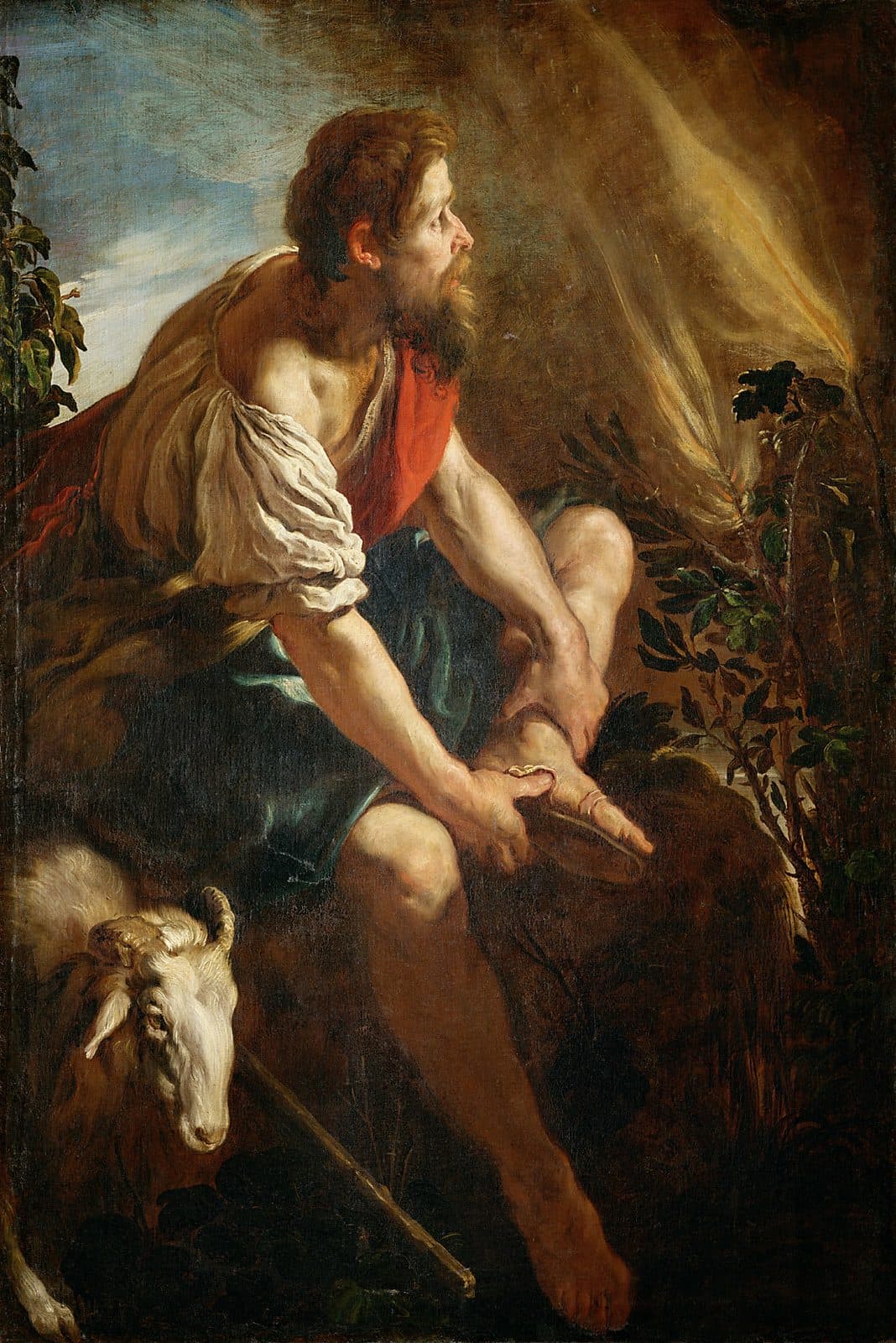
Domenico Fetti, Moses before the Burning Bush, about 1615 to 1617, Kunsthistorisches Museum, Vienna. Public domain by date (painted before 1930), via Wikimedia Commons.
THE ARTWORKFetti painted Moses taking off his sandal at the command of Exodus 3:5, his eyes on the fire. The name of Exodus 3:14 was spoken to him at this bush.
Summary
At the bush God gave Moses His name, the LORD, and explained it with the words I AM WHO I AM.
- Exodus 3:15 calls the LORD His name forever and the way He is to be remembered in every generation.
- Exodus 6:3 says the patriarchs knew God as God Almighty and did not know Him by His name the LORD.
- Exodus 34 proclaims what the name means, and the LORD names Himself compassionate and gracious.
- In John 8:58 Jesus says that before Abraham was born, I am, and His hearers pick up stones.
Six Verses on the Name
The question, the answer, the memorial, the patriarchs, the proclamation and the Gospel
Five of the six verses are in Exodus, from the bush at Horeb to the second giving of the tablets, and the last is in John.
Then Moses asked God, “Suppose I go to the Israelites and say to them, ‘The God of your fathers has sent me to you,’ and they ask me, ‘What is His name?’ What should I tell them?”Moses expects the people to test his commission by asking God's name.
God said to Moses, “I AM WHO I AM. This is what you are to say to the Israelites: ‘I AM has sent me to you.’”The answer explains the name of the next verse by the verb to be.
God also told Moses, “Say to the Israelites, ‘The LORD, the God of your fathers—the God of Abraham, the God of Isaac, and the God of Jacob—has sent me to you.’ This is My name forever, and this is how I am to be remembered in every generation.The name joins the God of the fathers to every generation after them.
I appeared to Abraham, to Isaac, and to Jacob as God Almighty, but by My name the LORD I did not make Myself known to them.This verse sets the patriarchs' knowledge of God beside what Moses now receives.
Then the LORD passed in front of Moses and called out: “The LORD, the LORD God, is compassionate and gracious, slow to anger, abounding in loving devotion and faithfulness,The LORD Himself says what His name means, after Israel's sin at the golden calf.
“Truly, truly, I tell you,” Jesus declared, “before Abraham was born, I am!”Jesus speaks of Himself in the present tense before Abraham's birth.
The Name from Seth to Paul
Who called on the name, or spoke it, from Genesis to Romans
| Who | What the verse says of the name | Verse |
|---|---|---|
| The men of Seth's day | Men begin to call upon the name of the LORD | Genesis 4:26 |
| Abram at Bethel | He builds an altar and calls on the name of the LORD | Genesis 12:8 |
| God to Abram | He names Himself God Almighty | Genesis 17:1 |
| The LORD to Jacob | He names Himself the LORD, the God of Abraham | Genesis 28:13 |
| God to Moses at Horeb | I AM WHO I AM, and I AM has sent me | Exodus 3:14 |
| God to Moses in Egypt | The patriarchs did not know Him by His name the LORD | Exodus 6:3 |
| The LORD at Sinai | His name is not to be taken in vain | Exodus 20:7 |
| The LORD on the mountain | He proclaims His name, the LORD | Exodus 34:5 |
| The LORD through Isaiah | He declares that the LORD is His name | Isaiah 42:8 |
| The LORD through Joel | Everyone who calls on His name will be saved | Joel 2:32 |
| Jesus in the temple | Before Abraham was born, I am | John 8:58 |
| Paul to the Romans | The promise of Joel is quoted for believers in Christ | Romans 10:13 |
- What the verse says of the name
- Men begin to call upon the name of the LORD
- Verse
- Genesis 4:26
- What the verse says of the name
- He builds an altar and calls on the name of the LORD
- Verse
- Genesis 12:8
- Who
- God to Abram
- What the verse says of the name
- He names Himself God Almighty
- Verse
- Genesis 17:1
- What the verse says of the name
- He names Himself the LORD, the God of Abraham
- Verse
- Genesis 28:13
- What the verse says of the name
- I AM WHO I AM, and I AM has sent me
- Verse
- Exodus 3:14
- What the verse says of the name
- The patriarchs did not know Him by His name the LORD
- Verse
- Exodus 6:3
- What the verse says of the name
- His name is not to be taken in vain
- Verse
- Exodus 20:7
- What the verse says of the name
- He proclaims His name, the LORD
- Verse
- Exodus 34:5
- What the verse says of the name
- He declares that the LORD is His name
- Verse
- Isaiah 42:8
- What the verse says of the name
- Everyone who calls on His name will be saved
- Verse
- Joel 2:32
- What the verse says of the name
- Before Abraham was born, I am
- Verse
- John 8:58
- What the verse says of the name
- The promise of Joel is quoted for believers in Christ
- Verse
- Romans 10:13
From the Bush to the Mountain
Exodus 3, Exodus 6 and Exodus 33 to 34
Exodus gives the name in three stages: the name spoken at the bush, the name tied to the covenant in Egypt, and the name proclaimed with its meaning on the mountain.
The God of the fathersExodus 3:6
Then He said, “I am the God of your father, the God of Abraham, the God of Isaac, and the God of Jacob.” At this, Moses hid his face, for he was afraid to look at God.God names Himself first by the men He made His covenant with.
I am the LORDExodus 6:6 to 7
Therefore tell the Israelites: ‘I am the LORD, and I will bring you out from under the yoke of the Egyptians and deliver you from their bondage. I will redeem you with an outstretched arm and with mighty acts of judgment. I will take you as My own people, and I will be your God. Then you will know that I am the LORD your God, who brought you out from under the yoke of the Egyptians.The promises of rescue, redemption and adoption all hang on the name.
The name proclaimedExodus 33:19 and 34:7
“I will cause all My goodness to pass before you,” the LORD replied, “and I will proclaim My name—the LORD—in your presence. I will have mercy on whom I have mercy, and I will have compassion on whom I have compassion.”Moses asked to see the glory, and the LORD promises His goodness and His name.
maintaining loving devotion to a thousand generations, forgiving iniquity, transgression, and sin. Yet He will by no means leave the guilty unpunished; He will visit the iniquity of the fathers on their children and grandchildren to the third and fourth generations.”The LORD's mercy and His judgment stand side by side in His own words.
What the Text Says of the Name
Three questions the text answers, each with its verse
WHETHER EHYEH MEANS I AM OR I WILL BE
The verb of Exodus 3:14 is the verb of 3:12, where the Berean text reads I will surely be with you. Driver gives I will be that I will be as the true sense.
WHO SPOKE FROM THE BUSH
Exodus 3:2 names the angel of the LORD in the fire, and verse 4 says that God called to Moses from within the bush.
WHETHER THE NAME BELONGS TO THE SON
Romans 10 has the confession that Jesus is Lord, then quotes Joel on calling upon the name.
The Words of the Name
Six Hebrew words from the lexicon, each in the verse where it stands
HAYAH, TO BE (HEBREW, H1961)
Strong's gloss gives to exist, be or become, always emphatic, the verb of ehyeh in Exodus 3:14.
YHWH, THE LORD (HEBREW, H3068)
The lexicon gives the national name of God and counts 6,520 uses, printed LORD in capitals in the Berean text.
SHEM, NAME (HEBREW, H8034)
Strong's gloss gives a mark of individuality, and by implication honor, authority and character.
ZEKER, MEMORIAL (HEBREW, H2143)
The lexicon gives a memento or commemoration, the word rendered remembered in Exodus 3:15.
EL, GOD (HEBREW, H410)
Strong's gloss gives strength, and especially the Almighty, the first word of El Shaddai.
SHADDAI, ALMIGHTY (HEBREW, H7706)
The lexicon gives the Almighty and counts 48 uses, joined to El when God speaks to the patriarchs.
What the Text Leaves Unsaid
Three questions the verses leave open
Scripture writes the name with four letters and does not say how it was spoken aloud.
Your name, O LORD, endures forever, Your renown, O LORD, through all generations.The psalm promises that the name endures without saying how it sounds.
God gives no reason for answering with a sentence before He gives the name in 3:15.
Exodus 6:3 does not explain how the patriarchs could call on the name the LORD and still not know Him by it.
The LORD also told him, “I am the LORD, who brought you out of Ur of the Chaldeans to give you this land to possess.”Here the LORD speaks His name to Abram in Genesis.
Before Abraham Was Born
John 8 and Philippians 2
Your father Abraham rejoiced that he would see My day. He saw it and was glad.” Then the Jews said to Him, “You are not yet fifty years old, and You have seen Abraham?”The hearers' question is about Jesus' age, and His answer is about His being.
At this, they picked up stones to throw at Him. But Jesus was hidden and went out of the temple area.The crowd answers with stones, the penalty for blasphemy in the law.
Irenaeus read Abraham's joy in John 8:56 as faith in the Son of God who would become a man.
“Therefore Abraham also, knowing the Father through the Word, who made heaven and earth, confessed Him to be God; and having learned, by an announcement [made to him], that the Son of God would be a man among men, by whose advent his seed should be as the stars of heaven, he desired to see that day, so that he might himself also embrace Christ; and, seeing it through the spirit of prophecy, he rejoiced.”
Irenaeus · Against Heresies Book IV · on John 8:56Patristic
Therefore God exalted Him to the highest place and gave Him the name above all names, that at the name of Jesus every knee should bow, in heaven and on earth and under the earth, and every tongue confess that Jesus Christ is Lord, to the glory of God the Father.Paul's hymn shows what becomes of the name of the LORD once Christ is exalted.
Three Teachers on the Name
Irenaeus, Jerome and Matthew Henry, each with the work named
Irenaeus sets the man and the God in one person.
“The sacred books acknowledge with regard to Christ, that as He is the Son of man, so is the same Being not a [mere] man; and as He is flesh, so is He also spirit, and the Word of God, and God.”
Irenaeus · Fragments from the Lost Writings of Irenaeus · on John 8:58Patristic
About 376 Jerome read I AM as the being that God alone has of Himself.
“There is one nature of God and one only; and this, and this alone, truly is. For absolute being is derived from no other source but is all its own. All things besides, that is, all things created, although they appear to be, soon are not. For there was a time when they were not, and that which once was not may again cease to be. God alone who is eternal, that is to say, who has no beginning, really deserves to be called an essence. Therefore also he says of him, ‘I am has sent me.’”
Jerome · LETTER 15.4 · on Exodus 3:14Patristic
Henry explains why God names Himself by three fathers at the bush.
“Abraham, Isaac, and Jacob, are particularly named, because with Abraham the covenant was first made, and with Isaac and Jacob often expressly renewed; and these three were distinguished from their brethren, and chosen to be the trustees of the covenant, when their brethren were rejected.”
Matthew Henry · Commentary on the Whole Bible · on Exodus 3:6Puritan
What Exodus 6:3 Means
Three readings, each with its case and the strongest objection
The meaning of the name made knownJohn Wesley, Explanatory Notes upon the Old Testament, on Exodus 6:3
This reading keeps the word the LORD in the patriarchs' mouths and places the newness of Exodus 6 in the rescue from Egypt.
“The patriarchs knew this name, but they did not know him in this matter by that which this name signifies. God would now be known by his name Jehovah, that is, 1. A God performing what he had promised, and so giving being to his promises.”
John Wesley · Explanatory Notes upon the Old Testament · on Exodus 6:3Evangelical
The objection: the verse speaks of the name the LORD itself, which this reading must take to mean what the name signifies.
A question that expects yesJamieson, Fausset and Brown, Commentary Critical and Explanatory, on Exodus 6:3
This reading takes the second half of the verse as a question: was I not known to them by My name the LORD?
The objection: the Berean text and the King James both print the sentence as a statement.
A name first given to MosesS. R. Driver, The Book of Exodus, Cambridge Bible, 1911
This reading holds that one source of the Pentateuch, which Driver calls P, knew no use of the name before Moses, and that Genesis uses it elsewhere because another source uses it from the beginning.
Books on the Name
Three works to read whole, earliest first
Commentary on the Whole Bible
Matthew Henry · 1710
Henry writes on the bush, the name and the covenant with the fathers in Exodus 3.
Explanatory Notes upon the Old Testament
John Wesley · 1765
Wesley gives short notes on Exodus 6:3 and on the covenant renewed in Exodus 34.
The Book of Exodus
S. R. Driver · 1911
Driver sets out the Hebrew of Exodus 3:14 and the source reading of Exodus 6:3.
Read it free at the Internet ArchiveI Have Revealed Your Name
Moses asked for a name to carry to slaves, and God gave him the name He would be remembered by in every generation. The reader who knows Jesus has been shown the name Moses asked for.
I have revealed Your name to those You have given Me out of the world. They were Yours; You gave them to Me, and they have kept Your word.Jesus names the making known of the Father's name as His own work.
Keep studying
Read it4
Studies2