
Leviticus 6 · Numbers 5 · Exodus 22 · Subject · Featured Study
Restitution and the Added Fifth
Leviticus 5 and 6 and Numbers 5 read beside the theft laws of Exodus 22 and the promise of Zacchaeus, with the readings of Jewish and Christian commentators.
The one who confessed a wrong gave back what he took, added a fifth of its value, and brought a ram to the priest.
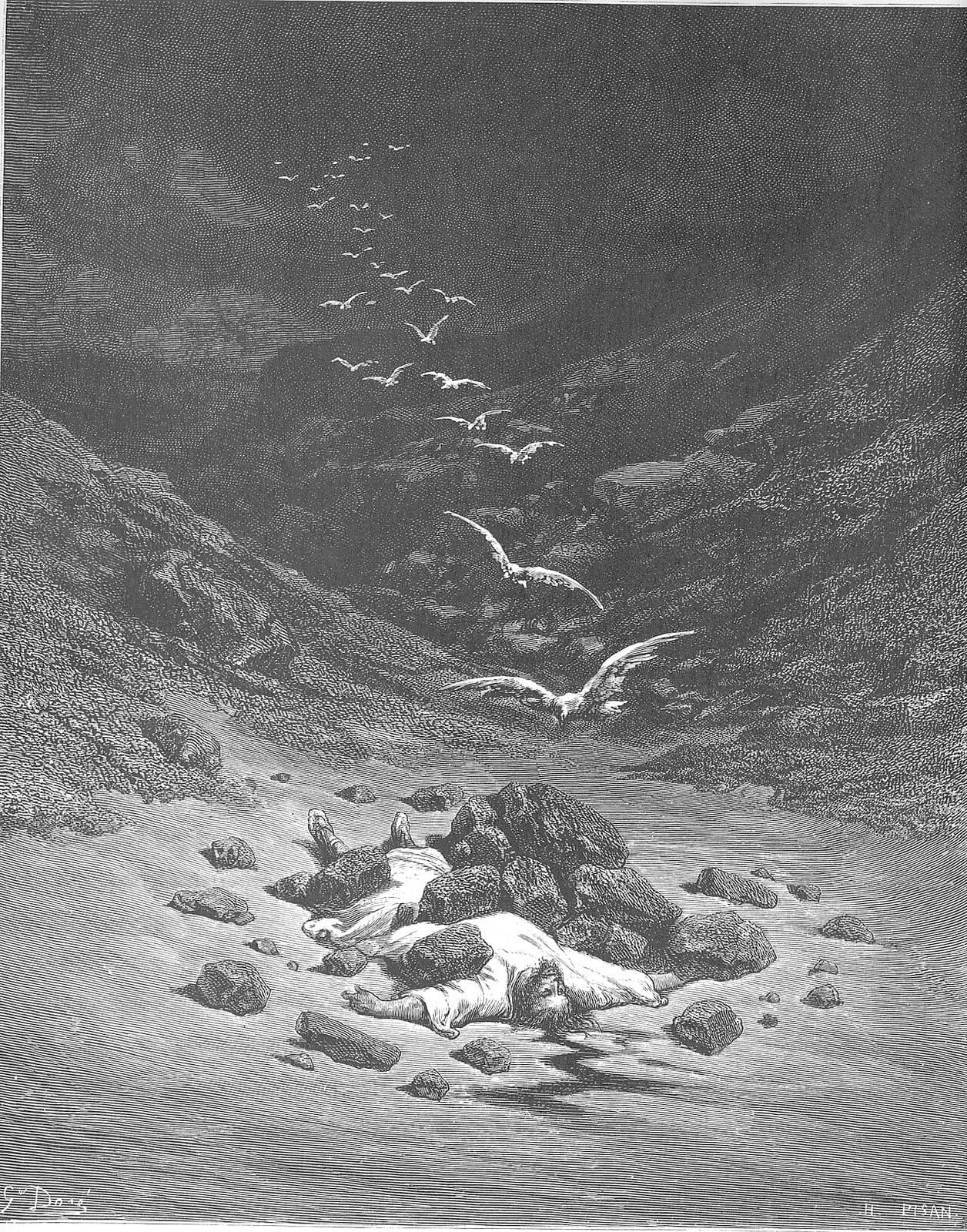
Gustave Doré, Achan Is Stoned to Death, wood engraving, 1866, from the English edition of La Grande Bible de Tours. Public domain by date (Doré died in 1883).
THE ARTWORKDoré engraved the Valley of Achor after Israel stoned Achan, whose taking of the devoted things Joshua 7:1 names with the word for unfaithfulness that Leviticus 5:15 and 6:2 use. Achan confessed only after the lot had found him out.
Summary
The law of the guilt offering joined repayment to a neighbor with an offering to the LORD, because Scripture calls a wrong done to a neighbor unfaithfulness against the LORD.
- Leviticus 5:15 to 16 sets the added fifth on harm done to the LORD's holy things, and Leviticus 6:2 to 5 sets it on six wrongs done to a neighbor.
- Numbers 5:7 requires the guilty person to confess, and Numbers 5:8 gives the payment to the priest when the one wronged has no relative to receive it.
- Exodus 22 makes a thief who is found out pay double, and five oxen for an ox or four sheep for a sheep he has slaughtered or sold.
The Law in Leviticus and Numbers
The fifth on the holy things, on a neighbor's goods, and on the one who confesses
The law of the added fifth stands twice in Leviticus and once more in Numbers.
Regarding any holy thing he has harmed, he must make restitution by adding a fifth of its value to it and giving it to the priest, who will make atonement on his behalf with the ram as a guilt offering, and he will be forgiven.Here the one wronged is the sanctuary, so the payment goes to the priest.
or anything else about which he has sworn falsely. He must make restitution in full, add a fifth of the value, and pay it to the owner on the day he acknowledges his guilt.When a neighbor is the one wronged, the payment goes to the owner, and it is due on the day the guilt is owned.
and must confess the sin he has committed. He must make full restitution, add a fifth to its value, and give all this to the one he has wronged.Numbers names the confession that comes before the payment.
But if the man has no relative to whom restitution can be made for the wrong, the restitution belongs to the LORD and must be given to the priest along with the ram of atonement, by which the atonement is made for him.Numbers also provides for the case in which no relative of the one wronged is left to be paid.
The Cases and the Repayments
Nine cases of the added fifth in matched rows, then five repayments drawn as bars
| The wrong | Repaid | The offering |
|---|---|---|
| Harms one of the LORD's holy things | Its value, with a fifth, to the priest | A ram valued in silver shekels |
| Deceives his neighbor about a deposit | The deposit in full, with a fifth, to the owner | A ram of proper value |
| Deceives his neighbor about security entrusted to him | The security in full, with a fifth, to the owner | A ram of proper value |
| Deceives his neighbor about what was stolen | What he stole, with a fifth, to the owner | A ram of proper value |
| Extorts his neighbor | What he took, with a fifth, to the owner | A ram of proper value |
| Finds lost property and lies about it | The lost property, with a fifth, to the owner | A ram of proper value |
| Swears falsely | Whatever he swore falsely about, with a fifth, to the owner | A ram of proper value |
| Commits any sin against another and confesses it | The full value, with a fifth, to the one he wronged | The ram of atonement |
| Wrongs a man who leaves no relative to be repaid | The value and its fifth, to the priest | The ram of atonement |
On a wrong worth 100 shekels, taken as an example, the one who confesses repays 120, and a thief who is found out repays from 200 to 500.
- Paid on confession
- Thief found out
The 5 repayments in shekels as a table
| The case | Repayments in shekels | Who repays | Verse |
|---|---|---|---|
| Confessed, Leviticus 6:5 | 120 | Paid on confession | Leviticus 6:5 |
| Theft found, Exodus 22:4 | 200 | Thief found out | Exodus 22:4 |
| Sheep sold, Exodus 22:1 | 400 | Thief found out | Exodus 22:1 |
| Ox sold, Exodus 22:1 | 500 | Thief found out | Exodus 22:1 |
| Zacchaeus, Luke 19:8 | 400 | Paid on confession | Luke 19:8 |
Five bars from one zero baseline, each the sum repaid on the example wrong of 100 shekels and coloured by whether the one who repays confessed or was found out. Exodus 22:7 and 9 set the double of Exodus 22:4 again.
The Fifth and the Fourfold Through Scripture
The passages in canon order, from Exodus 22 to Luke 19
The law sets the fifth on the one who confesses or redeems and the double and the fourfold on the thief, and in Luke 19 a chief tax collector chooses the thief's rate.
The thief in Exodus 22Exodus 22:1 to 9
“If a man steals an ox or a sheep and slaughters or sells it, he must repay five oxen for an ox and four sheep for a sheep.This verse sets the heaviest repayment in the law of theft.
In all cases of illegal possession of an ox, a donkey, a sheep, a garment, or any lost item that someone claims, ‘This is mine,’ both parties shall bring their cases before the judges. The one whom the judges find guilty must pay back double to his neighbor.The double falls on the one the judges find guilty, the case Wesley sets beside Leviticus 6.
Wesley, on Leviticus 6:4, explains the lower sum: the one whose guilt is shown by his own confession restores the principal with a fifth, while the one convicted pays double by Exodus 22:9. Rashi, the eleventh-century Jewish commentator of Troyes, reads the confession of Numbers 5:7 the same way, so that one convicted by witnesses owes neither the fifth nor the guilt offering.
Holy food eaten in errorLeviticus 22:14
If anyone eats a sacred offering in error, he must add a fifth to its value and give the sacred offering to the priest.The rule of Leviticus 5:16 reaches the priest's food, so one who eats it by mistake also adds a fifth.
Redeeming what was given to the LORDLeviticus 27:13 to 31
If, however, the owner decides to redeem the animal, he must add a fifth to its value.The owner who takes back an animal he has vowed pays its value and a fifth.
If a man wishes to redeem part of his tithe, he must add a fifth to its value.The same rule holds for a tithe that its owner buys back.
Rashi, on Leviticus 27:13, says that only the owner adds the fifth when he redeems, and no other buyer does. The Mishnah, the code of Jewish law compiled about 200, counts five such cases at Bava Metzia 4:8. Among them are eating a priest's portion, redeeming one's own consecrated property, and robbing with a false oath.
David's verdict2 Samuel 12:5 to 6
Because he has done this thing and has shown no pity, he must pay for the lamb four times over.”David's sentence on the rich man of Nathan's story matches the four sheep for a sheep of Exodus 22:1.
Zacchaeus at JerichoLuke 19:8
But Zacchaeus stood up and said to the Lord, “Look, Lord, half of my possessions I give to the poor, and if I have cheated anyone, I will repay it fourfold.”The promise comes before any word of Jesus about it, at the house where He had chosen to stay.
Jamieson, Fausset and Brown observe that no one had demanded either the gift to the poor or the repayment, and that Zacchaeus gave up of his own will all that was ill-gotten, quadrupled.
What the Law of the Fifth Says
Three things often said of the law, each tested by a verse
THE RAM SETTLED THE WRONG BY ITSELF
Leviticus 6:4 to 6 sets the return of the goods and the fifth before the ram, and Clarke holds that God will not forgive one who keeps a neighbor's property.
A FIFTH WAS ADDED FOR EVERY SIN
Barnes ties the fifth to the guilt offering, which was brought for an injury to the LORD or to a neighbor in respect of property, and sets it apart from the ordinary sin offering.
RESTITUTION WAS OWED ONLY FOR THEFT
Leviticus 6:2 also names a deposit or a security denied and a neighbor extorted, wrongs in which nothing need have been stolen.
Unfaithfulness, Guilt and the Kinsman
Three Hebrew words the law of restitution turns on
The wrong these laws name is ma'al, to act unfaithfully. Rashi says the word means a change of allegiance everywhere in Scripture, as when Israel went after other gods in 1 Chronicles 5:25 and a wife goes astray in Numbers 5:12.
The guilt offering of these laws is the asham, and Rashi reads the first asham of Leviticus 5:19 as the noun for the offering and the last as the verb for incurring guilt.
It is a guilt offering; he was certainly guilty before the LORD.”The verse ends the law for a sin committed in ignorance.
The relative of Numbers 5:8 is the go'el.
If your brother becomes impoverished and sells some of his property, his nearest of kin may come and redeem what his brother has sold.This verse gives the duty of redeeming that the word go'el names.
What the Text Leaves Unsaid
Two questions the law and Luke 19 leave open
Leviticus names no price for the ram. Rashi reads the plural shekels of Leviticus 5:15 as a value of at least two.
“If someone acts unfaithfully and sins unintentionally against any of the LORD’s holy things, he must bring his guilt offering to the LORD: an unblemished ram from the flock, of proper value in silver shekels according to the sanctuary shekel; it is a guilt offering.This verse is the only measure the law gives for the ram.
Luke records the promise of Zacchaeus and no payment, and he names no one Zacchaeus had cheated.
Jesus said to him, “Today salvation has come to this house, because this man too is a son of Abraham.Jesus answers the promise with salvation for the house and asks for no account of the sums.
A Wrong to a Neighbor and the Altar
Why the repayment came before the offering, as Wesley, Henry and Jesus teach it
Wesley, on Leviticus 6:5, holds that the repayment may not be delayed, because keeping what was unjustly taken repeats the taking. Jesus gives the same order for a gift brought to the altar.
So if you are offering your gift at the altar and there remember that your brother has something against you, leave your gift there before the altar. First go and be reconciled to your brother; then come and offer your gift.Jesus sends the worshipper to be reconciled to his brother before he offers the gift.
Henry, on Leviticus 6:6 to 7, writes that the ram could not of itself make satisfaction for sin and that it signified the atonement of Jesus.
Yet it was the LORD’s will to crush Him and to cause Him to suffer; and when His soul is made a guilt offering, He will see His offspring, He will prolong His days, and the good pleasure of the LORD will prosper in His hand.Henry points to this verse because Isaiah uses the same word, asham, for the Servant's offering.
Matthew Henry on the Neighbor and on Zacchaeus
Two notes from his Commentary on the Whole Bible
Henry gives the reason the law names the LORD in a case between neighbors.
“Though all the instances relate to our neighbour, yet it is called a trespass against the Lord, because, though the injury be done immediately to our neighbour, yet an affront is thereby given to his Maker and our Master. He that speaks evil of his brother is said to speak evil of the law, and consequently of the Law-maker, Jam. iv.”
Matthew Henry · Commentary on the Whole Bible · on Leviticus 6:2 to 3Puritan
He sets the promise of Zacchaeus against the boast of the Pharisee.
“He does not expect to be justified by his works as the Pharisee who boasted of what he had done, but by his good works he will, through the grace of God, evidence the sincerity of his faith and repentance; and here he declares what his determination was.”
Matthew Henry · Commentary on the Whole Bible · on Luke 19:8Puritan
How the Fifth Is Reckoned, and Who Had No Kinsman
Two readings of the fifth and two of Numbers 5:8, with the objection to each
The fifth is a fifth of the principalRabbi Yonatan, in a teaching the Talmud cites at Bava Metzia 54a
Rabbi Yonatan reads the fifth of Leviticus 27:27 as one fifth of the principal, which gives the 120 of the example.
The objection: the same words can be read as one part of five in the whole repayment.
The fifth is a fifth of the whole repaymentRabbi Yoshiya, and the Talmud at Bava Metzia 54a
Rabbi Yoshiya reads Leviticus 27:27 to mean that the thing and its fifth together make five parts. The fifth is then a quarter of the principal, and the example of 100 shekels comes to 125. The Talmud settles the law this way from a case in which an owner who would redeem at 20 dinars pays 25.
The objection: the Berean text renders Leviticus 6:5 as a fifth of the value, which is Rabbi Yonatan's reading.
But if it is among the unclean animals, then he may redeem it according to your valuation and add a fifth of its value. If it is not redeemed, then it shall be sold according to your valuation.Both rabbis read this verse, which adds a fifth of its value to the price of an unclean animal redeemed.
The man with no kinsman was a convertRashi on Numbers 5:8, after Sifrei Bamidbar and Bava Kamma 109a
Rashi asks whether anyone in Israel could lack every relative on his father's side back to Jacob, and reads the verse of a convert who died without heirs. The Mishnah, Bava Kamma 9:11, gives the principal and the fifth to the priests when the one robbed was a convert who has died.
The objection: Numbers 5:8 names no convert.
The man with no kinsman was anyone who died without oneKeil and Delitzsch, The Pentateuch, volume 3, 1871
Keil and Delitzsch take the mention of the go'el to mean that the one wronged was no longer alive, and they apply the verse to any such person.
The objection: Clarke observes that a stranger living in the camp might have no relative in any tribe of Israel.
Books on Restitution
Two works to read whole
Rashi on Leviticus and Numbers
Rashi, in the English of M. Rosenbaum and A. M. Silbermann · 1929 to 1934
Rashi explains the words of Leviticus 5 and Numbers 5 and names the rabbinic source of each reading.
Read Rashi on Numbers 5 at SefariaBiblical Commentary on the Old Testament: The Pentateuch, volume 3
C. F. Keil and F. Delitzsch, translated by James Martin · 1871
The commentary explains the Hebrew of Numbers 5 and the place of the go'el in its law of restitution.
Read volume 3 at the Internet ArchiveSalvation Came to the House
The law joined the return of a neighbor's goods to the offering for guilt, and it gave the lighter sum to the one who owned his wrong. Jesus came to the house of a chief tax collector, and the man's first recorded words to Him were a promise to repay anyone he had cheated. The reader is asked to make right what can be made right and to bring the rest to the One who came to save.
For the Son of Man came to seek and to save the lost.”Jesus gives the reason for His visit in His own words.
Keep studying
Studies6
People1
Places1