
Genesis 3 · Exodus 25 · John 1 · Revelation 21 · Subject · Featured Study
God Dwelling with His People, from Eden to the New Jerusalem
The presence of God with His people in Scripture, with its verses, its Hebrew and Greek words, and the readings of Eden and of Ezekiel 37.
In the last city of Scripture God's servants see His face, and in the first garden the man hid from Him.
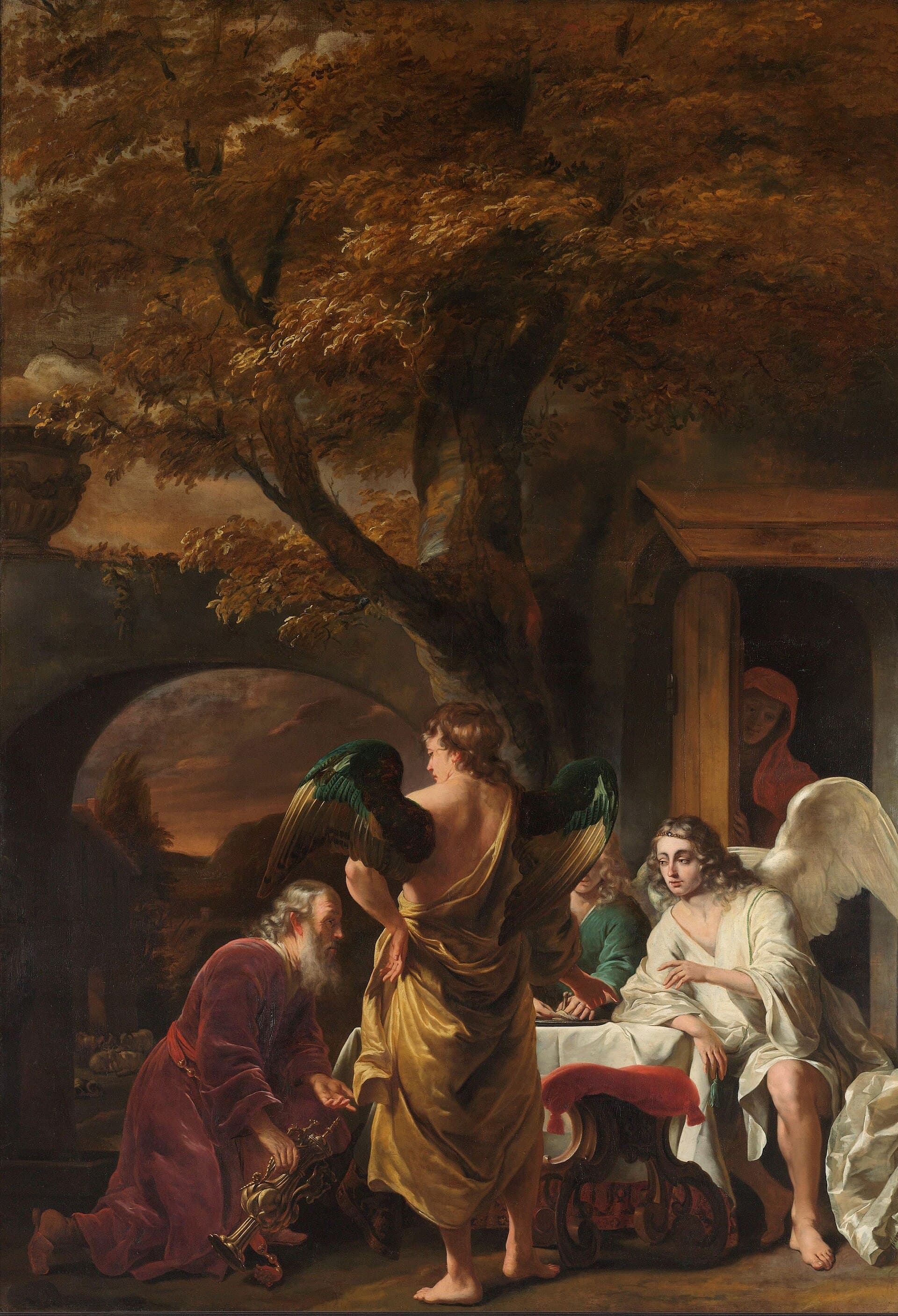
Ferdinand Bol, Abraham Entertaining the Three Angels, between about 1660 and 1663, Rijksmuseum, Amsterdam. Public domain (painted before 1930), via Wikimedia Commons.
THE ARTWORKBol painted Abraham on his knees serving his three guests under the tree of Genesis 18:8. Sarah listens in the doorway behind him, where Genesis 18:10 places her.
Summary
Scripture tells of God dwelling with His people in a line of places, from Eden through the tent and the temple to the New Jerusalem.
- The garden in Eden shares five features with the tabernacle, and readers differ on whether Genesis draws it as the first sanctuary.
- Abraham's tent, Bethel, the tabernacle and the temple each mark a place where God met His people in the Old Testament.
- In the New Testament the dwelling is Jesus Himself, then the church, then the body of each believer.
Six Verses on God's Dwelling
Six books give one verse each, set in canon order.
Then the man and his wife heard the voice of the LORD God walking in the garden in the breeze of the day, and they hid themselves from the presence of the LORD God among the trees of the garden.No earlier verse tells of the LORD God walking, so the line of the subject starts here.
And they are to make a sanctuary for Me, so that I may dwell among them.Moses heard this command during his forty days on the mountain, so the tent was planned by God before Israel built it.
And I will make My dwelling place among you, and My soul will not despise you. I will walk among you and be your God, and you will be My people.The promise proves that God walking among Israel is the height of the covenant blessings, above rain, harvest and peace.
But will God indeed dwell upon the earth? Even heaven, the highest heaven, cannot contain You, much less this temple I have built.Solomon's own prayer shows that the house was a place to meet God and never a place to contain Him.
The Word became flesh and made His dwelling among us. We have seen His glory, the glory of the one and only Son from the Father, full of grace and truth.The verse proves that the line reaches its centre in Jesus, since John uses the verb of the tabernacle, skenoo, for His coming.
And I heard a loud voice from the throne saying: “Behold, the dwelling place of God is with man, and He will dwell with them. They will be His people, and God Himself will be with them as their God.Here God dwells with His people in the new creation itself, and the line ends.
The Dwelling Places from Eden to the City
Ten places, from Genesis 2 to Revelation 21.
- The beginningThe garden in Eden, The LORD God plants a garden in the east and places the man there.Genesis 2:8
- After the fallOutside the garden, After the man is driven out, cherubim and a whirling sword of flame are stationed to guard the way to the tree of life.Genesis 3:24
- AbrahamAbraham's tent at Mamre, The LORD appears to Abraham as he sits at the entrance of his tent.Genesis 18:1
- JacobBethel, Jacob calls the place the house of God and the gate of heaven.Genesis 28:17
- The wildernessThe tabernacle, The cloud covers the Tent of Meeting, and the glory of the LORD fills the tabernacle.Exodus 40:34
- SolomonThe temple in Jerusalem, Solomon tells the LORD he has built Him an exalted house, a place for Him to dwell forever.1 Kings 8:13
- The exileThe temple of Ezekiel's vision, The LORD names the place of His throne, where He will dwell among the Israelites forever.Ezekiel 43:7
- The GospelsThe Word made flesh, The person of Jesus of Nazareth.John 1:14
- The churchThe household of God, Jews and Gentiles are joined in one household.Ephesians 2:22
- The new creationThe New Jerusalem, The holy city comes down out of heaven from God.Revelation 21:2
A timeline of ten places where Scripture sets God with His people, each row with its verse.
From the Garden to the Promised Sanctuary
The Old Testament carries the line from Eden to the sanctuary Ezekiel was promised in exile.
Between the garden and the exile the dwelling moves from place to place, and twice it is a tent: Abraham's at Mamre and the tabernacle made at Sinai.
The rabbis on the walking in the gardenGenesis Rabbah 19:7
Genesis Rabbah, a collection of the rabbis' teaching on Genesis, reads the walking of Genesis 3:8 as the Divine Presence going up from the earth. It goes up one firmament at a time for the sins of Adam, Cain, Enosh, the flood, the dispersion, Sodom and Egypt.
Abraham's tent and Jacob's roadGenesis 18 and 28
At Mamre the LORD comes to Abraham's own tent, and at Bethel He meets Jacob on the road from Beersheba to Haran.
Look, I am with you, and I will watch over you wherever you go, and I will bring you back to this land. For I will not leave you until I have done what I have promised you.”The LORD promises Jacob His presence on the road, before Jacob wakes and names the place the house of God.
The tabernacle and the covenantExodus 29, 2 Samuel 7
Then I will dwell among the Israelites and be their God. And they will know that I am the LORD their God, who brought them out of the land of Egypt so that I might dwell among them. I am the LORD their God.The LORD names His dwelling among Israel as the purpose of the exodus itself.
For I have not dwelt in a house from the day I brought the Israelites up out of Egypt until this day, but I have moved about with a tent as My dwelling.The verse shows that God's dwelling with Israel never depended on a house of cedar.
The cloud that filled the tent and the temple is taught on The Glory That Filled the House.
Ezekiel's promised sanctuaryEzekiel 37
My dwelling place will be with them; I will be their God, and they will be My people. Then the nations will know that I the LORD sanctify Israel, when My sanctuary is among them forever.’”The dwelling place of the covenant outlasts the exile in this promise, for it is set among Israel forever.
What the Text Says of God's Dwelling
Two things often said, each beside the verse that tests it.
THE TREE OF LIFE LOST FOR GOOD
Genesis 3:24 guards the way to the tree of life, and Revelation 22:2 sets a tree of life on either side of the river in the city.
HEAVEN AS GOD'S ONLY DWELLING
Solomon asks God to hear from heaven, His dwelling place, and in the same prayer names the temple as the place where His Name shall be.
Eden and the Tent, Feature by Feature
The verses that set the garden beside the tent come from Genesis, Exodus, Leviticus, Numbers, 2 Samuel and 1 Kings.
| Feature | In Eden | At the tabernacle or the temple |
|---|---|---|
| An entrance on the east | The guard is posted at the eastern side (Genesis 3:24). | The east side of the court faces the sunrise, and Moses and Aaron camp to the east of the tabernacle (Exodus 27:13, Numbers 3:38). |
| Cherubim | Cherubim keep the way (Genesis 3:24). | Gold cherubim overshadow the mercy seat, and cherubim are worked into the veil and carved on the temple walls (Exodus 25:18 to 22, 26:31, 1 Kings 6:29). |
| Gold and onyx | The land of Havilah by the first river has pure gold, bdellium and onyx (Genesis 2:11 to 12). | Two onyx stones in gold settings carry the names of the sons of Israel on the ephod (Exodus 28:9 to 12). |
| To work and to keep | The man is placed in the garden to cultivate and keep it (Genesis 2:15). | The Levites keep the duties of the Tent of Meeting by attending to the service of the tabernacle, with the same two verbs (Numbers 3:7 to 8). |
| God walking among them | Genesis 3:8 uses halak of God going among the trees. | The LORD promises to walk among Israel, and He moves about with a tent, with the same verb (Leviticus 26:12, 2 Samuel 7:6). |
The Words of Dwelling
Six words from the lexicon, each in a verse where it stands.
SHAKAN, TO DWELL (HEBREW, H7931)
The lexicon gives to reside or permanently stay, and Genesis 3:24 uses the same verb for stationing the cherubim.
MISHKAN, DWELLING PLACE (HEBREW, H4908)
The lexicon gives a residence and, specifically, the Tabernacle, and Ezekiel 37:27 uses the noun for the promised dwelling place.
HALAK, TO WALK (HEBREW, H1980)
The lexicon gives to walk in a great variety of uses, and here it tells of the LORD going about in a tent.
AVAD, TO WORK OR SERVE (HEBREW, H5647)
The lexicon gives to work in any sense, and by implication to serve or till.
SHAMAR, TO KEEP (HEBREW, H8104)
The lexicon gives to hedge about and guard, and generally to protect and attend to.
SKENOO, TO MAKE A DWELLING (GREEK, G4637)
The lexicon gives to tent or encamp, and John uses the verb here beside its noun for the dwelling place of God.
What the Text Leaves Unsaid
Three questions the verses leave open.
Genesis 3:8 gives no form for the One heard in the breeze of the day, and no verse counts such visits.
But the LORD God called out to the man, “Where are you?”The verse shows God seeking the man who hid, while the text says nothing of His form.
Jacob names Bethel the house of God in Genesis 28 and builds no house there. He returns in Genesis 35 and builds an altar.
Early the next morning, Jacob took the stone that he had placed under his head, and he set it up as a pillar. He poured oil on top of it,A stone set up as a pillar, with oil poured on it, is all Jacob raises at Bethel on that first visit.
Scripture does not say what became of the garden or of its guard after the man was driven out.
The Word, the Temple of His Body and the Church
The Gospel of John, the letters of Paul and Revelation 21 and 22 carry the line to Christ, His people and the city.
After John 1:14 the dwelling is found first in Jesus, then in the people joined to Him, and last in the city of the new creation.
In the Gospel of JohnJohn 2 and 4
Jesus answered, “Destroy this temple, and in three days I will raise it up again.” “This temple took forty-six years to build,” the Jews replied, “and You are going to raise it up in three days?” But Jesus was speaking about the temple of His body.The verse shows the meaning of the temple passing to the body of Jesus, which would be raised.
But a time is coming and has now come when the true worshipers will worship the Father in spirit and in truth, for the Father is seeking such as these to worship Him. God is Spirit, and His worshipers must worship Him in spirit and in truth.”True worship is bound to no single mountain or house, by the words of Jesus here.
The church and the believer1 Corinthians 3 and 6, 2 Corinthians 6, Ephesians 2
Paul's letters give the temple three settings: a congregation, a single believer's body, and the whole household of God.
Do you not know that you yourselves are God’s temple, and that God’s Spirit dwells in you?The whole congregation, divided as it was over Paul and Apollos, is God's temple in this verse.
Do you not know that your body is a temple of the Holy Spirit who is in you, whom you have received from God? You are not your own;Holiness of the body rests here on the presence of the Holy Spirit within it.
What agreement can exist between the temple of God and idols? For we are the temple of the living God. As God has said: “I will dwell with them and walk among them, and I will be their God, and they will be My people.”Paul reads the promise of Leviticus 26:12 here as kept in the church.
In Him the whole building is fitted together and grows into a holy temple in the Lord. And in Him you too are being built together into a dwelling place for God in His Spirit.Gentiles, once strangers, are built here into the same dwelling place as Jews.
The city of the new creationRevelation 21 and 22
Revelation 21:3 repeats the covenant words of Leviticus 26:12 and Ezekiel 37:27, that they will be His people.
But I saw no temple in the city, because the Lord God Almighty and the Lamb are its temple.The verse shows the line of houses ending, because the Lord God and the Lamb take the place of the temple.
No longer will there be any curse. The throne of God and of the Lamb will be within the city, and His servants will worship Him. They will see His face, and His name will be on their foreheads.These verses show the curse of Genesis 3 lifted in the presence of God and the Lamb.
Four Teachers on God's Dwelling
Matthew Henry twice, John Wesley and Apringius of Beja, each with the work named.
Henry hears in the visit at Mamre a likeness of the incarnation.
“The appearance of God to Abraham seems to have had in it more of freedom and familiarity, and less of grandeur and majesty, than those we have hitherto read of; and therefore more resembles that great visit which, in the fullness of time, the Son of God was to make to the world, when the Word would be flesh, and appear as one of us.”
Matthew Henry · Commentary on the Whole Bible · on Genesis 18:1Puritan
Wesley draws from the promise at Bethel God's care for His people in every place.
“He knew not, but God foresaw what hardships he would meet with in his uncle's service, and therefore promiseth to preserve him in all places. God knows how to give his people graces and comforts accommodated to the events that shall be, as well as to those that are. He was now going as an exile into a place far distant, but God promiseth him to bring him again to this land.”
John Wesley · Explanatory Notes upon the Old Testament · on Genesis 28:15Evangelical
Henry sets the presence of God at the centre of the church's glory.
“The presence of God with his church is the glory of the church. It is matter of wonder that a holy God should ever dwell with any of the children of men. The presence of God with his people in heaven will not be interrupted as it is on earth, but he will dwell with them continually.”
Matthew Henry · Commentary on the Whole Bible · on Revelation 21:3Puritan
Apringius reads the dwelling of Revelation 21:3 as the saints made into God's temple.
“The Lord gives witness to himself, for the multitude of the saints will become his temple, so that he might dwell with them forever and that he might be their Lord and they might be his people. He himself will take away all weeping and …”
Apringius of Beja · Tractate on the Apocalypse 21:3-4 · on Revelation 21:3Patristic
Two Questions in Dispute
Whether Eden is drawn as a sanctuary, and how the promise of Ezekiel 37 is kept, each with two readings.
Eden drawn as the first sanctuaryThe Book of Jubilees, chapters 3 and 8, trans. R. H. Charles, 1913
This reading takes the features Eden shares with the tent as signs that Genesis draws the garden as the first sanctuary. The Book of Jubilees, a retelling of Genesis that R. H. Charles dated after 135 BC, calls the Garden of Eden the holy of holies and the dwelling of the Lord.
You were in Eden, the garden of God. Every kind of precious stone adorned you: ruby, topaz, and diamond, beryl, onyx, and jasper, sapphire, turquoise, and emerald. Your mountings and settings were crafted in gold, prepared on the day of your creation. You were anointed as a guardian cherub, for I had ordained you. You were on the holy mountain of God; you walked among the fiery stones.Ezekiel calls Eden the garden of God and speaks in the next verse of the holy mountain of God.
The objection: Genesis 2 and 3 name no altar, no offering and no priest in the garden, so each feature is read from texts written of the later sanctuary.
Eden as a garden in a wide regionJamieson, Fausset and Brown, Commentary Critical and Explanatory, 1871
Jamieson, Fausset and Brown read Eden as a wide region and the garden as a park in which the man was trained under the care of his Maker.
The objection: Ezekiel 28 sets Eden beside the holy mountain of God, and Genesis 3 posts the same guardians at Eden that Exodus sets over the ark.
The promise kept in the church of Jew and GentileMatthew Henry, Commentary on the Whole Bible, 1710
Matthew Henry reads the union of Judah and Israel in Ezekiel 37 as chiefly the union of Jews and Gentiles in the gospel church.
The objection: Ezekiel names the people and the land that receive the promise.
They will live in the land that I gave to My servant Jacob, where your fathers lived. They will live there forever with their children and grandchildren, and My servant David will be their prince forever.This verse ties the promise of the dwelling place to the land.
The promise kept for Israel in the landJohn Wesley, Explanatory Notes upon the Old Testament, 1765; Adam Clarke, Commentary on the Bible
John Wesley reads Ezekiel 37:25 as the Jews converted to Christ inheriting Canaan, and Adam Clarke, in his Commentary on the Bible, reads it as the twelve tribes possessing the whole of the Promised Land.
The objection: Ephesians 2:21 to 22 already calls the church of Jew and Gentile a dwelling place for God.
Books on God's Dwelling
Three works to read whole, earliest first, each free to read at CCEL.
Commentary on the Whole Bible
Matthew Henry · 1710
Henry turns to God's dwelling with His people in his notes on Genesis 18 and 28 and on Revelation 21.
Read Henry at CCELExplanatory Notes upon the Old Testament
John Wesley · 1765
Wesley's notes on Ezekiel 37 read the promised sanctuary as a spiritual temple to be consummated in heaven.
Read Wesley at CCELThe Apocrypha and Pseudepigrapha of the Old Testament
R. H. Charles · 1913
Charles gives an introduction on the manuscripts of Jubilees and on its date.
Read Jubilees at CCELGod with Us
The line from the garden to the city passes through Jesus, the Word who made His dwelling among us. The text asks the reader to belong to God as one of His people, the end that the covenant promise names from Leviticus 26:12 to Revelation 21:3. It also asks the reader to keep body and spirit clean in the fear of God, as Paul wrote after he set the promise of Leviticus 26:12 before the Corinthians.
“Behold, the virgin will be with child and will give birth to a son, and they will call Him Immanuel” (which means, “God with us”).The name Immanuel shows that in Jesus God is with His people, the point the whole line has reached.
Keep studying
Read it4
Studies1
Places10
Doctrines13
Peoples and groups1