
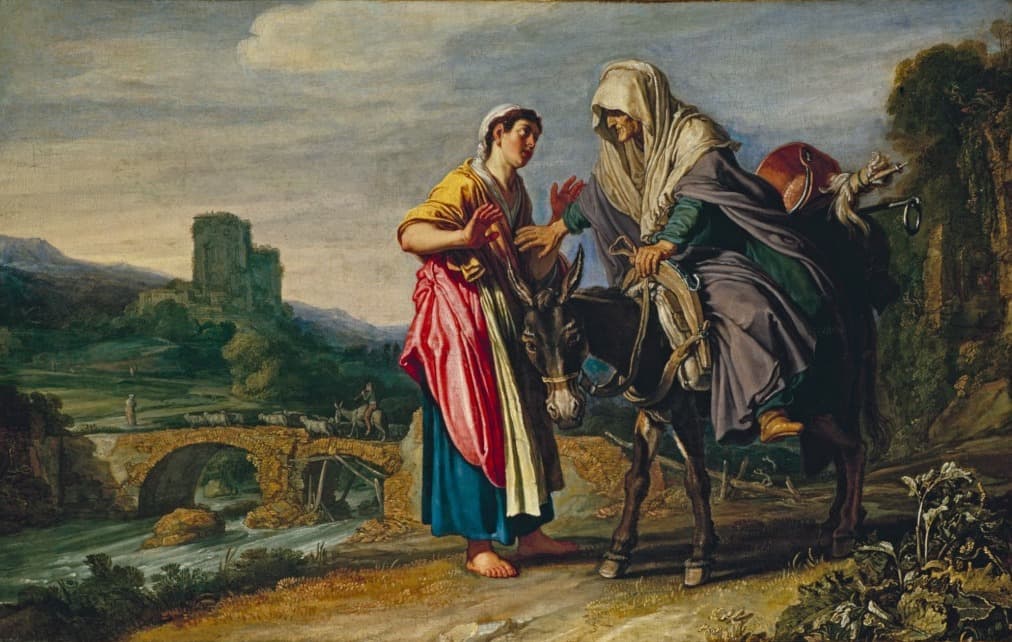
Genesis 2:2 · Symbol · Rest
The Words Shabbat, Nuach and Anapausis
English renders four Hebrew words and four Greek words of the Bible as rest.
Exodus 23:12 uses shabath for the Israelite's ceasing on the seventh day and nuach for the rest it gives his ox and his donkey.
And by the seventh day God had finished the work He had been doing; so on that day He rested from all His work.
- The word
- שָׁבַת (shabath), H7673
- First appears
- Genesis 2:2 “And by the seventh day God had finished…”
Summary
Shabath is the Hebrew verb for ceasing from labor, and its noun shabbat names the Sabbath. Nuach is the verb for settling, and its noun menuchah can name a home. The Greek anapausis and anapauo carry the sense of a pause that renews, and Jesus uses both words when He calls the weary to Himself. Each word takes its exact sense from the verse it stands in.
- Exodus 16:23, in the account of the manna, is the first verse where the noun shabbat stands.
- Naomi's blessing in Ruth 1:9 wishes her daughters-in-law menuchah, the rest of a husband's house.
- Revelation 14:13 promises rest from labor to those who die in the Lord.
- Genesis 5:29 explains the name Noah with nacham, to comfort.
Words for Rest in Both Testaments
The words belong to the vocabulary of the seventh day, of the land and of the gospel.
The Words Shabbat, Nuach and Anapausis studies the Hebrew and Greek vocabulary of rest. It belongs to the value of rest, because these words carry what Scripture means when it speaks of God's rest and of the rest He gives His people.
The question it answers is what each word means and how the words differ. It counts every use of each word in one table. It then gives the two Hebrew verbs with their nouns, the Greek words of Jesus' invitation, and a caution on reading the name Noah.
Where the Words Stand
The Hebrew words far outnumber the Greek in their uses.
Nuach and shabbat carry two thirds of the uses.
| Word | Sense in the STEP Bible lexicon | Uses | One use in the Berean words |
|---|---|---|---|
| Hebrew | |||
| shabath, שָׁבַת, H7673, verb | to cease | 71 | Exodus 16:30, "So the people rested on the seventh day." |
| shabbat, שַׁבָּת, H7676, noun | Sabbath | 110 | Exodus 16:23, "a holy Sabbath to the LORD" |
| nuach, נוּחַ, H5117, verb | to rest, to settle down | 142 | Joshua 21:44, "gave them rest on every side" |
| menuchah, מְנוּחָה, H4496, noun | repose | 22 | Psalm 23:2, "He leads me beside quiet waters." |
| Greek | |||
| anapausis, ἀνάπαυσις, G372, noun | rest, intermission | 5 | Revelation 4:8, "Day and night they never stop" |
| anapauo, ἀναπαύω, G373, verb | to give rest | 12 | Mark 6:31, "let us rest for a while" |
| katapausis, κατάπαυσις, G2663, noun | rest | 9 | Acts 7:49, "where will My place of repose be?" |
| sabbatismos, σαββατισμός, G4520, noun | Sabbath rest | 1 | Hebrews 4:9, "a Sabbath rest for the people of God" |
anapausis, ἀνάπαυσις, G372, noun, anapauo, ἀναπαύω, G373, verb, katapausis, κατάπαυσις, G2663, noun, sabbatismos, σαββατισμός, G4520, noun
Shabath, to Cease
Strong's Concordance defines shabath "to repose, i.e. desist from exertion", and the noun shabbat as "intermission".
Then God blessed the seventh day and sanctified it, because on that day He rested from all the work of creation that He had accomplished.Hebrew uses shabath for God's rest in this verse and the one before it, and here the rest is joined to the blessing of the day.
For in six days the LORD made the heavens and the earth and the sea and all that is in them, but on the seventh day He rested. Therefore the LORD blessed the Sabbath day and set it apart as holy.At Sinai the command stands on God's own rest, and the verb for His resting is nuach while the day is shabbat.
Anapausis and Anapauo, Rest and Refreshment
The Greek words stand in the Gospels, in Paul's letters and in Revelation.
Strong's defines anapausis as "intermission; by implication, recreation", and anapauo as to repose and "by implication, to refresh".
Come to Me, all you who are weary and burdened, and I will give you rest. Take My yoke upon you and learn from Me; for I am gentle and humble in heart, and you will find rest for your souls.Jesus' invitation carries the verb in its first line and the noun in its second.
Paul uses the verb of friends who came to him from Corinth and "refreshed my spirit and yours as well" (1 Corinthians 16:18).
The Name Noah and the Verb Nuach
Adam Clarke and John Gill both heard the verb for rest in the name of Noah.
And he named him Noah, saying, “May this one comfort us in the labor and toil of our hands caused by the ground that the LORD has cursed.”This verse stands here because it records the naming itself and the reason given at the birth.
The name Noah, Noach in Hebrew, is written with nun and chet, letters that stand in both nuach and nacham.
Genesis gives its own reason for the name, and the shared letters show that the words sound alike.
Two Readings of the Name Noah
The two commentators part on whether comfort belongs to the name.
The name comes from nuach, to restAdam Clarke
Adam Clarke, in his Commentary on the Bible, noted that some derive the name from nacham, to comfort. He judged that "it is much more likely that it comes from נח nach or נוח nuach, to rest, to settle".
Against this reading, Strong's defines nacham as properly "to sigh, i.e. breathe strongly" and by implication "to pity, console", the sense of Lamech's verb.
The name means rest and comfort togetherJohn Gill
John Gill, in his Exposition of the Old Testament, wrote that the name "signifies rest and comfort; for rest gives comfort, and comfort flows from rest".
Against this reading, the support Gill gives is 2 Samuel 14:17, where the noun menuchah stands, while Lamech's verb is nacham.
They Will Rest from Their Labors
And I heard a voice from heaven telling me to write, “Blessed are the dead—those who die in the Lord from this moment on.” “Yes,” says the Spirit, “they will rest from their labors, for their deeds will follow them.”This is the last use of anapauo in the order of the canon.
The Hebrew words keep apart the end of work and the settling in a place, and the Greek words add the sense of refreshment.
Sources
Scripture is the Berean Standard Bible.
- STEP Bible, Translators Amalgamated Hebrew Old Testament and Greek New Testament, the tagged texts (Tyndale House, Cambridge), CC BY 4.0.
- STEP Bible TBESH and TBESG lexicons (Tyndale House, Cambridge), CC BY 4.0, with the definitions of James Strong, Strong's Exhaustive Concordance of the Bible (1890)
- Robert Jamieson, A. R. Fausset and David Brown, Commentary Critical and Explanatory on the Whole Bible (1871), on Deuteronomy 5:14.
- Matthew Henry, Commentary on the Whole Bible (1710), on Ruth 3:1.
- Adam Clarke, Commentary on the Bible (1832), on Genesis 5:29.
- John Gill, Exposition of the Old Testament (1748 to 1763), on Genesis 5:29.
Keep Studying
Read it1
People and groups9
Places1
Symbols2