
Leviticus 18:21 and 20:1 to 5 · Subject · Featured Study
Molech and Topheth
What the Law said about Molech, what kings of Judah did at Topheth, and how the name of that valley reached the Gospels.
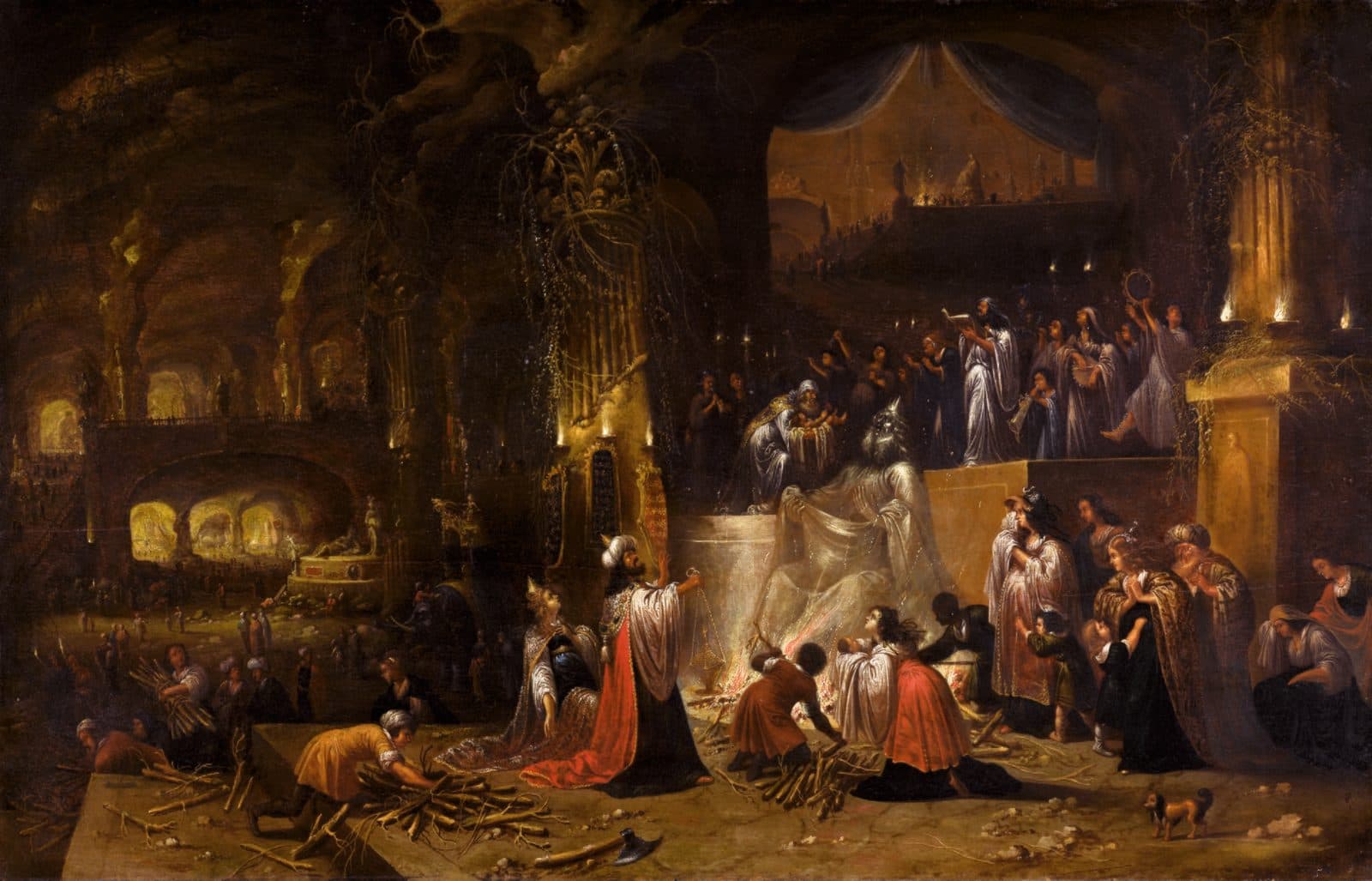
Rombout van Troyen, King Ahaz Sacrifices His Son to Moloch, 1626. Public domain (published before 1930), via Wikimedia Commons.
THE ARTWORKVan Troyen set the scene in a vaulted cavern lit by torches and lamps. The king kneels with his crown on, men bring bundles of wood, and mothers weep at the right.
Jeremiah said of the fires in the valley that the LORD had never commanded them, nor had they entered His mind.
Summary
The Law of Moses forbade any Israelite to give a child to Molech, and kings of Judah did it in the Valley of Hinnom, south of Jerusalem.
- Leviticus 20 set death by stoning for the man who did it, and God's face against his family if the people looked away.
- Ahaz and Manasseh sacrificed sons in the fire, and Josiah desecrated Topheth so that no one could do it again.
- Jeremiah said the valley would be called the Valley of Slaughter and would be filled with the dead.
- The Hebrew name of the valley became Gehenna, the word the Berean renders hell in the words of Jesus.
A Law Against Giving Children to Molech
One verse of chapter 18 gives the law, and four verses of chapter 20 give its penalty
Leviticus 18 forbids the practices of Egypt and of Canaan, and verse 21 names one of them, the giving of a child to Molech. The verse gives the name of God as the reason, since the act would profane it.
Leviticus 20 returns to the same act and sets its penalty.
You must not give any of your children to be sacrificed to Molech, for you must not profane the name of your God. I am the LORD.Every other law of verses 6 to 23 concerns sexual relations, and this verse alone names a god other than the LORD.
“Tell the Israelites, ‘Any Israelite or foreigner living in Israel who gives any of his children to Molech must be put to death. The people of the land are to stone him. And I will set My face against that man and cut him off from his people, because by giving his offspring to Molech, he has defiled My sanctuary and profaned My holy name.The verses set two penalties, one carried out by the people and one by God, and repeat the reason chapter 18 gives.
When the people hide their eyesLeviticus 20:4 to 5, Rashi and Albert Barnes
And if the people of the land ever hide their eyes and fail to put to death the man who gives one of his children to Molech, then I will set My face against that man and his family and cut off from among their people both him and all who follow him in prostituting themselves with Molech.These verses carry the judgment from the man to his family and to everyone who followed him.
Rashi, in his commentary on Leviticus, asks how the family had sinned. His answer is that a family shields the man who does such a thing.
Barnes explains why the sins of chapter 18 return in chapter 20.
“The crimes which are condemned in Lev. 18; 19 on purely spiritual ground, have here special punishments allotted to them as offences against the well-being of the nation.”
Albert Barnes · Notes, Explanatory and Practical, on the Old and New Testaments (1832-1869) · on Leviticus 20:1Evangelical
The land and the sanctuaryLeviticus 18:24 to 25 and Ezekiel 23:38 to 39
Do not defile yourselves by any of these practices, for by all these things the nations I am driving out before you have defiled themselves. Even the land has become defiled, so I am punishing it for its sin, and the land will vomit out its inhabitants.These verses look back over the whole chapter, so the law of verse 21 is one cause of the judgment they name.
They have also done this to Me: On that very same day, they defiled My sanctuary and profaned My Sabbaths. On the very day they slaughtered their children for their idols, they entered My sanctuary to profane it. Yes, they did this inside My house.Ezekiel records what Leviticus 20:3 warned of, children slaughtered for idols and the sanctuary profaned on the same day.
Molech and Topheth Across the Canon
Ten books that name Molech, record the sacrifice of children, or name the valley where it was done
- LeviticusThe law against giving a child to Molech, and its penalty, in Leviticus 18:21 and 20:2 to 5
- DeuteronomyThe burning of sons and daughters, named as a practice of the nations, in Deuteronomy 12:31 and 18:10
- 1 KingsSolomon's high places for the gods of Moab and Ammon, in 1 Kings 11:7
- 2 KingsTwo kings sacrifice a son in the fire, and a third desecrates Topheth, in 2 Kings 16:3, 21:6 and 23:10
- 2 ChroniclesThe Valley of Hinnom named as the place of both sacrifices, in 2 Chronicles 28:3 and 33:6
- PsalmsSons and daughters sacrificed to demons, as the psalm reviews Israel's history, in Psalm 106:37 to 38
- JeremiahThree oracles against what Judah did at Topheth, in Jeremiah 7:31 to 32, 19:6 and 32:35
- EzekielChildren given up through the fire to idols, in Ezekiel 16:20 to 21
- MarkJesus warns of geenna, the Greek form of the valley's name, in Mark 9:43 to 48
- ActsStephen names the tabernacle of Molech from Amos, in Acts 7:43
The ten books stand in canon order, each with its passage.
From Solomon to Josiah
Four kings in Jerusalem, from the first high place for Molech to the desecration of Topheth
SOLOMON
On a hill east of Jerusalem, Solomon built a high place for Molech, the abomination of the Ammonites.
AHAZ
Ahaz walked in the ways of the kings of Israel and sacrificed his son in the fire, after the abominations of the nations.
MANASSEH
Manasseh sacrificed his own son in the fire, practiced sorcery and divination, and consulted mediums.
JOSIAH
Josiah desecrated Topheth so that no one could sacrifice a son or a daughter there again.
2 Kings 23:13 to 14 records that Josiah also defiled the places of worship Solomon had built and covered their sites with human bones, which made the ground unclean.
Jamieson, Fausset & Brown, in their Commentary on those verses, held that Hezekiah had long before torn down the temples Solomon built there. Josiah defiled the spot because the people still held it sacred.
Topheth in the Valley of Ben-hinnom
Where the valley lay, and what Jeremiah said and did there
The Valley of Hinnom ran along the southern slope of Jerusalem and marked the border of Judah. Topheth was a place within it where the high places stood.
Jeremiah gave the LORD's judgment on Topheth in chapters 7 and 19.
They have built the high places of Topheth in the Valley of Hinnom so they could burn their sons and daughters in the fire—something I never commanded, nor did it even enter My mind. So behold, the days are coming, declares the LORD, when this place will no longer be called Topheth and the Valley of Hinnom, but the Valley of Slaughter. For they will bury the dead in Topheth until there is no more room.The place where the children were burned would become the place where Judah buried its own dead.
Then you are to shatter the jar in the presence of the men who accompany you, and you are to proclaim to them that this is what the LORD of Hosts says: I will shatter this nation and this city, like one shatters a potter’s jar that can never again be repaired. They will bury the dead in Topheth until there is no more room to bury them.A jar broken past repair stood for the nation, and the prophet broke it at the valley where the sin was done.
The dead in the valleyAlbert Barnes on Jeremiah 7:29
Barnes reads the judgment as a reversal of what was done in the valley.
“Jeremiah summons the people to lament over the miserable consequences of their rejection of God. In the valley of Hinnom, where lately they offered their innocents, they shall themselves fall before the enemy in such multitudes that burial shall be impossible, and the beasts of the field unmolested shall prey upon their remains.”
Albert Barnes · Notes, Explanatory and Practical, on the Old and New Testaments (1832-1869) · on Jeremiah 7:29Evangelical
The border of JudahJoshua 15:8
From there the border went up the Valley of Hinnom along the southern slope of the Jebusites (that is, Jerusalem) and ascended to the top of the hill that faces the Valley of Hinnom on the west, at the northern end of the Valley of Rephaim.The valley first appears as a boundary line, long before anything was done in it.
Why the place was called TophethThe lexicon, Rashi and John Gill
The Brown, Driver and Briggs lexicon calls the origin of the name doubtful. Rashi derived the name from the Hebrew word for drums, and said they were beaten in that place so that a parent would not hear the cries.
John Gill, in his Exposition of the Old Testament on Jeremiah 7:31, gives the same account of the drums from Rashi, whom he calls Jarchi.
Every Verse That Names Molech or Topheth
Molech stands in eight verses of the Hebrew text, Topheth nine times in eight verses, and the longer form Tophteh once
| Word | Verses | The setting of the passage |
|---|---|---|
| Molech | Leviticus 18:21 and 20:2 to 5 | The first five uses of the name, all of them in Leviticus |
| Molech | 1 Kings 11:7 | The account of Solomon's last years, where the lexicon reads Milcom |
| Molech | 2 Kings 23:10 | The account of Josiah's reform, in the same verse as Topheth |
| Molech | Jeremiah 32:35 | The LORD's charge against Judah while the army of Babylon besieged Jerusalem |
| Topheth | 2 Kings 23:10 | The one verse of Kings that names the place |
| Topheth | Isaiah 30:33 | The pyre made ready for the king, in the oracle against Assyria, where the Hebrew has the form Tophteh |
| Topheth | Jeremiah 7:31 to 32 | The sermon Jeremiah gave at the gate of the LORD's house |
| Topheth | Jeremiah 19:6, 11, 12, 13 and 14 | The sign of the broken jar, given at the valley itself |
The Hebrew Words
Four Hebrew words, each with the lexicon entry that defines it
MOLEK
Molek has the consonants of melek, king, and the vowels of boshet, shame.
TOPHETH
The lexicon counts nine uses, six of them with the article, and gives two senses in Jeremiah, a place of sacrifice and then a burial ground.
GE BEN-HINNOM
Ge means a valley or a gorge, and the lexicon finds the meaning of Hinnom doubtful.
HE'EVIR
The verb of the law means to make pass, and in this stem it can also mean to dedicate or devote.
Molech, Milcom and the Phoenician Milk1 Kings 11:5, 7 and 33
The lexicon notes a Phoenician god whose name is written Milk. It reads the Molech of 1 Kings 11:7 as probably Milcom.
For they have forsaken Me to worship Ashtoreth the goddess of the Sidonians, Chemosh the god of the Moabites, and Milcom the god of the Ammonites. They have not walked in My ways, nor done what is right in My eyes, nor kept My statutes and judgments, as Solomon’s father David did.The verse names Milcom as the god of the Ammonites among the gods for which the kingdom was torn from Solomon's son.
Topheth in later HebrewThe Klein Dictionary
The Klein Dictionary defines Topheth as a place south of Jerusalem where children were burnt to Moloch, and it gives hell as the sense of the word in later Hebrew.
What the Text Leaves Unsaid
Four matters on which the text is silent
The Law names no image of Molech and describes no rite.
Scripture gives no count of the children who died at Topheth. It does not say whether the Molech of Leviticus and the Milcom of 1 Kings 11:5 are one god.
What the LORD Said of the Fires
What the LORD said of the practice, and where the name of the valley went
Jeremiah records the LORD's disowning of the practice three times, in 7:31, 19:5 and 32:35.
Henry answers the claim that Abraham's offering of Isaac gave a pattern for the practice.
“Abraham's offering Isaac could not give countenance, much less could it give rise to this barbarous practice, since, though that was commanded, it was immediately countermanded.”
Matthew Henry · Commentary on the Whole Bible · on Leviticus 20:2 to 3Puritan
They have built high places to Baal on which to burn their children in the fire as offerings to Baal—something I never commanded or mentioned, nor did it even enter My mind.This verse adds that the LORD never mentioned the practice, a word Jeremiah 7:31 does not have.
“Do not lay a hand on the boy or do anything to him,” said the angel, “for now I know that you fear God, since you have not withheld your only son from me.”The angel's word at Moriah forbids the very act that Judah later did in the valley.
The lexicon traces the name of the valley through Isaiah 66:24 to the Jewish Gehinnom and the geenna of the New Testament. Jerome, in his Commentary on Jeremiah 19:6, wrote that the valley of the son of Hinnom is called Gehenna in Hebrew. Eleven of the twelve verses with geenna are in the Gospels, all in the words of Jesus, and the twelfth is James 3:6.
Do not be afraid of those who kill the body but cannot kill the soul. Instead, fear the One who can destroy both soul and body in hell.The Berean renders geenna as hell in this verse, so the name of the valley stands behind the warning.
Voices on Molech and Topheth
Matthew Henry and John Wesley
Henry reads the sin as God's judgment on a people who had already given up His glory.
“Surely it was in a way of righteous judgment, because they had changed the glory of God into the similitude of a beast, that God gave them up to such vile affections that changed them into worse than beasts.”
Matthew Henry · Commentary on the Whole Bible · on Jeremiah 7:31Puritan
Wesley gathers the places where the prophets name the sin and the valley.
“The sin in the general was idolatry, but a most barbarous species of it, mentioned also chap. vii, 31; xxxii, 35, where it is said, they made their sons and their daughters pass thro' the fire to Molech; the place where they did it is called Tophet, ver. xix, 6, of which also mention is made, Isaiah xxx, 33.”
John Wesley · Explanatory Notes upon the Old Testament · on Jeremiah 19:5Evangelical
What Molech Names, and What the Fire Did
Readings of the name Molech and of what was done to the children
The god of the AmmonitesJohn Wesley; Jamieson, Fausset & Brown; Rashi
John Wesley, in his Explanatory Notes on Leviticus 18:21, called Molech an idol chiefly of the Ammonites, also named Milcom. Jamieson, Fausset & Brown, on Jeremiah 32:35, gave the name the meaning king and took Molech as the same god as Milcom. Rashi, in his commentary on Leviticus 18:21, called it an idol whose name was Molech.
The objection: Jeremiah 32:35 places the giving of children to Molech at the high places of Baal in Judah's own valley.
A divine titleBrown, Driver and Briggs; Adam Clarke
Brown, Driver and Briggs, in their lexicon, read Molech as a divine title, King, borne by the god to whom Israel gave its children. Adam Clarke, in his Commentary on Leviticus 18:21, took the name to mean king and thought the idol likely stood for the sun.
The objection: 1 Kings 11:7 calls Molech the abomination of the Ammonites, which names the god of one people.
They have built the high places of Baal in the Valley of Hinnom to make their sons and daughters pass through the fire to Molech—something I never commanded them, nor had it ever entered My mind, that they should commit such an abomination and cause Judah to sin.Both readings of the name must account for this verse.
Children burned to deathJeremiah 7:31, Ezekiel 16:21; Adam Clarke and John Gill
Jeremiah 7:31 uses the verb to burn, and Ezekiel 16:21 says the children were slaughtered. Adam Clarke, on Leviticus 20:2, and John Gill, on Jeremiah 7:31, report the rabbis' account of a brass image heated by fire into whose arms the child was put.
You even took the sons and daughters you bore to Me and sacrificed them as food to idols. Was your prostitution not enough? You slaughtered My children and delivered them up through the fire to idols.God calls the children His, so the act is counted as a wrong done to Him.
The objection: the law in Leviticus 18:21 and the account of Josiah in 2 Kings 23:10 use the verb to make pass, which does not by itself mean death.
A passage between two firesRashi on Leviticus 18:21
Rashi, on Leviticus 18:21, cites the Talmud's tractate Sanhedrin 64b for the rite. The father handed his child to the idol's priests, who lit two pyres and made the child walk between them.
you are to present to the LORD the firstborn male of every womb. All the firstborn males of your livestock belong to the LORD.The verb of Leviticus 18:21 gives the firstborn to the LORD here, and verse 13 has every firstborn son redeemed.
The objection: Psalm 106:38 speaks of innocent blood shed, and Jeremiah 19:5 speaks of children burned in the fire as offerings to Baal.
Death for some, a rite for othersJohn Wesley; Ishodad of Merv
Wesley, on Leviticus 18:21, allowed for both burning and a walk between two great fires.
Ishodad of Merv, in his Books of Sessions on 2 Kings 23:10, wrote that some children were immolated and some only underwent the symbolic rite.
The Father Who Gave His Son
Romans 8:32 and Mark 10:14
Judah gave its children to an idol in a valley beside Jerusalem. God gave His own Son for us all.
So the text asks the reader to give no idol the place that belongs to God, and to bring every child to Jesus.
He who did not spare His own Son but gave Him up for us all, how will He not also, along with Him, freely give us all things?Paul reasons from this gift to every other gift God gives with Him.
But when Jesus saw this, He was indignant and told them, “Let the little children come to Me, and do not hinder them! For the kingdom of God belongs to such as these.His welcome stands against the valley where Judah gave its sons and daughters away.
Keep studying
Read it5
Studies5
Places1