
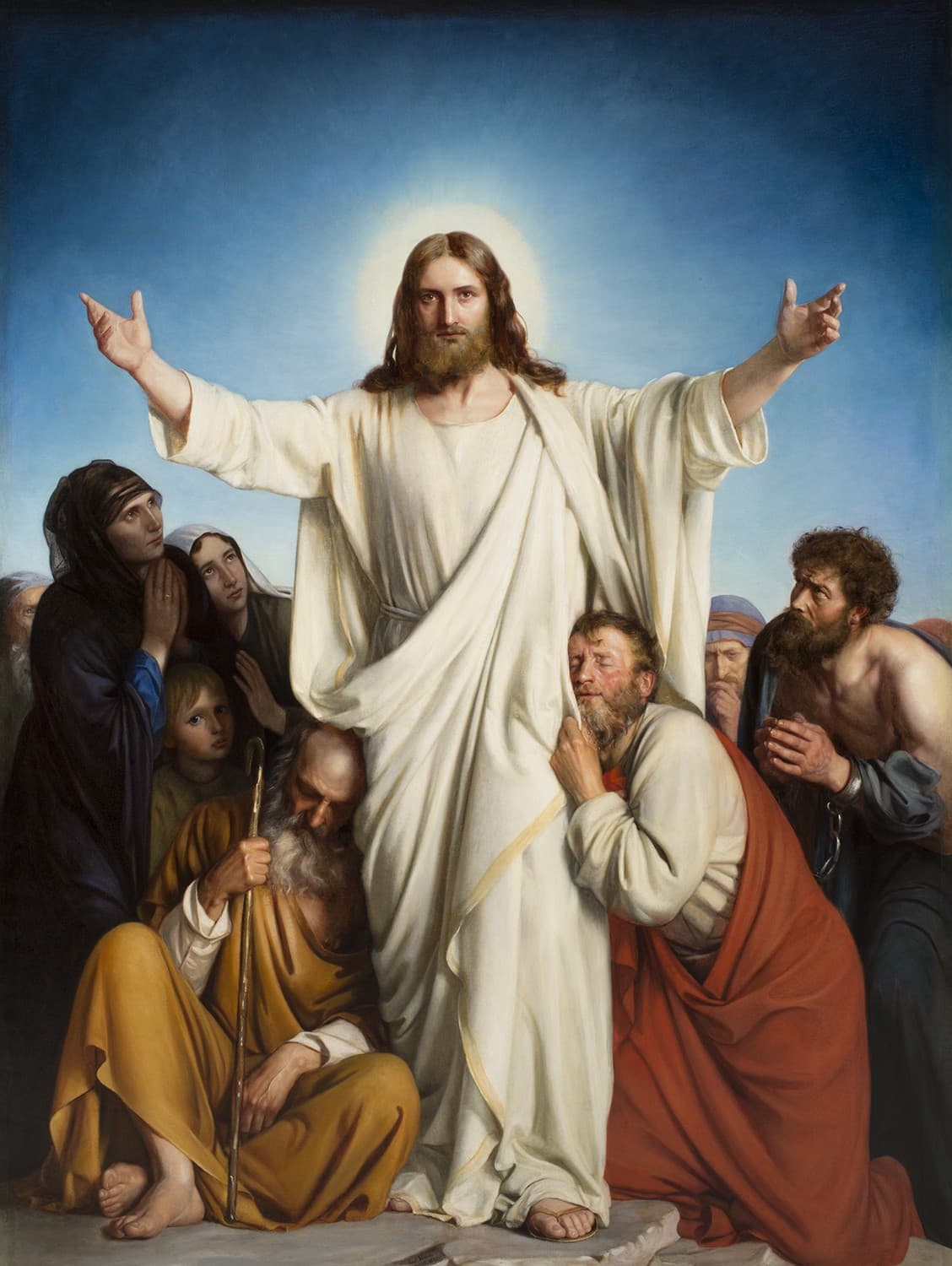
Matthew 11:25 to 30 · Passage · Rest
Come to Me, and I Will Give You Rest
Matthew 11:25 to 30 closes the chapter that opens with John the Baptist's question from prison.
The word Jesus uses for burdened stands once more in the New Testament, when He tells the experts in the law, “You weigh men down with heavy burdens” (Luke 11:46).
Take My yoke upon you and learn from Me; for I am gentle and humble in heart, and you will find rest for your souls.
- The passage
- Matthew 11:25 to 30, Jeremiah 6:16, Matthew 12:1 to 14
- Books
- Matthew, Jeremiah
- Hold in memory
- Matthew 11:28, Matthew 11:30
Summary
Matthew 11:25 to 30 is the call of the One who alone reveals the Father to all who are worn out and weighed down. He offers them rest as His own gift and asks them to take His yoke and learn from Him. The promise of rest for the soul is older than the Gospel and goes back to the prophet Jeremiah.
- Matthew 11:28 to 29 promises rest with two words, a verb of giving and a noun joined to the verb to find.
- Jesus lays His own yoke on the weary and calls it easy, so the rest He gives comes with His service.
- Commentators read the burden either as the Law and its traditions or as sin and every trouble.
The Thanksgiving and the Call
Two sentences of prayer and claim come before the invitation.
Come to Me, and I Will Give You Rest studies Matthew 11:25 to 30 under the value of rest, whose key text it is. In these six verses Jesus speaks first to His Father and then to everyone who is tired and loaded down.
The question it answers is what rest Jesus offers, to whom and on what terms. It sets the words in Matthew 11 and 12 and gives the Greek of the two promises of rest. It explains the yoke, the easy burden and the line of Jeremiah that Jesus takes up. It also sets out the two ways commentators have read the burden.
The passage opens with praise. Jesus thanks the Father, “Lord of heaven and earth”, for hiding these things “from the wise and learned” and revealing them “to little children” (Matthew 11:25).
He then claims that “no one knows the Father except the Son and those to whom the Son chooses to reveal Him” (Matthew 11:27).
Come to Me, all you who are weary and burdened, and I will give you rest.The verse stands first among the lines Jesus speaks to His hearers, after two sentences spoken to and about the Father.
Matthew gives the weary two Greek participles. The first, kopiontes, is from kopiao, glossed “to feel fatigue” in Strong's dictionary. The second, pephortismenoi, is a perfect passive of phortizo, to load up as one loads a vessel or an animal. It names people on whom a load has been laid and still lies.
Rest Given and Rest Found
The four verbs of the call and the two words for rest show its order.
The call moves through four verbs. Matthew 11:28 opens with deute, come here, and Matthew 11:29 gives arate, take up, mathete, learn, and heuresete, you will find.
In Matthew 11:28 Jesus says anapauso, I will give rest, a future verb with Himself as its subject. In Matthew 11:29 the weary become the subject, and the words are heuresete anapausin, you will find rest, with the noun from the same root. The first promise is His gift to those who come, and the second is what they discover as they live under His teaching.
A yoke coupled working animals to their load, and Paul warns the Galatians against “a yoke of slavery” (Galatians 5:1). John Gill, in his Exposition of the New Testament (1746 to 1748), called Jesus' phrase Rabbinical. He wrote that Jewish teachers spoke of taking up “the yoke of the kingdom of heaven”.
Jesus gives His own character as the reason to learn from Him, since He is praus, gentle, and tapeinos, humble, in heart.
The Easy Yoke and the Light Burden
The adjective Jesus uses for His yoke is a word for kindness.
For My yoke is easy and My burden is light.”The last line gives the reason the weary can take on a yoke at all, since the yoke and the load are His own.
The Greek for easy is chrestos, the adjective Luke uses when Jesus says of the Most High, “He is kind to the ungrateful and wicked” (Luke 6:35). The burden is phortion, a word for a load of freight, and light is elaphron.
The Weary in Matthew 11 and 12
The call stands between a chapter of unbelief and a chapter of disputes over the Sabbath.
Jesus likens “this generation” to children in the marketplaces who would neither dance nor mourn (Matthew 11:16 to 17). He then denounces Chorazin, Bethsaida and Capernaum, the towns where most of His miracles were done, “because they did not repent” (Matthew 11:20 to 23).
The next words in Matthew are “At that time Jesus went through the grainfields on the Sabbath” (Matthew 12:1). The Pharisees charge His hungry disciples with doing what is unlawful on the Sabbath. Jesus answers with David, the priests in the temple and the words “I desire mercy, not sacrifice” (Matthew 12:7). In the synagogue they ask whether it is lawful to heal on the Sabbath, and He heals a man's withered hand.
He replied, “If one of you has a sheep and it falls into a pit on the Sabbath, will he not take hold of it and lift it out? How much more valuable is a man than a sheep! Therefore it is lawful to do good on the Sabbath.”Jesus' answer about the sheep in the pit shows what the Sabbath is for, soon after He has offered rest to the weary.
Rest for Your Souls
Jesus takes up a line of Jeremiah and an offer that Israel had heard before.
This is what the LORD says: “Stand at the crossroads and look. Ask for the ancient paths: ‘Where is the good way?’ Then walk in it, and you will find rest for your souls. But they said, ‘We will not walk in it!’Jeremiah's call holds the same promise of rest for the soul that Jesus makes in Matthew 11:29.
Jeremiah's word for rest is margoa, which stands only in this verse of the Old Testament. Jeremiah sent the people to the ancient paths, and Jesus calls the weary to Himself.
to whom He has said: “This is the place of rest, let the weary rest; this is the place of repose.” But they would not listen.Isaiah records an earlier offer of rest to the weary that Israel would not hear, so Jesus' call meets an old refusal.
And the LORD answered, “My Presence will go with you, and I will give you rest.”The LORD's promise to Moses ties rest to His own presence, and in Matthew 11 the One who offers rest stands among His hearers.
How the Church Has Read the Call
Three teachers of the early church, each under the line it teaches.
died 407 · John Chrysostom
Homily on the Gospel of Matthew 38
The quotation1 quotation
“‘Take my yoke upon you, and learn of me, for I am meek and lowly in heart; and ye shall find rest unto your souls. For my yoke is easy, and my burden is light.’ Thus, ‘be not afraid,’ saith He, ‘hearing of a yoke, for it is easy: fear not, because I said, 'a burden,' for it is light.’ And how said He before, ‘The gate is narrow and the way strait?’ Whilst thou art careless, whilst thou art supine; whereas, if thou duly perform His words, the burden will be light; wherefore also He hath now called it so. But how are they duly performed? If thou art become lowly, and meek, and gentle. For this virtue is the mother of all strictness of life. Wherefore also, when beginning those divine laws, with this He began. And here again He doeth the very same, and exceeding great is the reward He appoints. ‘For not to another only dost thou become serviceable; but thyself also above all thou refreshest,’ saith He. ‘For ye shall find rest unto your souls.’ Even before the things to come, He gives thee here thy recompense, and bestows the prize already, making the saying acceptable, both hereby, and by setting Himself forward as an example. For, ‘Of what art thou afraid?’ saith He, ‘lest thou shouldest be a loser by thy low estate? Look to me, and to all that is mine; learn of me, and then shalt thou know distinctly how great thy blessing.’ Seest thou how in all ways He is leading them to humility? By His own doings: ‘Learn of me, for I am meek.’ By what themselves are to gain; for, ‘Ye shall find,’ saith He, ‘rest unto your souls.’ By what He bestows on them; for, ‘I too will refresh you,’ saith He. […]”
John Chrysostom · Homily on the Gospel of Matthew 38 · on Matthew 11:28 to 30Patristic
died 430 · Augustine of Hippo
Catena Aurea by Aquinas
The quotation1 quotation
“So then they who with unfearing neck have submitted to the yoke of the Lord endure such hardships and dangers, that they seem to be called not from labour to rest, but from rest to labour. But the Holy Spirit was there who, as the outward man decayed, renewed the inward man day by day, and giving a foretaste of spiritual rest in the rich pleasures of God in the hope of blessedness to come, smoothed all that seemed rough, lightened all that was heavy. Men suffer amputations and burnings, that at the price of sharper pain they may be delivered from torments less but more lasting, as boils or swellings. What storms and dangers will not merchants undergo that they may acquire perishing riches? Even those who love not riches endure the same hardships; but those that love them endure the same, but to them they are not hardships. For love makes right easy, and almost nought all things however dreadful and monstrous. How much more easily then does love do that for true happiness, which avarice does for misery as far as it can?”
Augustine of Hippo · Catena Aurea by Aquinas · on Matthew 11:30Patristic
died 533 · Remigius of Rheims
Catena Aurea by Aquinas
The quotation1 quotation
“Come, He says, not with the feet, but with the life, not in the body, but in faith. For that is a spiritual approach by which any man approaches God; and therefore it follows, Take my yoke upon you.”
Remigius of Rheims · Catena Aurea by Aquinas · on Matthew 11:28Patristic
What the Burden Is
Two readings of the weight on the weary, each with its holders and the objection to it.
The burden of the Law and its traditionsHilary of Poitiers; Jerome
Hilary of Poitiers, as the Catena Aurea of Thomas Aquinas prints him, wrote that Jesus “calls to Him those that were labouring under the hardships of the Law”. Jerome, in the same collection, asked of Matthew 11:30, “how is the Gospel lighter than the Law”, and answered that “by the Gospel the will is sought for”.
The objection: Jesus calls “all you who are weary” and names no class of hearer, so the call reaches beyond those who kept the Law.
The burden of sin and every troubleJohn Wesley; Albert Barnes
John Wesley, in his Explanatory Notes upon the New Testament (1755), glossed heavy laden as “With the guilt and power of sin”. Albert Barnes, in his Notes, Explanatory and Practical (1832 to 1869), granted that the words “perhaps” referred “primarily to the Jews”. He held that Jesus “meant here chiefly to address the poor, lost, ruined sinner”.
The objection: Jesus speaks of a yoke, the word Peter used at Jerusalem for the law, a yoke “that neither we nor our fathers have been able to bear” (Acts 15:10).
The Call to a Person
Every line of the passage turns on Jesus Himself.
He alone reveals the Father, He gives the rest, and the yoke and the load are His. The weary are asked first to come to Him, and only then to carry what He lays on them.
Sources
Scripture is the Berean Standard Bible.
- STEP Bible, Translators Amalgamated Greek New Testament and the tagged Hebrew Bible (Tyndale House, Cambridge), CC BY 4.0.
- STEP Bible brief lexicons of Extended Strongs for Greek and Hebrew (Tyndale House, Cambridge), CC BY 4.0, with the Strong's glosses.
- John Gill, Exposition of the New Testament (1746 to 1748), on Matthew 11:29.
- John Chrysostom, Homilies on the Gospel of Matthew, Homily 38, on Matthew 11:28 to 30 (Nicene and Post-Nicene Fathers, first series, volume 10)
- Thomas Aquinas, Catena Aurea on the Gospel of Matthew, chapter 11 (English translation, Oxford, 1841), printing Hilary of Poitiers, Jerome, Augustine and Remigius.
- John Wesley, Explanatory Notes upon the New Testament (1755), on Matthew 11:28.
- Albert Barnes, Notes, Explanatory and Practical, on the Old and New Testaments (1832 to 1869), on Matthew 11:28.
Keep Studying
Studies8
People and groups10
Symbols1
Doctrines1