
The Unseen Realm
The Throne Room
One seat of God, shown to four seers across eight centuries — four sustained visions of the same room.
Summary
What the four throne visions agree on, where they differ, and why the differences are honest reporting rather than contradiction. The page ends at the question the room itself settles: whose throne it is.
- Four sustained visions, one throne.
- The living creatures are handled with care, by the text.
- Whose throne it is: the room answers the question.
- The throne room is where every book's politics are settled.
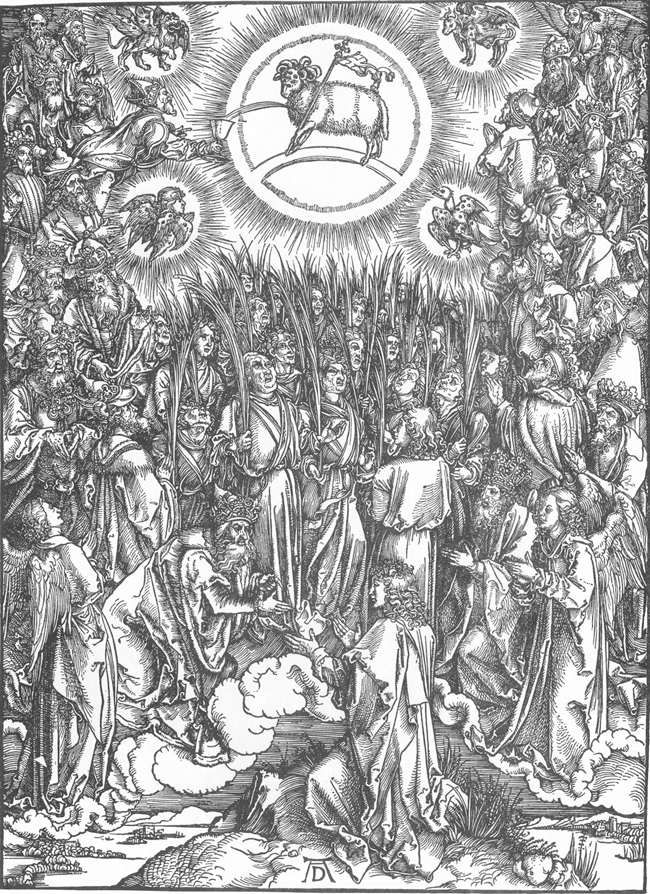
The Adoration of the Lamb and the Hymn of the Chosen — Albrecht Dürer
Albrecht Dürer, The Adoration of the Lamb and the Hymn of the Chosen (1498) — Public domain, via Wikimedia Commons
The Unseen Realm
Four windows into one room
Four of Scripture's throne visions are drawn at length, the veil drawn back and a seer shown the throne of God directly. Isaiah sees it in the Jerusalem temple "in the year that king Uzziah died" (Isa 6:1), c. 740 BC. Ezekiel sees it as a storm-borne chariot by the Chebar canal in Babylonian exile (Ezek 1), c. 593 BC. Daniel sees it in a night-vision as the Ancient of Days on a throne of fiery flame (Dan 7:9), c. 550 BC. John sees it through "a door opened in heaven" on Patmos (Rev 4:1), c. AD 95. Eight centuries and three empires separate the first sighting from the last.
The details differ because the seers differ. Isaiah reports six-winged seraphim; Ezekiel, four-faced living creatures riding wheels full of eyes; Daniel, ten-thousand times ten thousand attendants and a river of fire; John, four living creatures and twenty-four elders around a sea of glass. But the fixed points recur: a high throne, a burning guard of living creatures, and, in Isaiah and John alike, the three-fold cry, "Holy, holy, holy" (Isa 6:3; Rev 4:8). These are not four thrones. They are four windows into one room.
Cried - Singing in consort. Holy - This is repeated thrice, to intimate the Trinity of persons united in the Divine essence. Glory - Of the effects and demonstrations of his glorious holiness, as well as of his power, wisdom, and goodness.
— John Wesley, Explanatory Notes upon the Bible (1765), on Isaiah 6:3
The Unseen Realm
The living creatures, handled with care
The hardest question the throne texts raise is whether the burning attendants are the same beings. Isaiah names seraphim, Hebrew śārāp̄ (H8314), "burning ones", with six wings each (Isa 6:2). Ezekiel describes four "living creatures" (ḥayyôt), each with four faces, man, lion, ox, eagle, and four wings (Ezek 1:5–10); in Ezekiel 10:20 he identifies them as kərûḇîm, cherubim. John's four living creatures (Greek zōa, G2226) each bear a single face from that same quartet and six wings apiece (Rev 4:7–8).
The wing-counts and faces do not line up cleanly (six / four / six), so two readings stand. One holds that seraphim, cherubim, and the zōa are a single highest throne-guard, each seer shown a different aspect, the shared six wings and Trisagion of Isaiah and Revelation anchoring the identification. The other holds that "seraph" and "cherub" name distinct orders in the Hebrew canon, with Revelation's creatures fusing features of both.
Scripture names seraphim only in Isaiah and cherubim from Eden (Gen 3:24) to the ark's mercy seat (Exo 25:18–22), and never equates them outright. The site takes no flag here. A later tradition (Irenaeus, Against Heresies 3.11.8) read the four faces as the four Gospels; another PD reading heard a Trinitarian and incarnational echo in the same four faces, both noted as tradition, not as the plain sense of the text.
Just such were the four cherubim in Ezekiel, who supported the moving throne of God; whereas each of those that overshadowed the mercy-seat in the holy of holies had all these four faces: whence a late great man supposes them to have been emblematic of the Trinity, and the incarnation of the second Person.
— John Wesley, Explanatory Notes upon the Bible (1765), on Revelation 4:7
Merkabah, a later tradition, not the text itself. Ezekiel's throne-chariot (Hebrew merkāḇâ, "chariot," a term Ezekiel never uses of it himself, it derives from 1 Chr 28:18's plan for the ark) seeded a substantial post-biblical Jewish mystical tradition: Merkabah and Hekhalot literature, meditative ascents through the heavenly "palaces" to the throne. The Mishnah itself treats the material as dangerous to handle loosely, restricting who may expound "the Chariot" (Hagigah 2:1). Merkabah mysticism is a later interpretive tradition built on Ezekiel 1. Ezekiel himself makes no such claim, and the tradition is not doctrine.
The Unseen Realm
Whose throne it is
The four visions are not merely a shared image; they converge on a single claim. Daniel's throne is the hinge: it is no distant blaze but a seat that receives a person, "one like unto a son of man" brought with the clouds of heaven and "given dominion, and glory, and a kingdom" (Dan 7:13–14). Revelation completes the movement. At the center of the very throne John sees "a Lamb standing, as though it had been slain" (Rev 5:6), who alone is worthy to take the sealed scroll.
The New Testament reads even Isaiah's oldest sighting christologically. Of Isaiah 6, John writes that the prophet "saw his glory, and he spake of him" (John 12:41), that is, of Christ. The mercy seat between the cherubim, where God promised to meet Israel (Exo 25:22), turns out to be the earthly copy of what John saw whole: the throne, the living creatures, and the Lamb at its heart. Read together, the four windows show one room, one throne, and, from Isaiah's temple to John's open door, one Lord upon it.
One throne · four sightings4
The same room, seen four times
Across eight centuries and three empires, four seers are shown the same seat of God: a throne, a burning guard of living creatures, and a song. Isaiah in the temple; Ezekiel by a canal in exile; Daniel in a Babylonian night; John through a door in heaven. The details differ because the seers differ. The throne does not.
- Isaiah 6c. 740 BCJerusalem · the templeSeraphim · six wings · the Trisagion
“I saw the Lord seated on a throne, high and exalted; and the train of His robe filled the temple.”
Isaiah 6:1 · BSB - Ezekiel 1c. 593 BCExile · by the ChebarLiving creatures · four faces · wheels of eyes
“Above the expanse over their heads was the likeness of a throne with the appearance of sapphire, and on the throne high above was a figure like that of a man.”
Ezekiel 1:26 · BSB - Daniel 7c. 550 BCBabylon · a night visionAncient of Days · fiery throne · Son of Man
“Thrones were set in place, and the Ancient of Days took His seat… His throne was flaming with fire, and its wheels were all ablaze.”
Daniel 7:9 · BSB - Revelation 4–5c. AD 95Patmos · a door in heavenFour living creatures · the Lamb · the Trisagion
“I saw a throne standing in heaven, with someone seated on it… and a rainbow that gleamed like an emerald encircled the throne.”
Revelation 4:2–3 · BSB
Feature by feature
| Feature | Isaiah 6 c. 740 BC | Ezekiel 1 c. 593 BC | Daniel 7 c. 550 BC | Revelation 4–5 c. AD 95 |
|---|---|---|---|---|
| Guardian beings | Seraphim (śārāp̄, H8314)6:2 | Living creatures: named cherubim at 10:201:5 | Not named: attendants, thousand thousands7:10 | Living creatures (zōa, G2226)4:6 |
| Wings each | Six6:2 | Four1:6 | Not given | Six4:8 |
| Faces | Not given | Four each: man, lion, ox, eagle1:10 | Not given | One each, the same four4:7 |
| “Holy, holy, holy” | Sung6:3 | Not recorded | Not recorded | Sung4:8 |
| Signature detail | The temple fills with smoke6:4 | Wheels full of eyes1:18 | Ancient of Days; ten thousand times ten thousand7:9–10 | Twenty-four elders; a Lamb as though slain4:4; 5:6 |
Blank cells mean the passage does not give that detail; nothing is filled in from the others.
The song that carries across
Holy, holy, holy: in two rooms, one anthem
Isaiah 6:3 · c. 740 BC
In the temple
“Holy, holy, holy is the LORD of Hosts; all the earth is full of His glory.”Seraphim call it, one to another; the threshold shakes and the house fills with smoke (Isa 6:4, BSB).
Revelation 4:8 · c. AD 95
In heaven
“Holy, Holy, Holy, is the Lord God Almighty, who was and is and is to come!”The four living creatures rest not day and night, singing the same three-fold word (Rev 4:8, BSB).
The living creatures4
Four faces, one guard
Ezekiel’s creatures each bear four faces (Ezek 1:10); John’s four each bear one (Rev 4:7). Together the faces are the same quartet — the summit of the wild, the tame, humanity, and the air. Ezekiel later names these creatures cherubim (Ezek 10:20) — the same order that guards Eden (Gen 3:24) and overshadows the mercy seat (Exo 25:18–22).
- LionEzek 1:10 · Rev 4:7the wild: dominion
- OxEzek 1:10 · Rev 4:7the tame: service
- ManEzek 1:10 · Rev 4:7the crown of creation
- EagleEzek 1:10 · Rev 4:7the heights: flight
A later Christian tradition (Irenaeus, Against Heresies 3.11.8) read the four faces as the four Gospels. That is tradition, labeled as tradition — not the plain sense of Ezekiel or John.
Daniel 7 · the hinge
The throne receives a Man
I saw One like the Son of Man coming with the clouds of heaven… And He was given dominion, glory, and kingship, that the people of every nation and language should serve Him.The one throne is no distant blaze: a Son of Man is brought near to it and given everlasting dominion. Revelation seats the slain Lamb there (Rev 5:6).
Seen by an exile
Wheels within wheels, full of eyes
Ezekiel’s Vision, a print copied after the German engraver Matthäus Merian the Elder, sets down what the chapter itself describes: four living creatures each with four faces, wings, and beside them wheels “full of eyes round about” (Ezek 1:18). Above them, “the likeness of a throne” and, on it, “a likeness as the appearance of a man” (Ezek 1:26): the storm-borne throne-chariot a Judean exile saw by a Babylonian canal.

Handle with care
Seraphim, cherubim, living creatures: one order or three?
◈Do the four visions show the same beings?contested · Open question: the site does not flatten it
View 1 · one order, four disclosuresThe seraphim (“burning ones,” śārāp̄), Ezekiel’s cherubim, and John’s ζῷα (zōa) are one highest throne-guard; differing wings (6 / 4 / 6) and faces record what each seer was shown. The shared six wings and Trisagion of Isaiah 6 and Revelation 4 anchor this reading.
View 2 · distinct ranks, fused in John “Seraph” and “cherub” name separate orders in the Hebrew canon; Revelation’s creatures combine features of both as a single summary disclosure of the same throne.
The site takes no flag here: Scripture names seraphim only in Isaiah and cherubim from Eden to the ark, and never equates them outright. What every text agrees on is the throne and the One upon it.
Standard lexicons (BDB, Gesenius) · on śārāp̄, kərûḇ, and ʾôp̄an
Walk on from the throne4
Doorways
Word study
kərûḇ: cherubFrom the flaming guard of Eden (Gen 3:24) to the gold figures over the mercy seat (Exo 25) to the throne-chariot of Ezekiel: one word traces the throne across the canon.Verse
John 12:41: whose glory?John says Isaiah “saw His glory and spoke of Him”, reading the throne of Isaiah 6 as the throne of Christ.Lens
Throne, mercy seat, and LambThe mercy seat between the cherubim is the earthly copy; Revelation 5 shows the reality: the slain Lamb at the center of the throne.Verse
Daniel 7:9: the Ancient of DaysThe fiery throne with burning wheels: Daniel's night vision set beside Ezekiel's chariot and John's sea of glass.Keep Studying
On this page
Studies4
People and groups1
Places1
Symbols2