

Genesis 1:1 to Exodus 6:3 · Doctrine · Featured Study
Names of God
Scripture names God as Elohim in its first verse, as El Shaddai to the patriarchs and as YHWH to Moses, and the New Testament carries the names to Jesus.
At the burning bush God gave Moses the name He calls His name forever, the LORD.
- First taught
- Genesis 1:1 “In the beginning God created the heavens and…”
- Fullest statement
- Exodus 3:13 to 15 “Then Moses asked God, “Suppose I go to…”
Claude Lorrain, Landscape with Hagar and the Angel, 1646. Public domain.
Summary
Each name of God in Scripture is given at a moment in the story, and the covenant name YHWH stands at the centre of them.
- Elohim names God as Creator in Genesis 1:1, and the El names carry what He is: Most High, Almighty, Eternal, the God who sees.
- Abraham, Moses and Gideon named a mountain and two altars for what the LORD did there.
- Jewish readers say Adonai where YHWH is written, and English Bibles print the name as LORD in small capitals.
- Jesus spoke the words I am in John's Gospel, and the New Testament confesses Him with the Greek word that rendered YHWH.
The Covenant Name at the Bush
Genesis opens with the name Elohim, and Exodus 3 gives the covenant name with its meaning.
Elohim is plural in form, and in Genesis 1:1 its verb is singular.
In the beginning God created the heavens and the earth.The covenant name was given to a man in trouble, sent back to Egypt to face Pharaoh. The Hebrew behind I AM WHO I AM is ehyeh asher ehyeh.
Then Moses asked God, “Suppose I go to the Israelites and say to them, ‘The God of your fathers has sent me to you,’ and they ask me, ‘What is His name?’ What should I tell them?” God said to Moses, “I AM WHO I AM. This is what you are to say to the Israelites: ‘I AM has sent me to you.’” God also told Moses, “Say to the Israelites, ‘The LORD, the God of your fathers—the God of Abraham, the God of Isaac, and the God of Jacob—has sent me to you.’ This is My name forever, and this is how I am to be remembered in every generation.The four Hebrew letters YHWH are called the Tetragrammaton. Every compound name of the LORD is built on it.
God also told Moses, “I am the LORD. I appeared to Abraham, to Isaac, and to Jacob as God Almighty, but by My name the LORD I did not make Myself known to them.The verse joins the El names of the patriarchs to the covenant name given to Moses.
The Names and Where Scripture First Speaks Them
Twenty-eight names, each with its Hebrew or Greek, its meaning and its first text.
The rows run with the El names first, then the YHWH names, then Adonai and the Greek titles.
| Name | Hebrew or Greek | Meaning | First text | Where it is given |
|---|---|---|---|---|
| El | אֵל | God, mighty one | Genesis 14:18 | the oldest Semitic divine word, claimed for YHWH |
| Elohim | אֱלֹהִים | God, Creator, Judge (plural form, singular referent) | Genesis 1:1 | the Creator of Genesis 1 |
| Eloah | אֱלוֹהַּ | God (singular of Elohim) | Deuteronomy 32:15 | the God Jeshurun forsook; the God of Job |
| El Elyon | אֵל עֶלְיוֹן | God Most High | Genesis 14:18 | Salem, in Melchizedek's blessing |
| El Shaddai | אֵל שַׁדַּי | God Almighty | Genesis 17:1 | the covenant of circumcision |
| El Olam | אֵל עוֹלָם | the Everlasting God | Genesis 21:33 | Beersheba |
| El Roi | אֵל רֳאִי | the God who sees me | Genesis 16:13 | Hagar at the spring along the road to Shur |
| El Gibbor | אֵל גִּבּוֹר | Mighty God | Isaiah 9:6 | title of the promised child; reused of YHWH himself at Isaiah 10:21 |
| YHWH | יְהוָה | the LORD, the covenant name | Genesis 2:4 | the covenant name, explained at the bush in Exodus 3:14 to 15 |
| Yah | יָהּ | short form of YHWH | Exodus 15:2 | the Song of the Sea; the '-iah' in names and Hallelu-Yah |
| Ehyeh Asher Ehyeh | אֶהְיֶה אֲשֶׁר אֶהְיֶה | I AM WHO I AM / I WILL BE | Exodus 3:14 | Horeb, the mountain of God |
| YHWH-Yireh | יְהוָה יִרְאֶה | the LORD will provide / see | Genesis 22:14 | Moriah |
| YHWH-Rapha | יְהוָה רֹפְאֶךָ | the LORD who heals | Exodus 15:26 | at Marah's bitter water made sweet |
| YHWH-Nissi | יְהוָה נִסִּי | the LORD is my banner | Exodus 17:15 | Moses' altar after the defeat of Amalek |
| YHWH-Shalom | יְהוָה שָׁלוֹם | the LORD is peace | Judges 6:24 | Gideon's altar at Ophrah |
| YHWH-Ra'ah | יְהוָה רֹעִי | the LORD is my shepherd | Psalm 23:1 | David's psalm; fulfilled 'I am the good shepherd' (John 10:11) |
| YHWH-Tsidkenu | יְהוָה צִדְקֵנוּ | the LORD our righteousness | Jeremiah 23:6 | the name of the righteous Branch |
| YHWH-Shammah | יְהוָה שָׁמָּה | the LORD is there | Ezekiel 48:35 | the closing name of the restored city |
| YHWH-Mekaddishkem | יְהוָה מְקַדִּשְׁכֶם | the LORD who sanctifies you | Exodus 31:13 | the sabbath sign of sanctification |
| YHWH Tseva'ot / Sabaoth | יְהוָה צְבָאוֹת | the LORD of hosts / armies | 1 Samuel 1:3 | first at Shiloh; transliterated into Greek at Romans 9:29 and James 5:4 |
| Adonai | אֲדֹנָי | Lord, Master | Genesis 15:2 | Abram's address 'Adonai YHWH'; its vowels produced 'Jehovah' (qere perpetuum) |
| Theos | Θεός | God | Matthew 1:23 | God with us, in the name Immanuel |
| Kyrios | Κύριος | Lord, the Septuagint's word for YHWH | Matthew 1:20 | the word of the confession that Jesus Christ is Lord in Philippians 2:11 |
| Logos | Λόγος | Word | John 1:1 | 'In the beginning was the Word'; Revelation 19:13 |
| Christos | Χριστός | Anointed, Messiah | Matthew 1:1 | carries every Old Testament mashiach |
| Emmanouel | Ἐμμανουήλ | God with us | Matthew 1:23 | Matthew's fulfilment citation of Isaiah 7:14 |
| ego eimi | ἐγώ εἰμι | I am (absolute) | John 8:24 | the absolute form, with no picture joined to it |
| Alpha and Omega | Ἄλφα / Ὦ | the first and the last | Revelation 1:8 | the title of the Almighty |
El Roi, El Gibbor, YHWH, Yah, Ehyeh Asher Ehyeh, YHWH-Yireh, YHWH-Rapha, YHWH-Nissi and 14 more
Where the Names Were Spoken
Five names of Genesis, each given in the life of Abraham's household.
GOD MOST HIGH, GENESIS 14:18 TO 20
Melchizedek, king of Salem and priest of God Most High, brings out bread and wine and blesses Abram after the battle. Hebrews 7:2 reads his name as king of righteousness and his title as king of peace.
THE GOD WHO SEES ME, GENESIS 16:13
Hagar, Sarai's Egyptian maidservant, meets the angel of the LORD by a spring in the desert after she flees. She gives a name to the LORD who spoke to her, the God who sees her.
GOD ALMIGHTY, GENESIS 17:1
The LORD appears to Abram at ninety-nine years old and calls him to walk before Him and be blameless. The name El Shaddai opens the covenant of circumcision.
THE ETERNAL GOD, GENESIS 21:33
Abraham plants a tamarisk tree at Beersheba and calls on the name of the LORD, the Eternal God. The noun olam first appears in Genesis 3:22 and returns in Isaiah 40:28.
THE LORD WILL PROVIDE, GENESIS 22:14
On Moriah a ram caught by its horns dies in Isaac's place, and Abraham names the mountain for the LORD's provision.
God Almighty, Genesis 17:1, The Eternal God, Genesis 21:33, The LORD Will Provide, Genesis 22:14
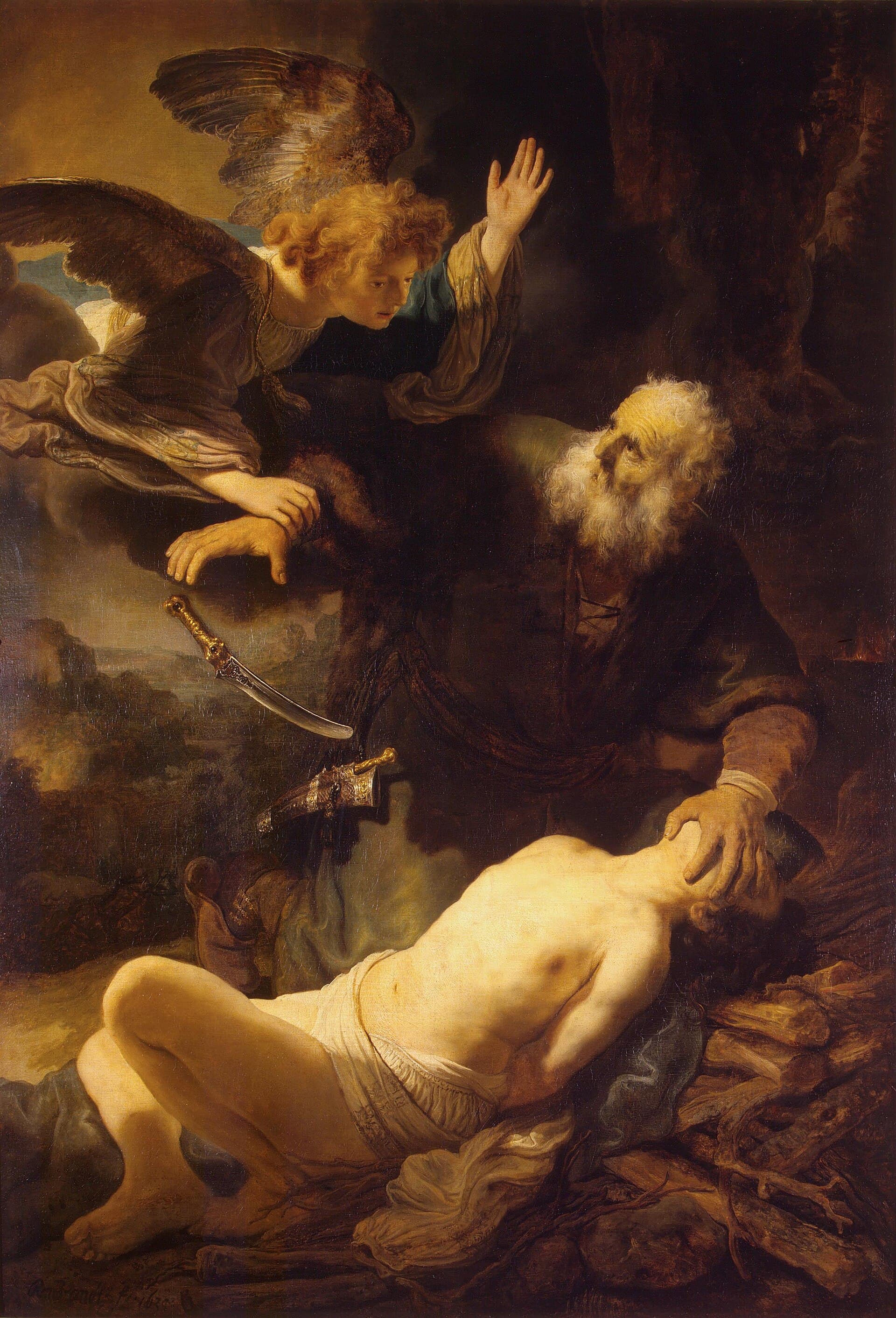
Rembrandt, The Sacrifice of Isaac, 1635. Public domain.
Rembrandt painted the angel staying Abraham's hand on Moriah, the moment before the mountain was named.
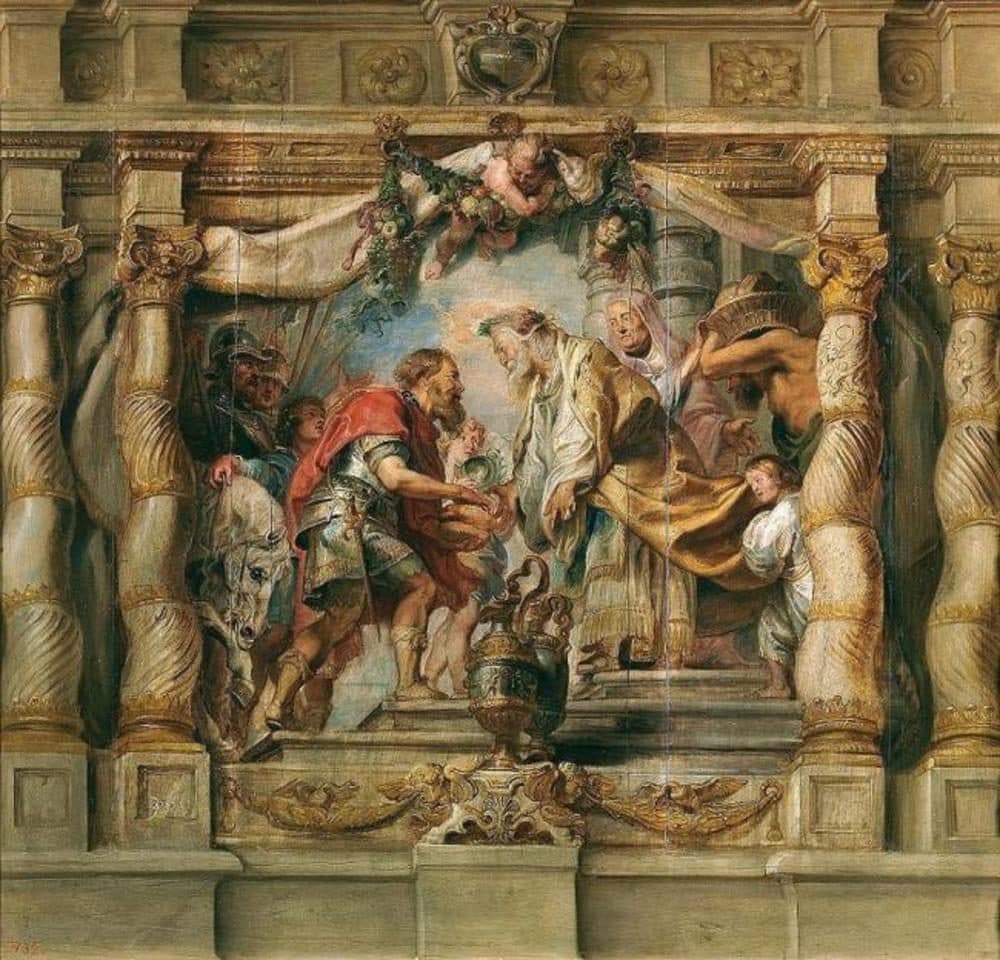
Peter Paul Rubens, The Meeting of Abraham and Melchizedek, c. 1626. Public domain.
Rubens set the meeting under a stone arch, with a servant carrying a basket and a wine jar on the step.
Altar Names, Epithets and Titles
Nine compound names of YHWH read against the Hebrew text, with two altars, the LORD of Hosts and Adonai.
The Blue Letter Bible's study Names of God lists nine compound names of Jehovah: Jireh, Rapha, Nissi, Shalom, Ra'ah, Tsidkenu, Shammah, Mekaddishkem and Sabaoth.
In the Hebrew text most of them are names given to an altar, a place or a city, or a phrase inside a sentence. Read that way, each name in the set is a real Hebrew phrase, YHWH joined to a noun.
The altars at Rephidim and OphrahExodus 17:15 and Judges 6:24
And Moses built an altar and named it The LORD Is My Banner.The verse gives the name to an altar, the pattern most of the compounds follow.
So Gideon built an altar to the LORD there and called it The LORD Is Peace. To this day it stands in Ophrah of the Abiezrites.The name was still in use when the book of Judges was written.
The LORD of Hosts1 Samuel 1:3, Romans 9:29 and James 5:4
The title takes in Israel's fighting men and the angels of heaven. Paul and James keep the Hebrew word in Greek letters as Sabaoth.
Year after year Elkanah would go up from his city to worship and sacrifice to the LORD of Hosts at Shiloh, where Eli’s two sons, Hophni and Phinehas, were priests to the LORD.The title first stands in the story of Samuel's parents at Shiloh, before Israel had a king.
Adonai, my LordGenesis 15:2
Adonai means Lord or Master. It is a reverent address in its own right, first in Abram's prayer for an heir.
But Abram replied, “O Lord GOD, what can You give me, since I remain childless, and the heir of my house is Eliezer of Damascus?”Abram joins Adonai to YHWH, which the Berean text prints as Lord GOD.
How YHWH Became LORD
Jewish reading, the Greek Bible and the Latin Bible each put a word for Lord where the name stands.
Hebrew, Greek, Latin and Englishfour steps
The name YHWH became the English LORD through the Greek kyrios and the Latin Dominus.
- The word
- יְהוָה
- What happened
- Jewish readers spoke Adonai, Lord, where the four letters stood, and the vowels of Adonai written under YHWH later produced the form Jehovah.
2Greek, the Septuagint, third to second century BC
- The word
- Κύριος
- What happened
- The Septuagint renders YHWH as kyrios, Lord, and the New Testament writers use the same word of Jesus.
3Latin, the Vulgate, fourth century AD
- The word
- Dominus
- What happened
- Jerome's Vulgate follows the Greek with Dominus and carries the custom into a thousand years of Latin Bibles.
4English, Tyndale to the King James Version of 1611
- The word
- LORD
- What happened
- The English Bibles print LORD in small capitals where YHWH stands and Lord for Adonai. The American Standard Version of 1901 printed Jehovah, before most later versions returned to LORD.
The name in the Greek Biblecontested
Henry Barclay Swete, in An Introduction to the Old Testament in Greek (Cambridge, 1902), writes that the Septuagint put ho kyrios, kyrios, or often ho theos for the Tetragrammaton. He adds that the newly found fragments of Aquila's Greek version write the name in archaic Hebrew letters.
The seven names Jewish law forbids erasingthe Jewish Encyclopedia of 1906
The Jewish Encyclopedia of 1906 records seven divine names that require the scribe's special care, and a name once written may not be erased: El, Elohim, Adonai, YHWH, Ehyeh asher ehyeh, Shaddai and Tzevaot.
What the Hebrew Text Leaves Unsaid
The Hebrew text writes the covenant name with its four consonants and gives it no vowels of its own.
The pronunciation Yahweh rests on evidence outside the Hebrew text. The Catholic Encyclopedia of 1910 reports that the form Yahweh has been generally accepted by modern scholars as the true pronunciation.
Jesus and the Words I Am
In John's Gospel Jesus speaks the words I am, with a picture and without one.
Jesus spoke the Greek words ego eimi, I am, and His hearers in the temple took Him to be claiming the name given at the bush. At this they picked up stones to throw at Him.
“Truly, truly, I tell you,” Jesus declared, “before Abraham was born, I am!”The words echo the Septuagint of Exodus 3:14, ego eimi ho on.
The seven I am sayings and the sayings without a pictureseven with a picture and five without
Seven sayings in which Jesus joins I am to a picture of who He is.
| The saying | Text |
|---|---|
| I am the bread of life | John 6:35 |
| I am the light of the world | John 8:12 |
| I am the gate | John 10:9 |
| I am the good shepherd | John 10:11 |
| I am the resurrection and the life | John 11:25 |
| I am the way and the truth and the life | John 14:6 |
| I am the true vine | John 15:1 |
The sayings without a picture are John 8:24, John 8:28, John 8:58, John 13:19 and John 18:5 to 8. The last was spoken in the garden, where the arresting party drew back and fell to the ground when He said I am He.
Where later Scripture takes up a namesix rows
Each row joins a name of God to a person or a saying in a later book, and the link to the Lamb of God is proposed as a type.
| From | To | The text that joins them |
|---|---|---|
| El Shaddai | YHWH | Exodus 6:3, the patriarchs knew God Almighty |
| The first and the last | Alpha and Omega | Isaiah 44:6, Revelation 1:8 and 22:13 |
| El Elyon | Melchizedek | Hebrews 7:1, priest of God Most High |
| El Roi | The angel of the LORD | Genesis 16:7, the angel Hagar names as God |
| YHWH Yireh | The Lamb of God | Genesis 22:14 and John 1:29, proposed as a type |
| The name proclaimed in Exodus 34:6 | The Word | John 1:14, grace and truth |
Names that carry God's nameEl and Yah in the names of people
The divine names are folded into the names of people, and each such name is a short confession about the covenant God. Nathanael, Daniel, Immanuel, Israel, Elijah, Ishmael and Elimelech carry El, God. Elijah, Isaiah, Jeremiah, Zechariah, Hezekiah and Joshua carry Yah, taken from YHWH, and Joshua is the Hebrew form of the name Jesus, Yehoshua, the LORD saves.
She will give birth to a Son, and you are to give Him the name Jesus, because He will save His people from their sins.”The angel's reason for the name rests on what the Hebrew name means.
Then the man said, “Your name will no longer be Jacob, but Israel, because you have struggled with God and with men, and you have prevailed.”The new name of Jacob carries El and names the nation.
The Voices on the Names
Matthew Henry on the plural name in Genesis 1:1 and Jerome on the name I AM.
died 420 · Jerome
“There is one nature of God and one only; and this, and this alone, truly is. For absolute being is derived from no other source but is all its own. All things besides, that is, all things created, although they appear to be, soon are not. For there was a time when they were not, and that which once was not may again cease to be. God alone who is eternal, that is to say, who has no beginning, really deserves to be called an essence. Therefore also he says of him, ‘I am has sent me.’”
Jerome · LETTER 15.4 · on Exodus 3:14Patristic
1662 to 1714 · Matthew Henry
“This plural name of God, in Hebrew, which speaks of him as many though he is one, was to the Gentiles perhaps a savour of death unto death, hardening them in their idolatry; but it is to us a savour of life unto life, confirming our faith in the doctrine of the Trinity, which, though but darkly intimated in the Old Testament, is clearly revealed in the New.”
Matthew Henry · Commentary on the Whole Bible · on Genesis 1:1Puritan
Where the Names Are Contested
Seven questions on which readers of the names differ, each with its holders.
Do the divine names mark separate sources?Genesis and Exodus 6:3
Julius Wellhausen, in his Prolegomena to the History of Israel (1878), read the change between Elohim and YHWH as the mark of separate sources. He read Exodus 6:3 as one source saying the name was first revealed to Moses. The Jewish Encyclopedia of 1906 sets the names by their sense as well: Elohim for God as the transcendent and universal Lord, and YHWH as the more distinctively Hebrew national name. Rashi on Genesis 1:1 had already paired Elohim with strict justice and the LORD with mercy. John Wesley, in his Explanatory Notes upon the Old Testament (1765), read Exodus 6:3 to mean that the patriarchs knew the name but did not know God as the name makes Him known.
What does El Shaddai mean?no agreed derivation
Jamieson, Fausset and Brown, in their Commentary Critical and Explanatory (1871), gloss El Shaddai as all-sufficient. Three derivations are proposed. The Jewish Encyclopedia of 1906 records the suggestion that it is connected with the Assyrian shadu, mountain, an epithet of Assyrian deities. It records a rabbinical explanation of the word as He who is sufficient, and judges it improbable. The third, shadad, to overpower, stands behind Almighty, which the Septuagint sometimes renders pantokrator, and the article allows that the name may keep the sense of overpowering strength.
I AM, or I WILL BE?Exodus 3:14
Jerome, in his Letter 15, takes I AM WHO I AM as the name of the one God who alone truly is. Adam Clarke, in his Commentary on the Bible (1810 to 1826), notes that the Septuagint renders it I am he who exists. Rashi, in his commentary on Exodus 3:14, reads ehyeh as I will be with them, in this sorrow and in the sorrows to come under other kingdoms. Schrader reads YHWH as a causative, He Who brings into existence, and the Catholic Encyclopedia of 1910, which records his reading, answers that it is not in keeping with Exodus 3:14.
Is El the Canaanite high god?the ancient Near Eastern background
Matthew Henry, in his Commentary on the Whole Bible (1706), reads Most High in Genesis 14:19 as a title of the one God, which speaks of His sovereign dominion over all the creatures. The Jewish Encyclopedia of 1906 finds El in Assyrian and Phoenician as an ordinary name of God, and finds the name Elyon among the Phoenicians in Philo of Byblos.
Does the title Lord join Jesus to YHWH?Philippians 2:9 to 11 and Romans 10:13
Albert Barnes, in his Notes on the New Testament, holds that the writers of the New Testament apply to Jesus expressions which in the Old Testament are applicable to God. His examples are Romans 10:13 over Joel 2:32, and an allusion to Isaiah 45:23 in Philippians 2:10. The biblical unitarian site biblicalunitarian.com answers that calling on Jesus where Joel called on Yahweh shows a shift of responsibility rather than an identity of persons. It adds that the second lord of Psalm 110:1 is adoni, a word used of human masters and lords.
Immanuel and Isaiah 7:14the child of Ahaz's day
Matthew 1:23 names Jesus Immanuel, God with us, quoting Isaiah 7:14. Albert Barnes, in his Notes on Isaiah 7:14, says the verse has given more perplexity to commentators than almost any other. He reads its obvious meaning as a son born to a young woman of Ahaz's own day. He also weighs the Hebrew almah against the Septuagint's parthenos, young woman and virgin, and holds that almah means virgin.
Why do the counts of the names differ?YHWH and Elohim
The Blue Letter Bible counts YHWH 6,519 times. The STEPBible tagged Hebrew text that the word pages read counts YHWH 6,520 times and Elohim 2,601 times. The Catholic Encyclopedia of 1910 notes that the concordances of Fürst and Mandelkern do not exactly agree on the number.
Books to Read Next
Three works on the names of God, written between 1851 and 1906.
Names of God
The Jewish Encyclopedia · 1906
The article sets out the Hebrew names of God one by one, and it is in the public domain.
The Septuagint
Brenton, translator · 1851
The Greek Old Testament reads ego eimi ho on at Exodus 3:14 and kyrios for YHWH at Joel 2:32.
Bible Names Dictionary
Hitchcock · 1869
Hitchcock gives the traditional meanings of the names of Scripture.
The Name Above Every Name
What the names of God ask of the reader.
The names came at moments of need: Hagar named the LORD at a spring, and Abraham named the mountain on Moriah. Each name tells what God is and what He does, and the reader is asked to call on Him by the name He has given.
Therefore God exalted Him to the highest place and gave Him the name above all names, that at the name of Jesus every knee should bow, in heaven and on earth and under the earth, and every tongue confess that Jesus Christ is Lord, to the glory of God the Father.Paul ends his account of Christ's humbling and exaltation, begun in Philippians 2:6, with this confession.
Sources
Scripture is the Berean Standard Bible.
- Brown, Driver and Briggs, Hebrew and English Lexicon; STEPBible TBESH and TBESG; Abbott-Smith, Manual Greek Lexicon of the New Testament (1922)
- The Jewish Encyclopedia (1906), Names of God.
- The Septuagint, Brenton (1851) and Swete (1887 to 1894)
- Hitchcock's Bible Names Dictionary (1869)
- Nathan Stone, Names of God (Moody, 1944)
- Frank Moore Cross, Canaanite Myth and Hebrew Epic (1973)
- Larry Hurtado, Lord Jesus Christ (2003)
- Richard Bauckham, Jesus and the God of Israel (2008)
- biblicalunitarian.com.
- Blue Letter Bible, Names of God.
- The Catholic Encyclopedia (1910), Jehovah (Yahweh)
- Albert Barnes, Notes on the New Testament.
- Albert Barnes, Notes on Isaiah.
- Julius Wellhausen, Prolegomena to the History of Israel (German 1878; English 1885)
- Umberto Cassuto, The Documentary Hypothesis (Hebrew 1941; English 1961)
- Rashi on Genesis, translated by M. Rosenbaum and A. M. Silbermann (London, 1929 to 1934)
- John Wesley, Explanatory Notes upon the Old Testament (1765)
- Matthew Henry, Commentary on the Whole Bible (1706)
- Jerome, Letters, Letter 15.
- Henry Barclay Swete, An Introduction to the Old Testament in Greek (Cambridge, 1902)
- Jamieson, Fausset and Brown, Commentary Critical and Explanatory on the Whole Bible (1871)
- Adam Clarke, Commentary on the Bible (1810 to 1826)
- Rashi on Exodus, translated by M. Rosenbaum and A. M. Silbermann (London, 1929 to 1934)
Keep Studying
Studies4
People and groups8
Show the next 2 titles
Doctrines11