
Exodus 12 to 19 and Numbers 33 · Place · Featured Study
The Route out of Egypt
Israel marched from Rameses to the Wilderness of Sinai by the third month, and few of its camps can be placed on a map today.
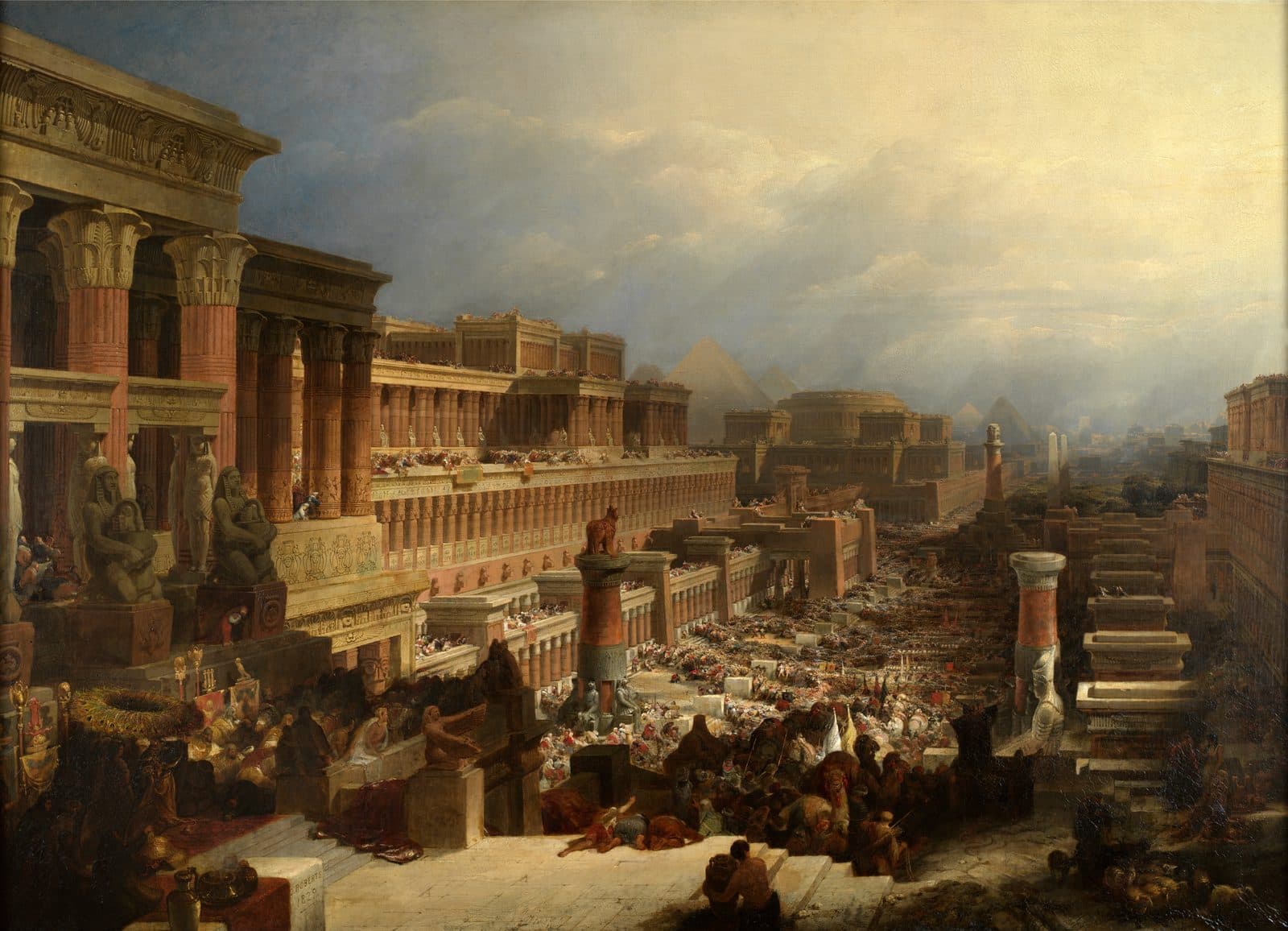
David Roberts, The Israelites Leaving Egypt, 1829. Public domain, via Wikimedia Commons.
THE ARTWORKDavid Roberts painted the start of the march of Exodus 12:37 as a column streaming out between the temples and colonnades of an Egyptian city, with the pyramids on the horizon.
God led His people out of Egypt by the longer road, and He went before them in a pillar of cloud and fire.
Summary
The route out of Egypt runs from Rameses through Succoth, Etham and the camp by the sea to Mount Sinai, as Exodus 12 to 19 tells it and Numbers 33 lists it.
- About 600,000 men on foot, besides women and children, set out from Rameses.
- Moses' own list in Numbers 33 adds three camps that Exodus leaves out: one by the Red Sea, Dophkah and Alush.
- Edouard Naville tied Succoth to the district of Pithom in the Wadi Tumilat after his work at Tell el-Maskhuta, published in 1885.
- Readers place the crossing at the lakes of the isthmus, at the head of the Gulf of Suez or by the Mediterranean, and the mountain in the south of the peninsula or in Arabia.
From Rameses to the Sea
Exodus 12 to 14 takes Israel from Rameses to the far side of the sea by way of three camps.
Joseph had settled his father and brothers in the district of Rameses, and at the end of 430 years their descendants set out from there.
The Israelites journeyed from Rameses to Succoth with about 600,000 men on foot, besides women and children.The march begins in this verse, at Rameses.
They set out from Succoth and camped at Etham on the edge of the wilderness.Etham is the last camp before the LORD turned the march back toward the sea.
“Tell the Israelites to turn back and encamp before Pi-hahiroth, between Migdol and the sea. You are to encamp by the sea, directly opposite Baal-zephon.The camp this verse orders lies on the shore where the crossing of verses 21 and 22 begins.
Then Moses stretched out his hand over the sea, and all that night the LORD drove back the sea with a strong east wind that turned it into dry land. So the waters were divided, and the Israelites went through the sea on dry ground, with walls of water on their right and on their left.The crossing in these verses takes the march out of Egypt's reach and into the wilderness.
The Stations of the March
Exodus 12 to 19 names thirteen places from Goshen to Mount Sinai, and the sites of most of them are proposals.
| Place | What the text says of it | Certainty | Verse |
|---|---|---|---|
| Goshen | The region where Israel lived, which Genesis 47:11 calls the district of Rameses | Probable, as a region | Genesis 47:27 |
| Rameses | The march set out from here | Proposed | Exodus 12:37 |
| Succoth | The first camp | Probable, as a region | Exodus 12:37 |
| Etham | A camp on the edge of the wilderness | Proposed | Exodus 13:20 |
| Pi-hahiroth | Israel was told to encamp before it | Proposed | Exodus 14:2 |
| Migdol | The camp lay between it and the sea | Proposed | Exodus 14:2 |
| Baal-zephon | The camp stood directly opposite it | Proposed | Exodus 14:2 |
| The Red Sea | Israel went through the sea on dry ground | Proposed, three sites | Exodus 14:22 |
| Marah | The water was bitter until the LORD made it sweet | Proposed | Exodus 15:23 to 25 |
| Elim | Twelve springs of water and seventy palm trees | Proposed | Exodus 15:27 |
| The Desert of Sin | Between Elim and Sinai | Not located | Exodus 16:1 |
| Rephidim | There was no water for the people to drink | Not located | Exodus 17:1 |
| Mount Sinai | Israel camped in front of the mountain | Proposed, two sites | Exodus 19:2 |
- Place
- Goshen
- What the text says of it
- The region where Israel lived, which Genesis 47:11 calls the district of Rameses
- Certainty
- Probable, as a region
- Verse
- Genesis 47:27
- Place
- Rameses
- What the text says of it
- The march set out from here
- Certainty
- Proposed
- Verse
- Exodus 12:37
- Place
- Succoth
- What the text says of it
- The first camp
- Certainty
- Probable, as a region
- Verse
- Exodus 12:37
- Place
- Etham
- What the text says of it
- A camp on the edge of the wilderness
- Certainty
- Proposed
- Verse
- Exodus 13:20
- Place
- Pi-hahiroth
- What the text says of it
- Israel was told to encamp before it
- Certainty
- Proposed
- Verse
- Exodus 14:2
- Place
- Migdol
- What the text says of it
- The camp lay between it and the sea
- Certainty
- Proposed
- Verse
- Exodus 14:2
- Place
- Baal-zephon
- What the text says of it
- The camp stood directly opposite it
- Certainty
- Proposed
- Verse
- Exodus 14:2
- Place
- The Red Sea
- What the text says of it
- Israel went through the sea on dry ground
- Certainty
- Proposed, three sites
- Verse
- Exodus 14:22
- Place
- Marah
- What the text says of it
- The water was bitter until the LORD made it sweet
- Certainty
- Proposed
- Verse
- Exodus 15:23 to 25
- Place
- Elim
- What the text says of it
- Twelve springs of water and seventy palm trees
- Certainty
- Proposed
- Verse
- Exodus 15:27
- Place
- The Desert of Sin
- What the text says of it
- Between Elim and Sinai
- Certainty
- Not located
- Verse
- Exodus 16:1
- Place
- Rephidim
- What the text says of it
- There was no water for the people to drink
- Certainty
- Not located
- Verse
- Exodus 17:1
- Place
- Mount Sinai
- What the text says of it
- Israel camped in front of the mountain
- Certainty
- Proposed, two sites
- Verse
- Exodus 19:2
The Camps in Order
Numbers 33:5 to 15 lists the camps from Succoth to the Wilderness of Sinai in the order Israel made them.
| Camp | Exodus | Numbers 33 |
|---|---|---|
| Succoth | Exodus 12:37, the first camp after Rameses | Numbers 33:5 |
| Etham | Exodus 13:20, on the edge of the wilderness | Numbers 33:6 |
| Pi-hahiroth | Exodus 14:2 and Exodus 14:9, where Pharaoh's army overtook them | Numbers 33:7 |
| Marah | Exodus 15:22 to 25, where the wilderness is called the Desert of Shur | Numbers 33:8 |
| Elim | Exodus 15:27, where they camped by the waters | Numbers 33:9 |
| By the Red Sea | Not named; Exodus 16:1 goes from Elim to the Desert of Sin | Numbers 33:10 |
| The Desert of Sin | Exodus 16:1, on the fifteenth day of the second month | Numbers 33:11 |
| Dophkah | Not named; Exodus 17:1 says they moved from place to place | Numbers 33:12 |
| Alush | Not named | Numbers 33:13 |
| Rephidim | Exodus 17:1, where the people had nothing to drink | Numbers 33:14 |
| The Wilderness of Sinai | Exodus 19:1 to 2, in the third month | Numbers 33:15 |
- Camp
- Succoth
- Exodus
- Exodus 12:37, the first camp after Rameses
- Numbers 33
- Numbers 33:5
- Camp
- Etham
- Exodus
- Exodus 13:20, on the edge of the wilderness
- Numbers 33
- Numbers 33:6
- Camp
- Pi-hahiroth
- Exodus
- Exodus 14:2 and Exodus 14:9, where Pharaoh's army overtook them
- Numbers 33
- Numbers 33:7
- Camp
- Marah
- Exodus
- Exodus 15:22 to 25, where the wilderness is called the Desert of Shur
- Numbers 33
- Numbers 33:8
- Camp
- Elim
- Exodus
- Exodus 15:27, where they camped by the waters
- Numbers 33
- Numbers 33:9
- Camp
- By the Red Sea
- Exodus
- Not named; Exodus 16:1 goes from Elim to the Desert of Sin
- Numbers 33
- Numbers 33:10
- Exodus
- Exodus 16:1, on the fifteenth day of the second month
- Numbers 33
- Numbers 33:11
- Camp
- Dophkah
- Exodus
- Not named; Exodus 17:1 says they moved from place to place
- Numbers 33
- Numbers 33:12
- Camp
- Alush
- Exodus
- Not named
- Numbers 33
- Numbers 33:13
- Camp
- Rephidim
- Exodus
- Exodus 17:1, where the people had nothing to drink
- Numbers 33
- Numbers 33:14
- Exodus
- Exodus 19:1 to 2, in the third month
- Numbers 33
- Numbers 33:15
These are the journeys of the Israelites when they came out of the land of Egypt by their divisions under the leadership of Moses and Aaron. At the LORD’s command, Moses recorded the stages of their journey. These are the stages listed by their starting points:The order of the camps in the table above comes from this record.
Marah, the first camp after the seaExodus 15:25 to 26
And Moses cried out to the LORD, and the LORD showed him a log. And when he cast it into the waters, they were sweetened. There the LORD made for them a statute and an ordinance, and there He tested them, saying, “If you will listen carefully to the voice of the LORD your God, and do what is right in His eyes, and pay attention to His commands, and keep all His statutes, then I will not bring on you any of the diseases I inflicted on the Egyptians. For I am the LORD who heals you.”The statute given here ties the healing of the water to obedience, and verse 26 names the LORD who heals.
From Elim to the mountainExodus 16:1 and Exodus 19:1 to 2
On the fifteenth day of the second month after they had left the land of Egypt, the whole congregation of Israel set out from Elim and came to the Desert of Sin, which is between Elim and Sinai.The date in this verse falls one month to the day after the departure of Numbers 33:3.
In the third month, on the same day of the month that the Israelites had left the land of Egypt, they came to the Wilderness of Sinai. After they had set out from Rephidim, they entered the Wilderness of Sinai, and Israel camped there in front of the mountain.This is the last camp of the table above, which Numbers 33:15 names after Rephidim.
Three Things Often Said of the Route
Scripture and the record of the excavations answer three common sayings about the march.
ISRAEL TOOK THE SHORTEST ROAD OUT OF EGYPT
God did not lead the people along the road through the land of the Philistines, though it was shorter. God said that if the people faced war, they might change their minds and return to Egypt.
ISRAEL WANDERED LOST BEFORE THE SEA
Pharaoh would say the people were wandering the land in confusion. The LORD had ordered the turn to the sea Himself, so that Pharaoh would pursue them.
THE ROUTE IS KNOWN STATION BY STATION
Of the camps before the mountain, only the district of Succoth has been tied to an excavated site, and the rest are still proposals.
The Names Along the Road
Three words of the route carry a meaning in Hebrew, and the lexicon glosses the other names as places.
Succoth (H5523) is spelled as the plural of sukkah (H5521), which the lexicon glosses as a hut or lair.
Migdol (H4024) is the name of a place in Egypt, and migdal (H4026), from the same letters, is a tower. Edouard Naville found the word in Egyptian as a common name for a fort or a tower.
The lexicon glosses Etham (H864) as a place in the desert, and Pi-hahiroth (H6367) and Baal-zephon (H1189) as places in Egypt.
The lexicon glosses suf (H5488) as a reed, especially the papyrus.
But when she could no longer hide him, she got him a papyrus basket and coated it with tar and pitch. Then she placed the child in the basket and set it among the reeds along the bank of the Nile.The reeds here are suf, the same word as in yam suf, the sea the Berean text calls the Red Sea in Exodus 13:18.
The Route in the Record
Josephus, the pilgrim Egeria, Edouard Naville and the commentators each set stations of the march on the ground.
Where each station has been placedEight places of the march
| Place | Where it has been placed | Who placed it there | Certainty |
|---|---|---|---|
| Rameses | Heroopolis; Cairo; the land west or north of Pithom, its city still to be found | Jamieson, Fausset and Brown, Commentary (1871); Adam Clarke, Commentary on the Bible (1832); Edouard Naville, The Store-City of Pithom (1885) | Proposed |
| Succoth | The district of Thuket around Pithom, at Tell el-Maskhuta in the Wadi Tumilat; a low hill in the middle of a valley | Edouard Naville, The Store-City of Pithom (1885); Egeria, The Pilgrimage of Etheria (late fourth century) | Probable |
| Etham | The district of Atuma by Lake Timsah | Edouard Naville, The Store-City of Pithom (1885) | Proposed |
| Pi-hahiroth | Pikerehet, a sanctuary of Osiris near Pithom | Edouard Naville, The Store-City of Pithom (1885) | Proposed |
| Migdol | A fort near the Serapeum; a Roman fort on the road from Clysma | Edouard Naville after Georg Ebers, Durch Gosen zum Sinai, in The Store-City of Pithom (1885); Egeria, The Pilgrimage of Etheria (late fourth century) | Proposed |
| Baal-zephon | A hill on the Asian shore such as Shekh Ennedek; a plain above the Red Sea | Edouard Naville, The Store-City of Pithom (1885); Egeria, The Pilgrimage of Etheria (late fourth century) | Proposed |
| Marah | The spring of Huwara | Albert Barnes, Notes on the Old Testament (1832 to 1869) | Proposed |
| Elim | The valley of Gharandel, two hours south of Huwara | Albert Barnes, Notes on the Old Testament (1832 to 1869) | Proposed |
- Place
- Rameses
- Where it has been placed
- Heroopolis; Cairo; the land west or north of Pithom, its city still to be found
- Who placed it there
- Jamieson, Fausset and Brown, Commentary (1871); Adam Clarke, Commentary on the Bible (1832); Edouard Naville, The Store-City of Pithom (1885)
- Certainty
- Proposed
- Place
- Succoth
- Where it has been placed
- The district of Thuket around Pithom, at Tell el-Maskhuta in the Wadi Tumilat; a low hill in the middle of a valley
- Who placed it there
- Edouard Naville, The Store-City of Pithom (1885); Egeria, The Pilgrimage of Etheria (late fourth century)
- Certainty
- Probable
- Place
- Etham
- Where it has been placed
- The district of Atuma by Lake Timsah
- Who placed it there
- Edouard Naville, The Store-City of Pithom (1885)
- Certainty
- Proposed
- Place
- Pi-hahiroth
- Where it has been placed
- Pikerehet, a sanctuary of Osiris near Pithom
- Who placed it there
- Edouard Naville, The Store-City of Pithom (1885)
- Certainty
- Proposed
- Place
- Migdol
- Where it has been placed
- A fort near the Serapeum; a Roman fort on the road from Clysma
- Who placed it there
- Edouard Naville after Georg Ebers, Durch Gosen zum Sinai, in The Store-City of Pithom (1885); Egeria, The Pilgrimage of Etheria (late fourth century)
- Certainty
- Proposed
- Place
- Baal-zephon
- Where it has been placed
- A hill on the Asian shore such as Shekh Ennedek; a plain above the Red Sea
- Who placed it there
- Edouard Naville, The Store-City of Pithom (1885); Egeria, The Pilgrimage of Etheria (late fourth century)
- Certainty
- Proposed
- Place
- Marah
- Where it has been placed
- The spring of Huwara
- Who placed it there
- Albert Barnes, Notes on the Old Testament (1832 to 1869)
- Certainty
- Proposed
- Place
- Elim
- Where it has been placed
- The valley of Gharandel, two hours south of Huwara
- Who placed it there
- Albert Barnes, Notes on the Old Testament (1832 to 1869)
- Certainty
- Proposed
Josephus on the marchAntiquities of the Jews, book 2, chapter 15
He counts the 430 years from Abraham's coming into Canaan, and only 215 years from Jacob's move into Egypt.
Now the duration of the Israelites’ stay in Egypt was 430 years.In the Berean text the 430 years are the length of the Israelites' stay in Egypt itself.
Egeria on the road from ClysmaThe Pilgrimage of Etheria, pages 13 to 15
Egeria went from Clysma to Goshen to see the places Israel passed between Rameses and the Red Sea. Soldiers escorted her from fort to fort, and the clergy and monks with her showed her the places on both sides of the road.
She judged that Israel turned back as far as it went forward until it reached the sea.
On the same road she was shown Pithom, the city the Israelites built, which was by then a fort.
What the Text Leaves Unsaid
The account leaves out three things a map would need.
Exodus gives no distance between any two camps, and it gives no count of days from Rameses to the sea.
The three days of Exodus 15:22 run from the sea to the first water.
The text names Pi-hahiroth, Migdol and Baal-zephon and says nothing of where any of them stood.
The Cloud and the Sea
Paul reads the cloud and the sea of the march as Israel's baptism into Moses.
And the LORD went before them in a pillar of cloud to guide their way by day, and in a pillar of fire to give them light by night, so that they could travel by day or night. Neither the pillar of cloud by day nor the pillar of fire by night left its place before the people.Every later stage of the march, from Etham to the mountain, was set by this sign.
Whenever the cloud was lifted from above the tabernacle, the Israelites would set out through all the stages of their journey. If the cloud was not lifted, they would not set out until the day it was taken up. For the cloud of the LORD was over the tabernacle by day, and fire was in the cloud by night, in the sight of all the house of Israel through all their journeys.Exodus ends with the same cloud deciding when Israel set out.
I do not want you to be unaware, brothers, that our forefathers were all under the cloud, and that they all passed through the sea. They were all baptized into Moses in the cloud and in the sea. They all ate the same spiritual food and drank the same spiritual drink; for they drank from the spiritual rock that accompanied them, and that rock was Christ.The third thing Paul names here, the rock that gave water, he calls Christ.
John Wesley drew the same line from the cloud to Christ.
“The Shechinah or appearance of the divine Majesty, which was a precious manifestation of the eternal Word, who in the fulness of time was to be made flesh, and dwell among us. Christ was with the church in the wilderness, 1 Cor. x, 9.”
John Wesley · Explanatory Notes upon the Old Testament · on Exodus 13:21Evangelical
Voices on the March
Origen, Jerome, Ambrose, Matthew Henry and John Wesley wrote on the camps of the march, from their meaning for the soul to the hour of the crossing.
Origen on the camps of Numbers 33Homilies on Numbers, homily 27
Origen read each camp of the list as a stage of the soul's progress toward the kingdom.
“He wrote them down, then, ‘by the word of the Lord’ so that when we read them and see how many starting places lie ahead of us on the journey that leads to the kingdom, we may prepare ourselves for this way of life. [Thus,] considering the journey that lies ahead of us, [we] may not allow the time of our life to be ruined by sloth and neglect.”
Origen of Alexandria · Homilies on Numbers 27:7 · on Numbers 33:2Patristic
“Sochoth [Succoth] is interpreted ‘tents.’ Thus the first progress of the soul is to be taken away from earthly agitation and to learn that it must dwell in tents like a wanderer, so that it can be, as it were, ready for battle and meet those who lie in wait for it unhindered and free.”
Origen of Alexandria · Homilies on Numbers 27:9 · on Numbers 33:5Patristic
Jerome on the list of campsLetter 77
Jerome tells how Fabiola pressed him on the meaning of each camp.
“Unrolling the book still further, [Fabiola] came to the passage in which is given the list of all the halting places by which the people after leaving Egypt made its way to the waters of Jordan. And when she asked me the meaning and reason of each of these, I spoke doubtfully about some, dealt with others in a tone of assurance and in several instances simply confessed my ignorance.”
Jerome · LETTER 77.7 · on Numbers 33:1Patristic
Ambrose and Matthew Henry on the wood at MarahOn the Mysteries; Commentary on the Whole Bible (1706)
Ambrose and Matthew Henry both set the log of Exodus 15:25 beside the cross of Christ.
“Marah was a fountain of most bitter water. Moses cast wood into it and it became sweet. For water without the preaching of the cross of the Lord is of no avail for future salvation. But after it has been consecrated by the mystery of the saving cross, it is made suitable for the use of the spiritual laver and of the cup of salvation.”
Ambrose of Milan · On the Mysteries 3.14 · on Exodus 15:25Patristic
“Some make this tree typical of the cross of Christ, which sweetens the bitter waters of affliction to all the faithful, and enables them to rejoice in tribulation. The Jews' tradition is that the wood of this tree was itself bitter, yet it sweetened the waters of Marah; the bitterness of Christ's sufferings and death alters the property of ours.”
Matthew Henry · Commentary on the Whole Bible · on Exodus 15:25Puritan
John Wesley on the night of the crossingExplanatory Notes upon the Old Testament (1765)
Wesley worked out from the calendar of the Passover that the crossing was made in the dark.
“This march through the sea was in the night, and not a moon-shine night, for it was seven days after the full moon, so that they had no light but what they had from the pillar of fire.”
John Wesley · Explanatory Notes upon the Old Testament · on Exodus 14:21Evangelical
Where the Sea and the Mountain Stand
The text names the sea and the mountain and places neither on a map, and readers have proposed several sites for each.
The sea of the crossingThree proposals
| Proposal | Where | Held by | The strongest objection |
|---|---|---|---|
| The lakes of the isthmus | Between Lake Timsah and the Bitter Lakes, by the Serapeum, where the gulf then reached north | Edouard Naville, The Store-City of Pithom and the Route of the Exodus (1885) | Naville granted that the stations after Etham can be fixed only by conjecture until surveys and excavations are made. |
| The head of the Gulf of Suez | At Clysma by Suez, or at Mount Attakah and the mouth of Wady Tawarik | Albert Barnes, Notes on the Old Testament (1832 to 1869); Jamieson, Fausset and Brown, Commentary (1871); the pilgrim road Egeria followed from Clysma | Naville held that the gulf reached much farther north in Moses' day, so the sea of the account lay north of the present gulf. |
| The northern lagoon | The narrow strip between the Mediterranean and the Serbonian bog | Matthias Schleiden and Heinrich Brugsch, as Naville reports them (1885) | Naville answered that this road would have taken Israel forty miles north onto the way of the land of the Philistines, which Exodus 13:17 says God did not take. |
- Proposal
- The lakes of the isthmus
- Where
- Between Lake Timsah and the Bitter Lakes, by the Serapeum, where the gulf then reached north
- Held by
- Edouard Naville, The Store-City of Pithom and the Route of the Exodus (1885)
- The strongest objection
- Naville granted that the stations after Etham can be fixed only by conjecture until surveys and excavations are made.
- Proposal
- The head of the Gulf of Suez
- Where
- At Clysma by Suez, or at Mount Attakah and the mouth of Wady Tawarik
- Held by
- Albert Barnes, Notes on the Old Testament (1832 to 1869); Jamieson, Fausset and Brown, Commentary (1871); the pilgrim road Egeria followed from Clysma
- The strongest objection
- Naville held that the gulf reached much farther north in Moses' day, so the sea of the account lay north of the present gulf.
- Proposal
- The northern lagoon
- Where
- The narrow strip between the Mediterranean and the Serbonian bog
- Held by
- Matthias Schleiden and Heinrich Brugsch, as Naville reports them (1885)
- The strongest objection
- Naville answered that this road would have taken Israel forty miles north onto the way of the land of the Philistines, which Exodus 13:17 says God did not take.
The mountain of the lawTwo proposals
| Proposal | Where | Held by | The strongest objection |
|---|---|---|---|
| The south of the peninsula | The peak the monks showed Egeria, with a monastery and a church at the mountain | Egeria, The Pilgrimage of Etheria (late fourth century) | Charles Beke argued that the southern site followed once the crossing had been placed near Suez. |
| Arabia | Jebel Baghir, near the head of the Gulf of Aqaba | Charles Beke, Discoveries of Sinai in Arabia and of Midian (1878) | Beke himself wrote that Paul's words about Mount Sinai in Arabia are too indefinite to allow any conclusion except, perhaps, that the mountain lay in the country then called Arabia. |
- Proposal
- The south of the peninsula
- Where
- The peak the monks showed Egeria, with a monastery and a church at the mountain
- Held by
- Egeria, The Pilgrimage of Etheria (late fourth century)
- The strongest objection
- Charles Beke argued that the southern site followed once the crossing had been placed near Suez.
- Proposal
- Arabia
- Where
- Jebel Baghir, near the head of the Gulf of Aqaba
- Held by
- Charles Beke, Discoveries of Sinai in Arabia and of Midian (1878)
- The strongest objection
- Beke himself wrote that Paul's words about Mount Sinai in Arabia are too indefinite to allow any conclusion except, perhaps, that the mountain lay in the country then called Arabia.
Now Hagar stands for Mount Sinai in Arabia and corresponds to the present-day Jerusalem, because she is in slavery with her children.Beke began his case for Arabia from Paul's phrase in this verse.
Written Down as Warnings
The route out of Egypt was the LORD's choice from the first camp to the last.
Now these things happened to them as examples and were written down as warnings for us, on whom the fulfillment of the ages has come.Paul gives the reason the march was written down, and he addresses it to the church.
The reader who belongs to Christ is asked to follow where He leads, at the bitter water and in the empty desert, and to trust Him as the LORD who heals.
Keep studying
Studies6